

Introduction
Picture this: You spend hours writing a college paper. You check every fact. You rewrite each paragraph. Then you submit it, and a machine says it was written by AI.

That’s the reality for many students in 2026. AI generated text now looks almost identical to human writing. This puts academic integrity under new pressure.
Colleges are responding fast. According to recent data on college AI detector adoption trends, about 40% of four year colleges already use AI detection tools. Another 35% are thinking about adding them soon. That means more than half of schools are changing how they check student work.
So what AI detector do colleges use? The answer matters for students, teachers, and anyone who writes for school. The most common tools include Turnitin, GPTZero, and Copyleaks. But each one works differently and has its own problems.
Some detectors mark perfectly human writing as AI. Others miss real AI content. If you are a student, you need to know which tools your school uses and how accurate they really are. If you are a teacher, you need to choose a tool that is fair to all students.
This article reviews the main AI detectors used in higher education today. We will look at their accuracy, their weak spots, and how to use them responsibly. Along the way, we will also share tips on how to detect and prevent AI hallucinations so you do not get fooled by false flags.
Because here is the truth: AI can sound right and still mislead. Before you trust any detection score, learn to trust AI less blindly. The smartest approach is to combine tools with common sense and human judgment.
Let us dive into the top AI detectors colleges rely on in 2026.
The Rise of AI in Academia: Why Detection Matters
ChatGPT changed everything when it launched. Suddenly, any student could generate a passable essay in seconds. By 2026, using AI for homework help has become almost normal. Some surveys suggest that over half of college students now use AI tools for at least some of their coursework.
Colleges had to react fast. The percentage of schools using detection tools rose from 28% in early 2023 to about 40% today, according to a 2026 overview of what AI detectors colleges use for applications. And that number is expected to keep climbing.
But detection is only one piece of the puzzle. The real challenge is teaching students how to use AI responsibly. AI can help with brainstorming, editing, and understanding hard topics. That is AI for good. But when students rely on AI to do the thinking for them, they miss out on learning.
Schools are starting to realize that banning AI does not work. Instead, they need to help students master AI tools while keeping academic honesty intact. This means mastering AI as a skill, not cheating.
If you are a student, you need to know which tools your school uses and how accurate they are. If you are a teacher, you need a fair way to check student work. You can start by reading our guide on the best AI for writing papers and how to verify its accuracy.
Detection tools have limits. They can flag human writing as AI and miss real AI content. That is why the conversation must go beyond detection to AI literacy. Understanding how AI works and where it fails helps everyone make better decisions.
As AI becomes more embedded in academic life, it can quietly shape how we think and write. This hidden influence is something most people never notice. You can explore this effect in a detailed note on how your collaboration is being Quietly Hijacked note by two different AI systems.
Now let us look at the top tools colleges actually use.
What AI Detectors Do Colleges Use? An Overview
So what AI detector do colleges use? The short answer is that most schools lean on a few big names. Turnitin is the most common, but GPTZero, Copyleaks, and other tools are part of the mix too.
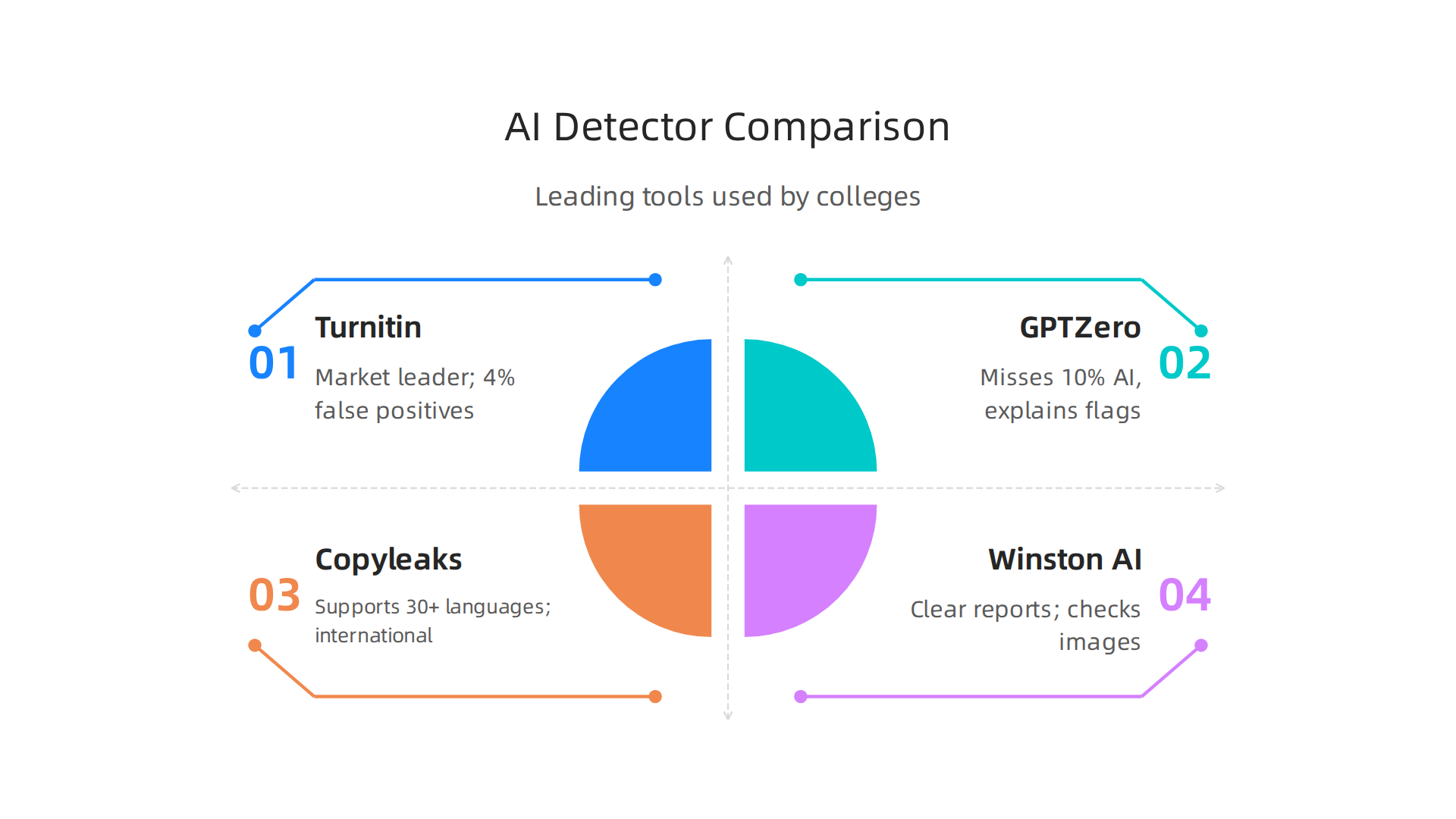
Turnitin is the market leader. It already connects with learning management systems like Canvas and Blackboard. Many schools already use Turnitin for plagiarism checks, so adding AI detection is an easy next step. But Turnitin has a real weakness. It flags about 4 out of every 100 human-written sentences as AI. That is a 4% false positive rate. For students who speak English as a second language, the rate climbs much higher. You can see the full breakdown in this overview of Which Colleges Use AI Detectors? Full List by School.
GPTZero is another popular tool. It is more open about its accuracy numbers. It misses about 10% of real AI content, which is its false negative rate. Many teachers like it because it explains why a piece of text got flagged instead of just giving a score.
Copyleaks is built for international schools. It supports over 30 languages and works with many learning platforms. That makes it a strong choice for schools with diverse student bodies.
Other tools include Originality.ai and Winston AI. Winston AI is gaining ground in 2026 because its reports are clear and easy to read. It also checks images for AI signs, which is useful as AI image tools spread.
Each school picks its tools based on budget, tech setup, and the needs of its students. Big state universities often go with Turnitin because it is already in place. Smaller schools might use GPTZero or Winston AI because they are cheaper and simpler to manage.
Understanding which tool your school uses can help you avoid surprises. And if you want to get better at spotting AI errors on your own, take a look at this guide on AI hallucinations causes and risks.
How AI Detectors Work: Technical Foundations
So how does a tool know if a human or an AI wrote a sentence? It sounds like magic, but the science is actually pretty simple once you break it down.
Most AI detectors look at two main things: perplexity and burstiness.
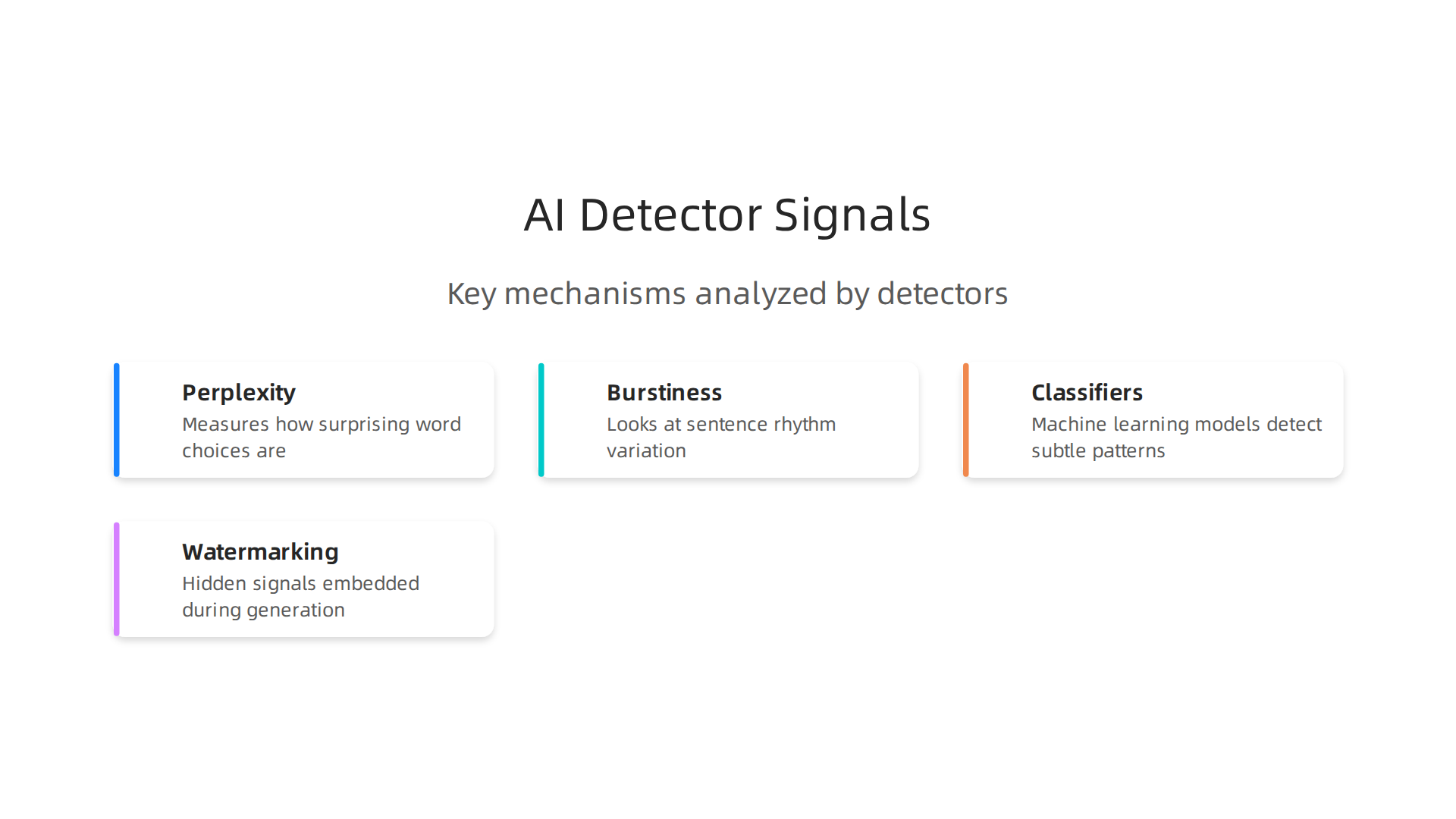
These are fancy terms, but they mean something easy.
Perplexity measures how surprising your word choices are. AI models are trained to pick the most likely next word. So AI text tends to have low perplexity. It is predictable. Human writing is different. We use unexpected words, change our minds mid-sentence, and break patterns. That gives human text higher perplexity.
Burstiness looks at sentence rhythm. Humans naturally vary their sentence lengths. One sentence might be long and complex. The next might be short and punchy. AI text tends to be more uniform. Every sentence is about the same length. That is low burstiness. Most detectors flag text when both perplexity and burstiness are low. You can see the full breakdown in this article on how AI text detectors work in 2026.
But these metrics are not perfect. In fact, some experts argue that perplexity and burstiness are not reliable enough to base big decisions on. A detailed analysis from Pangram Labs explains why perplexity and burstiness fail to detect AI in many real-world cases.
Classifiers and Watermarking
Beyond basic statistics, newer detectors use trained classifiers. These are machine learning models trained on huge datasets of human writing and AI writing. The classifier learns subtle patterns that humans would never notice. Things like how often you use certain transition words or the exact shape of your paragraph structure.
Some detectors also check for watermarks. A watermark is a hidden signal that some AI providers embed in their text during generation. Google’s SynthID is the most famous example. When a watermark is present, detection is over 99% accurate. But here is the catch. Watermarks only work if the AI provider added one. And they break easily. If you paraphrase the text, the watermark is gone. The 2026 guide on AI content detection and watermarking explains these limits clearly.
Why Accuracy Is Still a Problem
Even with all this technology, no detector is perfect. Real-world accuracy on mixed content is often between 65% and 80%. That means 20% to 35% of the time, the detector gets it wrong. False positives are especially common for non-native English speakers and technical writing. A short email or a paragraph under 250 words is basically useless for detection.
So when your professor says an AI detector flagged your paper, remember what it really means. The tool found patterns that look like AI. It is not proof. It is a risk signal. And understanding that signal can help you write better and avoid false flags. If you want to learn more about catching AI errors in your own work, check out this guide on how to detect AI hallucinations.
How Accurate Are These Detectors? The Data
You have probably seen bold claims on product pages. Turnitin says 98% accuracy. GPTZero says 99%. Originality.ai says 99.98%. Those numbers sound great. But what about real-world testing?
Independent research tells a different story. A 2026 University of Chicago Booth benchmark found that some detectors hit 99.3% recall on controlled tests.

But when real students submitted essays, the false positive rate jumped to 15%. That means 15 out of 100 fully human essays got flagged as AI. Data on AI detector false positive rates shows that vendor claims often exceed what independent evaluations find.
A study in Frontiers in AI tested multiple tools and found detection accuracy ranging from 65% to 90%. Newer models like GPT-5 and Claude 3.5 were much harder to catch. The detailed GPTZero vs other AI detectors comparison shows that false positive rates vary widely by tool.
So what affects accuracy? Text length matters a lot. Below 300 words, detection becomes unreliable. Paraphrasing also ruins detection. If you rewrite AI text, most detectors miss it completely. Domain also plays a role. Technical and scientific writing is harder to classify because it already uses formal language that looks "AI-like." Turnitin itself acknowledges that its false positive rate climbs to 5% to 12% on non-native English and technical prose, as shown in the Turnitin AI detection accuracy 2026 report. The key takeaway? Accuracy depends heavily on context.
Equity Concerns
False positives are not just a technical problem. They are a fairness problem. A Stanford study found that AI detectors flagged 61% of non-native English essays as AI compared to a much lower rate for native speakers. This bias means international students face unfair accusations. If your school uses a tool without accounting for this, the consequences can be serious.
When asking what AI detector do colleges use, remember that no tool is perfect. The data says to take every score with a grain of salt. Always review flagged content manually before making any decisions. And if you want to learn more about catching AI errors before they cause real damage, read this guide on how to catch AI hallucinations before they hurt your business.
AI can sound right and still mislead. That is why you should Trust AI Less Blindly and verify everything a detector tells you.
The Problem of False Positives and Academic Fairness
So if you are a college student or an instructor, the question "what ai detector do colleges use" matters a lot. But the real issue is not just which tool is picked. It is how well that tool works for everyone.
Here is the uncomfortable truth. False positives hit some students much harder than others. The research is clear. Non-native English speakers are flagged at much higher rates.
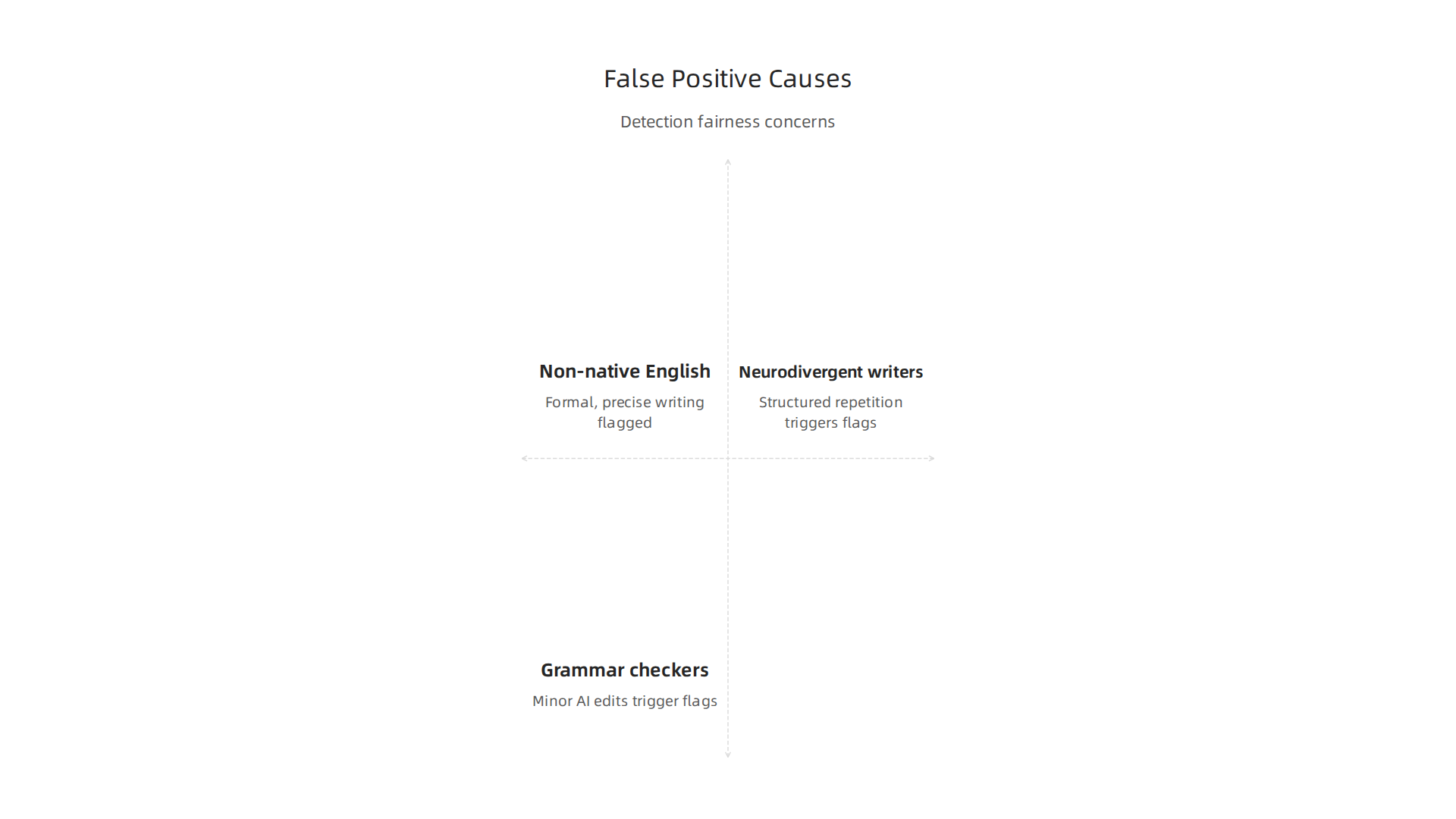
Their writing is formal and grammatically precise. To a detector, that can look like AI text. A 2026 meta-analysis of AI detection accuracy found that tools like Originality.ai and GPTZero show false positive rates between 10% and 20% for non-native writers. That means one in five perfectly human essays could get flagged.
But it is not just about language. Neurodivergent writers also face unfair risks. Students with autism or ADHD often write in structured, repetitive patterns. That triggers detectors too. And what about tools that are supposed to help? Many students use grammar checkers and paraphrasing tools as part of their writing process. Those small AI edits can push a fully human paper over the threshold. Suddenly a student who used an AI powered homework help tool for spelling gets accused of cheating.
This is where trust breaks down. When detectors cry wolf too often, students lose faith in the process. Teachers get exhausted chasing false alarms. The whole system starts to feel unfair. And that damages the goal of using AI for good in education.
Here is the thing. False positives are not just a technical glitch. They are a fairness failure. The data shows that some groups get punished for writing differently. That is a problem schools must fix.
So what can institutions do? First, they need to calibrate their detector thresholds. A tool set to catch every hint of AI will flag too many human essays. Schools should set a higher bar. Second, human review is not optional. No score from a machine should be the final word. Teachers need to talk to students, look at the context, and use their judgment.
This is the key to mastering AI in education. Use the tools. But never let them replace common sense. A detector is a hint, not a verdict. If you want to learn more about catching AI errors before they cause real harm, check out this guide on how to detect and prevent AI hallucinations in your own work.
Beyond Detection: Responsible Use of AI in the Classroom
So where does that leave us? Here is the thing. Chasing students with detection tools is not the only path forward. Actually, many schools are flipping the script entirely. Instead of asking "what ai detector do colleges use," forward-thinking institutions are asking a better question: how can we teach students to use AI responsibly?

This is where mastering AI becomes a skill, not a threat. The goal is not to catch students breaking rules. It is to help them use AI powered homework help wisely. That means teaching AI literacy in the classroom. Students need to know when AI helps and when it hurts. They need to learn to spot errors, question outputs, and keep their own thinking sharp.
Many universities are now building frameworks for transparent AI use. They want students to disclose when and how they used tools. Some courses now ask for a short note explaining which AI tool was used and what prompts were entered. That is a far better approach than secret detection. As one guide on crafting a generative AI use policy in higher education notes, getting students involved in creating these rules builds trust and shared responsibility.
Here is the simple truth. Punitive approaches can harm learning. When students fear being flagged, they stop experimenting. They stop asking questions. That is the opposite of what education should be. Instead, guidance and education work better. Give students clear rules. Show them good examples. Help them understand the limits of AI.
This shift is AI for good in action. It turns a scary tool into a learning partner. And it prepares students for a world where AI is everywhere. The goal is not to hide from AI. It is to use it with confidence and care.
If you want to go deeper on how different AI systems can quietly shape your work without you noticing, this field note on being quietly hijacked by two different AI systems is worth your time. It explains the hidden influence these tools have on how we think and collaborate.
Building an Institutional AI Policy: A Step-by-Step Approach
So what does it take to build a policy that actually works? Many schools are moving away from simply asking what ai detector do colleges use and toward a bigger picture. The question is not just about catching bad behavior. It is about creating clear rules that help everyone use AI well.
A strong policy covers several key parts. First, it defines acceptable use.
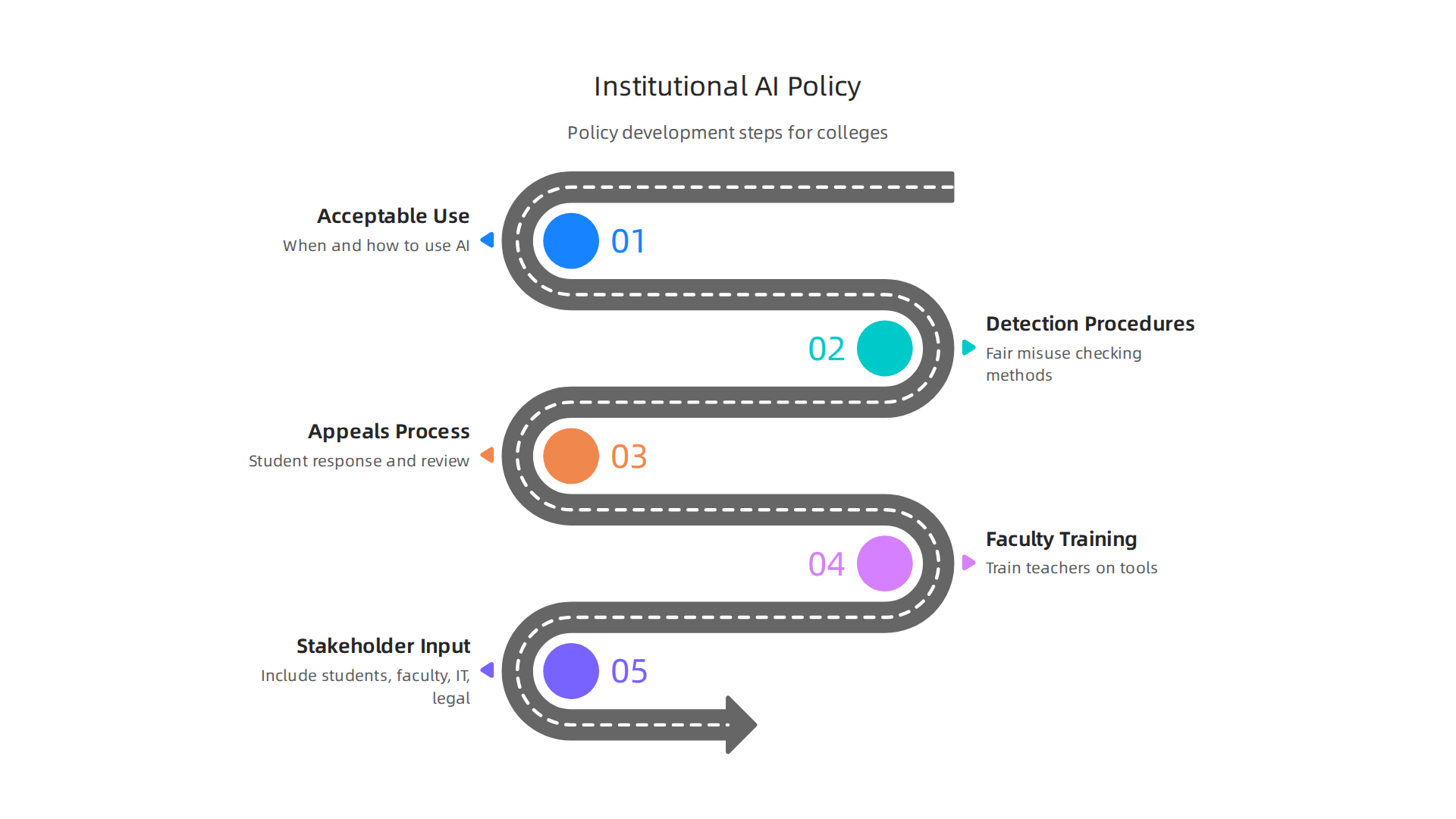
When can students use AI? For brainstorming? Editing? Research? Some courses allow AI for study help but not for final exams. Second, it spells out detection procedures. If a professor suspects misuse, how will they check? Third, it includes an appeals process. False accusations happen. Students need a fair way to respond. Fourth, it requires faculty training. Teachers must understand the tools too.
Getting the right people in the room matters a lot. Stakeholder input from students, faculty, IT, and legal is essential. You cannot write a good policy alone in an office. You need to hear from students who use AI daily and from faculty who grade their work. IT staff know the technical limits of detection tools. Legal teams understand privacy risks. When everyone has a voice, the policy feels fair to all sides.
Many universities now follow three core rules that build trust. According to a 2026 guide on University AI Policy Principles for Students, the basics are be transparent about AI use, protect your personal data, and remember you are still accountable for your work. These simple rules make AI use clear instead of scary.
Transparency about when and how detectors are used builds trust even further. If a school uses a detection tool, students should know. If a course bans AI entirely, that must be in the syllabus from day one. Surprise enforcement creates anger and distrust. Open communication creates cooperation.
Faculty training is another big piece. Teachers need to know what AI can and cannot do. They need to spot AI hallucinations and understand how students might misuse tools. A good starting point is an AI hallucination detection training guide that helps educators learn to spot errors and teach students to do the same.
When all these pieces come together, the policy stops being a weapon and starts being a guide. It helps students learn. It protects academic integrity. And it prepares everyone for a world where AI is normal.
Challenges in AI Detection: Technical and Ethical Limitations
Even the best detection tools have serious flaws. And those flaws matter when a student’s grade or reputation is on the line. So when colleges ask what ai detector do colleges use, they need to also ask: how well does it really work?
One big problem is adversarial evasion. Students can fool detectors with simple tricks. For example, they might ask AI to write an outline, then write the final paper themselves. Or they run AI text through rewording tools. Independent testing shows that once a student edits or "humanizes" AI text, detection accuracy drops to 60 to 80 percent. Many bypassers are cheap and easy to find.
Another blind spot is non-English writing. AI detectors flag text with low "perplexity" and low "burstiness." But here is the issue. English learners often write with simpler vocabulary and shorter sentences. That looks exactly like AI output. According to a 2026 guide on AI text detector technical limitations, ESL writers get flagged at two to three times the rate of native speakers. And technical writing with standardized terms triggers false positives too. A perfectly honest engineering student could be accused of cheating because their language is clear and consistent.
These limitations create an ethical problem. When detection tools are unreliable, over reliance on them can damage trust. Students feel watched and suspected. They may stop asking questions or exploring new ideas because they fear being flagged. Instead of fostering learning, the detector becomes a barrier.
A better path is to use detectors as one clue among many. Pair them with conversations, drafts, and human judgment. And learn to spot errors yourself. A solid guide to catching AI hallucinations can help you build those skills without relying on imperfect tools.
No detection method works well enough to stand alone. Understanding these limits is the first step toward using AI honestly and wisely.
The Future of AI Detection and Academic Integrity
Looking ahead, the question of what ai detector do colleges use may shift entirely. Instead of chasing cheaters after the fact, schools are starting to build trust into the process from the start.
One big change is the rise of content provenance standards like C2PA, the Coalition for Content Provenance and Authenticity.
C2PA lets creators attach a cryptographically signed "manifest" to digital files. This manifest records who made the content, what tools they used, and how it was edited. Any tampering breaks the signature. Adobe, Microsoft, Intel, and the BBC are all part of this alliance. According to the C2PA frequently asked questions, the standard does not detect AI content on its own. Instead, it records what the creator declares about the content’s origin. So if a student writes a paper using only their own words, they can prove it with a signed manifest.
But C2PA has limits. As one detailed guide on digital media provenance verification explains, C2PA metadata can be stripped from files. And the standard only works when creators choose to use it. Still, as more tools like Adobe’s Content Authenticity Web App and Google’s SynthID become common, content without provenance data will start to look suspicious.
Another shift is toward integrated academic integrity ecosystems. Instead of relying on a single detector, schools will combine watermarking, blockchain-based provenance records, and human judgment. A look at blockchain securing content without C2PA labels shows how blockchain adds immutability to provenance records, making them harder to fake.
The most exciting development may be AI assistants that document their own contribution. The Value Reinforcement System (VRS) patent methodology creates a permission-based capture framework that logs every AI interaction at the source. This means students can use AI for research or editing help, and the system records exactly what was contributed. While still emerging, this technology points toward a future where transparency is built into the tool itself.
If you want to explore how to verify AI outputs responsibly, you can read this guide on how to detect AI hallucinations before they hurt your reputation. Building these skills now will prepare you for the integrity systems of tomorrow.
For a deeper comparison of patent approaches, you can compare Meta’s simulation-based patent coverage with VRS. Understanding these frameworks helps you stay ahead of the curve in academic integrity.
The future is not about catching everyone who cheats. It is about making honesty easier and cheating harder.
Summary
This article explains which AI detectors colleges use in 2026, how they work, and why their limits matter for students and faculty. It reviews market leaders like Turnitin, GPTZero, Copyleaks and newer entrants, then breaks down the technical signals detectors use (perplexity, burstiness, classifiers, and watermarks). You’ll read independent accuracy data showing real-world detection often ranges from about 65%–90% with notable false positive rates—especially for short texts, technical writing, and non-native speakers. The piece highlights fairness and ethical concerns, recommends human review and transparent policies, and outlines practical classroom approaches to teach responsible AI use. Finally, it surveys emerging solutions such as provenance standards and logging systems that aim to make honesty easier and cheating harder. After reading, you’ll know how these tools operate, when to trust a result, how to respond to flags, and how institutions can build fair AI policies.