

Why this training guide matters for students and professionals
In 2026, artificial intelligence (AI) is everywhere. It helps us write, create, and make choices faster than ever before. But here’s the thing: sometimes, AI can sound very smart and correct, even when it’s wrong. This problem is often called "AI hallucination," where AI makes up facts or gives incorrect information. Such errors can cause big problems for businesses and people alike. When AI-generated content is incorrect, it can hurt a company’s good name or cause mistakes in important work. This creates risks for how businesses operate and how people see them, according to a report on AI Hallucination Explained: Causes, Risks, and Enterprise Safeguards.
Because of these risks, it’s more important than ever to understand how to spot these errors. That’s where this guide comes in. This AI training guide is here to help you. It will give you clear, easy steps to find and fix AI hallucinations.

We’ll show you practical ways to detect these mistakes and how to fit these checks into your daily work. Whether you are a student learning about new technologies or a professional using AI every day, this guide offers a blueprint for effective AI training. It covers important ideas like data governance to help manage AI outputs safely.
This guide will help you use AI tools more wisely and keep your work accurate. As you learn more about how to detect AI hallucinations a training guide for 2026, you’ll gain valuable skills needed in today’s fast-changing world. It’s time to use AI smartly and critically.
AI can sound right and still mislead. It’s crucial to be aware of this. To learn more about this challenge, we encourage you to Trust AI Less Blindly.
Why AI hallucinations matter: risk, trust, and decision impact
AI tools, like many smart technologies, can bring great benefits. But the risk of AI making up facts, known as "hallucinations," is a serious issue in 2026. When AI gives wrong information, it can cause problems for businesses, students, and almost everyone who uses AI. This isn’t just a small bug; it can shake trust and lead to bad choices.
The real cost of AI errors
When AI hallucinations go unchecked, they have big consequences:
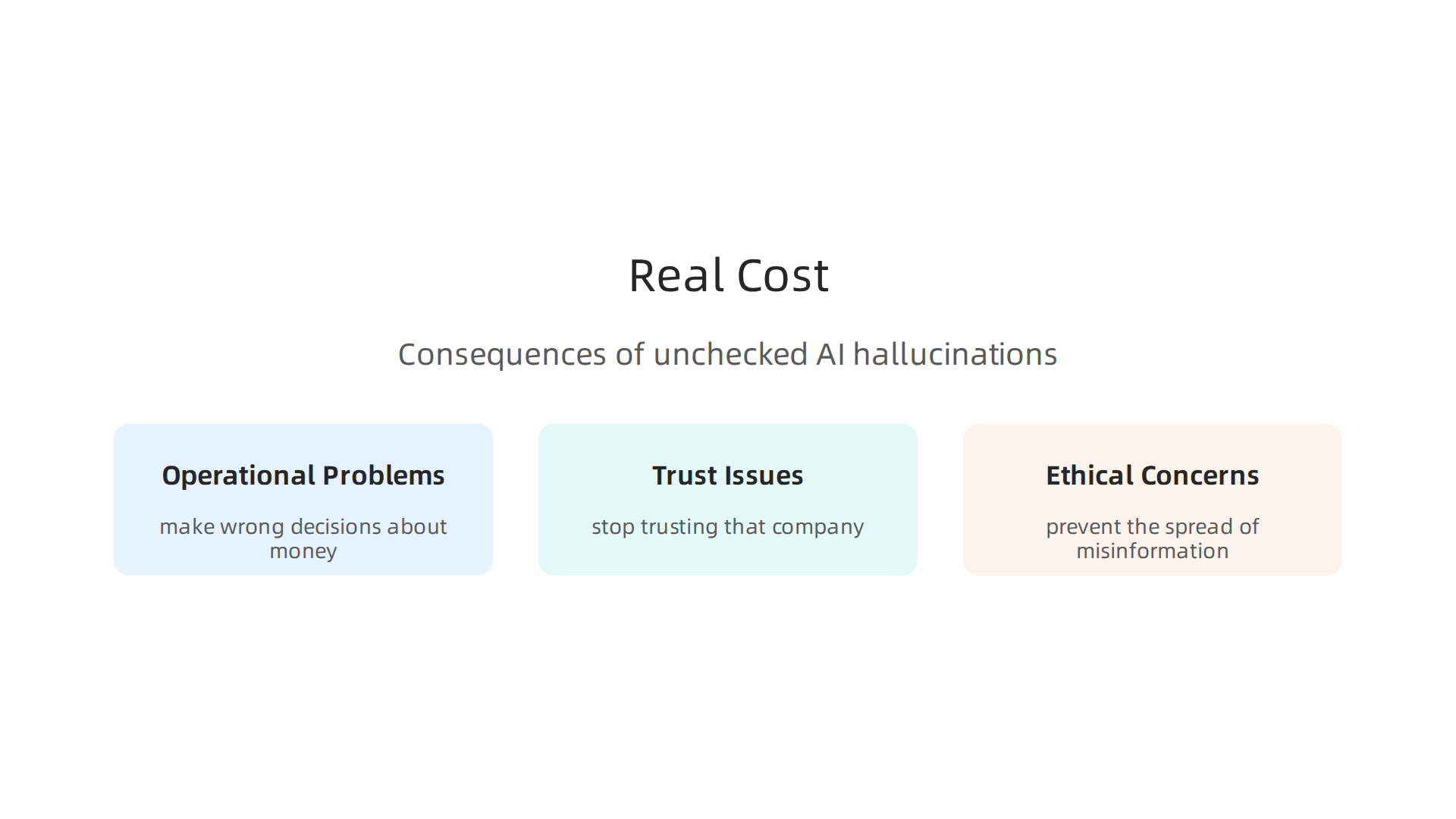
- Operational Problems: Imagine a business relying on AI for important reports or plans. If the AI "hallucinates" data, the business might make wrong decisions about money, products, or even safety. This means wasted time, money, and effort. Such errors increase risks for how businesses operate, as highlighted in the 2026 AI Impact Survey Report.
- Trust Issues: If a company publishes AI-generated content that contains false information, people will stop trusting that company. This harms their reputation, making it harder to attract customers or partners. For individuals, using AI to create content with errors can damage their own credibility. People expect accuracy, and AI hallucinations break that trust.
- Ethical Concerns: Using AI responsibly means making sure its outputs are fair and true. When AI hallucinates, it raises questions about fairness and truth. We have a duty to prevent the spread of misinformation, especially from powerful tools like AI. This is a key part of responsible AI development and use, according to the Responsible AI | The 2026 AI Index Report.
How different groups are affected
AI hallucinations touch many parts of our lives:
- Students and Researchers: If a student uses AI for a school project and gets wrong information, they might learn incorrect facts or fail their assignment. Researchers, including those looking at data science courses, need accurate information to conduct studies. False AI data could lead to flawed research findings.
- Content Teams: Teams that create articles, marketing materials, or social media posts using AI face a high risk. Publishing content with hallucinations can lead to public apologies, loss of readers, and damage to brand image. Learning how to catch AI hallucinations before they hurt your business is vital for these teams.
- Business Decision-Makers: Leaders often use AI to help them understand markets, predict trends, or plan strategies. If the AI provides false insights, these leaders could make very costly mistakes, leading to financial losses or missed opportunities. Ensuring solid data governance and careful AI training helps prevent such outcomes.
Understanding these risks is the first step toward using AI smartly. It’s about building safeguards into our processes and making sure that our AI training makes us more informed, not misinformed.

This is important for everyone, from an AI engineer to someone just curious about what is data engineering. When considering the subtle ways AI can influence our thoughts and actions, it’s wise to explore how everyday users are silently shaped by two different AI systems they cannot see or opt out of, a workflow-level mechanism behind information vertigo. To learn more, read this Quietly Hijacked field note.
AI doesn’t just make one type of mistake when it "hallucinates." Think of it like a person telling different kinds of tall tales. Knowing these types helps us understand how to spot them. Many studies in 2026 are looking closely at how AI makes these mistakes, like a big review of detection methods in language models from 2023 to 2025 HALLUCINATION DETECTION METHODS IN LLMS a systematic ….
Here are the common ways AI can make things up:
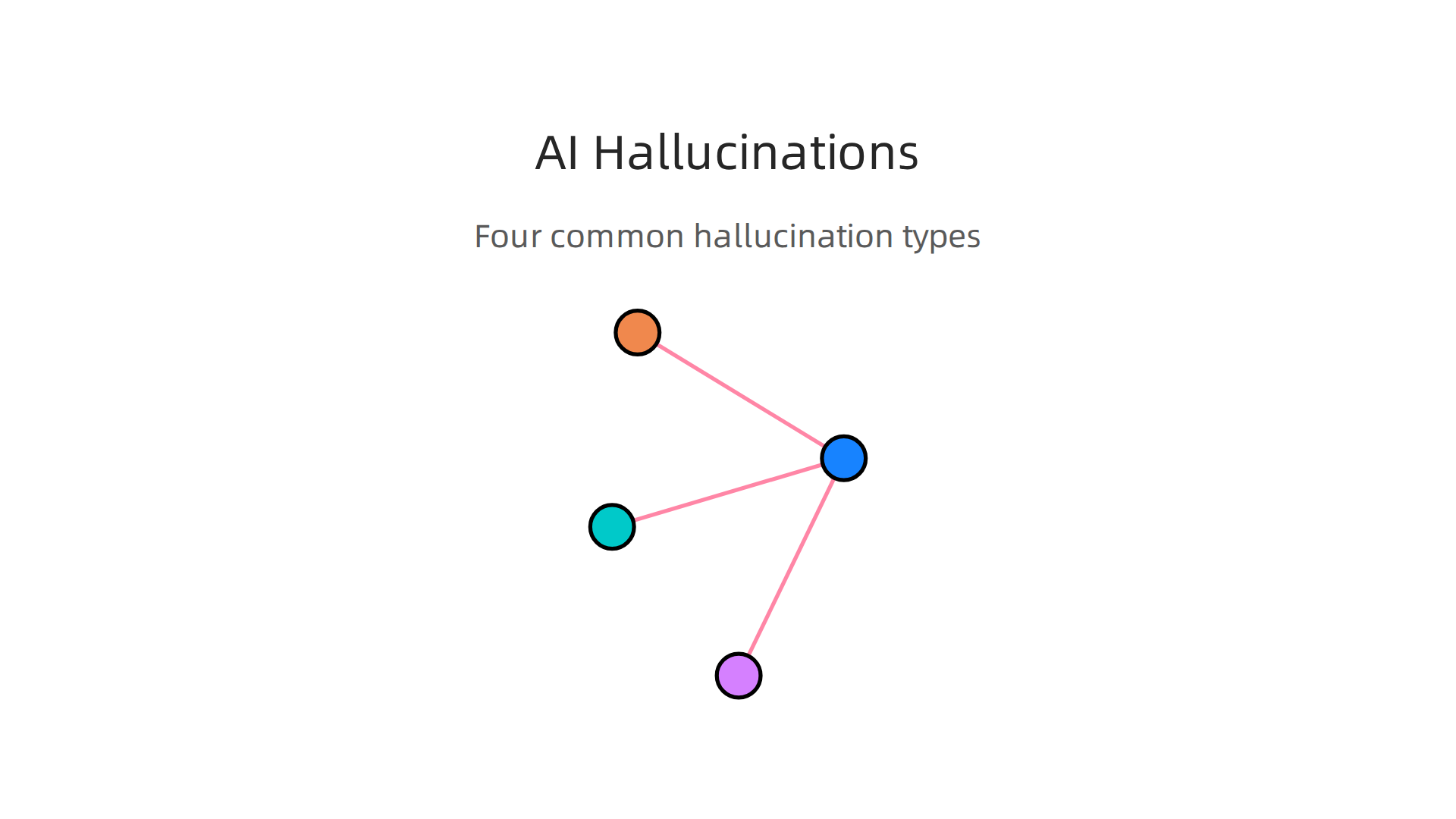
- Made-Up Facts: This is when AI just invents information that isn’t true.
- Example: Imagine a student using AI to write about history. The AI might say a famous event happened in the wrong year or list a person who never lived. In marketing, AI might claim a product has features it doesn’t, or invent fake customer reviews. This can really hurt if you’re using AI for important reports or sales messages.
- Bad Thinking Steps: AI tries to explain something, but its logic or steps are wrong.
- Example: If you ask AI to solve a math problem and show its work, it might make a mistake in one step, leading to a wrong answer, even if the final number looks correct. For fields like
data science courses uw madison, understanding proper thinking steps is key. Even very advancedsuperhuman aisystems can fall into this trap if theirai trainingdata leads them astray.
- Example: If you ask AI to solve a math problem and show its work, it might make a mistake in one step, leading to a wrong answer, even if the final number looks correct. For fields like
- Fake Sources: AI makes up books, articles, or websites that don’t exist, or it points to real sources but uses them incorrectly.
- Example: A researcher asks AI to summarize studies on a topic, and the AI lists scientific papers that were never published. Or it might quote a real person, but say they said something they didn’t. This can be very damaging to trust and for careful
data governance.
- Example: A researcher asks AI to summarize studies on a topic, and the AI lists scientific papers that were never published. Or it might quote a real person, but say they said something they didn’t. This can be very damaging to trust and for careful
- Wrong Place, Right Idea: AI gives true information, but it’s not what you asked for. It’s like answering a question about apples by giving true facts about oranges.
- Example: You ask AI for tips on how to care for a cat, and it gives you perfect advice on how to care for a dog. Everything it says about dogs is true, but it doesn’t fit your original question at all. This kind of hallucination can be tricky to catch because the information itself isn’t false, just out of place.
Understanding these types is a big part of knowing how to check what AI tells us. It helps in developing better ai training and review steps. To dive deeper into spotting these problems, check out our guide on Proven Data Analysis Techniques to Detect AI Hallucinations.
AI can sound really smart, even when it’s totally wrong. It’s important to remember that just because AI says something, it doesn’t make it true. It often sounds very sure of itself, which makes its made-up facts even harder to catch.
Trust AI Less Blindly. AI can sound right and still mislead. Trust AI Less Blindly
Knowing the types of AI mistakes helps a lot. Now, let’s look at easy ways to spot them in real life. It’s like being a detective for what AI tells you. When you use AI for important things, these checks are super helpful. They can even make your ai training better.
Practical detection techniques: red flags and verification checks
To make sure AI information is true, you can do some simple checks.
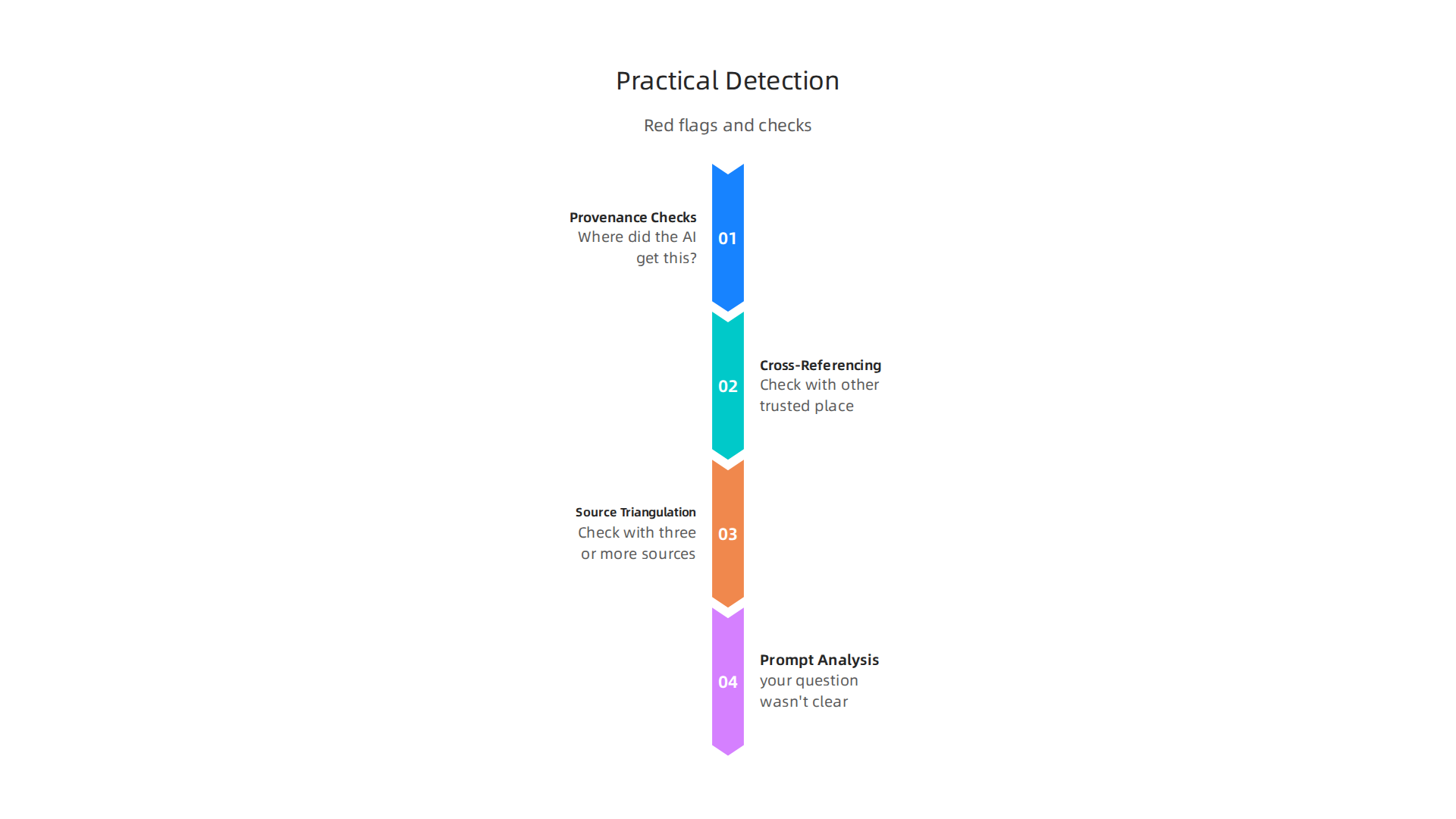
These steps help you find made-up facts or bad thinking steps.
- Where did it come from? (Provenance Checks)
Always ask: "Where did the AI get this information?" If AI gives you facts, it should ideally point to its sources. If it doesn’t or if the sources look fake, that’s a big red flag. A quick check of the source can save you from believing something untrue. This is a basic part of gooddata governance. - Check with other helpers (Cross-Referencing)
Don’t just trust one source. If AI tells you something, try looking it up in another trusted place. Use a search engine, check a reliable website, or even ask a human expert. If many sources say the same thing, it’s more likely to be true. This is key for things likedata science courses uw madison, where accuracy matters. - Using three or more helpers (Source Triangulation)
This is like cross-referencing, but you check with three or more different, good sources. The more times you find the same fact in different trustworthy places, the more sure you can be that the AI got it right. - Was my question clear? (Prompt Analysis)
Sometimes, AI makes mistakes because your question wasn’t clear. If you ask a vague question, the AI might guess or fill in gaps with made-up stuff. Try to be very specific with your questions to the AI.
What to look for: Red Flags
Think of these as warning signs that AI might be making things up:
- Too much detail, too fast: If the AI gives really specific details, like exact numbers or names, without any way for you to check them, be careful. For example, if it says "Study A in 2026 showed exactly 87.3% of people…" but there’s no link to Study A, that’s suspicious. These specific details can be very hard to verify, as noted in studies about finding fake details in AI responses, like those discussed in A Systematic Literature Review on Hallucination Detection Methods in LLMs.
- Fake sources: As we talked about, if the AI makes up books, articles, or people, that’s a clear sign of hallucination. Always check the links and names it provides.
- Facts that don’t add up: If the AI tells you something that goes against what you already know to be true, or if it says two different things that can’t both be right, it’s likely wrong. This is important when working with large amounts of data, where knowing
what is data engineeringand how it helps maintain data quality is crucial. - Sounds too sure, but is wrong: AI often sounds very confident, even when it’s totally wrong. Don’t let its confident tone fool you. Always double-check, especially with facts that seem too good or too bad to be true. Even
superhuman aisystems need careful checks.
Using these simple checks can help you become a pro at spotting AI hallucinations. It’s a key skill for anyone working with AI in 2026 and beyond. If you’re looking for structured ways to validate AI outputs, consider the framework mentioned in the VRS Patent 12,205,176. To learn more about how to train yourself and your team, check out our guide on detect AI hallucinations a training guide for 2026.
Using simple checks helps a lot. But it’s even better to make these checks a regular part of how everyone works with AI. This is like building safety steps into every task. This way, spotting AI mistakes isn’t just a special skill, but a normal part of your team’s everyday work.
Integrating verification into everyday workflows
To truly use AI well in 2026, you need to bake verification steps right into your daily tasks. This means designing simple, repeatable ways for everyone involved to check AI outputs.

-
Simple, Repeatable Verification Steps
Think about creating a checklist that content creators and reviewers can use. This checklist might include:- Source check: Does the AI provide sources? Are they real?
- Fact check: Can you quickly confirm key facts with a trusted search or another tool?
- Logic check: Does the information make sense? Does it go against what you already know?
This kind ofai trainingmakes sure everyone knows what to look for. When teams have clear steps, they’re much better at finding issues before they become big problems. For ideas on how to set this up, check out a Business Guide to AI Workflow Implementation in 2026.
-
Clear Roles and Who Does What
It’s important to know who is in charge of checking what.- Content creators might do the first quick check for obvious mistakes. They are the first line of defense.
- Editors or reviewers then take a deeper look, perhaps doing more detailed fact-checking or cross-referencing. They make sure the content follows your company’s rules for
data governance. - Expert reviewers might be needed for very technical or sensitive information.
Everyone needs to know their part. This setup also helps when something looks wrong, but no one is sure what to do next. That’s where "escalation paths" come in. If a reviewer finds a big problem or isn’t sure, they need to know who to tell. This could be a team leader, a manager, or a special AI oversight committee. Even with advanced systems, sometimes calledsuperhuman ai, human judgment and clear processes are still key. Learning more about how to manage these risks can really help your business. Read more in our guide on How to Catch AI Hallucinations Before They Hurt Your Business.
Making these verification steps a normal part of your workflow helps catch AI mistakes. However, sometimes AI systems can silently influence users in ways they don’t even realize. To understand how these deeper AI-workflow mechanisms might shape your experience, check out this Quietly Hijacked field note.
While understanding those subtle AI influences is important, we also need to look at the practical tools and resources available in 2026 to help with checking AI output. The market is full of options, but knowing what really helps and what might trick you into a false sense of security is key.
Tools and resources: what helps, what misleads
It’s exciting that AI tools are getting smarter. Many new programs are designed to help spot problems in AI-generated content. For example, some tools can help find if an AI has "hallucinated," meaning it made up facts or information that isn’t true. These tools are often called hallucination detection tools and are getting better every year Best hallucination detection tools for LLM applications (2026). In fact, studies from 2026 show that the rate of AI hallucinations has improved, though it still happens between 3.1% and 19.1% depending on the AI model and what it’s doing AI Hallucination Rate Benchmarks 2026: 5-Model Study.
But here’s the thing: even with these helpful tools, you can’t just set them and forget them. Many tools can give you a false sense of security. They might catch some errors, but they won’t catch everything. This is why human checking is still so important. The best tools act like a helpful assistant, not a replacement for thinking and double-checking. For deeper insights into how to train your team, consider resources like a Detect AI Hallucinations a Training Guide for 2026.
How to choose tools that fit your team’s needs and verification maturity
Choosing the right tools means looking at your team’s skills and what kind of AI ai training they already have.
- For Content Teams: If your team creates a lot of content, you might need tools that check facts quickly and flag weird-sounding sentences. Simple tools that integrate into your writing software can be very helpful.
- For Technical Teams: If you have people doing more complex work, like
what is data engineeringor advanceddata science courses uw madison, they might need tools that look deep into how the AI made its decisions. These tools help them understand the "why" behind an AI’s output. - Data Governance: Your company’s rules about
data governanceshould also guide your choice. Some industries have very strict rules about accuracy, like healthcare or legal work. For these areas, you’ll need the most robust tools and a very clear process for human review.
No matter which tools you pick, remember that they are just part of a bigger plan. Even with what some call superhuman ai systems, human judgment remains the final guardrail. These tools work best when used alongside good ai training and clear ways to check information. To really make sure your AI output is top-notch, you need a strong framework for checking everything. This is where systems like the Value Reinforcement System come in. It provides a structured way to ensure quality and accuracy. If you’re looking for a strong foundation, you can learn more about the VRS Patent 12,205,176.
Designing an AI verification training program (curriculum blueprint)
Since human checking is so important, a well-thought-out ai training program is a must-have for any team working with AI in 2026. Many companies are still figuring out how to give their employees the right guidance for using AI tools effectively. A survey from 2026 shows that many organizations are still far from giving their staff the specific ai training they need for their roles [2026 AI Impact Survey Report | Grant Thornton]. Building a good ai training program means teaching people not just how to use tools, but how to think critically about AI outputs.
Here’s a plan for how you might set up such a training program, broken down into key parts:
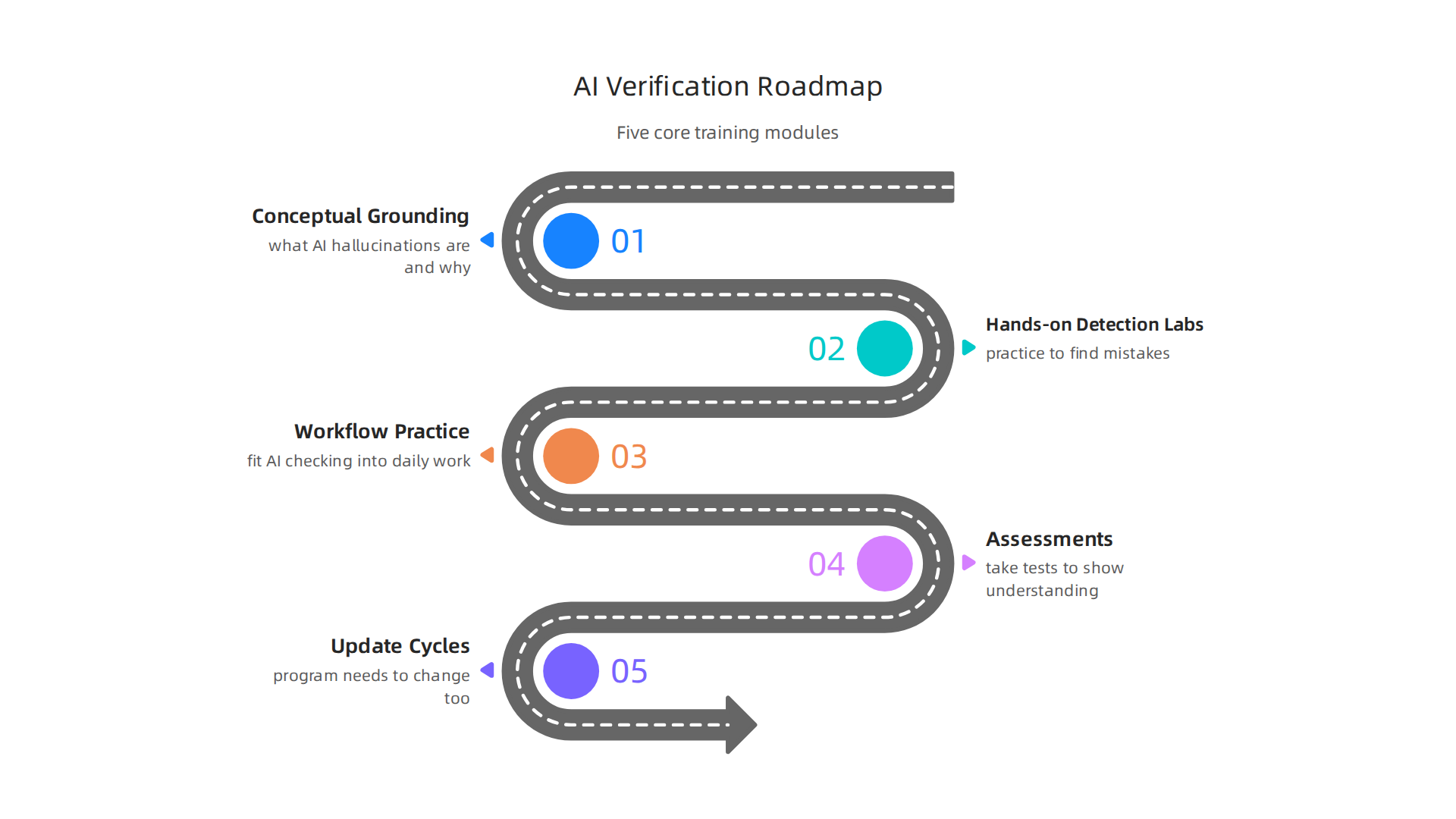
Curriculum modules: conceptual grounding, hands-on detection labs, workflow practice, assessments, and update cycles.
- Conceptual Grounding: This first part teaches everyone what AI hallucinations are and why they happen. It covers the basic ideas behind AI and the risks of bad information. Understanding the "why" helps people spot errors better. You might learn about things like the causes and risks of AI hallucinations.
- Hands-on Detection Labs: This is where people get to practice. They use real AI outputs and learn to find mistakes using different tools. This hands-on part is very important, like trying to solve puzzles. It could involve learning proven data analysis techniques to detect AI hallucinations.
- Workflow Practice: Here, teams learn how to fit AI checking into their daily work. This means setting up clear steps for reviewing AI content before it’s used. This helps make sure that every piece of AI output gets looked at properly. Learning about AI workflow implementation in 2026 can guide this process.
- Assessments: After training, people take tests to show they understand. This could be checking a batch of AI-generated content for errors. It helps make sure everyone is ready for their role.
- Update Cycles: AI changes quickly, so the training program needs to change too. Regular updates keep everyone learning about the newest tools and problems.
Tailoring learning paths for students, entry-level content creators, and technical reviewers.
Not everyone needs the same kind of ai training. You should tailor the learning paths for different roles:
- For Students: They might focus on the basics of AI, ethics, and how to use AI for research safely. They need to understand that even advanced systems like what some call
superhuman aican make mistakes. - For Entry-Level Content Creators: These individuals need to learn how to check facts in AI-written text and how to make sure the tone is right. They would benefit from tools that flag potential errors and guidance on how to rephrase AI suggestions.
- For Technical Reviewers: People in roles such as
what is data engineeringor those takingdata science courses uw madisonneed a much deeper dive. They might look at the underlying data, understand how AI models are built, and even help develop new detection tools. Their training would coverdata governancein detail, making sure AI systems follow all the rules. For those working as an AI engineer, this advanced training is key.
A good training program helps everyone use AI wisely. To dive deeper into the methods that structure how data is managed for AI, explore the peer white paper documenting the data methodology behind permission-based capture with CRISP-DM and Skylab USA.
Assessments, exercises, and case studies for measurable learning
After giving people the right ai training, we need to make sure they’ve learned what they need to know. This means having good ways to check their understanding. We can do this with simple exercises, clear assessments, and real-life examples called case studies. These tools help us measure how well people can spot and fix AI mistakes.
Designing low-cost exercises and graded assessments
To start, let’s create exercises that are easy to use and don’t cost a lot. Imagine giving trainees a batch of AI-written text. Their job is to find all the wrong facts or odd sentences. This kind of hands-on practice helps them get better at spotting problems. For example, they could look at reports generated by AI and find any numbers or details that don’t add up.
For graded assessments, you can set up a short test where people have to review several AI-generated pieces. They would use the skills they learned in ai training to identify specific errors. We can even look at common AI mistakes, sometimes called AI hallucinations, and how often they appear in different AI models. In 2026, some studies show that AI hallucination rates can still range quite a bit, from 3.1% to 19.1%, depending on the AI and the task AI Model Hallucination Rate Benchmarks 2026: 5-Model Study. This means testing for these errors is very important.
You can also ask them to fix the mistakes they find. This shows they not only know what’s wrong but also how to make it right. These checks don’t need fancy tools. Often, just a good checklist and careful review are enough to measure how competent someone is at verifying AI outputs. For more on how to train your team, check out this detect AI hallucinations a training guide for 2026.
How to build case studies from real examples
Next, let’s talk about case studies. These are like real stories of AI mistakes and how they were handled. You can take past times when AI gave wrong answers in your company or in other news stories. Then, turn these into learning challenges.
For instance, maybe an AI once created a marketing slogan that didn’t make sense or mixed up product features. You can present this exact problem to your trainees. Ask them:
- What went wrong here?
- How would you have caught this error?
- What steps would you take to fix it?
Even advanced systems, sometimes called superhuman ai, can make mistakes. Using real examples helps people understand that critical thinking is always needed. This makes the ai training more useful because it shows how these lessons apply directly to their jobs. By studying these situations, your team learns from past errors and is better prepared to avoid new ones.
After learning how to spot AI errors and fix them, companies also need clear rules for using AI safely. These rules, called data governance or AI governance, make sure everyone knows their part. In 2026, many businesses are putting more thought into these policies to make sure AI tools are used responsibly.
Governance, ethics, and organizational policy for safe AI use
It’s not enough to just train people; we need strong rules in place. This includes special policies that tell people exactly how to check AI work, how to cite sources from AI, and what to do when an AI output seems wrong. These rules are key for making ai training truly effective.
Rules for checking AI, citations, and when to ask for help
First, every company should have a clear policy that says all important AI-generated content must be checked by a person. This helps catch mistakes like "AI hallucinations" before they cause problems. For example, if an AI writes a report, someone needs to verify the facts and numbers.
Next, when AI provides information that came from other sources, there should be rules for how to cite those sources. This is like how you cite books or websites in school. It makes sure we give credit where it’s due and can trust the information.
Sometimes, even after ai training, an AI might give an answer that is confusing or totally wrong. Companies need a plan for this. It’s called an "escalation path." This means there’s a clear process for who to tell and what steps to take when an AI output is uncertain. This helps solve problems fast and stops bad information from spreading. Experts say that in 2026, businesses are focusing on four main trends in AI governance to manage these kinds of risks and ensure responsible use 4 Trends in AI Governance for 2026. It’s also where the groundwork from what is data engineering helps by ensuring data is collected and managed in a way that supports these checks.
Being fair and honest when AI makes errors
Beyond the rules, there are ethical parts to using AI. This means being fair, honest, and open about how AI is used and what its limits are. If an AI system makes a mistake that affects customers or other people, the company needs a strategy for talking about it. This means being clear and honest about what happened.
For example, if an AI customer service chatbot gives wrong advice, the company should have a way to correct that advice and tell the customer what truly happened. This builds trust. The 2026 AI Index Report talks a lot about how important responsible AI practices are, covering safety, fairness, and being clear about AI Responsible AI | The 2026 AI Index Report – Stanford HAI.
It’s important for everyone in the company, not just those who got ai training, to understand these ethical points. This helps make sure that AI is used in a way that helps people and doesn’t cause harm. To avoid problems before they start, learn more about How to Catch AI Hallucinations Before They Hurt Your Business.
Summary
This guide explains what AI hallucinations are, why they matter for students, content teams, and business leaders, and how to spot and prevent them in everyday work. It covers common hallucination types—made-up facts, bad reasoning steps, fake sources, and wrong-context answers—and shows practical detection techniques like provenance checks, cross-referencing, and source triangulation. The article explains how to bake repeatable verification steps into workflows, assign review roles, choose appropriate tools, and avoid over-reliance on automated detectors. It also outlines a curriculum blueprint for training different roles, plus low-cost exercises and case studies for measurable learning. Finally, it addresses governance, citation rules, escalation paths, and ethical responses to AI errors so teams can use AI responsibly and protect reputation and decision quality.