

Why organizations need a clear AI engineer role in 2026
In 2026, many businesses are using Artificial Intelligence (AI) more and more. AI helps with many tasks, from writing emails to making big business choices. But there’s a hidden danger: AI can sometimes make mistakes or even invent facts. These mistakes are often called "AI hallucinations." When people trust AI outputs without checking them, it can cause big problems for a company.

Think about it: if an AI gives wrong information, and a company uses that for an important plan or tells it to customers, it can hurt the company’s good name and make people stop trusting them. This isn’t just a small issue; it can lead to real money loss and damage a company’s reputation. Knowing how to catch these AI errors before they cause harm is super important for any business today. To make sure AI tools are helpful and not harmful, organizations need someone special in charge.
This is where the ai engineer comes in. An ai engineer is like a bridge builder. They make sure that the smart AI models (the brains of the AI) connect well with the data engineering parts (how information is gathered and cleaned) and the teams who build the final products. They ensure all parts work together smoothly and correctly. Their main job is to make sure the AI is not just working fast, but also working right. This helps stop those AI hallucinations from ever reaching customers or affecting big business decisions. The need for these experts is growing quickly, with some reports showing a big jump in demand for ai engineer roles year after year. For businesses looking to truly use AI without the headaches, a skilled ai engineer is not just a nice-to-have, but a must-have role in 2026.
AI can sound right and still mislead. To protect your business, it’s time to Trust AI Less Blindly.
AI engineer vs. related roles: clarifying boundaries
While the ai engineer role is clearly vital in 2026, it’s easy to confuse it with other important jobs in the world of data and AI. These roles often work together, but they have different main tasks. Understanding these differences helps companies know who to hire and what to expect from each expert.
Let’s break down how an ai engineer stands apart from other key players.
AI Engineer: The AI Implementer
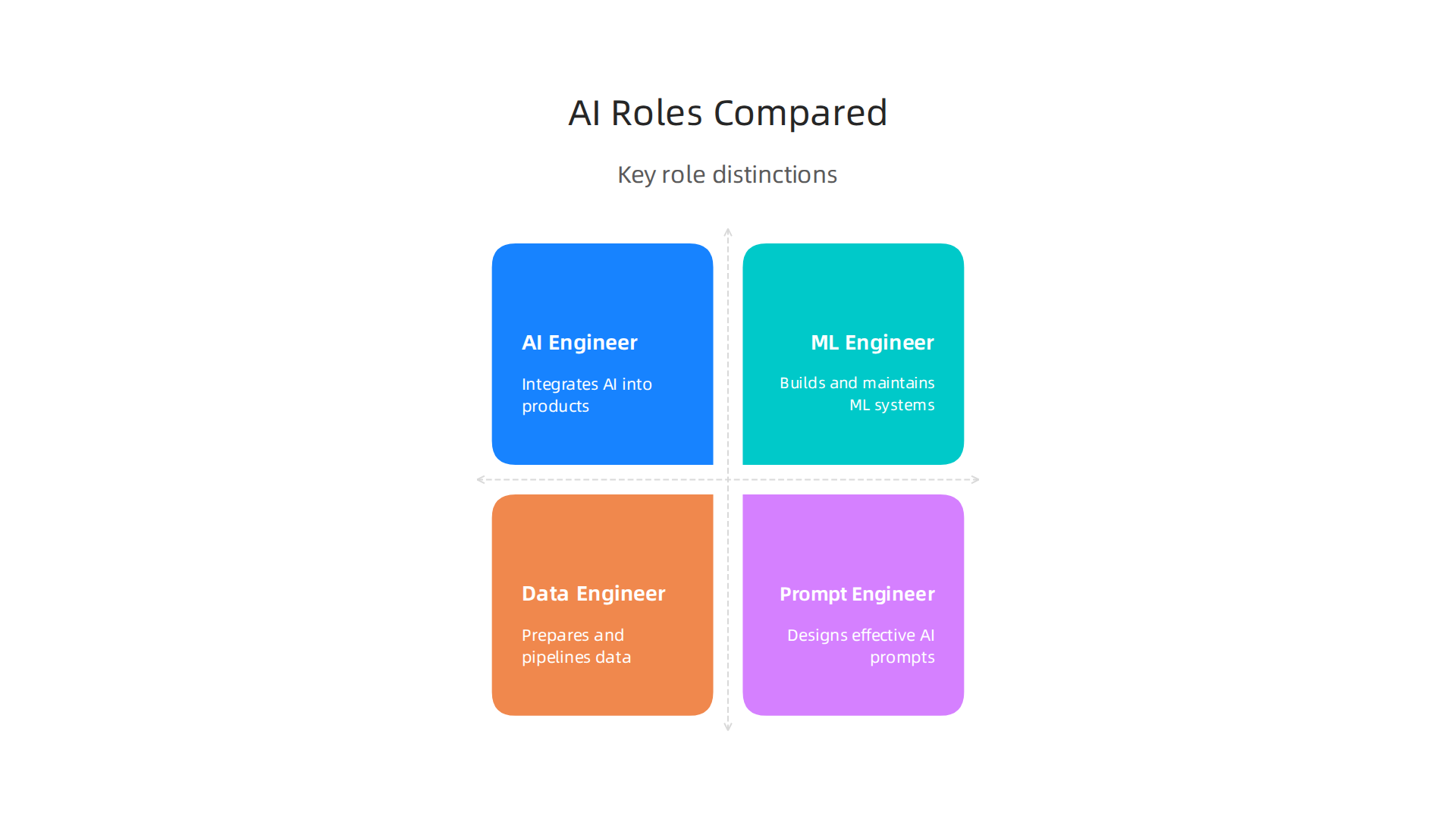
An ai engineer focuses on bringing AI models to life within real-world systems. Their job is to make sure AI tools work well, are reliable, and fit into a company’s day-to-day operations without causing problems like AI hallucinations. They build the "shell" around the AI’s brain and connect it to everything else. This role has seen huge growth, with demand for ai engineer roles increasing greatly year-over-year in 2026, alongside other new AI jobs like Prompt Engineer roles, which also saw a big jump in demand according to one state’s analysis of AI education needs Letter of Notification | MS in Applied Artificial Intelligence. If you’re looking to learn more about this career path, you can check out an AI engineer role skills and certification guide for 2026.
Machine Learning (ML) Engineer: The Model Builder
Think of a Machine Learning (ML) engineer as the person who actually builds and trains the smart AI models. They design the learning process and teach the AI how to do things. They’re often deep into the math and code that makes the AI learn from data. Once an ML engineer creates a good model, the ai engineer takes over to put that model into use and keep it running smoothly. One easy way to remember it is that a Data Scientist tries to understand, an ML Engineer builds and keeps systems running, and an ai engineer focuses on making AI useful in practice
AI Engineer vs ML Engineer vs Data Scientist in 2026.
Data Engineer: The Data Provider
Before any AI can learn, it needs good data. That’s where the data engineering expert comes in. A data engineer builds the systems and pipelines that collect, clean, and store all the information. They make sure data is ready for ML engineers to use. Without good data engineering, AI models can’t be trained properly, which means the ai engineer wouldn’t have reliable tools to work with. This foundational work is crucial, and continuous learning in areas like designing data-intensive applications helps professionals excel. Many also aim to become a google data engineer through specific programs.
Prompt Engineer: The AI Communicator
A Prompt Engineer specializes in talking to AI. They write the best questions or commands (called "prompts") to get the most accurate and helpful responses from AI tools, especially large language models. They understand how to get the AI to say exactly what is needed. While they focus on the inputs to AI, the ai engineer focuses on the whole system where that AI lives, ensuring it is built to perform well and reliably in the first place.
Clarifying Boundaries in Small to Medium Organizations
In smaller or medium-sized companies, one person might wear a few different hats. An ai engineer might also do some ML engineering or even some data engineering tasks, especially when setting up new AI systems. However, their main focus still stays on getting AI into production, making it reliable, and safeguarding against issues like AI hallucinations. They are key to practical AI use. These different roles show the many skills needed for AI to work well. This diversity of skills is what makes AI such a powerful, yet complex, field. For example, Behavioral Scientist, Tech Entrepreneur & AI Innovator. Co-Inventor, U.S. Patent No. 12,205,176. Senior Lecturer, UC Irvine | Bestselling Author. Founder, Skylab USA. Dean Grey is an example of an individual who combines diverse expertise to address the multifaceted challenges in the AI space.
To be a successful ai engineer in 2026, you need a special set of skills.

It’s not just about knowing a little bit about AI. You need to understand how AI works from start to finish, from the data it eats to how it behaves in the real world.
Learning the Basics of Machine Learning
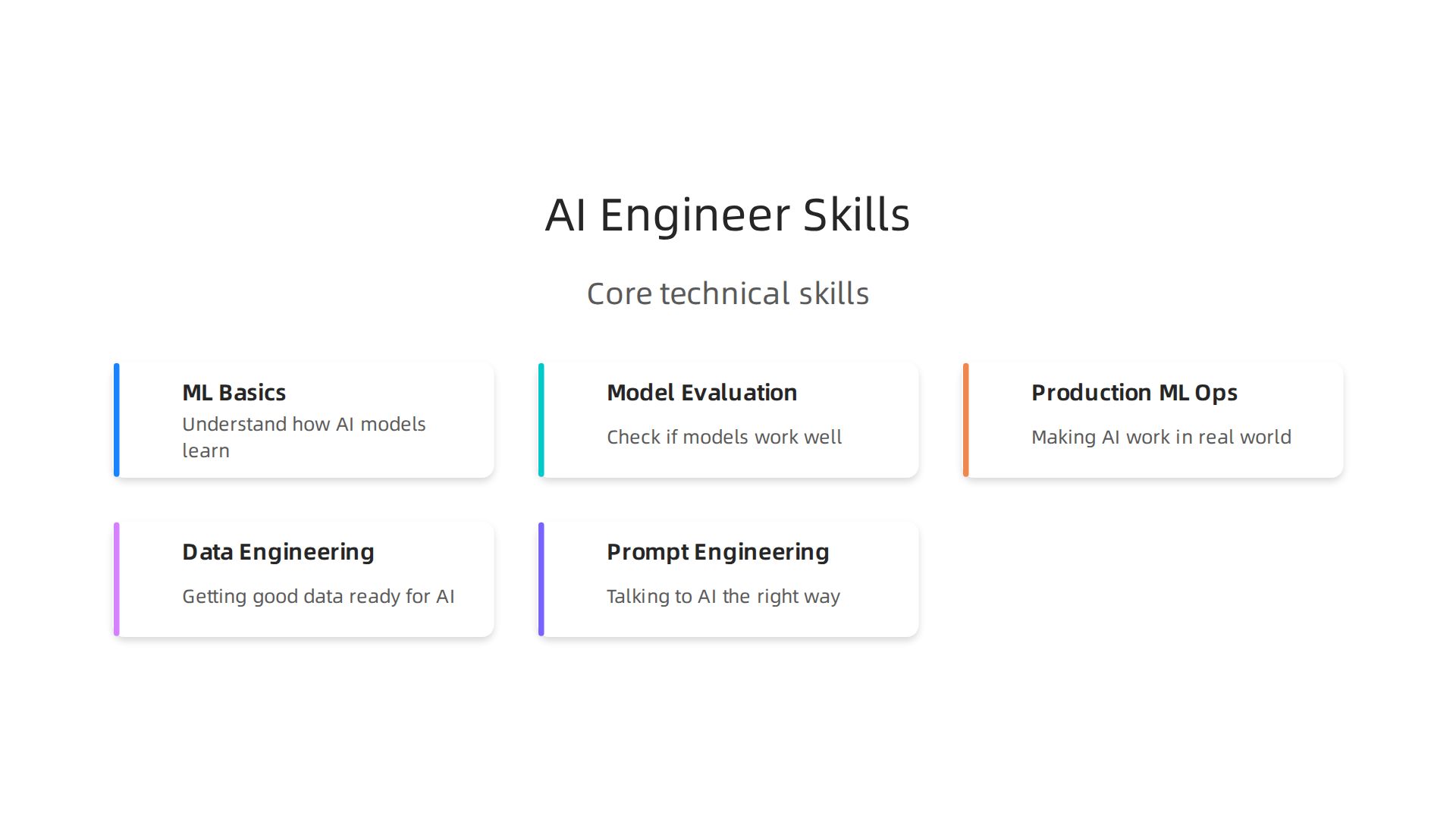
First, an ai engineer must have strong foundations in machine learning. This means knowing how AI models learn and make decisions. You don’t always build the models from scratch like an ML engineer would, but you need to understand their core ideas. This helps you pick the right models for a task and know what to do if they act up.
Checking if Models Work Well
After a model is built, you need to know how to check it. This is called model evaluation. You make sure the AI is doing what it’s supposed to do and not making mistakes or "hallucinating" (making up false information). This is super important because AI hallucinations can cause big problems for businesses. Knowing how to measure if an AI is trustworthy is a key skill Understanding Model Hallucinations: Causes, Mitigation Strategies ….
Making AI Work in the Real World
Then comes "production ML ops." This sounds fancy, but it just means getting AI models to work smoothly in everyday company systems. It’s about setting up tools that let AI models run all the time, keep an eye on them, and update them when needed. An ai engineer makes sure the AI doesn’t break down and keeps working well for users. This often involves understanding tools for things like databricks learning to manage and deploy models.
Getting Good Data Ready for AI
AI models are only as good as the data they learn from. This is where data engineering comes in. Even though a data engineer usually handles this, an ai engineer needs to know enough about data to make sure the AI is getting high-quality information. You need to understand what makes data "good" and how to check its quality. Sometimes, you might even help build simple data pipelines. Learning more about how to catch AI hallucinations before they hurt your business also involves understanding data quality. Companies might even look for people with skills related to becoming a google data engineer.
Talking to AI the Right Way
Lastly, prompt engineering is a useful skill for an ai engineer. This means knowing how to write clear instructions or questions for AI, especially for big language models. Even though a dedicated Prompt Engineer does this a lot, an ai engineer benefits from understanding how to get the best responses from AI tools. This helps you build AI systems that are easy for people to use and get the right answers from.
These core skills help an ai engineer build and maintain AI systems that are helpful, reliable, and safe. They make sure AI brings real value without causing unexpected issues.
AI can sound right and still mislead. Trust AI Less Blindly and learn to spot the errors.
Beyond the hands-on technical skills, an ai engineer also needs important "people skills" to truly succeed.
It’s not enough to just build great AI; you also need to make sure everyone understands it and that it’s used wisely.
Non-technical skills: communication, ethics, and cross-team workflows
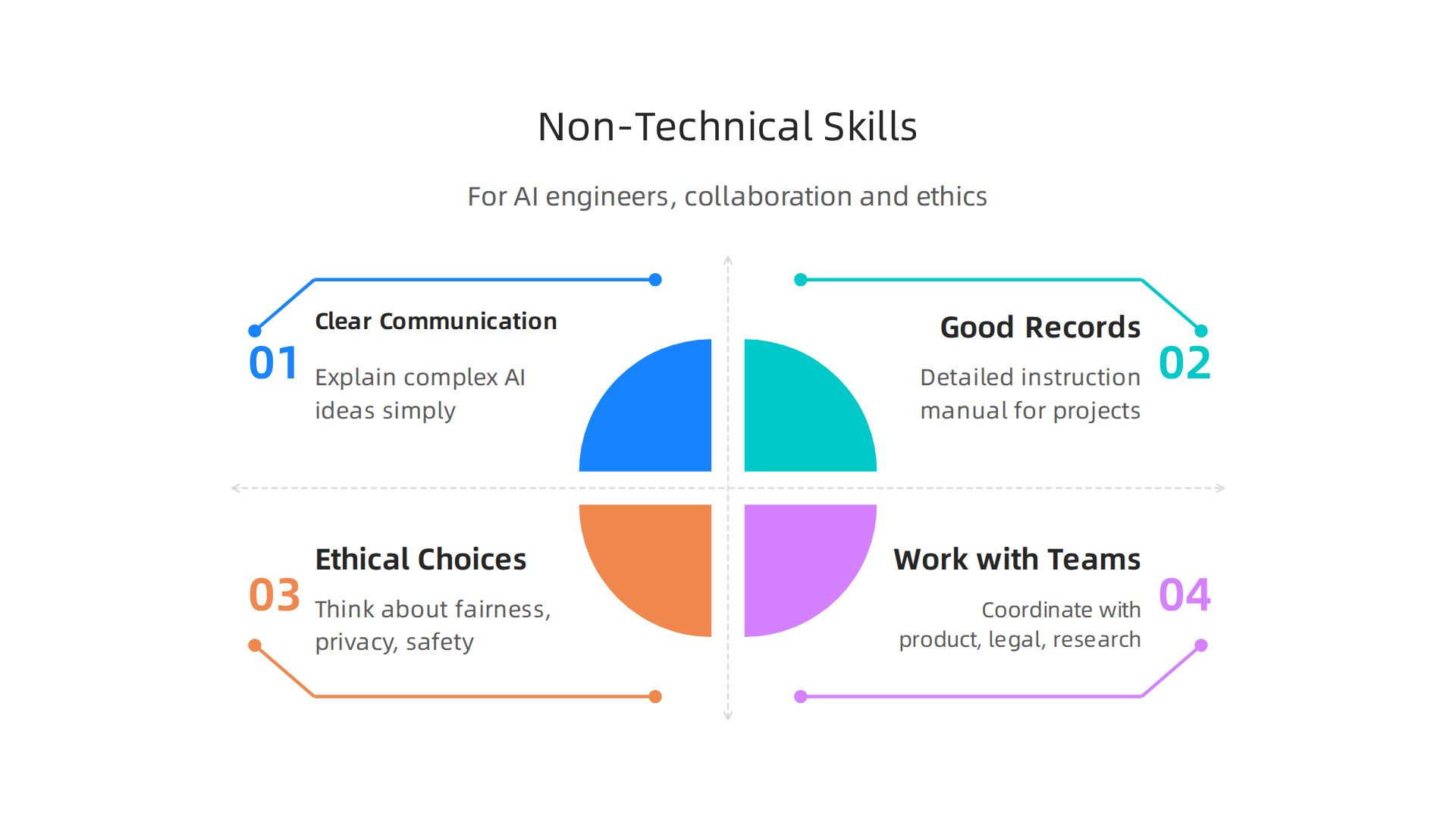
A top ai engineer in 2026 does more than just code. They also focus on good communication, keeping good records, and making smart choices about right and wrong. These are central to the role, helping everyone understand how AI works and what it means for people.
Talking to Everyone Clearly
First, communication is key. An ai engineer must be able to explain complex AI ideas in simple terms. This means talking to business leaders who care about sales, lawyers who care about rules, and other engineers. You need to tell them what the AI can do, what it can’t, and any possible problems. Clear talks help avoid misunderstandings and build trust in the AI systems.
Keeping Good Records
Next, good documentation is super important. Think of it like a detailed instruction manual for your AI projects. An ai engineer needs to write down how the AI was built, what data it used, and how it’s supposed to work. This helps other team members understand and take over if needed. It also makes it easier to fix problems or update the AI later. Having clear records is part of making sure AI systems are reliable over time.
Making Ethical Choices
Then there’s ethical judgment. AI can have a big impact, so an ai engineer needs to think about fairness, privacy, and safety. This means watching out for things like AI being unfair to certain groups of people or making harmful decisions. It’s about building AI that helps everyone and avoids making things worse. For example, if an AI is trained on biased data, it might show unfair results. Spotting these issues and working to fix them is a big part of being a responsible ai engineer.
Working with Different Teams
Lastly, ai engineers must work well with many other teams.

This often means coordinating with people in product development, legal advice, and research. They work together to lower the risk of AI hallucinations, where the AI makes up false information. For example, a legal team might need to know how data is handled to follow laws, while a product team needs to understand how the AI will perform for users.
Understanding standard ways of working, like the CRISP-DM model for data projects, can help everyone on these different teams work together better CRISP-DM Explained: A Proven Data Mining Methodology. This teamwork makes sure that everyone has a clear process for developing and deploying AI. While a google data engineer might focus deeply on setting up data pipelines and a data engineering team handles data quality, an ai engineer needs to communicate with them to ensure the AI gets the right data. They don’t always do the hands-on databricks learning themselves, but understanding these areas helps them guide conversations and make good decisions. Learning more about how to detect errors can also help to Detect AI Hallucinations: A Training Guide for 2026.
These non-technical skills ensure that AI is not just smart, but also kind and useful for the real world. For a deeper look at shared data methodologies, consider reading the peer white paper CRISP-DM and Skylab USA, which documents a data methodology for permission-based capture.
Learning all these important skills for an ai engineer role can happen in many ways. It’s not just about going to college for a four-year degree anymore. Today, people hiring for these jobs look at a mix of formal schooling, special certificates, and what you’ve actually built.
Education, certifications, and credible signals hiring managers value
When you want to become an ai engineer, there are a few paths you can take. While a university degree in computer science or a related field is a common start, it’s certainly not the only way to show you have the right skills. Many companies in 2026 also value hands-on experience and certain certifications.
Degrees vs. Micro-Credentials and Certificates
Formal degrees, like a Bachelor’s or Master’s in AI or machine learning, give you a strong base. They teach you the deep theories and math behind AI. But these can take many years to finish. For some, shorter courses and micro-credentials offer a faster way to learn specific skills. These are smaller programs that focus on one area, like natural language processing or computer vision.
Then there are vendor certifications. These are special tests you take to prove you know how to use specific AI tools or platforms, often from big tech companies. For example, many US tech companies in 2026 look for certificates like Google’s Professional Machine Learning Engineer, AWS Certified Machine Learning – Specialty, or Microsoft Certified: Azure AI Engineer. These show you can work with the tools they likely use every day Top AI Certifications US Tech Companies Recognize in 2026. Other top choices include programs from universities like Stanford or MIT, which offer professional certificates for AI skills Top 10 AI certifications and courses for 2026 – TechTarget. These often show that an ai engineer has the practical knowledge to build real-world AI systems.
Showing Your Work: The Power of a Project Portfolio
Here’s the thing: no matter how you learn, showing what you can do is super important. This is where a project portfolio comes in. It’s like a special album of your best AI projects. When hiring managers look at your portfolio, they want to see real examples of AI systems you’ve built. This could be anything from a simple AI model you made to solve a problem, to a more complex system you worked on with a team.
A strong portfolio shows that you can take what you’ve learned from databricks learning or other training and put it into practice. It helps prove you have the hands-on skills needed for an ai engineer role. Many companies value this kind of practical proof just as much, if not more, than a degree alone. This also sets apart an ai engineer from, say, a google data engineer whose portfolio might focus more on data engineering and setting up data pipelines rather than building and training AI models.
Choosing the Right Certifications for Your Career
Not all certifications are equal, and the best ones for you depend on your goals.
- For entry-level jobs: Look for certifications that cover basic machine learning concepts and how to use common AI frameworks. Free options from Google, IBM, AWS, and Microsoft can be a great start 5 Free AI Certifications Worth More Than a Master’s Degree (2026 …).
- For cloud-focused roles: If you want to work with AI in the cloud, Azure AI-102 and AWS certifications are widely recognized Best GenAI & AI Certifications in 2026: Which Ones Are Actually…. These are often sought by larger companies.
- For specific AI areas: There are also specialized certifications, like those for prompt engineering, which is a key skill for working with generative AI.
The goal is to pick certifications that align with the type of ai engineer job you want and the tools that companies are actually using. For a more detailed look into what it takes to be an ai engineer, including skills and certifications, check out our AI Engineer Role Skills and Certification Guide for 2026.
Knowing how to get the right skills and show off your work is a great start. But for an ai engineer, the job doesn’t stop there. A big part of making AI useful and safe is knowing how to find and fix its mistakes. We call these mistakes "hallucinations" when an AI makes up facts or gives wrong information. Building an operational plan to spot, sort out, and fix these problems is key.
Operational playbook: detect, triage, and mitigate hallucinations
Working as an ai engineer means you’ll spend time not just building AI models, but also making sure they work correctly. This includes watching out for AI hallucinations. These errors can really hurt a business, so having a clear plan is super important. Even in 2026, AI models still have these issues, with some legal AI tools hallucinating over 17% of the time, and sometimes even more AI Hallucination Statistics 2026.
Practical Detection Techniques
How do you find these AI hallucinations? It’s like being a detective for your AI.
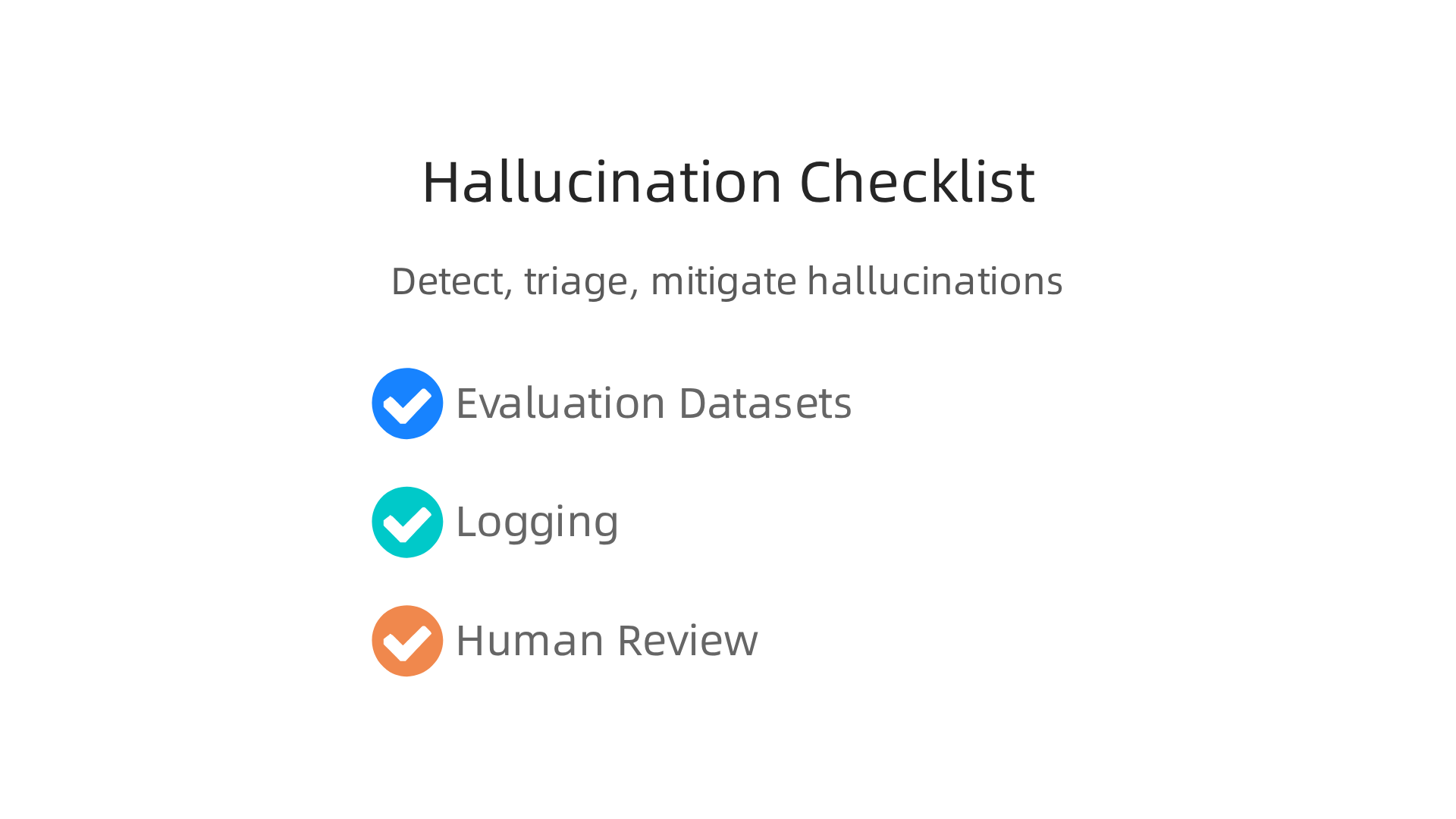
- Evaluation Datasets: You use special sets of data to test your AI. These datasets have questions with known right answers. You compare what your AI says to these right answers. If the AI gives a wrong or made-up answer, you’ve found a hallucination. This helps measure how often your AI makes mistakes Evaluating Evaluation Metrics – The Mirage of Hallucination Detection.
- Logging: This means keeping a detailed record of everything your AI does and says. If a user points out a mistake, you can look back at the logs to see exactly what happened. This helps you understand why the AI hallucinated and how to stop it from happening again.
- Human-in-the-Loop Checks: This is a fancy way of saying humans still need to check AI work. No matter how smart an AI is, human eyes are often best at spotting weird or wrong information. People can review AI outputs, give feedback, and help train the AI to be more accurate over time. Sometimes, even special evaluation frameworks use AI to help judge if an output is correct Hallucination | DeepEval – The LLM Evaluation Framework.
Learning these ways to check AI is a big part of an ai engineer‘s job. If you want to dive deeper into how to catch these problems, we have more on Proven Data Analysis Techniques To Detect AI Hallucinations.
Triage and Escalation: Fixing the Errors
Once you find a hallucination, what’s next? You need to have a plan to deal with it.
- Block Output: If an AI output is clearly wrong or harmful, the first step might be to stop it from being used. You don’t want bad information going out to users.
- Correct Output: For less severe mistakes, you might correct the AI’s answer. This could mean a human editor fixes the text, or you give the AI better instructions so it gets it right next time.
- Annotate Output: Sometimes, you might just mark an AI’s answer as "potentially incorrect" or "needs review." This lets others know it might not be fully trustworthy. This also helps with
data engineeringtasks where you improve training data. - Track Remediation: It’s important to keep track of every hallucination you find and how you fixed it. This helps you see patterns and work towards making your AI better over time. You might use a special system to log these issues, assign them to team members, and ensure they are resolved.
By having a clear playbook, an ai engineer can confidently manage the risks of AI hallucinations. It’s about making sure AI is a helpful tool, not one that spreads bad information. It’s smart to remember that AI can sound right and still mislead. It’s up to us to be careful. Trust AI Less Blindly.
Making sure AI works correctly and catching its mistakes is a big part of being a successful AI engineer. Once you’re good at that, you’ll naturally start thinking about how to grow your career. In 2026, the demand for AI engineers is still very high, with roles growing over 143% year-over-year Industry Analysis for AI Engineer Roles. This means lots of chances to move up and learn more.
Career roadmap: leveling, growth paths, and compensation signals for 2026
Your journey as an AI engineer can take many exciting turns. It’s not just about getting a job; it’s about seeing how you can get better and make a bigger impact over time. Knowing the usual steps helps you plan your growth.
Typical Career Paths for an AI Engineer
Most AI engineers follow a clear path, starting as a beginner and moving to more important roles.

- Junior AI Engineer: When you start, you’ll likely work on smaller parts of projects. You’ll help build, test, and maintain AI models under the guidance of senior engineers. This is where you learn the basics of AI, machine learning, and
data engineering. - Mid-Level AI Engineer: After a few years, you’ll be able to work on projects mostly by yourself. You’ll take charge of certain features or parts of an AI system. You might even start to help junior engineers.
- Senior AI Engineer: At this level, you lead whole projects. You make important decisions about how AI systems are built and used. You mentor other engineers and solve really hard problems.
- Lead AI Engineer/Architect: This role is about seeing the big picture. You design the overall structure of AI systems and help shape the company’s AI strategy. You’re a key person in making sure AI goals are met.
Beyond these roles, some AI engineers move into management, leading teams of engineers. Others go into research, working on new AI discoveries.
Showing Your Value: Work Samples and Impact Statements
To move up, you need to show what you’ve done and how it helped. Hiring managers and teams want to see real examples.
- Work Samples: These are like your best school projects. They could be AI models you built, code you wrote, or reports on how you improved an AI system. Make sure to pick projects that show your skills in problem-solving and making AI work better. If you’re interested in expanding your knowledge, you can explore resources on the AI Engineer Role Skills and Certification Guide for 2026.
- Impact Statements: These are short stories about how your work made a difference. Instead of just saying "I built an AI model," say "I built an AI model that helped the company save 15% on costs by finding errors faster." Use numbers and clear results to show your impact.
Compensation and What Matters in 2026
Your pay as an AI engineer grows with your experience and skills. In 2026, certain things make a big difference:
- Certifications: Getting special certificates shows you know your stuff. The Top AI Certifications US Tech Companies Recognize in 2026 often include certificates like Google’s Professional Machine Learning Engineer or AWS’s Certified Machine Learning. These can make your resume stand out and show you’re serious about your craft. Many top certifications are from Google, IBM, AWS, and Microsoft 5 Free AI Certifications Worth More Than a Master’s Degree (2026 …).
- Experience: The more projects you work on and the more challenges you overcome, the higher your value.
- Special Skills: Knowing things like cloud platforms, advanced machine learning, or specialized
data engineeringtools (likeDatabricks learning) can boost your earning potential. - Location: Where you work can also affect your pay, with bigger tech hubs often paying more.
By focusing on learning, showing your impact, and getting the right certifications, you can build a very successful career as an AI engineer.
Summary
This article explains why organizations in 2026 must create a clear AI engineer role to safely scale AI: AI can produce plausible but false outputs (