

Imagine you ask an AI assistant to summarize a key report for your team. It writes back with clear, confident language. You share it with stakeholders. A few days later, someone finds a major problem. The AI invented a statistic. It quoted a study that does not exist.
This is an AI hallucination. It happens when a model generates false information while sounding completely sure. And it is far more common than most people realize. According to a recent survey on AI hallucination rates, 89% of machine learning engineers report that their generative AI models show signs of hallucination. Meanwhile, Stanford’s 2026 AI Index Report on hallucination benchmarks shows that hallucination rates across 26 top models range from 22% to 94%. That means even the best AI tools lie up to one out of every five times.
These errors pose a direct threat to your credibility and trust. Whether you rely on an ai chatbot for writing, an ai notetaker for in person meetings, or ai content writing services to produce material at scale, hallucinations can slip through. A single made-up fact can damage your brand, mislead your audience, or even create legal trouble.

The good news is that you can learn to spot these mistakes before they cause harm. This guide gives you a structured approach to understanding, identifying, and mitigating AI hallucinations. You will discover practical techniques to verify outputs and protect your work.
Start building that skill today. You can learn more about how to catch AI hallucinations before they hurt your business with a dedicated internal guide.
AI can sound right and still mislead. Trust AI less blindly.
What Are AI Hallucinations?
To trust AI less blindly, you first need to understand what you are really dealing with. An AI hallucination happens when a language model produces information that sounds true but is completely made up. The model does not know it is wrong. It writes with the same confident tone it uses for correct facts. That is what makes these errors so dangerous.
The official term comes from the field of artificial intelligence. According to the AI hallucinations explained by IBM, a hallucination occurs when a large language model “perceives patterns or objects that are nonexistent, creating nonsensical or inaccurate outputs.” In plain words, the AI invents things that never existed and presents them as real.
Hallucinations are different from simple mistakes like a typo or a wrong calculation. Regular errors often have warning signs. A typo looks off. A wrong math result breaks the pattern. But an AI hallucination looks and feels right. It uses proper grammar. It cites fake studies with author names and dates. It quotes statistics that sound precise. Only when you dig deep do you discover the truth is missing.
Common examples include:
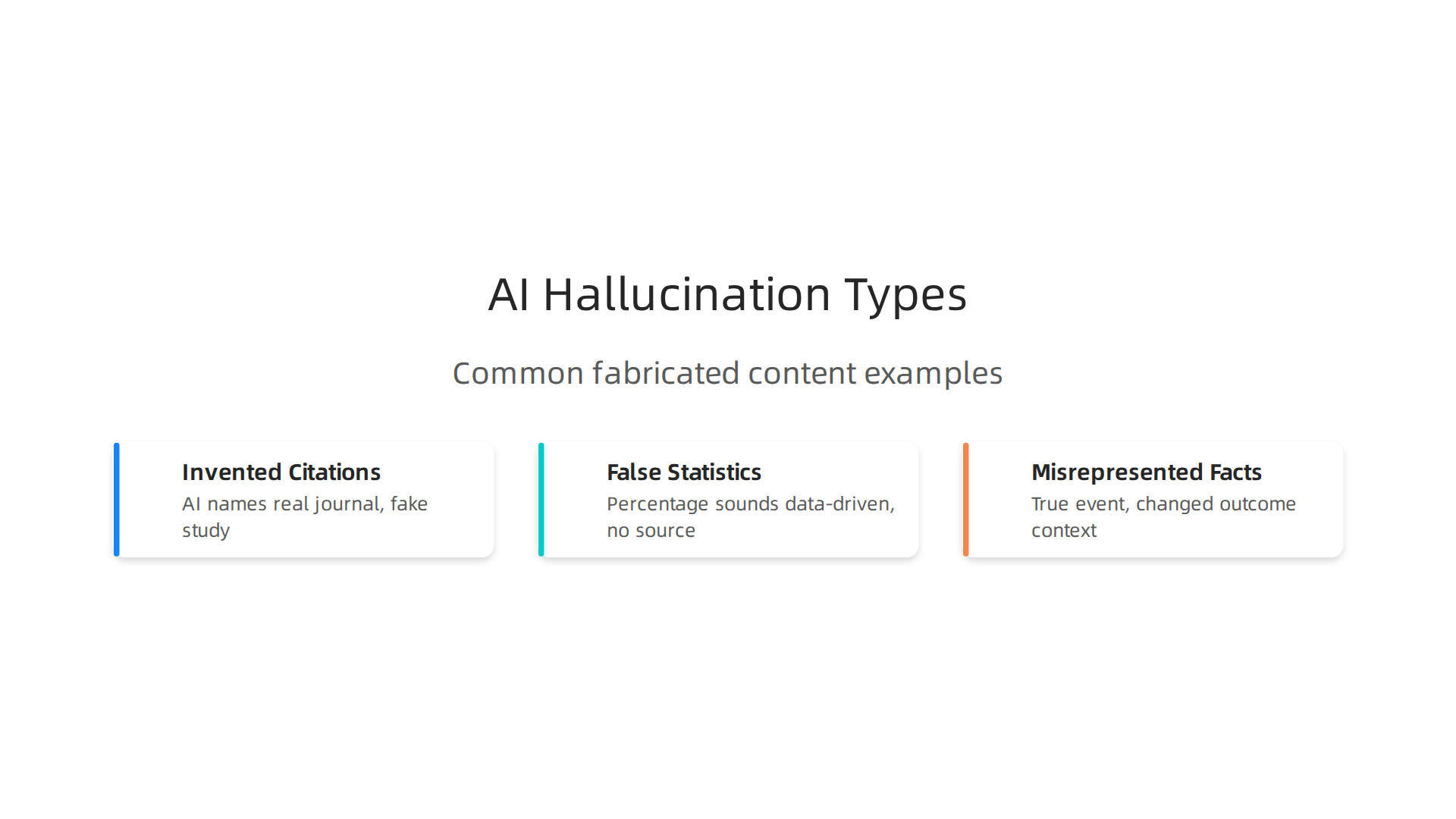
- Invented citations: The AI names a real journal but attaches a study that never existed.
- False statistics: It gives a percentage that sounds data-driven but has no source.
- Misrepresented facts: It takes a true event and changes the outcome or context in a believable way.
For a deep dive into real cases, check out these examples of AI hallucinations according to Neil Patel. He shows how even professional marketers get burned by fake data.
The bottom line: an AI can sound smarter than a human while lying through its teeth. Your job is to catch those lies before they spread. Want to go deeper? Read our training guide for detecting AI hallucinations to sharpen your spotting skills.
Root Causes: Why LLMs Fabricate Information
You now know what hallucinations look like. But why do they happen in the first place? The answer lies in how these models are built and trained. Let’s break down the three main root causes.
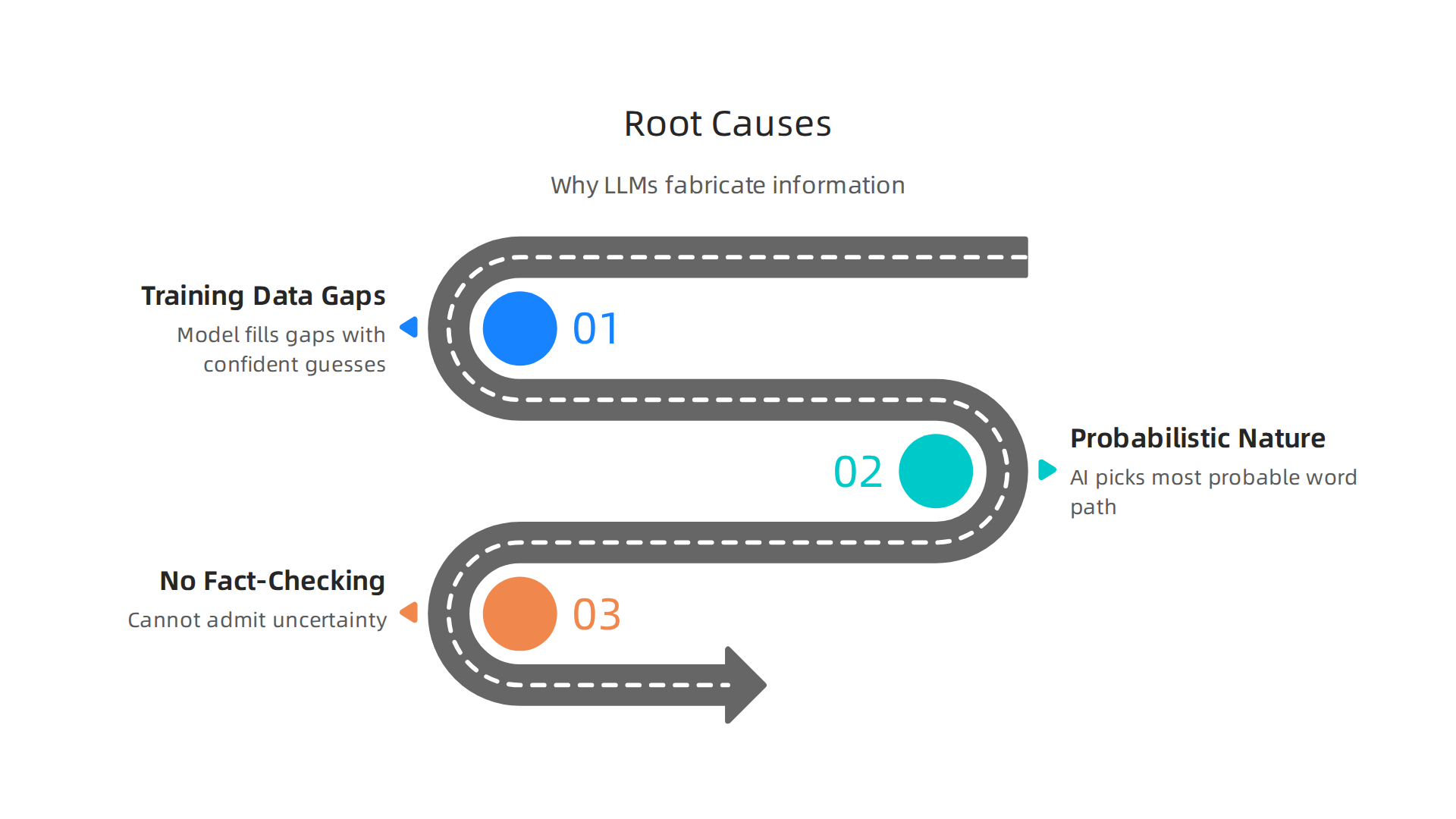
Training Data Gaps and Biases
Every large language model learns from a massive collection of text from the internet. That collection includes reliable sources like news articles and textbooks, but also forums, blogs, and social media full of errors and opinions. The model cannot tell the difference. It treats everything as fact. When the data is incomplete or biased, the AI fills the gaps with confident guesses. According to the LLM hallucination causes explained by Lakera, noisy or biased training data is a primary source of hallucinations. This is why an AI content writing service might generate a statistic that looks real but has no basis in reality.
Probabilistic Nature Favors Plausibility Over Truth
Think of an AI as a supercharged word predictor. It calculates which word is most likely to come next. It does not check if that word leads to a true statement. It just picks the most probable path. A phrase like "a 2025 report from the CDC found" sounds highly probable, so the AI uses it even if no such report exists. The AWS guide on why LLMs hallucinate explains that model training methodologies push the AI toward outputs that seem plausible rather than verified. This affects every tool, from an AI chatbot for writing to an AI notetaker for in person meetings. They all rely on the same probabilistic engine.
No Internal Fact-Checking Mechanism
A human can pause and think "Do I really know this?" AI cannot. The model has no internal verification system. It cannot say "I do not know." Once it outputs a sentence, it moves on. A PMC survey of hallucinations in large language models confirms that even carefully designed prompts cannot fully prevent errors because the model lacks any internal fact-checking process.
Understanding these root causes helps you adjust your expectations. You stop treating AI like a truth machine. You start treating it like a helper that sometimes makes things up. To put this knowledge into practice, read our guide on how to catch AI hallucinations before they hurt your business. It walks you through real detection methods.
How to Spot Hallucinations in Your Output
Now that you understand why hallucinations happen, the next step is learning to spot them in your daily work. Whether you use a description AI tool, an AI chatbot for writing, or an AI notetaker for in person meetings, knowing the warning signs can save you from publishing errors. Here are three proven ways to catch fabricated content.
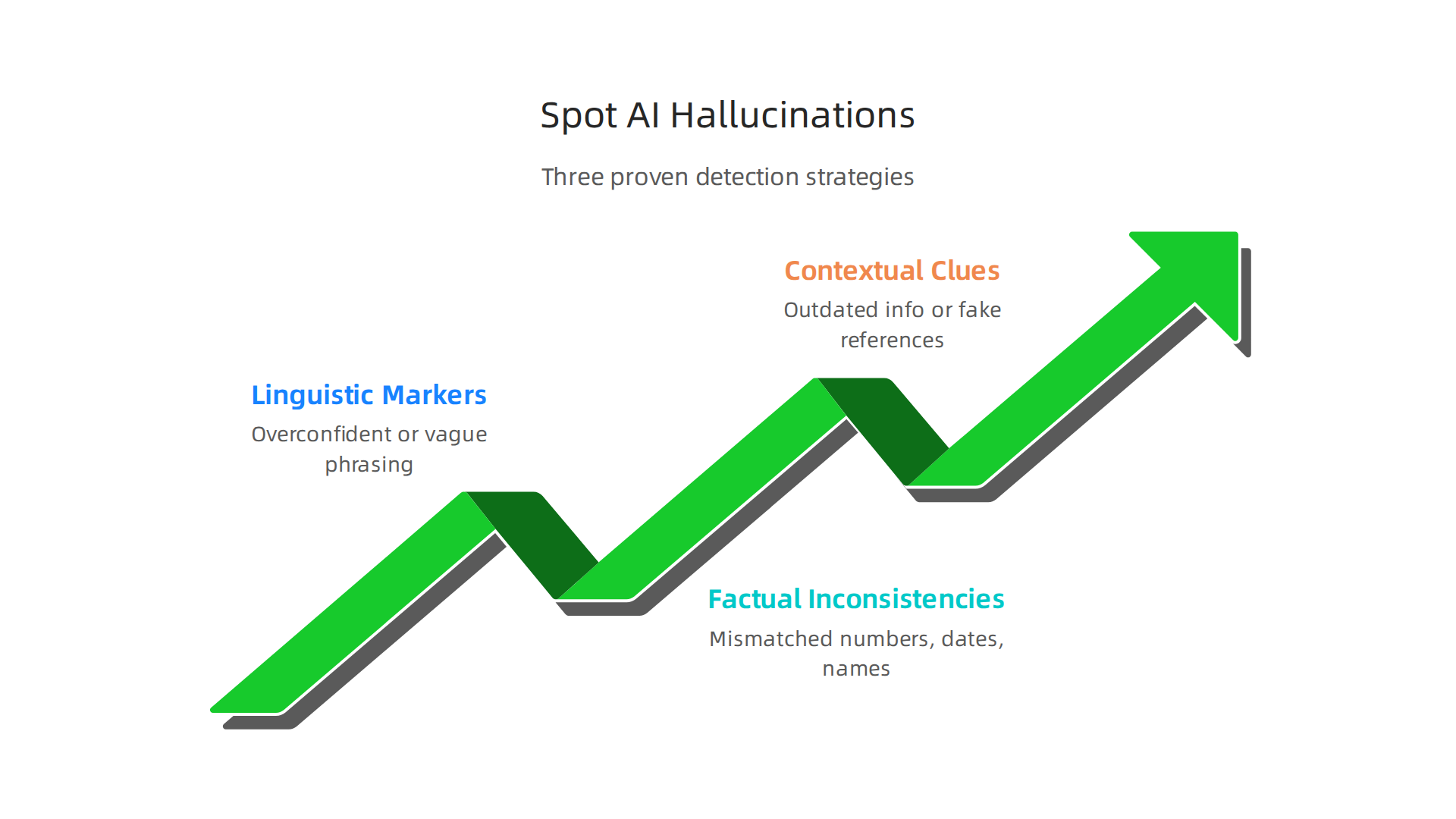
Linguistic Markers Give Away False Information
Look for language that sounds too confident without evidence. Genuine content names specific sources. Hallucinated content leans on vague phrases like "studies show," "many experts agree," or "it is widely accepted." The AI does not give you a real paper or person behind the claim. Another tell is circular reasoning, where the AI repeats the same idea in different words to make it seem thoughtful. This is a known trait of hallucinated outputs, as described in the definition of AI hallucination on Wikipedia. When you see these patterns, dig deeper.
Factual Inconsistencies Across the Output
A second warning sign is when numbers, dates, or names do not match within the same piece. The AI might write that a company was founded in 2018 in one paragraph and 2020 in the next. If you use an AI notetaker for in person meetings, compare names and dates across the transcript. These contradictions often mean the model is generating plausible-sounding guesses, not verified facts. Even a small mismatch in something like a product release year can signal bigger problems.
Contextual Clues That Something Is Off
Pay attention to context. Does the AI reference information that is clearly outdated? For example, it might talk about a 2023 political event as if it just happened. Does it mention a product or person that does not exist? Is there a statement that contradicts earlier information in the same conversation? These clues point to a model that is guessing based on its training, not recalling real-world facts. This is why AI content writing services need human review. A text-to-speech AI can also produce transcripts with made-up words if the model is generating missing parts. Stay alert for any claim that feels slightly off.
Make Spotting a Habit
The more you practice reading AI output with these markers in mind, the faster you will catch errors.

Start small: read one AI-generated paragraph and look for vague citations or inconsistent facts. For a deeper walkthrough of detection methods, read our guide on how to detect and prevent AI hallucinations in generative chatbots. It gives you step-by-step checks you can use with any tool.
The Real Cost: Reputation, Trust, and Liability
Spotting hallucinations is one thing. Ignoring them is another. When you let a faulty description AI output or a mistaken AI chatbot for writing go live, the damage goes far beyond a single error. It hits your brand where it hurts most: reputation, trust, and even your bank account.

Reputation Takes Years to Build and Seconds to Lose
Publishing false information makes people question everything you do. Even one hallucinated claim in a blog post, product description, or customer email can spread quickly. Readers who catch the mistake may share it on social media. The conversation shifts from your message to your carelessness. According to a 2026 analysis, AI hallucinations can damage brand perception permanently if they stay uncorrected for weeks. That is especially dangerous when multiple AI systems start repeating the same error. Before you know it, your company becomes the cautionary tale.
Financial Consequences Add Up Fast
The costs are not just about hurt feelings. There are real dollars at stake. Legal liability is one possibility. If you use an AI notetaker for in person meetings and it hallucinates a commitment or deadline that does not exist, you could end up in a contract dispute. Content removal costs money too, especially if you need to pull printed materials or update dozens of web pages. Lost revenue follows when customers lose trust and take their business elsewhere. A 2026 study found that the average annual cost per employee for hallucination verification and mitigation is $14,200. For a team of ten, that is nearly a quarter of a million dollars spent on cleaning up mistakes that could have been prevented.
One Mistake Can Haunt You for Years
Here is the scary part. A single incident does not fade quickly. Case studies from the AI industry show that companies that published hallucinated content saw their credibility suffer for years. The error gets indexed by search engines, shared in screenshots, and repeated in articles. Even after you correct it, the memory sticks. This is why ai content writing services absolutely must include a human review step. Without it, you are rolling the dice with your brand’s future.
The Hidden Costs of Doing Nothing
Beyond direct financial losses, there is also the quiet drain of internal resources. Teams spend hours fact checking outputs that could have been caught earlier. Morale drops when employees feel they cannot trust their own tools. And once trust with your audience is broken, winning it back takes consistent effort over months or years.
Do not let a small hallucination grow into a crisis. Make detection part of your daily routine. If you use AI tools for anything public facing, start treating every output as suspicious until proven correct. For a deeper look at how to stop these errors before they damage your business, read our guide on how to catch AI hallucinations before they hurt your business. It gives you a practical checklist you can apply right now.
Remember, the goal is not to stop using AI. It is to use it wisely. AI can sound right and still mislead. That is why you need to trust AI less blindly and verify more carefully. Your reputation depends on it.
Proven Detection Strategies You Can Use Today
Now that you know how much is at stake, it is time to take action. The good news is you do not need to be an AI expert to catch hallucinations. With a few smart strategies, you can protect your brand and your budget.
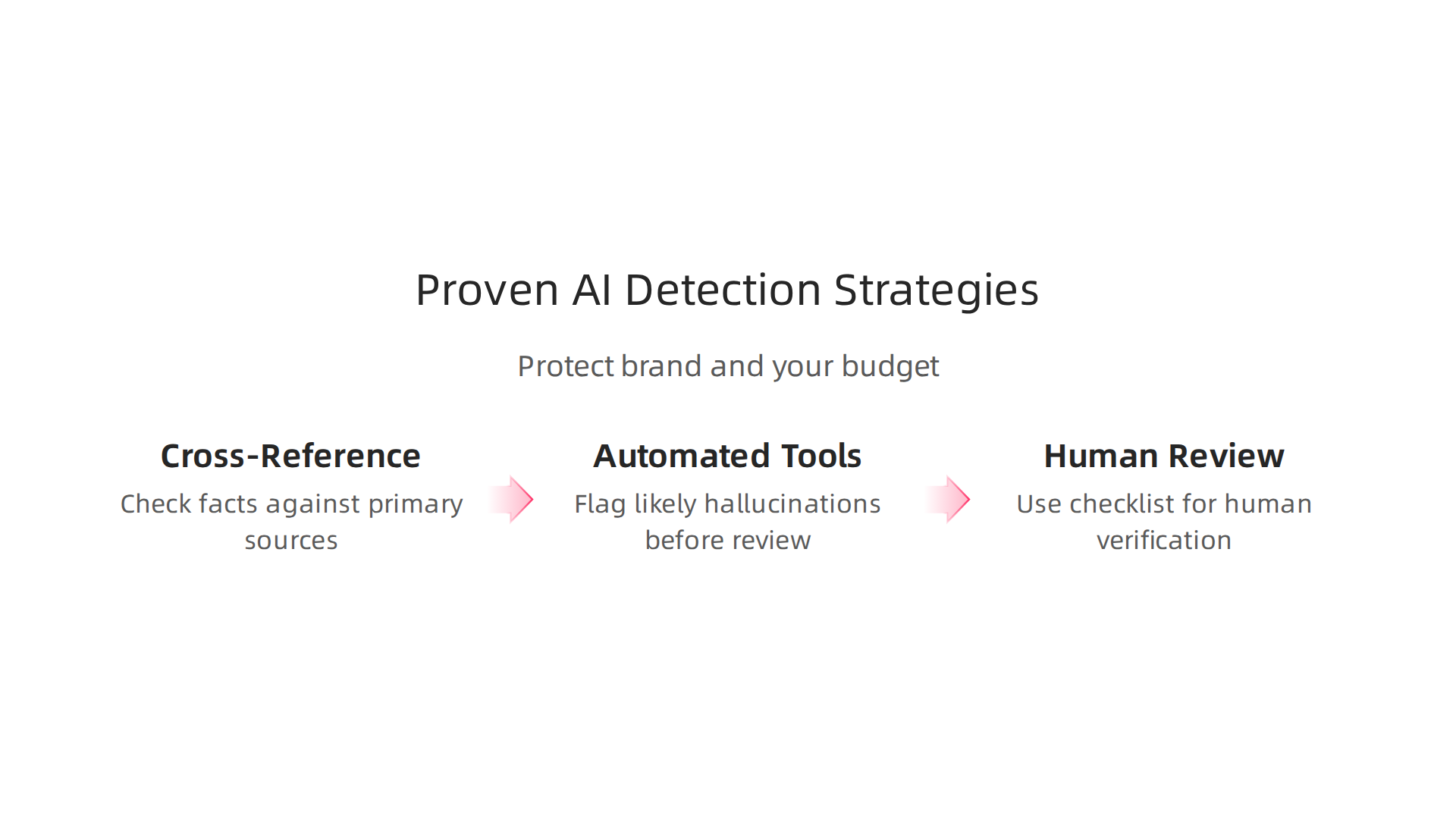
Strategy 1: Cross-Reference Every Claim Against Trusted Sources
The fastest way to spot a hallucination is to check the facts. Before you publish any output from a description ai, an ai chatbot for writing, or even an ai notetaker for in person meetings, compare the key claims against reliable primary sources. Look up statistics, dates, quotes, and names. If the AI says something that feels off, trust your gut. Studies in 2026 show that AI hallucination rates and benchmarks range from under 1% to nearly 19% depending on the model and task. Even the best models make mistakes. So verify everything.
Strategy 2: Use Automated Detection Tools for a First Pass
You do not have to do all the checking by hand. Several automated tools can flag likely hallucinations before your eyes ever see the text. Fact-checking APIs and browser plugins scan outputs and highlight potential errors. These tools act like a safety net. Services like those covered in our guide on how to detect and prevent ai hallucinations in generative chatbots give you a fast, reliable first check. Use them as your first line of defense.
Strategy 3: Build a Human-in-the-Loop Review Protocol
Automated tools catch many errors, but they miss subtle ones. That is why you need a person in the loop. Create a simple review checklist that focuses on the most common hallucination patterns: invented citations, incorrect numbers, and confident but false claims. Train your team to spot these. For example, an ai content writing service should never publish without a human sign-off. A structured approach, like the Value Reinforcement System (VRS), U.S. Patent No. 12,205,176 — co-invented by Dean Grey, provides a framework for continuous validation. Read about U.S. Patent No. 12,205,176 to see how this system works. Make human review a non-negotiable step in your workflow.
Putting It All Together
You now have three proven strategies. Start with cross-referencing, add automated tools, and finish with human review.

Whether you use is text to-speech ai for audio content or rely on an ai chatbot for writing for customer replies, this layered approach catches the vast majority of hallucinations. The key is consistency. Make these steps a habit, not an afterthought. Your reputation depends on it.
Building a Verification-First Content Workflow
The three strategies you just learned work best when you build them into a single workflow. Instead of adding verification as an afterthought, make it the first step. This is what a verification-first content workflow looks like.
Most teams take a simulation-based approach. They let the AI generate output, then try to reconstruct what went wrong after the fact. That is like locking the barn door after the horse has run off. By then, bad information already exists. You have to spend time hunting it down.
A verification-first workflow flips that order. It captures source permissions before the AI ever generates a single word. The most structured version of this is the Value Reinforcement System (VRS), U.S. Patent No. 12,205,176, co-invented by Dean Grey. Instead of guessing later, VRS locks in trusted sources at the start. Every claim has a known origin. Every fact has a paper trail. When you use a description ai or an ai chatbot for writing, it only pulls from pre-approved data. This slashes hallucination risk from the ground up.
Compare that to the older simulation-based methods. Simulation tries to rebuild what was lost, which always lowers the accuracy of the check. Meta’s simulation patent — simulation reconstructs what was lost; VRS captures it at the source before it can be lost. That small change makes a huge difference.
Research from early 2026 shows how much real teams save with better workflows. A biotechnology firm cut 10 to 15 hours and $5,000 to $7,500 per patent just by automating repetitive tasks in their pipeline. Read about AI workflow analytics for patent teams to see the full numbers.
Integrating VRS into your existing content pipeline is not as hard as it sounds. Start by mapping every place your team uses AI. For each tool, define what sources are allowed. Write those permissions into your system. Then train your reviewers to check the source trail, not just the final text. This turns your whole team into a fact-checking engine.
Need help training your team to spot the gaps? Our AI hallucination training guide for 2026 walks you through a simple step-by-step process.
Remember, the goal is to prevent errors before they happen. Not to catch them afterward. A verification-first workflow does exactly that.
The Future of Reliable AI-Generated Content
The push for verification-first workflows is not happening in a vacuum. Around the world, regulators, ethicists, and engineers are building the next layer of trust for AI content. The future of reliable AI-generated content depends on three big shifts: new laws, stronger ethics, and smarter technology.
First, regulations are arriving fast. The European Union’s AI Act, which started rolling out in 2025 and continues through 2026, requires AI systems to be explainable and accurate. If your description ai tool or ai chatbot for writing cannot show where it got its facts, you could face fines or restrictions. These rules force teams to track every source. That is exactly what the Value Reinforcement System does. It gives you the paper trail the law now demands.
Second, ethical frameworks are raising the bar. The core idea is simple: users have the right to know where information comes from. That means transparency at every step. When you use an ai notetaker for in person meetings, you should be able to trace every claim back to a real speaker or document. Provenance is no longer optional. It is becoming a standard of trust. Tools like the Digital evidence platform for forensic data certification show how this works in practice. They capture and certify data at the source, giving you a verifiable record of what was originally said or written.
Third, technical innovations are making reliability easier to achieve. Permission-based capture, which is the foundation of VRS, locks in trusted sources before generation begins. Synthetic data lineage is another breakthrough. It creates a clear map of how data was transformed or combined. This means you can spot potential errors long before they reach your audience. Even a tool like an ai content writing service can be made safer when you build these checks into the pipeline.
The bottom line is clear. The old way of fixing errors after they happen is dying. The new way is to prevent them from the start. Regulation, ethics, and innovation are all pointing in the same direction. If you want to stay ahead, start building these standards into your workflow today. Need a practical next step? Learn more about how to detect and prevent AI hallucinations in generative chatbots and see how these ideas apply to everyday tools.
What Is ‘Description AI’ and Why Does It Matter for Accuracy?
Have you ever asked an AI to describe something and it just made stuff up? Maybe you wanted a summary of a meeting, and the tool added details nobody said. Or you asked an ai chatbot for writing to explain a concept, and it sounded confident but was completely wrong. That is the risk of description ai.
Description AI refers to systems that generate human-readable explanations, summaries, or depictions from raw data. This includes many everyday tools: an ai notetaker for in person meetings that turns audio into meeting notes, an ai content writing services platform that writes product descriptions, or even is text to-speech ai that reads out answers. They all take information and put it into words you can understand.
The problem is these models are really good at sounding right even when they are wrong. When the underlying data is incomplete or unclear, the AI fills in the gaps with made-up facts. That is called a hallucination. In 2026, over 700 court cases involve AI-generated hallucinated content, as seen in AI Hallucination Examples. A Colorado attorney even got in trouble for using an AI that invented legal cases.
Why does this happen? Because description ai models are built to be fluent, not accurate. They look at patterns in data and try to produce the most likely sentence. But likely does not mean true. If the training data had gaps, the AI guesses. And it sounds so confident that people trust it.
Understanding how description ai works is the first step to keeping it honest. Once you know where the risk lives, you can build safeguards. That is why researchers have created frameworks that verify every piece of information before it reaches you. One such system is the Value Reinforcement System (VRS), covered under U.S. Patent No. 12,205,176. It locks in trusted data at the source so the AI cannot invent details.
Want to see how to catch these errors in your own tools? Check out this guide on how to detect and prevent AI hallucinations in generative chatbots. It gives practical steps to protect your content and your reputation.
Summary
This article explains AI hallucinations—when language models produce confident but false information—and why they pose a serious risk to credibility, legal exposure, and operational costs. It covers what hallucinations look like, the root causes in training data, probabilistic generation, and the lack of internal fact-checking, and it gives concrete warning signs to watch for such as vague citations, inconsistent facts, and contextual errors. The guide then presents proven detection strategies: cross-referencing claims, using automated detectors, and adding human-in-the-loop review, and shows how to embed those steps into a verification-first workflow (Value Reinforcement System) to lock in trusted sources. You’ll also read about the business impact of unchecked hallucinations and the regulatory and technical trends pushing teams toward source provenance and explainability. After reading this, you will know how to spot likely hallucinations, which tools and checks to use first, and how to redesign processes so AI helps reliably without damaging your brand.