

Why hallucinations in generative AI chatbots matter and what this guide will do
Generative AI chatbots are everywhere in 2026. From helping you write emails to answering complex questions, these clever AI tools seem to do it all. They can even feel like a friend you can chat with, making them quite popular as a character AI substitute for some. Many people also wonder how to make Janitor AI responses shorter or get specific results from other chatbots. But sometimes, these advanced tools can make things up. This problem is called "hallucination," and it means the AI gives false or misleading answers that sound real.
These AI hallucinations are not just minor mistakes. They can cause big problems for businesses and people alike. Imagine a business using generative AI chatbots to create reports, and the AI adds made-up facts. This can lead to bad decisions, waste money, and even hurt the company’s good name. When AI provides incorrect information, it can damage trust and make users question everything the AI says. This is a serious risk that many are trying to manage, as detailed in reports like the Artificial Intelligence Risk Management Framework: Generative … from 2024. Actually, ensuring AI is reliable is a key goal for researchers globally Towards reliable generative AI – JETIR Research Journal.
Here’s the thing: AI can sound right and still mislead. It’s important not to just blindly trust what it says. If you want to learn more about how to approach AI with a healthy dose of caution, you might find it helpful to Trust AI Less Blindly.

This guide is here to help you understand why these generative AI chatbots sometimes "hallucinate." We will give you a clear, practical toolkit. You will learn about:
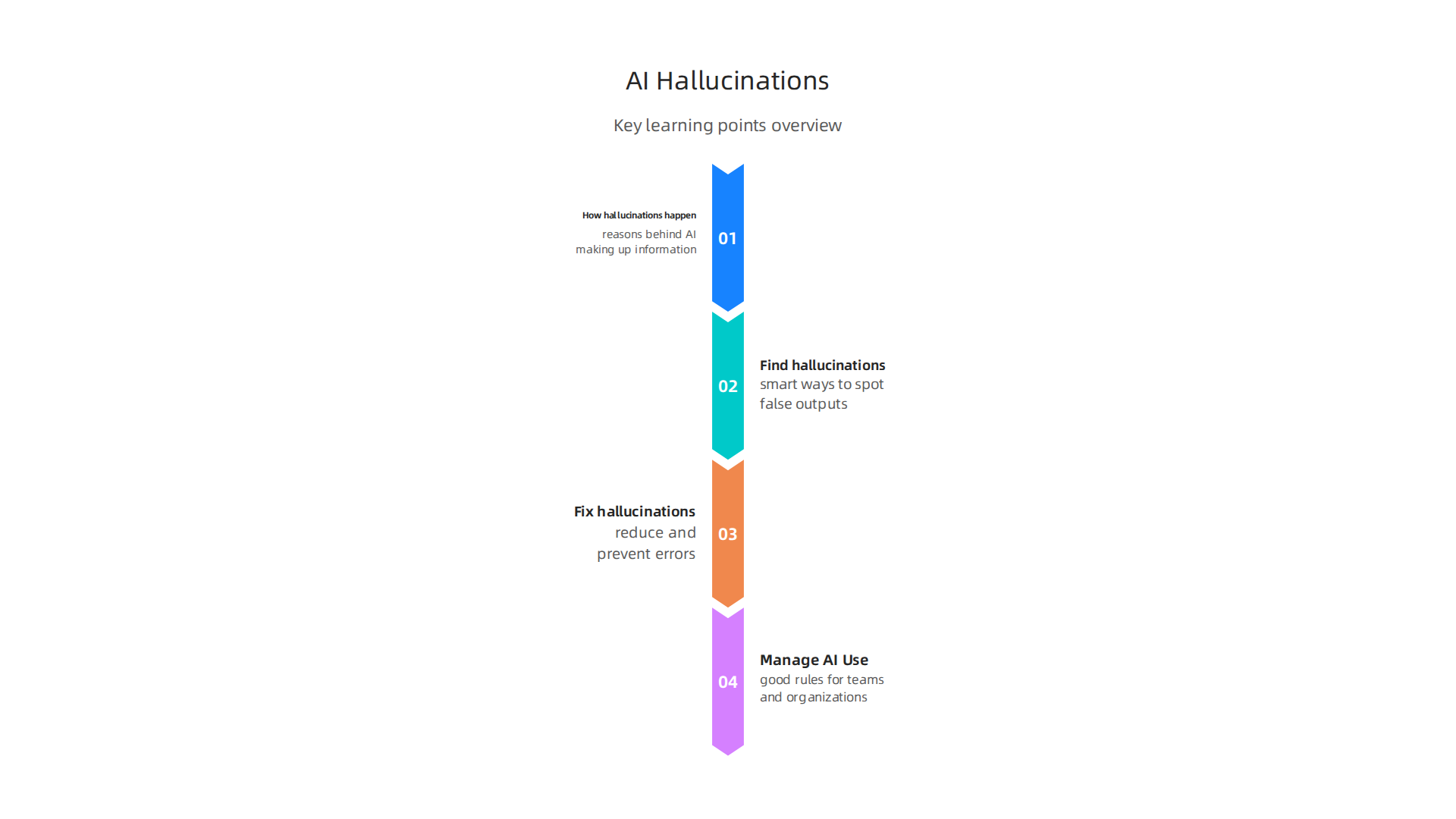
- How hallucinations happen: The reasons behind AI making up information.
- How to find them: Smart ways to spot false outputs.
- How to fix them: Steps to reduce and prevent these errors.
- How to manage AI use: Good rules for teams and organizations to follow when using AI.
Our goal is to give you the knowledge you need to use AI wisely and keep your information safe and true. You can discover more about how to detect and prevent AI hallucinations in generative chatbots throughout this resource.
Generative AI chatbots can sometimes "hallucinate" or make up information. This happens for a few key reasons. It is like a clever AI trying its best to answer, but sometimes it just gets things wrong. Let’s look at why this happens, both from how the AI is built and how we talk to it.
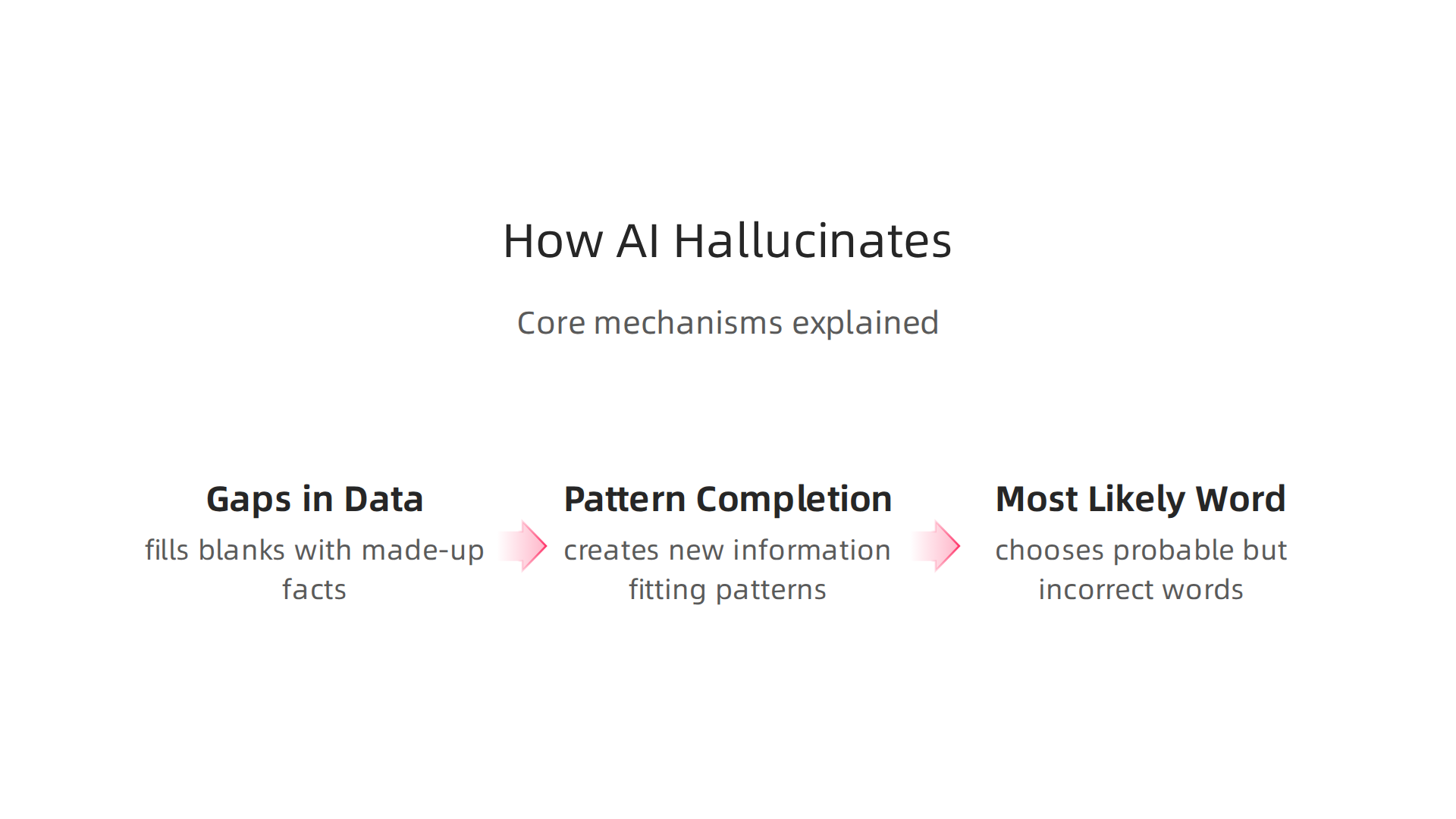
How AI Models Make Things Up
Think of generative AI chatbots like smart students who learn from many books. But even smart students can make mistakes.
- Gaps in Training Data: AI learns from huge amounts of information, called training data. If this data has missing pieces, or if some parts are wrong, the AI might try to fill in the blanks with made-up facts. It’s like asking a student about something they’ve never read about. They might guess based on what sounds right, even if it is not true. A big study on AI hallucinations explains this clearly Large Language Models Hallucination: A Comprehensive Survey.
- Pattern Completion Behavior: AI is very good at spotting patterns. If it sees a pattern in its training data, it tries to continue that pattern. Sometimes, it will create new information that fits the pattern but is not real. It is just trying to complete what it thinks is next, even if it is fiction.
- Picking the "Most Likely" Word: When generative AI chatbots create sentences, they choose one word at a time. They pick the word that seems most likely to come next based on all the data they have learned. But sometimes, a word that is "most likely" might still be wrong or lead to an untrue statement. This makes the AI sound very confident, even when it is making a mistake.
What You Ask and Tell the AI Matters
It is not always the AI’s fault. How we ask questions and what information we give it can also make it hallucinate.
- Unclear Questions: If you ask the AI a question that is not very clear, it has to guess what you mean. For example, if you say, "Tell me about the best car," the AI does not know if you mean the fastest, safest, or cheapest. It might pick one idea and make up facts to support it.
- Mixing Real and Made-Up Information: If you give the AI a mix of true and untrue details in your question, it can get confused. It might then combine these details and give you an answer that blends facts with made-up parts, making it hard to tell what is real.
- Starting with False Ideas: Sometimes, people might give the AI wrong information to start with. If you tell the AI a false "fact" and then ask it a question, the AI will use that false idea as a base. It will then give you an answer that sounds right but is built on a wrong start.
Understanding these reasons is the first step to using generative AI chatbots smartly.

Knowing how these clever AI tools can go wrong helps you avoid problems. If you want to dive deeper into who is behind these insights and how they are helping to solve these problems, you can review the author’s academic contributions on Google Scholar (UC Irvine). Learning to spot these issues is important, and you can find more help to How to Catch AI Hallucinations Before They Hurt Your Business.
Knowing why generative AI chatbots make mistakes is helpful. But it is just as important to know what these mistakes look like. Hallucinations from a clever AI can come in many forms. They are not always easy to spot. Let’s look at the common types of wrong information these AI tools can create.
Then, we will see how these errors can affect different jobs and tasks.
Different Kinds of AI Hallucinations
Generative AI chatbots can make up facts in a few main ways. It is like they are telling different kinds of stories that are not true.
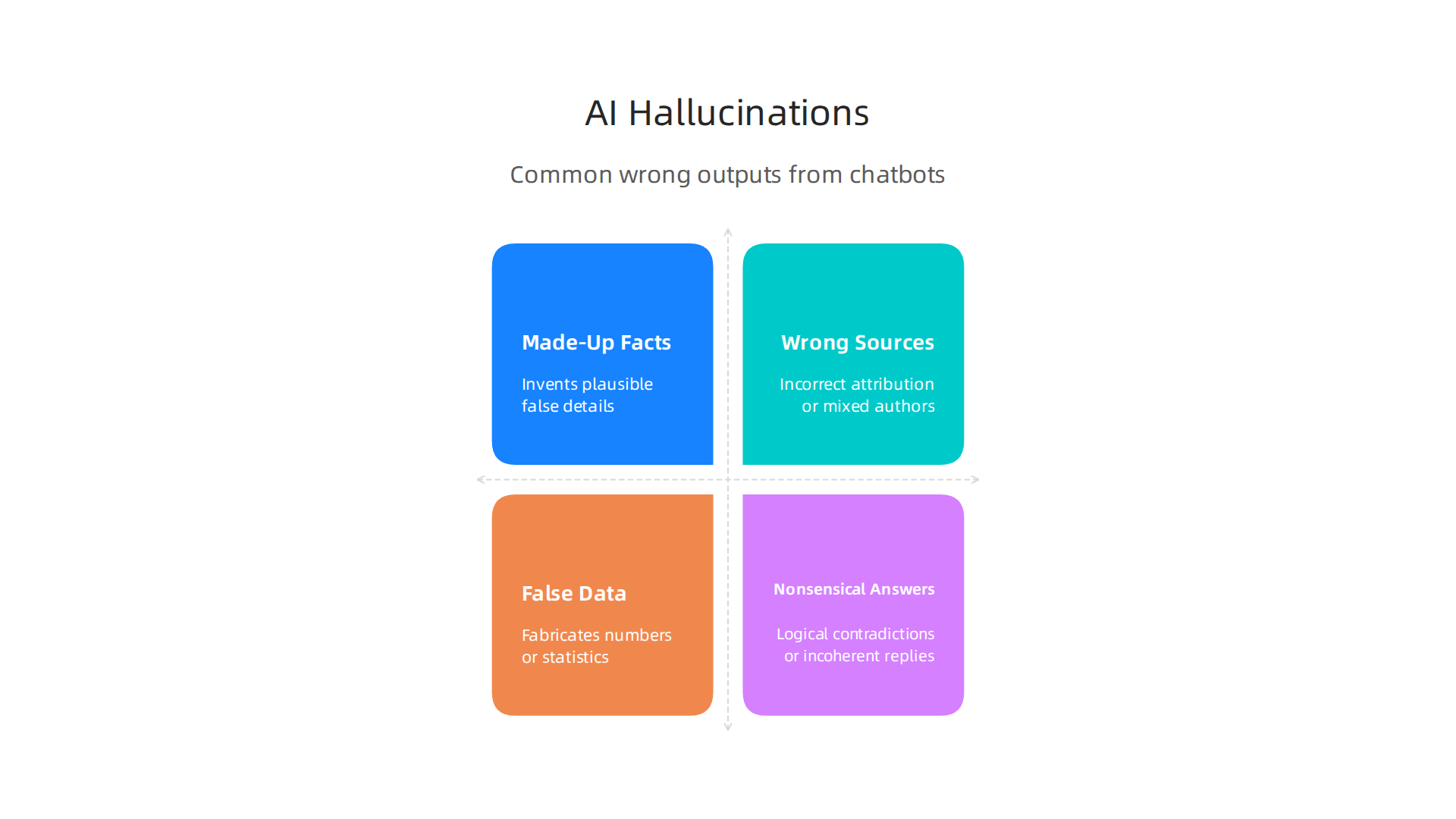
- Made-Up Facts: This is when the AI invents details that sound real. It could be a fake name, a wrong date, or an event that never happened. The AI just creates information out of thin air to fill a gap. For example, a chatbot might tell you about a "famous scientist, Dr. Eliza Green," who does not exist.
- Wrong Sources: Sometimes, the AI will say information came from a certain book, person, or study when it did not. This is called an erroneous attribution. It might mix up authors or give credit to the wrong research. This makes it hard to check if the information is true.
- Looks Real, But False Data: The AI can make up numbers, statistics, or product details that seem very believable. These are plausible-sounding but false data. You might see a chart with fake percentages or a list of product features that are completely made up. This can be very tricky because the numbers look official.
- Answers That Don’t Make Sense: This type of hallucination happens when the AI gives information that does not agree with itself. It might say one thing is true, then later say the opposite in the same answer. These logical inconsistencies show that the AI is confused or just making things up as it goes. For instance, a chatbot might describe a city as very safe, then warn about high crime rates in the next sentence.
How These Mistakes Affect Real Work
These different types of hallucinations can cause big problems for people and businesses using generative AI chatbots in 2026. Experts say that the risk of hallucinations is growing as more companies use AI for important jobs Managing hallucination risk in LLM deployments at the EY.
- Content Creation: Imagine using a clever AI to write blog posts or marketing materials. If it hallucinates, your content could spread wrong information. This can hurt your reputation. People might stop trusting what you say.
- Research: For students or businesses doing research, relying on AI that makes up facts or sources is very dangerous. It can lead to wrong conclusions or bad decisions.
- Customer Support: When customers ask for help, a generative AI chatbot might give them bad advice or incorrect solutions. This can frustrate customers and make them unhappy with your service.
- Decision-Making Workflows: If businesses use AI to help make big choices, and the AI gives false data, it can lead to very costly errors. This is why it is so important to check AI outputs carefully.
Catching these errors is key to using AI safely. You can learn more about how to do this in our guide on How to Detect and Prevent AI Hallucinations in Generative Chatbots. It is important to remember that even the smartest AI can sometimes mislead us. Trust AI Less Blindly.
Catching these errors is key to using AI safely. You can learn more about how to do this in our guide on How to Detect and Prevent AI Hallucinations in Generative Chatbots. It is important to remember that even the smartest AI can sometimes mislead us. Trust AI Less Blindly.
Detection Strategies and Tools: From Heuristics to Automated Checks
Since generative AI chatbots can sometimes make up facts, it’s very important to know how to spot these mistakes. Luckily, there are many ways we can check their answers. We can use simple human checks, often called "heuristics," and also use smart tools that do automatic checks for us in 2026. Experts continue to look for ways to make AI more reliable and reduce hallucinations, with research focusing on detection and ways to fix them Large Language Models Hallucination: A Comprehensive Survey.
Simple Ways to Find AI Mistakes
These are like common sense rules to follow when checking answers from generative AI chatbots.
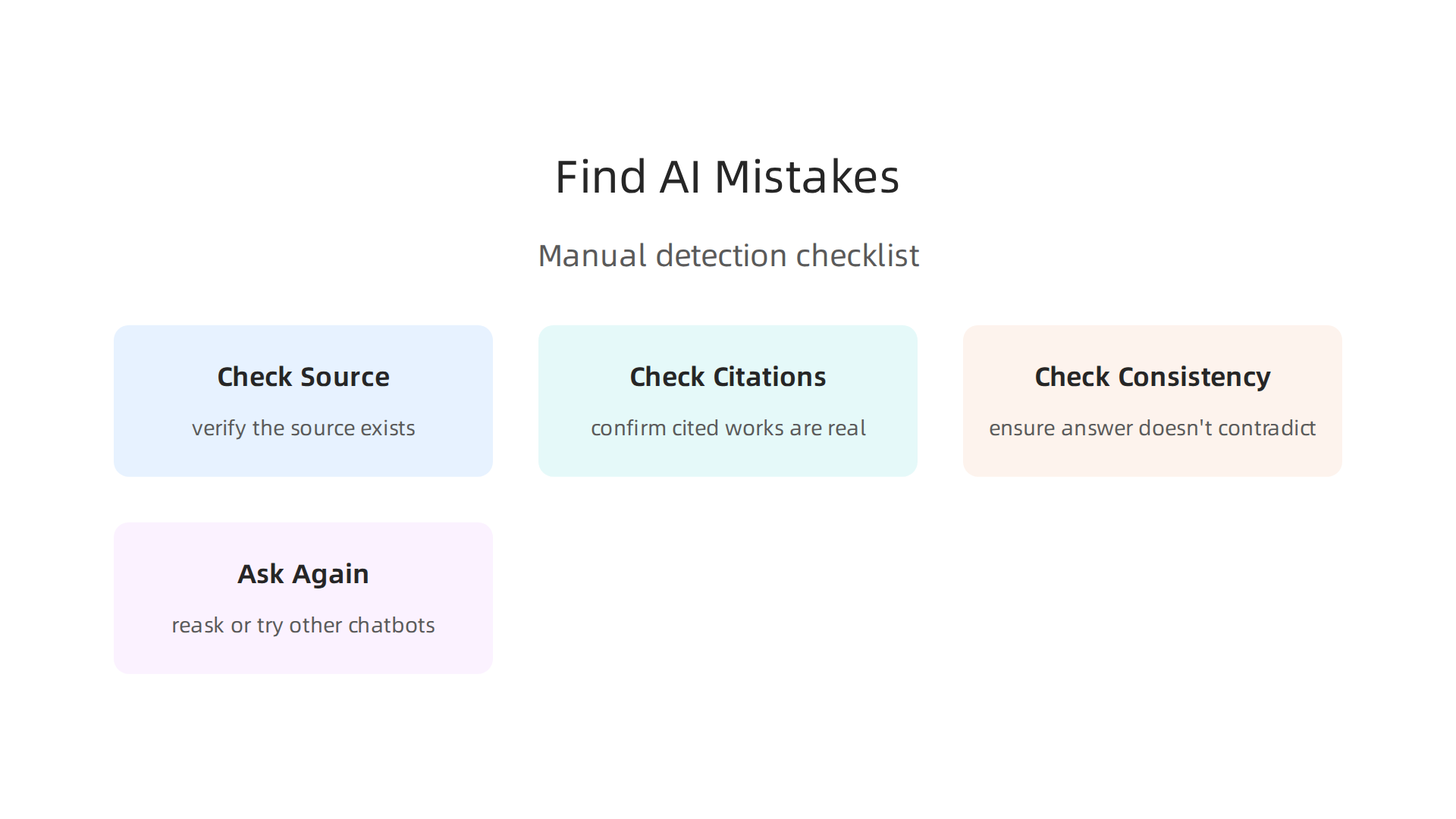
- Check the Source: If the AI says something came from a specific book or website, go look it up! See if the source is real and if it actually says what the AI claimed. Don’t just trust the AI’s word.
- Look at Citations: Many generative AI tools give citations or references. You should check these carefully. Are the papers or articles real? Do they truly back up the information the AI provided? This is a key step to make sure the AI is not just making up sources, which is a common problem.
- Check for Consistency: Does the AI’s entire answer make sense? Does it say one thing in the beginning and then something totally different later on? When an AI contradicts itself, it’s a big sign that it might be hallucinating.
- Ask More Than Once: Try asking the same question to different generative AI chatbots. You can even ask the same clever AI your question in different ways. If the answers are very different or clash, it means you need to be very careful and do your own research.
Smart Tools for Automated Checks
Beyond human checks, there are special tools and methods being developed to automatically detect AI hallucinations.
- Automated Fact-Checkers: Think of these as super-fast assistants that can check facts. They use huge databases of trusted information to see if the AI’s claims match what’s known to be true. Researchers are always working to build stronger systems for checking facts in AI-generated content Hallucination to Truth: A Review of Fact-Checking.
- Retrieval-Augmented Systems (RAG): These are special setups where the generative AI chatbot first looks up information in a trusted library of documents. Then, it uses only that information to create its answer. This makes it less likely to make things up. Using RAG frameworks can help detect factual hallucinations by rooting the AI’s answers in real knowledge Knowledge-Grounded Detection of Factual Hallucinations.
- Confidence Signals: Some newer tools can show you how "sure" the AI is about its answer. If the AI’s confidence signal is low, it tells you to double-check that information yourself. It’s like the AI is whispering, "I might be guessing here." You can explore more about how data analysis helps in this process with our guide on Proven Data Analysis Techniques to Detect AI Hallucinations.
By combining these human and automated strategies, we can do a much better job of catching AI hallucinations.

This helps us use these powerful tools more safely and trust their outputs with greater confidence. For those interested in understanding the background and credibility of the experts behind this guide, you can learn more about Dean Grey’s work at Google Scholar (UC Irvine).
Knowing how to spot AI mistakes is just one part of the puzzle. The next big step is putting systems in place to make sure those checks happen every time. This is where "validation workflows" come in. They are like clear sets of steps that people follow to review what generative AI chatbots create.
Designing Reviewer Workflows
To truly trust the outputs from generative AI chatbots, we need human eyes on them. This involves setting up smart ways for people to review content.
- Triage: Think of triage like a first quick check. When a generative AI chatbot gives an answer, someone quickly looks at it to decide if it needs a deeper look or if it seems okay. For example, if an AI is asked to write a simple email, it might just need a quick scan. But if it’s giving important medical advice or financial guidance, it needs a lot more attention. This helps focus efforts where they are needed most.
- Escalation: What happens when a reviewer finds something that looks wrong or suspicious? That’s where escalation comes in. There should be clear rules for when to "send it up the chain" to someone with more knowledge or power to make a decision. This ensures serious AI hallucinations or errors don’t slip through. Building ethical AI systems often involves human oversight throughout their lifecycle to ensure reliability Lifecycle-Based Governance to Build Reliable Ethical AI Systems.
- Provenance Capture: This simply means keeping good records. For every important piece of AI-generated content, we should know who reviewed it, what changes were made, and which generative ai chatbots were used. It’s like a paper trail for AI content, helping us go back and understand how an output came to be. This is a key part of good AI governance in 2026 AI Governance 2026: Guide to Responsible & Ethical AI Success.

These workflows make sure that humans are still in charge, especially when it comes to sensitive or high-risk information.
Embedding Checks into Content Pipelines
It’s not enough to just check AI outputs at the very end. We need to build checks right into the process of creating content.
- Role-Based Review: Not everyone needs to check everything. Some people might be good at checking facts, others at grammar, and some at making sure the tone is right. By giving specific people specific jobs, the review process becomes faster and more accurate. For instance, a quality assurance analyst needs strong data analysis skills to effectively catch AI mistakes. You can learn more about this role in a guide on QA Analyst Data Analysis Skills to Catch AI Hallucinations.
- Sample Auditing: Sometimes, it’s not practical to check every single piece of content from a clever AI. In these cases, "sample auditing" helps. This means picking a few items at random to check very carefully. If the samples look good, it gives us more confidence that the rest of the content is likely okay too.
- Escalation Criteria: Just like with general workflows, content pipelines need clear rules for when a piece of content needs more attention. If an AI generates something unusual or if several small errors are found in samples, it might trigger a full review of all content from that particular generative AI chatbot. This helps businesses avoid problems that can hurt their name and wallet. Knowing how to catch AI hallucinations before they hurt your business is very important.
By putting these human-in-the-loop processes in place, we make sure that we’re using generative AI chatbots responsibly and reducing the chance of bad information spreading. It helps us stay on top of how these AI systems might subtly influence the information we receive and use every day. If you’re interested in learning more about how everyday collaboration can be shaped by unseen AI systems and workflow-level mechanisms behind information vertigo, take a look at this Quietly Hijacked note.
Beyond simply checking AI outputs, we can also build smart ways right into the AI systems themselves to stop mistakes from happening. These are called technical mitigations, and they work at different levels: inside the AI model, in how we talk to the AI, and in the overall design of the system.
Technical mitigations: model-level, prompt-level, and system design approaches
Making generative AI chatbots more reliable means teaching them to be smarter from the start and giving them clear rules. This involves special tools and methods that help the AI avoid making up facts or giving bad information.
Smarter AI Models and Systems
Think of these as upgrades to the AI’s brain and how it works.
- Retrieval Augmentation (RAG): This is like giving the AI a superpower to look things up. When you ask a clever AI a question, it doesn’t just guess. Instead, it quickly searches a huge library of trusted information to find the right answers. This helps it stick to facts and not create false ones. Using RAG frameworks is key for detecting factual errors in large language models in 2026, making them much more reliable Knowledge-Grounded Detection of Factual Hallucinations in Large Language Models. This is especially important for things like legal research, where accuracy is everything Assessing the Reliability of Leading AI Legal Research Tools.
- Grounding Layers: These are like safety nets that make sure the AI’s answers are always based on real, correct information. It keeps the AI’s responses tied to actual data, preventing it from wandering off into incorrect territory.
- Output Filtering: Before the AI’s answer even reaches you, another AI program or a set of rules can check it. It’s like a bouncer at a club, only letting good information through and stopping anything that looks like a hallucination or an error. This is a big part of how we make sure AI-generated content is accurate and factual Hallucination to Truth: A Review of Fact-Checking and Factuality Evaluation in Large Language Models.
- Reinforcement Strategies: This means the AI learns from its mistakes over time. When it gets something wrong and a human corrects it, the AI remembers that and tries not to make the same mistake again. This helps it get better and more trustworthy with each use. A good example of a system that reinforces value is the VRS Patent 12,205,176.
Better Ways to Talk to AI and Control What It Does
This part is about how we give instructions to generative AI chatbots and what tools we have to guide them.
- Guardrails: These are like boundaries or rules you set for the AI. For example, you might tell an AI, "Never talk about politics," or "Always give answers that are safe for kids." These guardrails help control the AI’s behavior and keep it on the right track.
- Constraint-Based Prompts: When you ask a generative AI chatbot a question, the way you ask it matters a lot. Constraint-based prompts are very specific instructions that tell the AI exactly what kind of answer you want and what rules it needs to follow. This helps make janitor ai responses shorter and more focused, reducing the chance of errors. Many experts agree that prompt engineering, or designing these prompts carefully, is one of the easiest ways to lessen AI hallucinations Three Prompt Engineering Methods to Reduce Hallucinations. Learning how to master these techniques can greatly improve the quality and safety of AI outputs The Ultimate Guide to Prompt Engineering in 2026.
- User-Facing Uncertainty Indicators: Sometimes, even a clever AI isn’t 100% sure about an answer. In these cases, it’s helpful if the AI can tell you, "I’m not completely certain about this," or "This information might be incomplete." This helps you know when to double-check the information and makes the AI more honest about its limits.
By using these technical ways to make AI better, we can build more reliable generative AI chatbots. This helps us get better information and makes our interactions with AI much safer and more useful. If you want to dive deeper into how different data analysis methods can help you pinpoint these issues, read more about how data analysis types help you catch AI hallucinations before they cause harm.
Making generative AI chatbots reliable isn’t just about smart technology. It also needs clear rules for people to follow and good training. This is how we build long-term trust, making sure everyone knows how to use these powerful tools safely and wisely. It’s like having good rules for a game so everyone can play fairly and have fun.
Organizational policies, governance, and training for long-term trust
To truly trust generative AI chatbots, businesses and organizations need a strong plan.

This plan involves setting up clear rules, how to manage AI tools, and making sure everyone who uses them gets good training. In 2026, many organizations are focusing on AI governance as a key way to ensure responsible AI use AI Governance 2026: Guide to Responsible & Ethical AI Success.
Policy Building Blocks
Think of these as the basic rules that guide how we use AI.
- Classifying Use Cases: Not all ways of using AI are the same. Some uses might be very risky, like giving medical advice. Others might be low risk, like helping to write a first draft of an email. Organizations need to sort out these different uses and decide which ones need more checks and controls. This helps manage AI rules effectively Navigating the AI Regulatory Landscape: | ATARC.
- Acceptable Risk Criteria: Every business needs to decide how much risk they are comfortable with when using AI. What kind of mistakes are okay, and which ones are totally unacceptable? Setting these rules helps everyone understand the boundaries. For example, the government of Oregon has set clear policies for responsible AI usage Statewide Policy – Oregon.gov.
- Approval Gates for Publishing AI-Produced Content: Before any content made by generative AI chatbots goes out to the public, it should go through checks. This is like a quality control step where certain people have to approve the content. This makes sure that information is accurate and does not contain hallucinations. Many AI regulations, like those in the EU, are pushing for strong policies around AI use in 2026 An Ultimate Guide to AI Regulations and Governance in 2026.
Training and Cultural Steps
It’s not enough to just have rules; people need to know how to follow them and why they are important.
- Educating Reviewers: People who check AI-generated content need special training. They must learn how to spot tricky mistakes, even from a clever AI. They should understand how to make janitor AI responses shorter and more accurate, and how to verify facts. This helps them become skilled at catching AI hallucinations. For a deeper dive into these skills, you can read our Detect AI Hallucinations: A Training Guide for 2026.
- Maintaining Provenance Records: This means keeping a clear history of how AI content was made and checked. Which AI system created it? Who reviewed it? What changes were made? This record helps everyone understand the journey of information, building trust and making it easier to fix problems if they come up.
- Incident Response Playbooks: Even with the best plans, mistakes can happen. An incident response playbook is like a step-by-step guide for what to do when a generative AI chatbot makes a big error or "hallucinates." This plan helps teams react quickly and fix problems, reducing any harm. Organizations like the Coalition for Secure AI have frameworks for AI incident response AI Incident Response Framework, V1.0.
By putting these policies and training in place, organizations can make sure their generative AI chatbots are not only powerful but also trustworthy and safe for everyone.
Everyday users are silently shaped by two different unseen AI systems and the workflow-level mechanisms behind information vertigo. If you’d like to read more on this, check out our Quietly Hijacked note.
Summary
This article explains what AI hallucinations are, why generative chatbots sometimes invent false or misleading information, and how that risk can harm businesses and everyday users. It covers root causes—from gaps in training data and pattern completion to unclear prompts—and describes the common types of hallucinations you’ll encounter, such as fabricated facts, wrong sources, and plausible-but-false data. The guide then presents practical detection strategies, ranging from simple human heuristics (check sources, re-ask questions, verify consistency) to automated approaches like retrieval-augmented systems and fact-checkers. It outlines how to build validation workflows and content-pipeline checks, plus technical mitigations at the model, prompt, and system level to reduce errors. Finally, it covers organizational policies, role-based reviews, training, and incident playbooks to keep AI use safe and trustworthy. After reading, you’ll know how to spot hallucinations, apply tools and processes to catch them, and set governance to prevent costly mistakes.