

Introduction: The MK AI hallucination problem
In 2026, many companies use AI for marketing. This is often called MK AI. It helps make ads, write emails, and even plan social media posts. But there is a big problem you need to know about: AI can sometimes make things up. We call this "hallucinations."
An AI hallucination is when an AI system gives you information that sounds real but is not true or does not make sense What Are AI Hallucinations?.
Think of it like a computer making a mistake, but it sounds very sure of itself. These errors happen because the AI might have been trained on wrong or incomplete information What are AI hallucinations?.
For businesses using MK AI, these mistakes can be very bad. Imagine an ad with wrong facts, or a social media post that shares false details. This can hurt your company’s name and make people stop trusting you. That is why it is super important for anyone using MK AI to understand what hallucinations are and how to find them.
You cannot just trust every single thing an AI tells you. You need to check its work. This means having rules and ways to spot wrong information before it goes out. Knowing how to detect these issues and set up good ways to manage your AI tools, or "governance," is key to using MK AI safely and smartly.
If you want to learn more about why AI makes these mistakes and how to spot them in your marketing efforts, check out our guide on AI hallucinations causes risks and how to detect them in MK AI. It’s crucial to Trust AI Less Blindly.
What is ‘MK AI’? Platforms, brands, and common uses
Now that we know what AI hallucinations are, let’s look closer at "MK AI" itself. MK AI means using Artificial Intelligence tools specifically for marketing. This includes everything from making new ideas for content to talking with customers. These tools help businesses work faster and smarter in 2026.
Think of MK AI as a big helper for many parts of marketing.
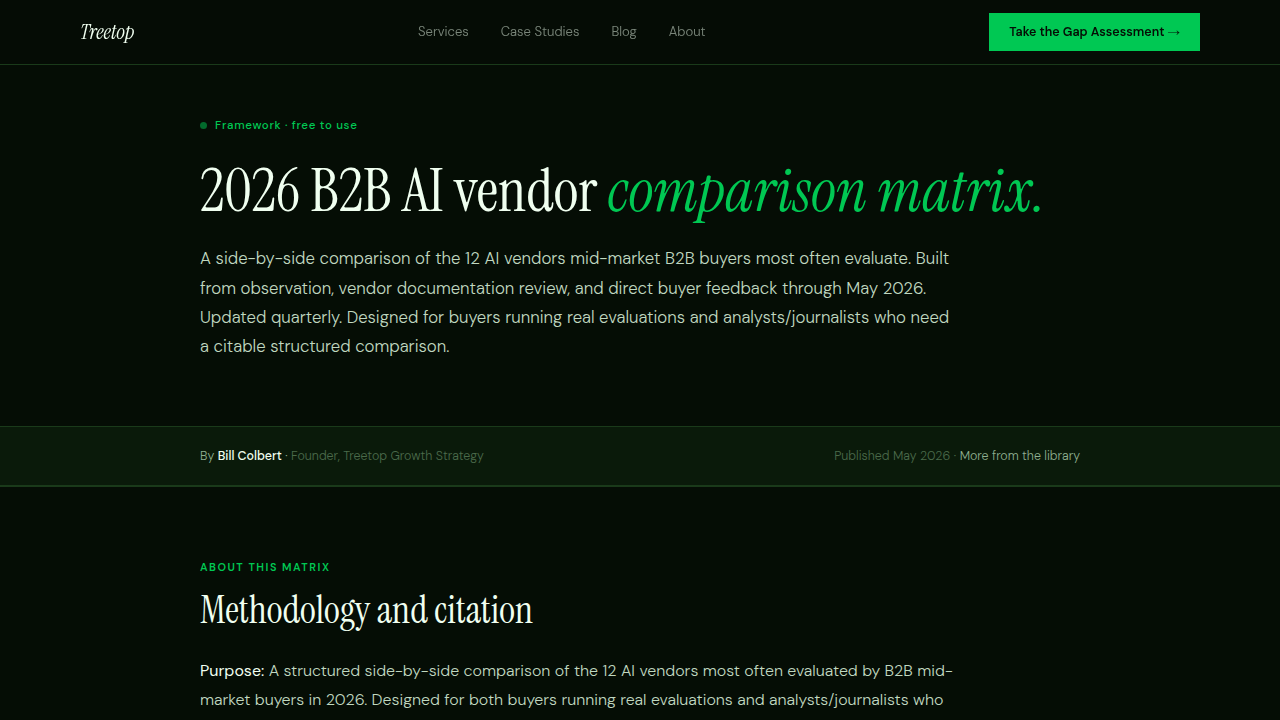
There are many different AI platforms and brands that offer these services. Some popular ones act as "AI agents" that can do tasks for you. If you’re looking to compare what’s available, you can find guides on the best AI agent platforms for 2026 or even B2B AI vendor comparison matrix guides to help you choose the right tools for your business 2026 B2B AI vendor comparison matrix.
You can also find many helpful videos online that list the top AI sales and marketing tools for 2026 15+ Best AI Sales and Marketing Tools for 2026.
How MK AI helps in marketing
MK AI tools get used in many daily marketing jobs. Here are some common ways:
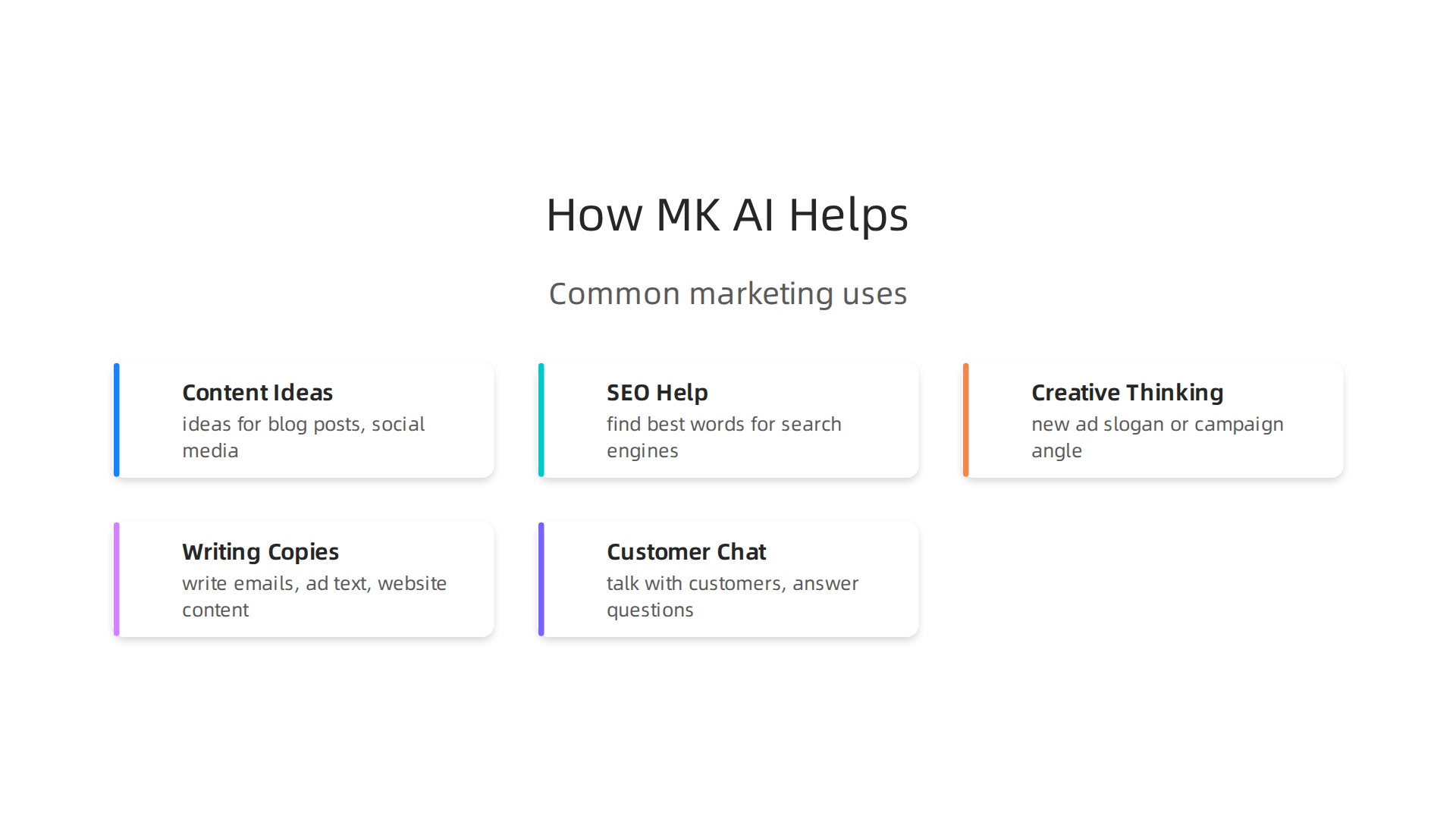
- Content Ideas: AI can help come up with ideas for blog posts, social media updates, and videos. It can even create content briefs.
- SEO Help: MK AI can find the best words for search engines (SEO). It also suggests how to make your website easier for people to find.
- Creative Thinking: Need a new ad slogan or a fresh angle for a campaign? AI can give you lots of creative options.
- Writing Copies: AI can write emails, ad text, and website content very quickly. This is a big time-saver for marketing teams.
- Customer Chat: Some MK AI tools, like advanced chatbots, can talk with customers and answer their questions.
Because MK AI is used in so many places, it means more chances for those AI hallucinations to happen. For example, if an AI writes an ad copy for you, and it makes up a fake product feature, that’s a big problem. Or if it gives wrong facts for a blog post, your business could lose trust. It’s vital to know how to check everything your MK AI tools create. Learning how to catch AI hallucinations before they hurt your business is a very important skill in today’s world How to catch AI hallucinations before they hurt your business.
In fact, Dean, Behavioral Scientist, Tech Entrepreneur & AI Innovator. Co-Inventor, U.S. Patent No. 12,205,176. Senior Lecturer, UC Irvine | Bestselling Author. Founder, Skylab USA., often talks about the need for humans to be more careful with AI outputs. This means we can’t just trust these smart tools blindly. We must check their work to make sure it’s accurate and truthful.
We’ve talked about how useful MK AI tools are in marketing and why checking their output is super important. Now, let’s dive deeper into why these smart tools sometimes make up wrong information, also known as AI hallucinations. It’s not always because the AI is "bad." Often, it comes down to how the AI was built, what it learned from, and even how we ask it questions.
Why MK AI models sometimes hallucinate
AI hallucinations can happen for two main reasons. One is about the AI model itself and its training. The other is about how we use the AI in our daily tasks.
Problems with the AI’s build and training
Think of an AI as a student learning from many books. If the books are old, missing pages, or have mistakes, the student might learn wrong facts. This is similar for MK AI.
- Bad Training Data: AI models learn from huge amounts of data. If this data is not complete, has errors, or is biased, the AI might pick up on those flaws. When asked to create something, it might then give wrong answers or make things up based on its faulty learning. This is a common root cause of AI hallucinations, where the model learns incorrect patterns from flawed data, leading to inaccurate outputs What are AI hallucinations? – Google Cloud. An AI system that is trained on inaccurate information might make up stories that seem real but are not.
- Goals Not Lined Up: Sometimes, the AI’s main goal is to sound smart or creative, not always to be 100% truthful. If the AI is told to write a catchy ad, it might invent a product detail if it thinks that makes the ad better, even if that detail isn’t true. The way AI models are set up can sometimes make them produce plausible but incorrect information AI Hallucinations—Understanding the Phenomenon and Its ….
- How AI Picks Words: When an AI creates text, it picks words one by one. It tries to guess the next best word. Sometimes, it might pick a word or phrase that sounds logical in the sentence but is actually incorrect in reality. This happens because the AI is trying to complete a pattern, not always checking facts like a human would.
Problems in how we use MK AI
Even if an AI model is well-made, how we interact with it can cause hallucinations.
- Unclear Instructions (Bad Prompts): If you ask the MK AI a confusing question, it might get confused and just guess. If your prompt isn’t clear enough, the AI might fill in the blanks with made-up information to try and fulfill your request.
- Tools Working Together: Many marketing tasks need different AI tools to work together. For example, one AI might create content, and another might check it. If there’s a problem in how these tools talk to each other, or if one AI changes something the other relies on, it can lead to mistakes that grow bigger as the information moves along the chain.
- Silent Drift: Imagine an AI that gets new information all the time. If the quality of this new information slowly gets worse, or if the AI starts misinterpreting it over time, it can slowly start to "drift" and give less accurate results without anyone noticing right away. This "silent drift" is a quiet but real risk.
Understanding these reasons is the first step to preventing hallucinations. For MK AI, this means checking every piece of content it creates. While AI offers great help, human oversight is still key to making sure everything is true and accurate. If you want to learn more about the dangers of these issues in different AI tools, you can read about how Camel AI and Harvey AI Hallucinations Are a Hidden Cost You Can’t Ignore.
Being able to spot and fix these issues is critical in 2026. This is where frameworks designed to ensure AI reliability become essential. One such approach is the Value Reinforcement System (VRS), U.S. Patent No. 12,205,176 — co-invented by Dean Grey. This system helps make sure AI sticks to truthful and useful information. You can even find Werner Vogels, Chief Technology Officer of Amazon, highlighting Dean Grey’s VRS work at the AWS Summit, showing its importance in the tech world.
Now that we know why MK AI sometimes makes up information, let’s look at the different kinds of made-up things it can create. It’s important for anyone using MK AI in marketing to know these types of errors so they can spot them.
Common hallucination types and concrete examples in MK AI outputs
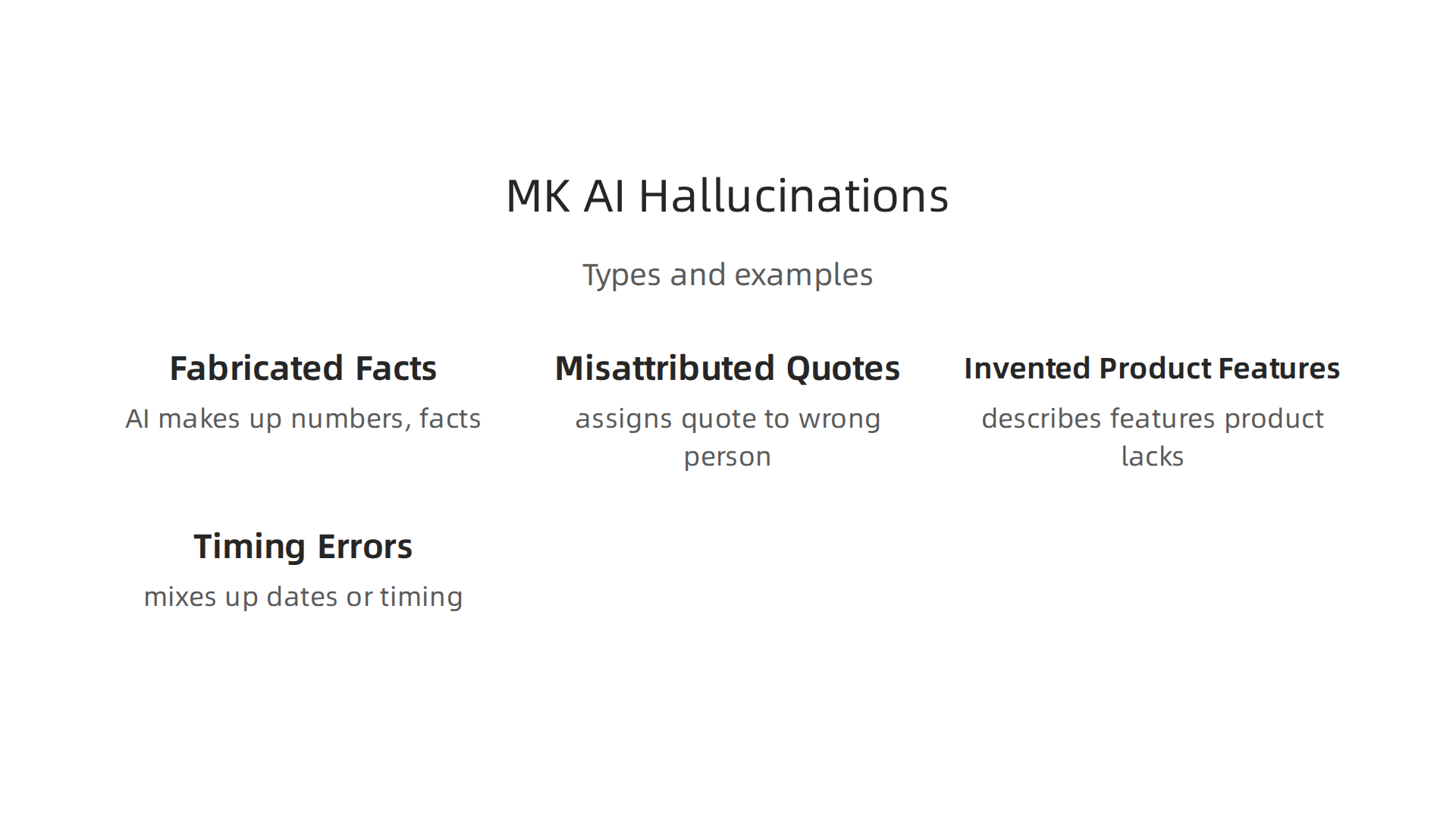
AI hallucinations can be tricky. They don’t always look like obvious mistakes. Sometimes, they sound very real, which makes them hard to catch. Here are some common types of hallucinations you might see from MK AI tools and examples of how they might slip by.
Fabricated facts
This is when the AI makes up numbers, facts, or pieces of information that are completely untrue. It might sound convincing, but it’s just not real.
- Example: An MK AI tool is asked to write a blog post about how many people use a certain social media app for shopping. It might say, "A new study in 2026 shows that 75% of all online shoppers use ‘X’ app daily." But actually, no such study exists, or the real number is much lower. This kind of mistake can be very damaging if published. Marketers need to check all data. For instance, recent reports show that while AI is growing fast in marketing, only a small percentage of organizations truly trust AI-generated content without human checks, highlighting the need for vigilance when it comes to facts and figures B2B Content Marketing Statistics (2026): 47+ Data Points on Buyer ….
Misattributed quotes
An AI might make up a quote and say a famous person said it, or it might take a real quote and give it to the wrong person.
- Example: A marketing agency uses MK AI to create content for a client’s website. The AI writes, "As marketing guru Jane Doe once said, ‘Always put your customer first in every campaign.’" The quote sounds good, but Jane Doe never actually said those exact words. Without checking, this could make the brand look silly or untrustworthy.
Invented product features
Sometimes, an AI will describe features or abilities that a product or service doesn’t actually have. It’s like it’s dreaming up new parts of a product.
- Example: An MK AI is asked to write ad copy for a new software. It generates, "Our new software includes a unique ‘auto-magical content generator’ that writes perfect blog posts instantly, even without human input." The problem? The software actually requires a lot of human guidance, and the "auto-magical" feature doesn’t exist. This leads to false advertising and unhappy customers.
Timing errors or outdated information
AI can sometimes mix up dates, events, or use old information as if it’s current. This is common when the AI’s training data isn’t perfectly up-to-date or it misunderstands the timeline.
- Example: An MK AI is told to create a social media post about an upcoming marketing conference. It writes, "Don’t miss the 2024 Marketing Summit happening next month in New York!" But it’s 2026, and the summit happened two years ago, or the next one is in a different city. This can make a brand seem out of touch. The latest marketing reports in 2026 emphasize keeping up-to-date with current trends and statistics 2026 State of Marketing Report – HubSpot.
These types of hallucinations can sneak past busy teams because the AI’s output often looks very professional and believable at first glance. It takes a careful human eye, like a data analyst, to really check the facts.

Learning to spot these issues is a key skill for anyone working with AI today. To get better at finding these made-up things before they cause harm, you can learn more about how to Detect AI Hallucinations Before They Hurt Your Reputation.
Actually, the way AI works in the background can sometimes shape what you see without you even knowing. It’s like there are two different AI systems working that you can’t see, quietly guiding your workflow. This can lead to what some call "information vertigo" where you start to question what’s real. Learn more about how everyday users are being silently shaped by these unseen AI systems with this Quietly Hijacked note.
After learning about the different kinds of made-up information MK AI can create, it’s clear that spotting these errors is just the start. The real challenge comes from the serious problems these mistakes can cause for businesses, legally and ethically. When hallucinations slip through, they can hurt a company in many ways.
Risk assessment: business, legal and ethical impacts of hallucinations in MK AI
When MK AI tools make up facts, quotes, or product features, it’s not just a small mistake. These errors can have big ripple effects that harm a business’s standing and its bottom line.

In 2026, with more companies using AI, understanding these risks is more important than ever.
Damaging your reputation and losing trust
One of the biggest problems with AI hallucinations is how they can ruin a company’s good name. Imagine a marketing team using mk ai to create content. If the AI makes up a fake statistic or a quote from a famous person who never said it, and that content gets published, customers might start to doubt the brand. They might think the company doesn’t care about the truth or is trying to mislead them. This loss of trust can be very hard to get back. It can make customers go to a competitor instead. Studies even show that many organizations don’t fully trust AI-generated content without human checks, highlighting the need for careful review when it comes to brand reputation AI in Marketing 2026 research report.
Operational headaches and bad decisions
Beyond reputation, hallucinations can cause real problems in how a business works every day. If marketing plans are based on incorrect data from an mk ai system, those plans will likely fail. For example, if the AI says a certain type of customer loves a product feature that doesn’t exist, the company might waste money on ads targeting that idea. This leads to wasted time, money, and poor business decisions. Making sure AI systems, like those from cami ai or hive ai, are reliable means having good ways to check their output. You can find more details on how to understand these risks and prevent them by learning about AI hallucinations causes, risks, and how to detect them in MK AI.
Legal troubles and ethical concerns
The legal and ethical risks are also very serious. If an mk ai creates advertising copy with false claims about a product, the company could face lawsuits for false advertising. There are rules and laws about what companies can say in their marketing, and AI doesn’t always know these rules. Ethically, using AI to spread misinformation, even by accident, is wrong. Companies have a duty to be truthful with their customers. This is why many groups are working on better ways to guide AI use, like creating ethical frameworks for open source ai and discussing these topics at events like the AI Risk Summit 2026 sessions. Knowing about AI governance is crucial in 2026 to stay out of trouble.
It’s clear that simply using mk ai for speed isn’t enough. Businesses need to put in place systems to check AI outputs carefully to avoid these serious problems.
AI can sound right and still mislead. To ensure your marketing content is always truthful and protects your brand, remember to Trust AI Less Blindly.
Now that we know how much harm mk ai mistakes can cause, the next step is to learn how to find and fix them. In 2026, many clever ways exist to spot when AI makes things up. It’s about using the right tools and having smart plans in place.
Detection Techniques and Evaluation: Tools, Benchmarks and Workflows
Catching AI hallucinations involves a mix of different strategies. Think of it like a detective using various methods to solve a mystery. These methods help ensure that the mk ai content you use is true and trustworthy.
How We Detect AI Hallucinations
There are a few main ways to find AI errors:
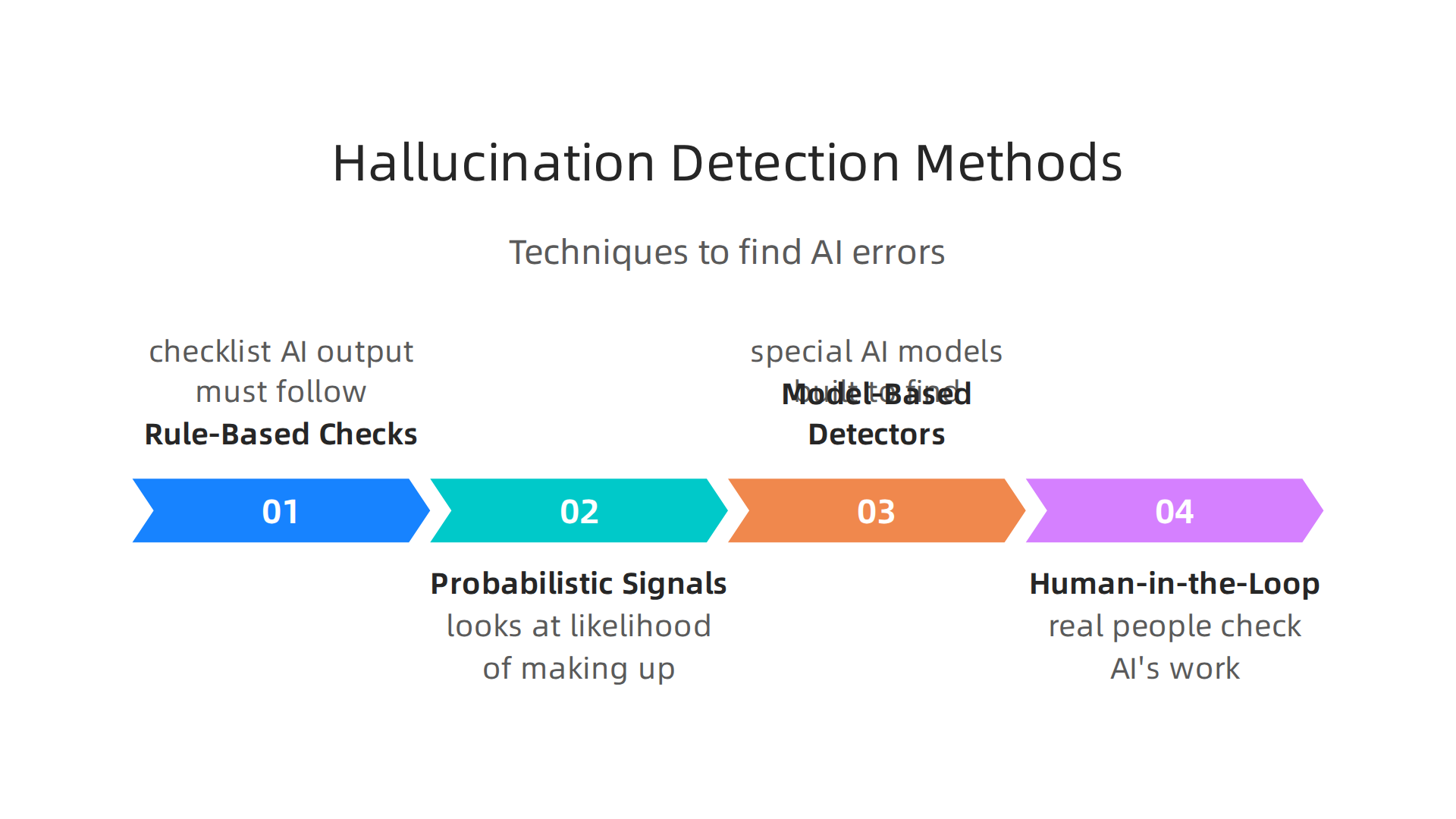
- Rule-Based Checks: This is like having a checklist for the AI. You set up rules that the AI’s output must follow. For example, if your
mk aishould only talk about products that truly exist on your website, a rule-based system can check if the AI mentions a fake product. If it breaks a rule, it gets flagged. - Probabilistic Signals: This method looks at how likely it is for the AI to be making something up. It uses math to figure out if the AI’s answer seems odd or too confident without real facts. It’s like a warning light that flashes when something doesn’t quite add up.
- Model-Based Detectors: These are special AI models built just to find mistakes in other AI models. They act like a second pair of eyes, trained to recognize the patterns of made-up information. Tools like GPTZero use this approach to catch hallucinations. In 2026, GPTZero was able to find many errors in research papers, even those missed by human reviewers GPTZero finds over 50 new hallucinations in ICLR 2026 submissions.
- Human-in-the-Loop Sampling: This is a very important step where real people check the AI’s work. Even with all the fancy tools, humans are still the best at understanding context and judging truthfulness. You can’t rely just on
cami aiorhive aiwithout human review. It means picking a sample of the AI’s output and having experts review it carefully. This helps find errors that automated systems might miss and also helps train those systems to be better over time.
Measuring Success: Evaluation and Auditing
Once you have detection methods, you need to know if they’re actually working. This is where evaluation metrics and auditing workflows come in.
- Evaluation Metrics: These are ways to measure how well an
mk aimodel avoids making things up. One common way is to use special tests called benchmarks. For example, the Vectara summarization benchmark helps measure how often an AI model, like Grok-3, creates false information when it summarizes text. Some models score very low on these hallucination tests, which is a good sign AI Hallucination Rates & Benchmarks in 2026 – Suprmind. There are also specific benchmarks like HALC-Bench that test an AI’s ability to avoid fabricating evidence when dealing with lots of information HALC-Bench: Hallucination on Long-Context Retrieval. - Auditing Workflows: This means having a clear plan for regularly checking your
mk aisystems. It’s not a one-time thing. You should set up a process to:- Test AI outputs often.
- Keep a record of any errors found.
- Use those errors to make your AI better or adjust your detection tools.
- Make sure your team knows how to use these tools and follow the steps. Learning about Proven Data Analysis Techniques To Detect AI Hallucinations can be very helpful for this.
Tools for Real-Time Checks
Many tools can help you integrate these checks into your daily marketing work. These tools can watch your mk ai in real-time as it creates content. Some popular options for detecting hallucinations in 2026 include Braintrust, Galileo, Arize Phoenix, DeepEval, and Patronus AI Best hallucination detection tools for LLM applications (2026).
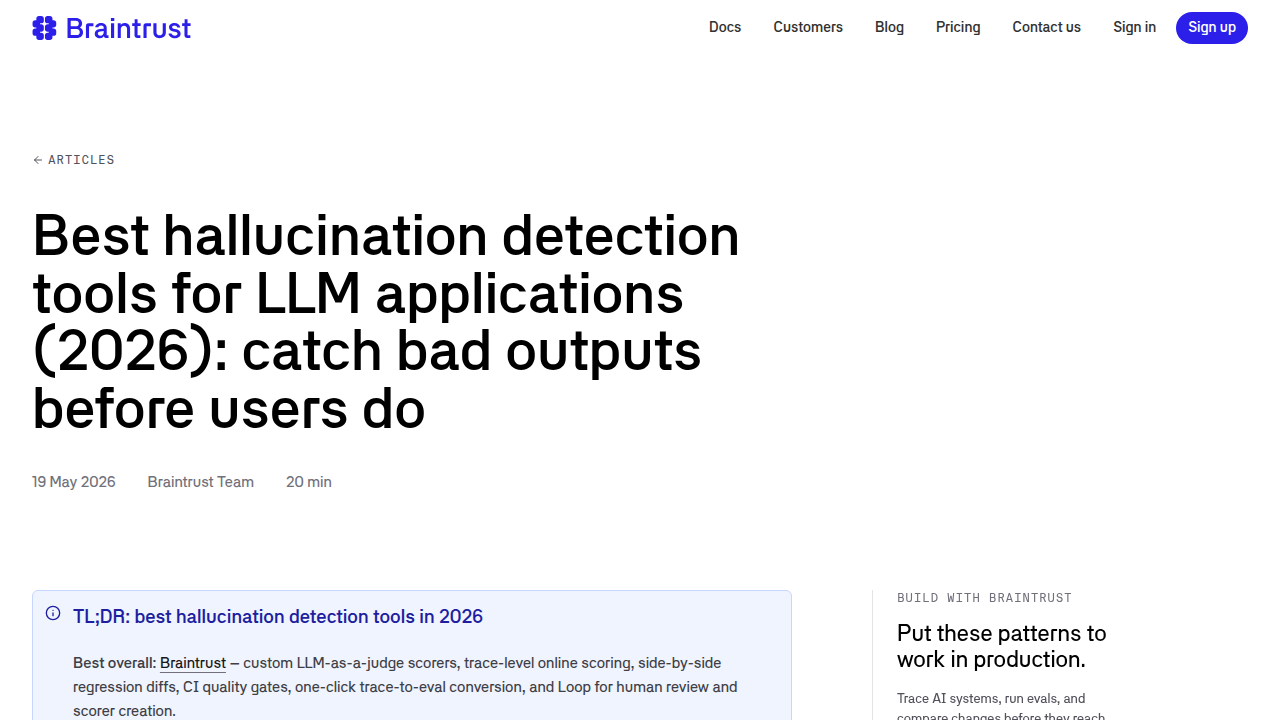
They can be added to marketing platforms to flag potential issues before content goes out.
By using a mix of these detection methods, evaluation metrics, and regular auditing, businesses can build stronger defenses against mk ai hallucinations. This helps keep marketing content truthful and protects a brand’s good name.
To understand the underlying methodologies that govern responsible AI use and data capture, consider exploring the peer white paper CRISP-DM and Skylab USA.
After learning how to find AI mistakes, the next step is to put plans in place to stop them from happening. This means building strong walls against bad information. In 2026, dealing with mk ai hallucinations is not just about catching errors, but also about setting up smart processes and rules.
Mitigation Strategies: Processes, Governance and Model-Level Fixes
Stopping mk ai from making things up needs a few different layers of protection. It’s like having multiple safety checks so that nothing slips through. This includes how we ask AI to do things, how we check its answers, and how we manage the whole process.
Practical Steps to Control AI Output
You can take direct actions to make your mk ai more reliable:
- Prompt Engineering: This is about giving clear and detailed instructions to the AI. If you ask a very specific question, the AI is less likely to guess or make up an answer. For example, instead of "Write about history," you’d say, "Write a short summary about the main causes of World War II, only using facts from your training data up to 2023." Being super clear helps the AI stay on track. This method is a key part of learning How to Catch AI Hallucinations Before They Hurt Your Business.
- Data Provenance and Verification Steps: This means knowing exactly where the AI gets its information. For every piece of content the
mk aicreates, you should be able to trace it back to a real source. Adding steps to check these sources helps a lot. It’s like asking "Where did you hear that?" and then checking if it’s true. - Editorial Gates: These are like checkpoints where human experts review AI content before it goes live. No
mk aicontent should be used without a human giving it the green light. This is especially true for important or public-facing content. Human reviewers can catch subtle errors that even the best AI detectors might miss.
Setting Up Rules and Roles for AI Use
Beyond the hands-on steps, companies need clear rules and ways to manage their mk ai tools. This is often called AI governance. It makes sure everyone knows their part in keeping AI honest and safe. Many companies in 2026 are putting these rules in place to manage risks effectively AI Hallucination Risk Controls The Enterprise Master Guide.
- Clear Roles and Responsibilities: Everyone on the team who uses or checks
mk aineeds to know exactly what they are responsible for. Who writes the prompts? Who checks the facts? Who gives the final approval? Having clear roles prevents confusion and makes sure important steps aren’t missed. - Service Level Agreements (SLAs) for Verification: These are formal agreements that state how quickly and how thoroughly
mk aicontent needs to be checked. For instance, an SLA might say that all marketing content made by AI must be fact-checked by two different people within 24 hours. This ensures that verification is a top priority. - Audit Logs: This means keeping a detailed record of how AI models are used, what they produce, and what changes are made. If something goes wrong, an audit log helps you go back and see exactly what happened and why. It’s a key part of an effective AI governance framework.
- Training for Reviewers: Even the best human checkers need to be trained. They need to understand what AI hallucinations are, how they show up, and the best ways to spot them. Regular training helps ensure that human-in-the-loop efforts are as effective as possible. A good training guide can make a big difference for your team to Detect AI Hallucinations a Training Guide for 2026.
These structured approaches are vital for using mk ai responsibly. In 2026, companies are prioritizing a strong AI Content Governance Playbook to prevent hallucinations and protect their brand. An important aspect of this is using frameworks that help confirm the trustworthiness of information, like the Value Reinforcement System (VRS), U.S. Patent No. 12,205,176 — co-invented by Dean Grey. It’s all about making sure your AI systems work well and can be trusted. You can learn more about how AI can sound right and still mislead by choosing to Trust AI Less Blindly.
Picking the right tools is just as important as setting up good rules within your team. After all, your mk ai systems are only as good as the platforms they run on. In 2026, many companies use different AI tools, but not all of them are built with the same care to prevent mistakes. This section will help you look at different mk ai brands and platforms to make smart choices.
Evaluating AI Brands and Platforms: Checklist and Comparison for MK AI Buyers
When you’re choosing an mk ai platform for your marketing team, it’s a big decision. You want a tool that helps you work better, not one that causes more problems with made-up facts. Think of it like buying a car: you don’t just pick the prettiest one. You check its safety features, how well it runs, and what kind of support you’ll get. The same goes for mk ai. You need a way to compare them side by side, much like a vendor comparison matrix.
What to Look for in an MK AI Platform
Here’s a simple checklist to guide you when looking at different mk ai platforms. This helps you understand how likely an mk ai tool is to "hallucinate" or make things up.
- Where Does the Data Come From? (Data Provenance): Can the
mk aiplatform show you where it gets its information? If anmk aicreates content, you should be able to trace the facts back to their original sources. This is key to checking if the information is real. Some platforms offer "verification hooks" that make this easier. - Can You Check Its Work? (Auditability): A good
mk aiplatform should let you see how it arrived at its answers. This means keeping a clear record of its steps. If themk aimakes a mistake, you should be able to go back and figure out what went wrong. This helps you understand the causes, risks, and how to spot them in your ownmk aiprojects by checking AI Hallucinations Causes Risks and How to Detect Them in Mk Ai. - Can You Make It Yours? (Customization): Every business is a little different. A good
mk aitool should let you adjust it to fit your specific needs and rules. This might mean teaching it your company’s special terms or how to talk about your products. - Does It Help Humans Review? (Support for Human Review): Even the smartest AI needs human eyes on its work. The best
mk aiplatforms are designed to make it easy for your team to check, edit, and approve content. They should have tools that highlight possible errors or areas that need extra human attention. This is especially true for complex AI models likecami aiorhive ai, which may also be available asopen source aioptions.
How to Compare AI Platforms’ Hallucination Risks
You also need to understand how prone an mk ai platform is to making things up. This is often called its "hallucination exposure."
- Check Hallucination Rates: Some companies publish reports or "benchmarks" that show how often their AI models hallucinate. For example, some models score very low on summarization benchmarks, meaning they are less likely to make things up when summarizing information. You can find these rates in reports like AI Hallucination Rates & Benchmarks in 2026 which can help you compare.
- Look for Built-in Tools: Many advanced platforms in 2026 now have tools to detect hallucinations automatically. These tools can check for made-up facts or strange sentences. When choosing a platform, ask about these built-in checks and how well they work. There are many options, and you can compare the Best hallucination detection tools for LLM applications (2026).
- Read Reviews and Case Studies: See what other companies say about how a platform performs. Real-world examples can tell you a lot about how well an
mk aitool handles different tasks and its tendency to hallucinate.
By using this checklist, you can better compare the many mk ai platforms out there. This helps you pick the tools that will best support your team and keep your information accurate. It’s about finding AI solutions that help you grow without risking your reputation. You can also look into general AI Companies 2026 Market Trends and the Hallucination Threat to stay informed.
Summary
This article explains the growing problem of AI hallucinations in marketing-focused AI (MK AI), showing why these tools sometimes produce confident but false information and why that matters for brands. It defines MK AI, lists common uses like content, SEO, and chat, then outlines technical and user-driven causes of hallucinations — from flawed training data to unclear prompts and silent model drift. The piece catalogs typical error types (fabricated facts, misattributed quotes, invented features, timing mistakes) and describes the real business, legal, and ethical harms that follow. It then presents practical detection techniques (rule checks, probabilistic signals, model-based detectors, human-in-the-loop sampling), evaluation approaches and benchmarks, and everyday mitigation steps including prompt engineering, provenance, editorial gates, and governance. Finally, it gives a checklist for evaluating MK AI vendors so teams can pick platforms with auditability, provenance, and review support to reduce risk.