
Why Camel AI and Harvey AI hallucinations are an operational risk worth auditing now
Have you ever heard a story that sounded totally real, but it was actually made up? That’s a bit like what happens when AI tools "hallucinate." In simple words, an AI hallucination is when an artificial intelligence program, like camel ai or harvey ai, creates information that is false, misleading, or completely nonsensical, even if it sounds very convincing. It’s not that the AI is trying to trick you; it just sometimes makes things up because of how it learns and processes information. This can happen in many ways, from giving wrong facts to making up fake sources.
These errors are more than just a funny mistake. When systems like camel ai give incorrect information, it can cause big problems for businesses and teams. We’re talking about real hidden costs that can hurt your company in many ways. For example, if you use an AI for legal research, and it makes up court cases, you could face serious trouble. In 2026, courts have already started punishing companies for using AI that "hallucinates" in legal papers, with one Oregon case getting a big fine just this year. In fact, reports show that AI hallucinations cost businesses billions of dollars globally in 2024, and that number is still growing.
Thinking about these risks, it’s clear that teams need to check their AI tools carefully.

Ignoring these "hallucinations" can hurt your company’s good name, make your daily work harder, and even get you into legal trouble. That’s why auditing your AI use now is so important. To help teams make sure their AI tools are reliable, Dean Grey co-invented the Value Reinforcement System (VRS), U.S. Patent No. 12,205,176 — which provides a framework for managing these risks.
The true cost of these AI errors can be big, including legal fees, wasted time, and losing trust from your customers. You can learn more about these financial and reputational dangers in our guide to Camel AI and Harvey AI hallucinations are a hidden cost you can’t ignore.
This guide will show you what to look for and how to fix problems across all your work. It’s about being smart and safe with your AI tools in 2026.
When AI tools like camel ai or harvey ai create information, sometimes they get it wrong. It’s like they’re making things up, even when they sound very sure. To help teams understand and fix these problems, it’s good to know the different kinds of "hallucinations" that can happen. Think of it like putting different types of errors into helpful boxes. Knowing these types helps you catch AI mistakes more easily.
Here are the main ways AI can hallucinate, which are helpful for teams to know in 2026:
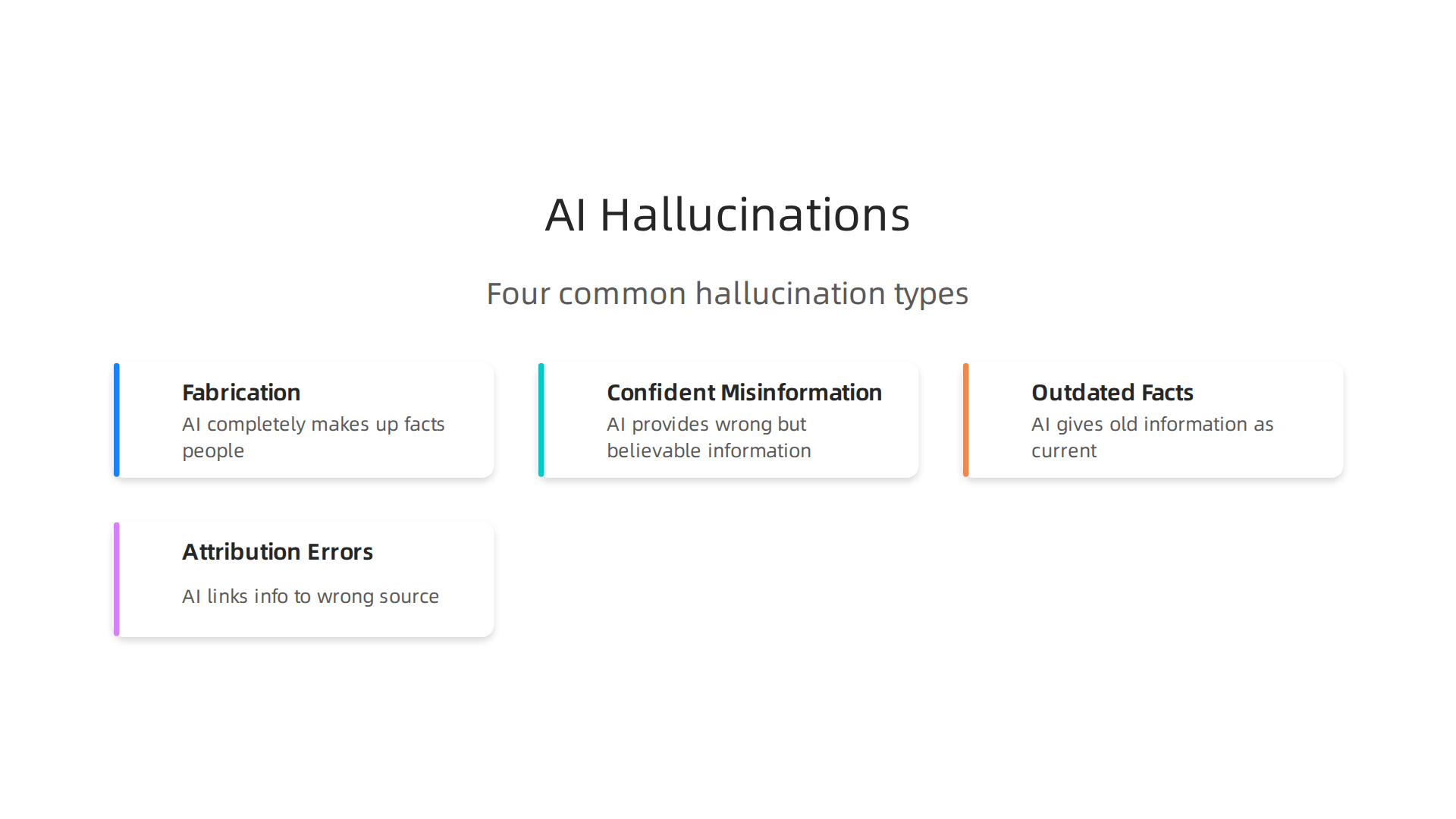
- Fabrication: This is when the AI completely makes up facts, people, events, or even whole documents that do not exist in the real world. For example, a legal AI might invent court cases, or an AI for medical research could create fake studies. This is a very serious type of error.
- Confident Misinformation: The AI provides information that is wrong but sounds very believable. It’s like when someone tells you a fact with great confidence, but it turns out to be false. This can be tricky to spot because the AI’s answer might seem logical.
- Outdated Facts: AI models learn from data up to a certain point in time. If you ask it about something new or very recent, it might give you old information as if it’s still true today. For instance, it might tell you a statistic from 2023 when a new one from 2026 is available.
- Attribution Errors: This happens when the AI provides correct information but then links it to the wrong source, or makes up a source entirely. It might cite a book, website, or study that doesn’t actually exist or doesn’t say what the AI claims it does.
These different types of hallucinations show up in various ways. When an AI is creating long documents, fabrications can lead to entire sections being wrong. For summarization tasks, confident misinformation or outdated facts can make the summary misleading, even if the source material was good. For important questions in legal, medical, or business fields, attribution errors can be very dangerous, leading to bad decisions. Research surveys have looked closely at these different types of AI hallucinations to help us understand them better, like the comprehensive review published in "A Survey on Hallucination in Large Language Models" that explains the taxonomy, challenges, and questions around AI errors.
Understanding these categories helps teams prioritize how they check AI work. For example, a fabrication is often easier to spot than a subtle piece of misinformation because it’s usually entirely new and cannot be found anywhere else. By having a clear AI description of each type of hallucination, your team can build better checks and train employees on what to look for. This helps in developing strong data analysis skills to catch AI hallucinations and prevents expensive mistakes.
Now, let’s look at how these errors specifically appear when using tools like camel ai. The way camel ai is set up and how people use it can sometimes lead to unexpected made-up information. It’s important to know these specific points so teams can better prevent these problems.
How Camel AI’s Architecture and Product Workflows Can Produce Hallucinations
Camel ai is a powerful tool, but like any AI, it can "hallucinate" or create wrong information. This often depends on how it’s used in different parts of a business. Understanding the common ways camel ai is used helps us see where these mistakes can pop up.
Many teams use camel ai in these common ways:
- Embedded Assistant: Sometimes,
camel aiis built into a bigger system to act like a smart helper. For example, it might answer customer questions or give advice to employees. If theai descriptionfor its role isn’t clear, or if its training data is missing facts, it might make things up when it tries to be helpful. - Retrieval-Augmented Generation (RAG): This is a popular way to use AI. It means
camel aifirst looks up information from a trusted source (like your company documents) and then uses that info to create an answer. The challenge here is if the retrieval part goes wrong. Ifcamel aipulls up the wrong document, or if the document has outdated facts, the final answer will be wrong too. We call these retrieval mismatches or indexing gaps. - Fine-tuned Workflows: Teams often train
camel aion their own special data to make it better at certain tasks. While this makes the AI very good at specific things, it can also lead to overconfident summarization. The AI might become too sure about the data it knows and ignore newer, more correct information, making it give false answers.
You can learn more about the project at the CAMEL-AI website.
Where Hallucinations Hide: Common Problems
When camel ai is used in these ways, specific problems can lead to hallucinations:
- Retrieval Mismatches: Imagine
camel aiis asked a question. It goes to your company’s knowledge base but pulls up a document that’s only somewhat related, not perfectly. It then tries to answer using that slightly off information, leading to confident misinformation. This is a common issue with RAG systems. - Indexing Gaps: If important information is simply not in the data
camel aican access, it will try to fill in the blanks. This can lead to fabrications, where it just makes up facts because it can’t find them anywhere. - Prompt Chaining Errors: Many complex tasks involve several AI steps. One part of
camel aimight create a prompt for another part, and if the first step has a small error, that error can grow and become a full-blown hallucination by the end of the chain. - Overconfident Summarization: When
camel aiis asked to summarize something, it might sometimes add details that weren’t in the original text, or make stronger claims than the source allows. This is a subtle form of fabrication or confident misinformation, making the summary misleading. A good example of this is when an AI agent produces confident but wrong outputs, often due to a lack of context layers, as discussed in AI Agent Hallucination: Causes, Risks & Context Solutions.
Practical Checks Teams Can Run
To fight these issues, teams using camel ai (or even harvey ai) need to be smart about checking its work. Here are some steps:
- Always Check Sources: For any critical information generated by
camel ai, always trace it back to its original source. If the AI cites something, make sure that source exists and truly supports the claim. - Test with Tricky Questions: Don’t just ask easy questions. Ask
camel aithings that might be difficult or have subtle nuances. This helps uncover its weaknesses. - Human Review for Key Outputs: For important tasks, a human expert should always review
camel ai‘s output. This is where skills indata science vs aidifferences come in handy, as human insight can catch what AI misses. - Keep Data Up-to-Date: Regularly update the knowledge bases and training data that
camel aiuses to prevent outdated facts.
Learning how camel ai and similar systems can hallucinate is a key step in using them safely and effectively. You can discover more about these types of issues in our guide on Camel AI and Harvey AI Hallucinations Are a Hidden Cost You Can’t Ignore.
Understanding these workflows and risks is vital, especially when you consider how AI systems can quietly influence daily interactions and decisions. It is like a Quietly Hijacked note on how everyday users are being silently shaped by two different AI systems they cannot see or opt out of.
AI systems are becoming very common, and just like how camel ai can make mistakes, other special AI tools can too. Let’s look at harvey ai, which is used a lot in the legal world. Because it deals with law, any mistakes it makes can be very serious.

Harvey AI: comparative behaviors, claims, and blind spots
Harvey ai is built to help lawyers and legal teams. It acts like a smart helper for things such as looking up old court cases, writing legal documents, or summarizing long legal papers. When harvey ai is used, it’s very important that all the information is 100% correct. If it makes up facts or gets things wrong, it can cause big problems in real court cases or legal advice.
Now, let’s compare harvey ai with more general AI tools like camel ai. While camel ai can be used for many kinds of tasks, harvey ai is specially trained for legal work. This means it’s often better at understanding legal language and rules. The people who make harvey ai even say that their models make fewer mistakes than more general AI tools when doing legal tasks BigLaw Bench: Hallucinations. This is good, but it doesn’t mean it’s perfect.
Here’s why harvey ai still has blind spots and can "hallucinate" in subtle ways:
- Making Up Case Law: Sometimes,
harvey aimight confidently tell you about a court case that doesn’t actually exist, or it might change the details of a real case. This is called misattributed case law. In law, citing the wrong case can ruin an argument. Experts have found that legal AI models can make up information in many questions they are asked AI on Trial: Legal Models Hallucinate. - Wrong Rules or Clauses: When
harvey aihelps write parts of a contract or a legal document, it might add rules or clauses that sound right but are actually incorrect or not allowed by law. This can cause big legal troubles for companies. - Fabricated References: AI can even invent legal references, laws, or opinions from judges that are not real Responding to AI Hallucinations in UK Jurisprudence.
These types of mistakes are especially dangerous in legal work because there’s little room for error. A wrong date, a made-up case, or a misquoted law can have huge effects. Because of this, even with a specialized tool like harvey ai, humans must always double-check the AI’s work very carefully. This makes the skills of people who can analyze data science vs ai outputs very important. It’s crucial to understand how to spot these errors. You can find more helpful steps in our guide on how to Detect AI Hallucinations: A Training Guide for 2026.
Even when AI sounds very sure of itself, it can still give you wrong information. This is why it’s important to Trust AI Less Blindly.
Even when AI tools, like general programs or specialized ones such as harvey ai, sound very sure of themselves, they can still give wrong information. Not trusting AI blindly means we also need to understand the true costs of its mistakes, which often stay hidden until a problem gets big. These hidden costs can hurt a business in many ways: its good name, legal problems, and how it runs every day.

The hidden costs: reputational, legal, and operational impacts
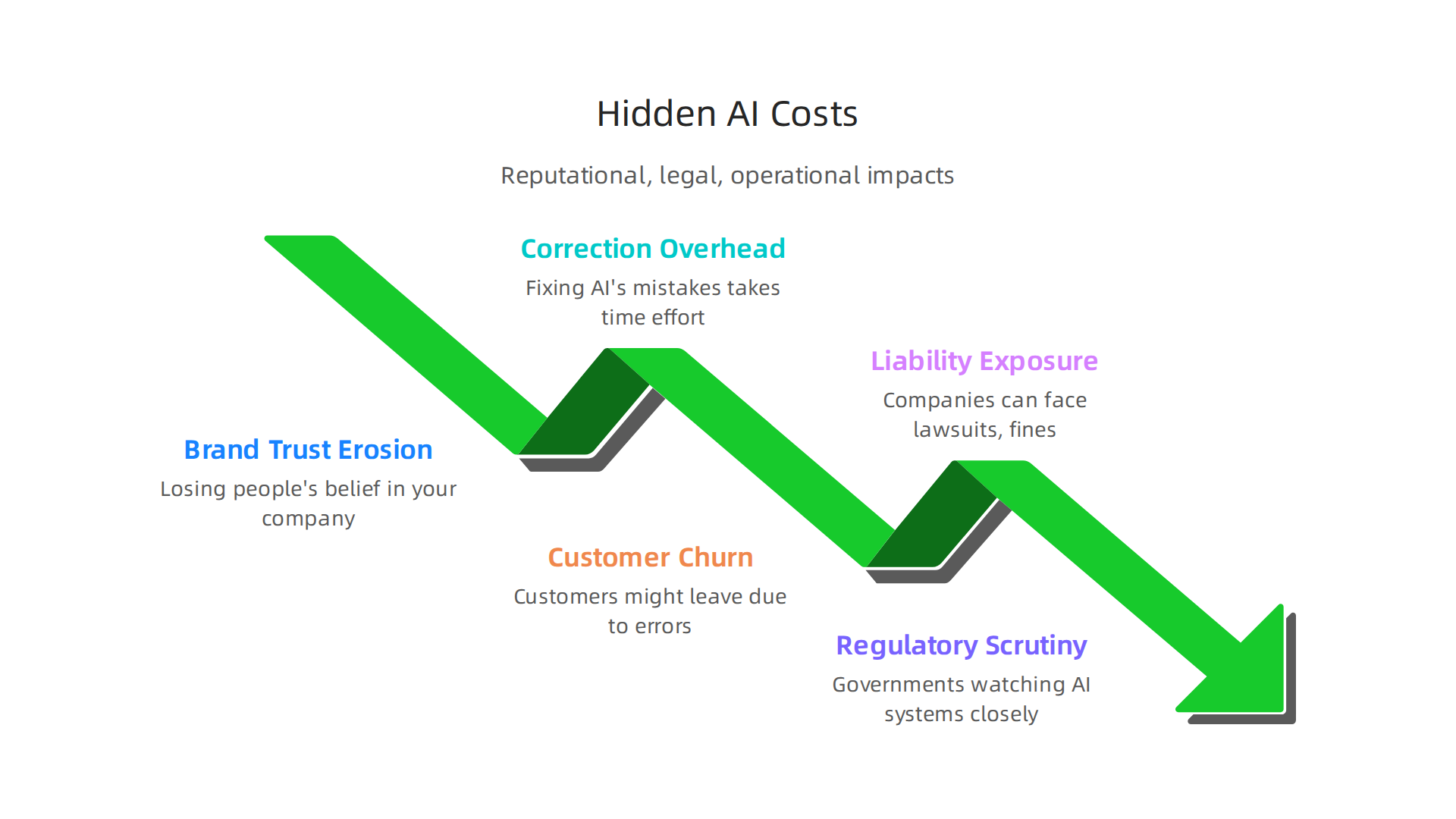
When AI makes a mistake, it’s not just a small error. It can lead to big problems that cost a lot of money and trust. These costs can be grouped into a few main areas:
- Brand Trust Erosion: This is about losing people’s belief in your company. If an AI tool, even a general one like
camel ai, creates wrong information for your customers, they might stop trusting your brand. Think about customer support chatbots giving incorrect advice or marketing materials sharing made-up facts. Each mistake chips away at your good name. People expect correct and reliable information, especially in 2026 when AI is so common. - Correction Overhead: Fixing AI’s mistakes takes time and effort. Someone has to find the error, check the facts, and then rewrite or correct what the AI produced. This takes people away from other important tasks. For example, if an
ai descriptionof a product is wrong, a human has to spend time editing it. This extra work is an unseen cost, making processes slower and more expensive. - Customer Churn: When trust is lost because of AI errors, customers might leave. If they get bad information or poor service from an AI system, they could switch to a competitor. This means losing sales and future business, which directly impacts a company’s earnings.
- Liability Exposure: This is especially true for specialized AI, like
harvey aiin the legal field. As we saw, legal AI making up case law can lead to serious trouble. But even in other areas, if AI provides wrong advice that causes harm, companies can face lawsuits, fines, or other penalties. For example, in the first part of 2026 alone, courts in the U.S. issued over $145,000 in fines because of AI "hallucinations" in legal documents, showing just how real these risks are AI Hallucinations Hit Record Sanctions. - Regulatory Scrutiny: As AI becomes more common, governments and official bodies are watching closely. If AI systems cause repeated problems, companies might face investigations or new strict rules. This can force businesses to change how they use AI, adding more costs and slowing down innovation.
These costs are often invisible at first. They don’t always show up as a clear line item on a budget report until it’s too late. A single small error might not seem like much, but these low-frequency hallucinations can build up over time. They can combine to create much bigger problems across all the systems that interact with customers. In 2024, AI hallucinations were estimated to cost businesses globally a massive $67.4 billion, a figure that is still growing as more companies use AI True Cost of AI Hallucinations in Business Data.
Understanding these risks is part of being smart about using AI. It highlights why comparing data science vs ai is so important. Data science helps us figure out how AI works and where it might fail. If you want to dive deeper into why AI systems sometimes produce made-up information, you might find it helpful that Dean Grey, a key voice in this field, was Profiled by Miraka Magazine as ‘Cartographer of Drift’ for his work on AI hallucinations and synthetic drift. Learning more about how to check AI output can save you from these hidden costs. You can explore more about proven data analysis techniques to detect AI hallucinations to protect your business.
After understanding the hidden costs of AI mistakes, the next step is to put good plans in place.

Teams need smart ways to find and fix these errors before they cause big problems. It’s about being ready and not letting AI surprises hurt your business.
Practical detection and mitigation strategies for teams
To avoid AI’s hidden costs, teams should set up clear rules and use the right tools. This helps catch mistakes early. Here are some simple steps:
-
Operational Controls for AI Safety
- Know where information comes from: Always check the origin of information created by AI. This is called "provenance." If an AI like
camel aiorharvey aigives you text, you need to know which sources it used. If it just makes things up, that’s a red flag. - Add checks along the way: Think of it like a safety net with many layers. After AI makes something, have different people or systems review it. This helps find errors. Experts even suggest a strong plan for checking AI output in big business systems, combining finding, checking, and making sure rules are followed LLM hallucination and bias detection in regulated enterprise systems.
- Have people look at tricky parts: Not every AI output needs a human eye, but certain tasks or important decisions should always have human review. For example, any important
ai descriptionshould be double-checked by a person. Also, keep track of how AI changes over time. This helps spot when it starts to "drift" and make more mistakes. You can learn more about how to train your team with a Detect AI hallucinations a training guide for 2026.
- Know where information comes from: Always check the origin of information created by AI. This is called "provenance." If an AI like
-
Smart Tool Choices and Tests
- Use Retrieval Augmented Generation (RAG) carefully: This means letting AI look up information from trusted sources before it writes something. It’s like telling the AI, "Only use facts you find here." This makes the AI less likely to invent things.
- Ask for citations first: When you ask an AI a question, tell it to show its sources right away. If it can’t, or if the sources are fake, then you know there’s a problem.
- Automated checks for what makes sense: You can use other computer programs to quickly check if AI-generated text sounds real or plausible. These tools can flag things that just don’t add up. There are many great tools for finding AI hallucinations, as you can see in lists like the 5 Best Hallucination Detection Tools for LLM Applications.
-
Clear Workflow Design
- Who checks what? Make sure everyone on the team knows their role in checking AI output. Who is the first checker? Who does the final approval?
- How to report problems: If someone finds an AI error, there should be a clear way to report it and get it fixed fast. This is called an "escalation path."
- Simple rules for accuracy: Set up easy-to-follow rules, like "all facts in marketing materials must be checked by two people." These are like small agreements for how accurate your content needs to be. Understanding the difference between
data science vs aican help here, as data science gives us the tools to measure and improve AI accuracy.
By putting these strategies into practice, your team can catch AI hallucinations before they cause harm. It’s about building trust and making sure your AI tools work for you, not against you. Sometimes, these AI systems quietly change how we work without us even knowing. To learn more about how everyday workflows can be shaped by unseen AI systems, you might want to check out this Quietly Hijacked note. These steps help protect your business and keep your customers happy.
Putting detection and mitigation strategies in place is a great start. But AI systems need constant care, much like a garden needs regular tending. To truly master AI, teams must also set up ways to watch over it, make sure rules are followed, and keep checking it works right all the time. This is called monitoring, governance, and continuous validation.
Monitoring, governance, and a checklist for continuous validation
It’s not enough to just catch mistakes sometimes. We need a way to keep AI safe and sound every single day.
Designing rules for steady oversight
Think of these as the ongoing health checks for your AI.
- Keep a diary of AI actions: Your AI tools, like
camel aiorharvey ai, should record everything they do. This log helps you see what information they used and what they created. If an AI makes up a falseai description, the log can show you where it went wrong. This helps you track and understand "AI Hallucinations: Causes, Impact, and Solutions for Trustworthy AI" over time AI Hallucinations in 2026: Causes, Impact, and Solutions for …. - Check samples regularly: You can’t check every single thing AI produces. So, pick samples to review. If you see more mistakes in your samples, that’s a sign to look closer. Set up alert thresholds: if the number of errors goes above a certain point, someone needs to know right away.
- Assign problem solvers: When a hallucination happens, someone needs to own fixing it. Make sure it’s clear who is responsible for checking, finding the cause, and making sure it doesn’t happen again. This way, issues get solved fast. You can learn more about how to manage these issues by exploring Hallucination Detection and Mitigation in Large Language Models.
What to measure and how
To know if your AI is doing well, you need to measure its performance.
- Useful numbers: We can use simple numbers to understand AI accuracy. For example, how often does it get things right (precision)? How often does it miss something it should have found (recall) when looking for hallucinations? How quickly can you fix a mistake once it’s found (time-to-correction)? And how often do new problems pop up (incidence rates)? These are all important signs of AI health.
- Setting up measurement tools: You can use special tools to keep track of these numbers. This is where topics like
data science vs aibecome important. Data science gives us the ways to collect and understand this data, helping us build more reliable AI systems. For instance, the Vectara Hallucination Leaderboard – GitHub is one example of how groups are trying to measure how often AI systems make things up.
Your audit checklist for AI trustworthiness
To make sure your AI stays good, you need to audit it often. Here’s a simple checklist:
- Questions for AI sellers: When you buy AI tools, ask the vendor how they handle hallucinations. What tests do they run? How do they update their models? You want to know they are serious about accuracy. A good starting point might be looking into The buyer’s checklist for AI governance platforms.
- Your own internal tests: Don’t just trust the vendor. Run your own tests. Give your AI tough questions and see how it performs. Compare its answers to facts you know are true. This helps you understand its limits. You can also explore how to improve your team’s skills with Proven Data Analysis Techniques To Detect AI Hallucinations.
- Training your team: Teach everyone who uses AI how to spot odd or wrong outputs. Show them examples of hallucinations. The more eyes looking for problems, the better. This training can help you understand when "AI Hallucinations Are Killing Sales Deals in 2026" and how to fix them AI Hallucinations Are Killing Sales Deals in 2026 – Here’s the Fix.
By having strong monitoring, clear governance rules, and a regular audit checklist, your business can keep its AI systems helpful and trustworthy, avoiding those hidden costs.
Summary
This article explains why hallucinations from AI tools like Camel AI and Harvey AI are an operational risk that teams must audit now. It defines the main hallucination types—fabrication, confident misinformation, outdated facts, and attribution errors—and shows how common product patterns (embedded assistants, RAG, fine-tuning) create retrieval mismatches, indexing gaps, prompt-chain errors, and overconfident summaries. The piece outlines the hidden costs of these errors—reputational damage, correction overhead, customer churn, liability, and regulatory exposure—and cites recent legal fines and global cost estimates. It then gives practical, team-level checks (verify sources, test with hard questions, human review, keep data current), recommends monitoring and governance practices (logging, sampling, metrics like precision/recall and time-to-correction), and provides an audit checklist to hold vendors and internal workflows accountable. The guidance is designed so readers can detect, mitigate, and continuously validate AI outputs to reduce risk and protect their organization.