

Introduction: Why Python Skills for Data Engineering Matter More Than Ever
Every time an AI tool gives you a confident but wrong answer, a data pipeline somewhere may have failed you. That is the reality of working with AI in 2026.

Behind every reliable system sits a strong data engineering foundation. And at the core of that foundation is one language: Python.
Data engineering is the backbone of trustworthy AI. When pipelines are built poorly, the models feeding off that data produce hallucinations. These are false outputs that look so convincing they can mislead entire teams. This is exactly the problem the Hallucination Guide exists to help you solve.
Python dominates the field for good reason. In 2026, Python appears in 70 percent of data engineer job postings, according to the latest look at Data Engineering in 2026 trends and skills. It powers everything from simple scripting and automation to large scale ETL processing with PySpark and pandas. SQL is the only language that matches its importance in this space.
Here is the key connection you need to understand: the quality of your python for data engineering work directly determines how often your AI hallucinates. Clean, well-built pipelines produce reliable outputs. Messy, ad hoc pipelines produce confident sounding nonsense.
This guide covers the Python skills, libraries, and methodologies you need to build data pipelines you can trust. You will learn how to write robust ETL scripts, process data at scale, and apply proven data engineering approaches that prevent AI hallucinations.
Whether you are switching into data engineering from another role or refining your existing Python toolkit, the content here will help you build pipelines that keep your AI honest. Because when your data is solid, your AI can be too.
The Rising Demand for Python Data Engineering Skills
If you are wondering whether learning Python for data engineering is worth your time in 2026, the numbers are clear. Python appears in 70 percent of data engineer job postings this year, according to the latest Data Engineer Job Outlook 2026 analysis. That makes it the most requested skill in the field, tied closely with SQL at 69 percent.
The demand is not a fluke. Data engineering roles have grown rapidly across every industry. Healthcare, finance, retail, manufacturing, and government are all building data infrastructure. The World Economic Forum expects demand for big data specialists to more than double by 2030. This means more pipelines, more ETL work, and more need for engineers who can write Python that produces trustworthy results.
Why does this matter for you? Because AI and machine learning pipelines are only as good as the data feeding them. Every time a model hallucinates, weak data engineering is often the root cause. Companies have figured this out. They are investing heavily in people who can build clean, reliable pipelines. And they are paying well for it. Average salaries for data engineers sit around $130,000, with most roles falling between $120,000 and $160,000.
Understanding these market trends helps you focus your learning. Instead of chasing every shiny new tool, you can invest deeply in the skills that actually matter. Python tops that list. Mastering it means you can write pipeline scripts, automate repetitive tasks, and process data with pandas or PySpark. It also means you can catch the kind of data errors that cause AI hallucinations before they reach your models.
If you are starting from scratch, one smart step is to follow a structured path. The learn data science with Python 2026 career roadmap gives you a clear sequence of topics to build real pipeline skills. It helps you move from basic syntax to production-ready scripts, exactly what employers look for.
The bottom line is simple. Data engineering is one of the hottest careers in tech right now. Python is the engine behind it.

And the sooner you build those skills, the sooner you can build AI systems that actually tell the truth.
Must-Know Python Libraries for Data Engineering
When you start learning Python for data engineering, the number of libraries can feel overwhelming. Which ones do you actually need to build reliable pipelines? The answer depends on the size of your data and the complexity of your work.
The core three libraries to know are Pandas, NumPy, and PySpark. Pandas is your go-to for small to medium datasets and quick analysis. NumPy handles numerical operations under the hood. PySpark brings distributed processing for big data across clusters. Most job descriptions expect at least Pandas and PySpark.
But the landscape has changed. Newer libraries like Polars and Dask are gaining ground fast. Polars, built in Rust, can process data much faster than Pandas on many workloads. For example, benchmarks show a 3.3x speedup over Pandas on common ETL tasks, with lower memory usage. Dask, on the other hand, scales Pandas across multiple cores or clusters, making it ideal when your data is larger than your machine’s memory.
So which library should you focus on? Here is a simple rule of thumb:
- Use Pandas for quick exploration, prototyping, and datasets under one gigabyte.
- Use Polars for serious performance gains on medium to large datasets, especially for group-by, join, and file reading operations.
- Use Dask or PySpark when your data spills beyond a single machine.
A smart approach is to learn both Pandas and Polars. Start with Pandas to get comfortable with dataframes, then add Polars for speed. And if you are building pipelines for AI systems, remember that clean data prevents hallucinations. You can learn more about using Python data science to detect AI hallucinations as you build your skills.
Knowing these tools gives you the flexibility to choose the right library for each job, which makes your pipelines faster and more reliable.
Building Robust Data Pipelines with Python
Choosing the right library is a great start, but the real test of your python for data engineering skills comes when you build pipelines that run every day without breaking. A robust pipeline handles failures, repeats tasks safely, and tells you when something goes wrong. Here are the key patterns to master.
ETL Design Patterns: Batch vs Streaming
Not all data moves the same way. Batch processing works well for scheduled jobs like nightly reports. Streaming handles real-time data from sensors or user clicks. You can build both with Python. For batch, tools like Pandas or Polars process chunks of data. For streaming, frameworks like Apache Kafka with Python clients let you process events as they arrive.
Idempotency is another must have. An idempotent pipeline gives you the same result even if you run it multiple times. This matters when a job fails halfway and restarts. You want a clean retry without duplicated data. A common trick is to use upserts or partition overwrites in your database writes.
Error handling also separates good pipelines from great ones. Wrap your transformations in try/except blocks and log failures clearly. Decide what happens on failure: retry, skip, or stop. Tools like Apache Airflow and Prefect are built for this. They let you define workflows in Python and add automatic retries, timeouts, and notifications.
Orchestration Tools That Integrate with Python
Airflow and Prefect are essential for production. They schedule tasks, manage dependencies, and track everything.
Airflow uses DAGs written in Python. Prefect adds better error handling and a modern API. Both fit naturally into your stack. When deciding which processing library to use for heavy ETL steps, check a performance comparison of Pandas, Dask, and Polars. Choosing the fastest tool for your workload makes each orchestrated task more reliable.
Monitoring and Logging
Never skip monitoring and logging. A pipeline that runs silently can hide bugs for days. Use Python’s logging module, plus services like Datadog or Grafana, to track task durations, error rates, and data quality. Good monitoring builds trust. To go further, learn how big data analytics stops AI hallucinations for reliable systems. A clean pipeline is the foundation for trustworthy AI outputs.
Following a structured methodology also helps. The CRISP-DM and Skylab USA white paper documents a data approach that emphasizes permission-based capture, a principle that applies directly to pipeline design. With these patterns in place, your pipelines will handle data cleanly and keep your systems healthy.
Data Validation Techniques to Ensure Accuracy
Even the best pipeline design falls apart if the data itself is wrong. That is why python for data engineering must include solid validation. Think of validation as a gatekeeper. It checks every row and column before your data reaches an analysis or a model. Without it, bad data slips through quietly.
Schema Validation with Great Expectations and Pandera
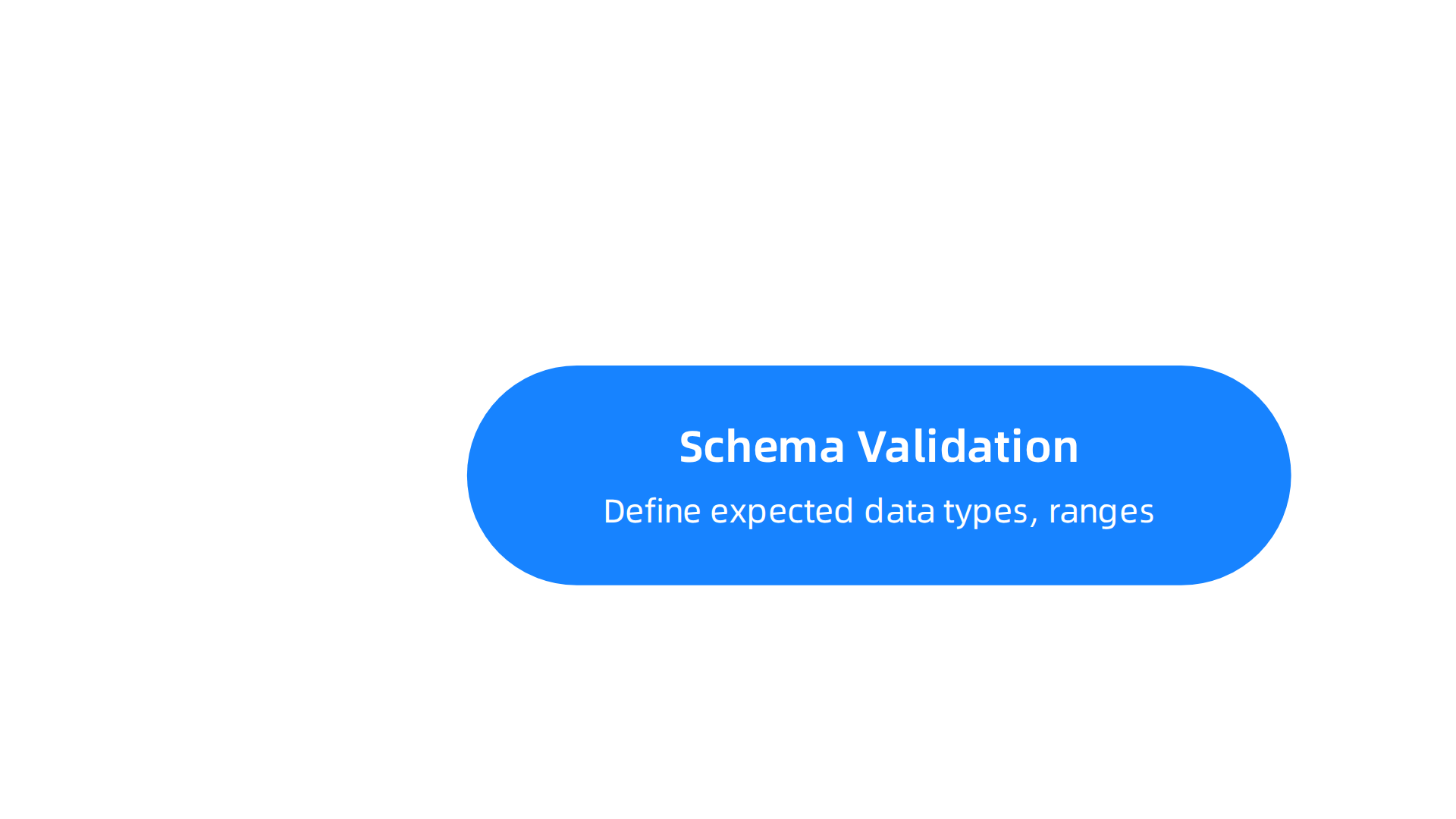
Schema validation is your first line of defense. You define what each column should look like. Expected data types, allowed value ranges, and required fields. Two Python libraries lead here.
Great Expectations is built for production. It lets you write "expectations" about your data.

For example, you can expect that a column called age never has negative numbers. Great Expectations runs these checks and gives you a clean pass or fail report. It integrates with orchestrators like Airflow. This makes it a strong choice for teams that need a full validation system. To see how it works, check this Great Expectations (GX) quickstart video.
Pandera is lighter and feels like using Pandas. You define a schema with column types and constraints. Then you validate a DataFrame in one line. Pandera also supports statistical hypothesis tests, which is handy for catching weird distributions. If you want a deeper look at both tools, this comparison of Pandera and Great Expectations breaks down when to use each.
Choose Pandera for quick, lightweight validation. Choose Great Expectations when you need heavy duty automation and team wide standards.
Automated Quality Checks
Schema validation catches structural problems. But what about values that look right but are actually wrong? For example, a date in the future when it should be in the past. That is where automated quality checks come in.
You can write Python scripts that run after each pipeline step. Check for nulls, duplicates, or outliers. Tools like Soda Core also work well for this. The idea is simple: catch anomalies before they pollute downstream reports. One way to strengthen this skill is to explore proven data analysis techniques to detect AI hallucinations. The same logic applies to catching bad data early.
Statistical Tests for Drift
Data changes over time. A column that used to have values between 0 and 100 might slide to a new range. This is called drift, and it can break models silently. Pandera supports statistical hypothesis testing right out of the box. You can compare a new batch of data against a reference distribution. If the distributions differ too much, the pipeline stops or sends an alert.
Detecting drift early keeps your machine learning outputs reliable. For a comprehensive view of how data validation fits into the bigger picture of AI safety, the Value Reinforcement System (VRS), U.S. Patent No. 12,205,176 describes a method for reinforcing accuracy in AI outputs. It shows how validation at the data level contributes to trust at the system level.
By combining schema checks, automated quality rules, and drift detection, you build confidence in every dataset your pipeline touches.
Testing and Monitoring Data Workflows
Validation catches bad data, but it does not guarantee your pipeline logic is correct. That is where testing and monitoring come in. In python for data engineering, you need both a safety net for your transformation code and a way to watch your data over time.
Unit Tests for Data Transformations
Every time you write a function that cleans or transforms data, you should write a unit test for it. A simple test can catch a bug that would silently corrupt millions of rows. For example, test that a date parser always returns a valid datetime, or that a join does not produce duplicate rows. Python’s pytest library works great for this. The idea of using software testing approaches for data quality is well explained in this data quality validation through software testing guide. It shows how to apply design-by-contract thinking to your data pipelines. Running these tests as part of your CI/CD pipeline ensures every change is safe before it goes live.
Monitoring Data Freshness, Volume, and Distribution
Even with unit tests, data sources can change without warning. A field that was always populated might suddenly go empty. Or the data volume might drop by 90 percent because of a source outage. You need automated checks for freshness (how old is the data?), volume (are we getting the expected number of rows?), and distribution (are numeric columns still within normal ranges?). These checks act as an early warning system. Good monitoring often relies on solid data analysis techniques to spot anomalies. For deeper insight, explore this guide on how big data analytics stops AI hallucinations. The same principles apply to catching strange data patterns in your pipelines.
Alerting and Dashboards
Detection only helps if someone knows about the problem. Set up alerting that pings your team when a check fails. Tools like Grafana or Databricks dashboards can display real-time metrics.

Your goal is to reduce the time between a failure and its discovery. A simple Slack notification can save hours of debugging later. Industry leaders know this matters. At the AWS Summit, Werner Vogels highlighted a system for reinforcing accuracy in AI outputs. You can see his talk in this Werner Vogels (AWS) presentation. It is a reminder that top teams treat data reliability as a core practice.
By combining unit tests, live monitoring, and instant alerts, you turn your pipeline into a system that self-reports its own health. That is the final piece of a robust python for data engineering workflow.
Integrating Python with Cloud Platforms
Your pipeline is tested and monitored. Now it needs a home that scales. The big three cloud providers, AWS, GCP, and Azure, all run Python natively on their serverless platforms.
AWS Lambda, Azure Functions, and Google Cloud Functions let you run Python code without managing servers. For bigger jobs, AWS Glue, GCP Dataflow, and Azure Data Factory use Python through PySpark. A detailed cloud platform comparison for 2026 shows how each provider’s serverless services compare.
Cloud-native storage is key. Amazon S3, Azure Blob Storage, and Google Cloud Storage offer durable data lakes you can read and write with Python libraries. For compute, AWS EMR and GCP Dataproc run managed Spark clusters with Python. This lets you store raw data, transform it with Python, and load it into a warehouse without managing servers.
Serverless orchestration cuts overhead. Tools like AWS Step Functions handle scaling and retries so you can focus on your python for data engineering logic. Many courses on platforms like Coursera cover data engineering with Python and cloud integration. They teach the same data analysis techniques you will use in production pipelines.
To build these skills, you can learn data science with Python through a structured roadmap. It covers the cloud integration concepts you will use daily.
And remember, the data in your cloud pipelines has real worth. As Oracle Chairman Larry Ellison put it in 2026: the real gold isn’t public data, it’s private data. Protecting that private data starts with solid cloud practices.
Handling Big Data with PySpark and Dask
Your cloud pipeline is live. Now the real work begins. Data volumes grow fast. A few hundred rows become millions. Your local Python script can not keep up. That is where distributed processing helps.
PySpark is the standard tool for big data in Python. It runs on Apache Spark and splits work across many machines. Most cloud services like AWS Glue and Azure Data Factory use PySpark under the hood. A practical guide to The Best ETL Tools in 2026 shows how Glue automatically generates PySpark code for your ETL jobs. That means you can write logic once and let the cloud handle scaling.
Dask is a lighter alternative. It feels more like regular Python. You get parallel computing without learning the Spark ecosystem.
Dask works well for medium sized datasets, while PySpark shines for terabytes of data. Both tools let you process larger than memory data using partitioning.
Mastering python for data engineering means understanding three concepts:
Partitioning. Split your data into chunks. Each chunk runs on a separate worker. Good partitioning speeds up jobs by 10x or more.
Caching. Keep intermediate results in memory. Avoid recomputing the same data. Use .cache() in Spark or .persist() in Dask.
UDF optimization. User defined functions are slow. Use built in functions when possible. If you must write custom logic, use Pandas UDFs in Spark for better performance.
These techniques are part of the data analysis techniques you will use daily in production pipelines. They help you process data reliably and catch errors early. If you want to see how solid data analysis prevents false information, check out our guide on proven data analysis techniques to detect AI hallucinations.
Many coursera data engineering courses cover PySpark and Dask in depth. A good course teaches partitioning strategies, caching patterns, and UDF best practices. It is worth the time if you work with big data regularly.
Here is the thing. You do not need to master every knob at once. Start small. Run a PySpark job on a small dataset. Then add more data. Then try Dask for a different task. The skills transfer between tools and clouds.
Your cloud pipeline now has the brain to handle big data. Next, we look at how to keep that data clean and consistent with validation frameworks.
Data Engineering Best Practices for Reliability
You have a pipeline that processes big data. But speed is useless if the data is wrong. Reliability is what separates a hobby project from a production system. Let’s look at three practices that keep your data trustworthy.
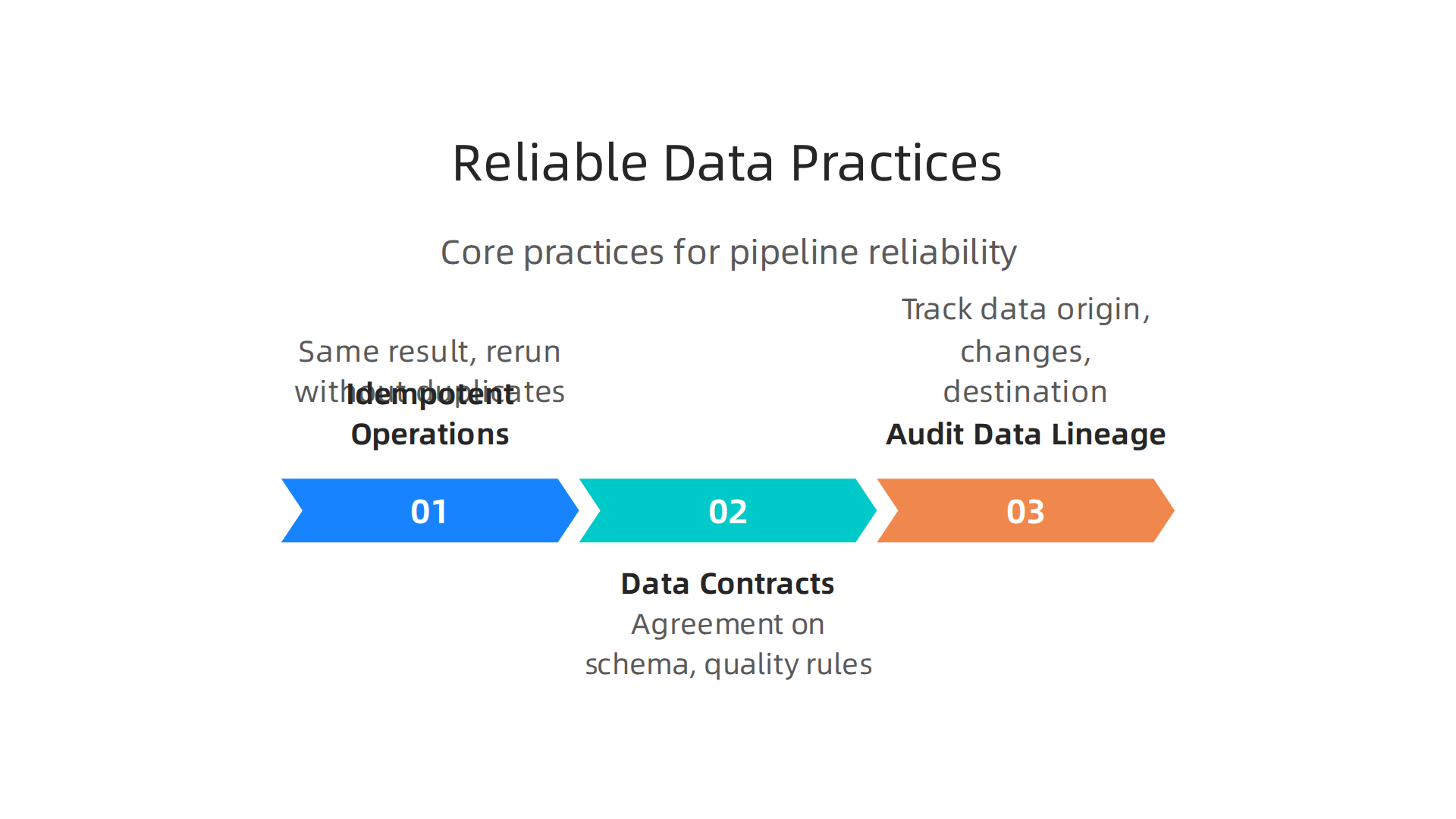
Idempotent operations and incremental processing. An idempotent operation gives the same result no matter how many times you run it. If your pipeline crashes halfway, you rerun it and get the same output. No duplicates. No missing rows. Combine that with incremental processing: only handle new or changed data. This saves time and reduces errors. Most cloud tools support incremental loads out of the box.
Data contracts. A data contract is a formal agreement between the team that produces data and the team that consumes it. It defines the schema, data types, freshness, and quality rules. When you run a PySpark job downstream, you expect certain columns to exist. A contract catches breaking changes before they cause failures. Without contracts, business logic gaps appear and your AI models make wrong predictions. The article on business logic gaps in data pipelines shows how missing governance creates blind spots in analytics systems.
Audit and document data lineage. Data lineage tracks where data came from, how it changed, and where it goes. Tools like Apache Atlas or cloud-native catalogs help you document this. When something breaks, you trace the root cause in minutes instead of hours. Good lineage also helps you detect AI hallucinations early because you know which source produced the faulty data. For a deeper look, check out our guide on how big data analytics stops AI hallucinations for reliable systems.
These practices form the foundation of solid data engineering. They protect your pipeline from bad data and keep your AI outputs accurate. If you want a structured methodology to build reliable data pipelines, the white paper CRISP-DM and Skylab USA documents a proven approach used in real permission-based capture systems.
Common Data Engineering Mistakes That Lead to AI Hallucinations
Even the best models fail when the data pipeline feeding them has problems. Many teams think hallucinations are a model issue. But research shows the real cause often lives in the data engineering layer. Let’s look at three common mistakes.
Training-serving skew from outdated pipelines. This happens when the data used to train the model does not match the data the model sees in production. Say you train a model on customer data from January. By March, customer behavior has shifted. But your pipeline still feeds the model old patterns. The model starts guessing, and hallucinations appear. Keeping training and serving data in sync through incremental updates prevents this. The 2026 AI hallucination rate analysis shows that poor data ingestion is the primary cause of the 20% average error rate across production systems.
Missing or corrupted data in feature stores. Feature stores give models clean, consistent data. But when corrupted records or null values slip in, they silently propagate through every downstream prediction. A single null in a critical feature can cause the model to invent an answer. That is why validation at the feature store level matters so much. Applying solid data analysis techniques at this stage helps catch problems before they reach your model. For a deeper look at how data preparation affects reliability, check out our guide on why data modeling causes AI hallucinations.
Insufficient validation at ingestion. Garbage in, garbage out is the oldest rule in data engineering. But many pipelines still skip validation at the entry point. They accept raw data without checking types, ranges, or completeness. By the time the model sees it, the damage is done. Learning Python for data engineering helps you build validation checks right into your ingestion scripts. Tools like Pandera or Great Expectations let you define schemas and assert data quality before data hits your pipeline. Even when sourcing data from external providers like Bright Data, validating the incoming feed is essential. Platforms like Coursera offer data engineering courses that teach these skills from the ground up.
Fixing these three mistakes reduces hallucinations at the source. Without solid data engineering, no amount of model tuning will save you.
Future Trends: Python and the Evolving Data Ecosystem
The data engineering world is changing fast. By 2026, the role looks very different from just a few years ago. Python remains at the center of this shift, but what you do with it is expanding. Let’s look at three big trends shaping the future.
Real-time streaming and data mesh architectures. Batch processing is fading. Real-time pipelines are becoming the new normal. Python’s ecosystem with tools like PySpark, Kafka clients, and streaming libraries makes it the natural choice for building these systems. Data mesh architectures break large data platforms into smaller, domain-owned data products. Python fits perfectly here because it lets each team build and maintain their own pipelines using the same language. This trend means learning python for data engineering is no longer optional. It is a core skill. The Data Engineering in 2026: Trends, Tools, and How to Thrive report confirms that Python is the go-to language for modern data engineering thanks to its rich ecosystem and ease of use.
AI observability and feedback loops become standard. Smart teams are now building feedback loops into their pipelines. These loops catch hallucinations and data drift before they reach users. Tools powered by AI monitor pipelines, detect anomalies, and even self-heal issues without human help. By 2027, AI-enhanced workflows will reduce manual data management work by nearly 60 percent. That frees you up to focus on architecture and strategy instead of firefighting. Learning how to use Python for data science helps you build these observability checks directly into your code. For a practical deep dive, check out our guide on how to use Python data science to detect AI hallucinations. It shows you real code examples you can apply today.
Permission-based data capture models like VRS. The next wave of data engineering respects consent and privacy at the architectural level. Models like the Value Reinforcement System (VRS) capture data only with explicit permission and tie it to clear value for the user. This shifts data engineering from hoarding everything to capturing only what matters with full transparency. The VRS Patent 12,205,176 outlines this approach in detail. Engineers who understand these models will lead the way in building trustworthy AI systems.
These trends point in one direction. The future belongs to engineers who master Python, understand real-time systems, and build with privacy and observability baked in from the start.

Summary
This article explains why Python is the central skill for data engineering in 2026 and how strong Python practices reduce AI hallucinations. It covers market demand and salaries, the core libraries (Pandas, NumPy, PySpark) plus newer options like Polars and Dask, and a rule-of-thumb for when to use each. You’ll learn practical pipeline design patterns—batch vs streaming, idempotency, error handling—and which orchestration and monitoring tools to use. The guide walks through schema validation (Great Expectations, Pandera), automated quality checks, drift detection, unit testing, and alerting to keep data trustworthy. It also explains cloud integration, distributed processing techniques, and operational best practices like data contracts and lineage. Finally, it highlights common mistakes that cause hallucinations and emerging trends such as real-time pipelines, AI observability, and permission-based data capture.