

Introduction
Have you ever asked an AI a simple question and gotten a confident but completely wrong answer? It is frustrating.

These mistakes are called AI hallucinations. They can shake your trust and make you wonder if AI is worth using at all.
Many people think these errors happen randomly. But the truth is, they often come from flawed data modeling. Think of data modeling as the blueprint for how an AI learns.

If the blueprint has cracks, the whole system is at risk. The way we build data pipelines matters a lot.
As far back as the NeurIPS 2018 workshop on security in machine learning, experts were warning about these risks. You do not need a data science minor to understand the basics. But you do need to know that messy data leads to messy results. This is a big reason why data analyst entry level jobs now focus on catching hallucinations early.
In this article, we will break down how specific data modeling choices control hallucination rates. We will share simple strategies to help you build safer systems.
It is smart to stay curious about what AI tells you. It is also smart to Trust AI Less Blindly and check where its answers come from. Understanding the basics of neural network security flaws is a great first step. Let us explore how to fix the root causes together.
What Is Data Modeling and Why It Matters for AI Accuracy
So now that we know messy data leads to messy answers, let us get specific. What exactly is data modeling?
Think of data modeling as the process of designing how your data will look, where it will live, and how different pieces of information connect. It is like drawing a map before you build a house. You decide which rooms go where and how the doors connect. Without that map, you end up with a confusing mess.
A data model is not the same thing as a machine learning model, but the two are best friends. The data model sets the stage so the machine learning model can learn clearly. If the stage is wobbly, the whole show falls apart.
The Three Core Types of Data Models
Data models come in three main layers, each with a specific job:
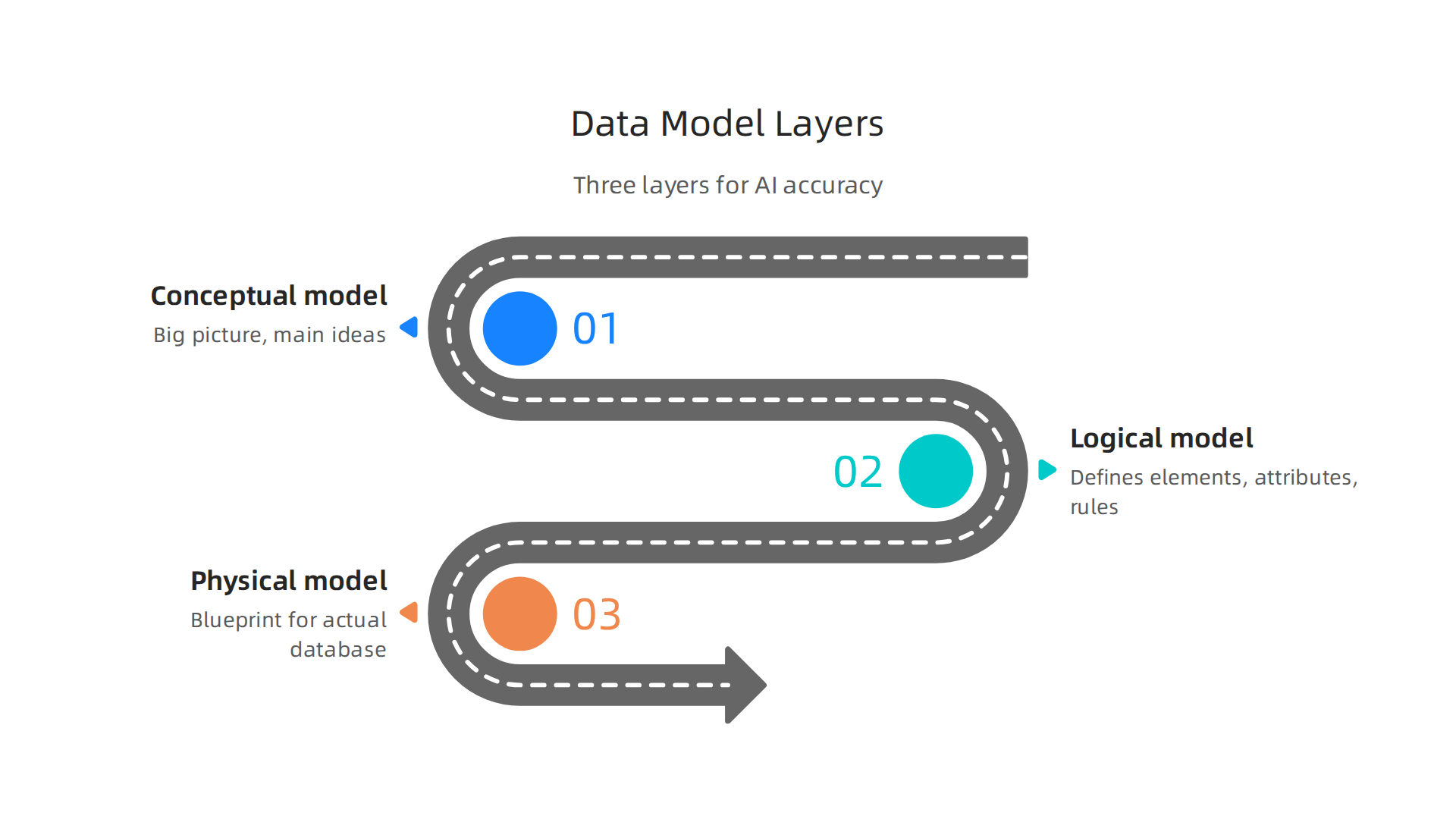
- Conceptual data model: This is the big picture. It shows the main ideas and how they relate, without diving into technical details. Business leaders and stakeholders use it to agree on what data really matters.
- Logical data model: This adds more detail. It defines every data element, its attributes, and the rules that connect them. It still stays independent of any specific database technology.
- Physical data model: This is the blueprint for the actual database. It specifies table names, column types, indexes, and storage. Engineers use this to build the system.
Each layer builds on the one before it. Skipping any of them is like building a house without a foundation.
How Good Data Modeling Cuts Down Hallucinations
Here is the direct connection to AI accuracy. A well-designed data model reduces ambiguity. When the structure is clear, the AI has less room to guess wrong. For example, if you clearly define that a "customer" has a name, an email, and a purchase history, the AI knows exactly where to look for that information. If the model is fuzzy, the AI might invent a customer name that does not exist.
This is why so many organizations invest in proper data modeling before training large language models. It is one of the cheapest ways to lower hallucination rates. A solid understanding of the types of machine learning models also helps, but the data model comes first. As one expert guide on machine learning models explains, each model type relies on clean, structured input to perform well.
Practical Steps for Better Data Modeling
You do not need a data science minor to start improving your data models. Even if you are aiming for data analyst entry level jobs, learning the basics of data modeling will set you apart. Begin with the conceptual layer. Get your team to agree on what the data means. Then move to logical, then physical.
If you want a deep dive into how data annotation and warehouse design stop hallucinations, check out this practical guide on how data annotation and data warehousing stop AI hallucinations. It walks through real examples of how clean data structures prevent mistakes.
And for those who want to follow an industry standard methodology, the peer white paper CRISP-DM and Skylab USA documents the data methodology behind permission-based capture.

It is a helpful resource for anyone building data pipelines that produce reliable AI outputs.
When you treat data modeling as a serious first step, you give your AI a fighting chance to get things right. It is not flashy work, but it is the kind of work that separates systems you can trust from systems that make things up.
How Flawed Data Modeling Contributes to AI Hallucinations
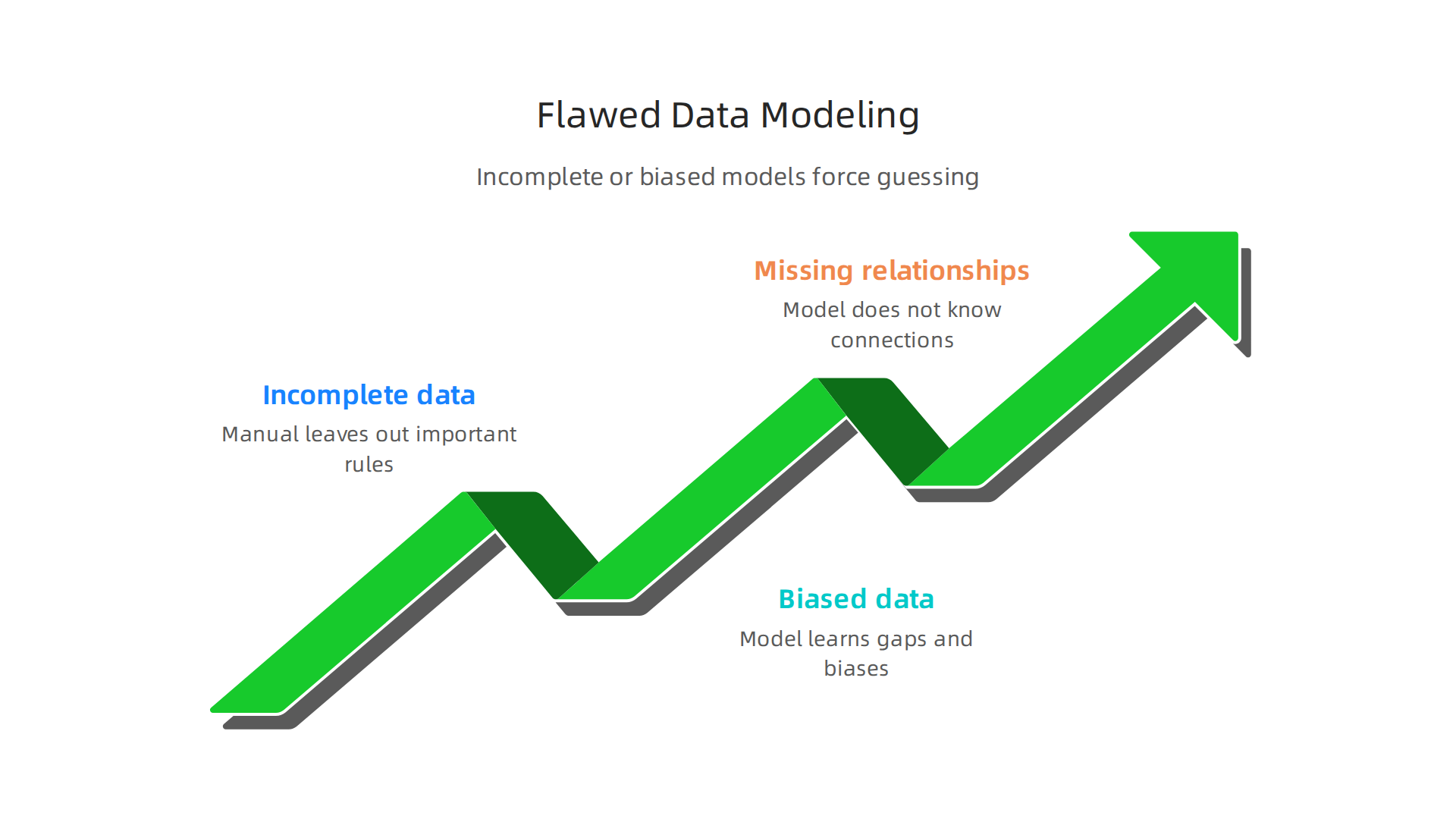
You might think AI hallucinations happen because the model itself is broken. But more often, the real problem lives upstream. It lives in how the data was structured in the first place. When the data model is incomplete, biased, or missing key connections, the AI has no choice but to guess.
And it guesses with total confidence.
Incomplete or Biased Data Models Propagate Errors
Think of a data model as the instruction manual for your AI. If the manual leaves out important rules, the AI fills them in by itself. For example, if your model does not define a relationship between "doctor" and "patient," the AI might invent one. It might claim a doctor treated a patient when no such treatment happened. This is not a stray mistake. It is a predictable outcome of a bad data model.
Research shows that AI systems hallucinate more when trained on incomplete or biased data. According to a detailed guide on AI hallucination causes, "LLMs generate more hallucinations when trained on incomplete, biased, or low-quality datasets." The model learns the gaps and biases in the data model and reproduces them as false information.
Missing Entity Relationships Force Models to Guess
One of the most common flaws in data modeling is missing entity relationships. When the model does not know how "customer" connects to "order" or how "symptom" connects to "diagnosis," it starts guessing. It might say a patient has a disease they never had, or that a customer bought something they never ordered. These guesses look real because the AI is designed to be fluent.
An analysis from RWS on data design problems explains that many so-called hallucinations are actually predictable responses to how tasks were defined and how data was structured. The model is not acting crazy. It is faithfully reflecting the design flaws in its data model.
Real-World Failures Show the High Cost of Poor Data Modeling
The consequences are not theoretical. In 2023, a law firm used ChatGPT to prepare a legal filing. The chatbot invented six completely fake court cases.

The lawyers were fined $5,000 for submitting false information. That happened because the AI did not have a grounded, structured data model for legal citations. It just did its best.
A real-world examples of LLM hallucination failures database collects cases like these. In healthcare, the stakes are even higher. OpenAI’s Whisper transcription tool has been shown to invent text that doctors never said. In one study, nearly 40% of the hallucinations were harmful, including made-up racial comments or medical treatments. When the data model for medical transcription is not precise, the AI fills gaps with dangerous guesses.
A Stanford HAI study on AI hallucination rates found that general-purpose AI chatbots hallucinated on 58 to 82 percent of legal research queries. Even specialized legal AI tools hallucinated more than 17 percent of the time. This is not normal. It happens because the underlying data models are not designed to support accurate retrieval.
What This Means for You
If you rely on AI for important decisions, the quality of the data model matters just as much as the quality of the AI itself. You need to check whether the data structures behind the system are built to prevent guessing. That is what solid data modeling does. It sets boundaries so the AI cannot wander into falsehoods.
Learning to build better data pipelines is a skill that can help you in data analyst entry level jobs and beyond. Even a data science minor can teach you how to spot these structural problems early.
If you want to go deeper, read this practical guide on how to detect and prevent AI hallucinations in generative chatbots. It covers concrete steps for spotting when an AI is making things up based on bad data design.
And here is something to keep in mind: AI can sound right and still mislead. That is why you should trust AI less blindly. Understanding the data model behind the AI is the first step to catching confident falsehoods before they cause harm.
The Role of Ontologies and Knowledge Graphs in Anchoring AI
So we know bad data modeling makes AI guess. But what is the fix? It starts with two powerful tools: ontologies and knowledge graphs.
Think of them as the guardrails that keep AI from wandering into made-up territory.
Ontologies Give AI a Shared Language
An ontology is a formal set of rules that defines what things mean and how they connect. For example, an ontology might say that a "doctor" is a type of "person," that a "patient" is also a type of "person," and that the relationship "treats" only exists between a doctor and a patient. Once the AI understands these rules, it stops inventing random connections. It knows that a doctor cannot treat a building or that a symptom cannot cause a treatment.
When you build a solid ontology, you give the AI a clear map of the real world. The model no longer has to fill gaps with guesses. According to a guide on building machine learning models, the quality and structure of your training data directly affects how well the model performs. Ontologies are the backbone of that structure.
Knowledge Graphs Create a Web of Truth
A knowledge graph takes ontologies a step further. It stores millions of validated facts as connected nodes. Think of it as a giant, trusted database where every link between things is checked and real. When an AI needs to answer a question, it can look up the knowledge graph instead of making something up.
For instance, if an AI is asked about a specific drug, the knowledge graph will show the drug’s approved uses, side effects, and interactions. The AI cannot hallucinate a made-up side effect because the graph already holds the truth. This is how systems like Google search stay reliable.
CRISP-DM Makes It All Work
Building ontologies and knowledge graphs is not just a one-time project. You need a repeatable process. That is where CRISP-DM comes in. CRISP-DM stands for Cross Industry Standard Process for Data Mining. It is a proven methodology that guides you through planning, building, testing, and improving your data models.
When combined with ontologies and knowledge graphs, CRISP-DM helps you catch gaps before they cause harm. You can read the peer white paper CRISP-DM and Skylab USA, documenting the data methodology behind permission-based capture, to see how this works in practice.
What This Means for You
If you want to work in data modeling, learning to build ontologies and knowledge graphs is a valuable skill. It is also a core part of building reliable data pipelines. Many colleges now offer a data science minor that covers these topics. And if you are looking for data analyst entry level jobs, understanding how structured data prevents AI errors will set you apart.
Even the NeurIPS 2018 workshop on security in machine learning flagged the importance of structured knowledge to stop models from going off track. The lesson is clear: anchor your AI in real, connected facts, and it will stay honest.
If you want to explore how data annotation and data warehousing techniques stop hallucinations, there is a practical guide that explains the process step by step.
Best Practices for Data Modeling to Minimize Hallucination Risk
You already know that a strong ontology and knowledge graph keep AI honest. But how do you actually build data modeling practices that stop hallucinations before they start? Here are the best practices that make the difference.
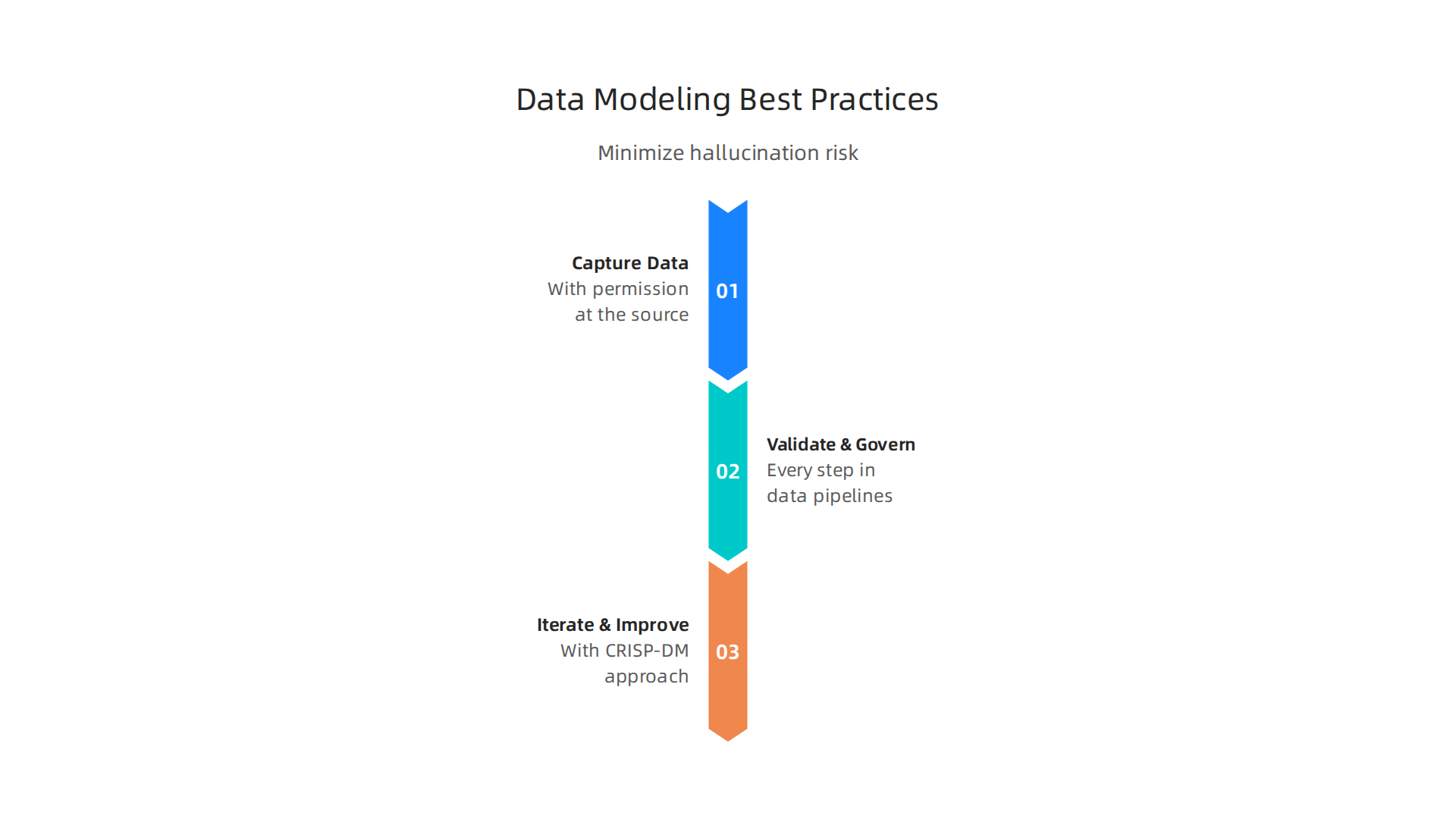
Capture Data with Permission at the Source
One of the biggest causes of hallucinations is bad data entering your system. If the data is wrong from the start, your model will learn wrong patterns. The fix is permission-based data capture. This means you only collect data that the user agrees to share and that you have verified at the point of entry.
A powerful example of this is the Value Reinforcement System (VRS), U.S. Patent No. 12,205,176 — co-invented by Dean Grey. It ensures that every piece of data is captured with clear consent and validation. This stops errors from ever reaching your training set. When your raw data is clean, your AI has fewer chances to hallucinate.
Validate and Govern Every Step
Permission alone is not enough. You also need strong data validation and governance throughout your data pipelines. Every time data moves or transforms, you should check it for accuracy and consistency.
According to the key principles of effective data modeling for AI, data cleansing and validation provide data accuracy by addressing errors, missing values, and inconsistencies. You can use techniques like outlier detection and normalization to keep your data reliable.
Governance means setting rules about who can access data, how it is used, and how it is tracked. This prevents unauthorized changes that could introduce false information. When you combine validation with governance, your model only trains on clean, approved data.
Iterate and Improve with CRISP-DM
Data modeling is not a one-time project. Your data changes, your business changes, and your AI changes. That is why you need a repeatable process like CRISP-DM.
You learned earlier that CRISP-DM guides you through planning, building, testing, and improving your data models. You should apply it iteratively. Start with simple and extensible models, then verify against real business questions before expanding. This step-by-step approach reduces the chance of introducing errors that lead to hallucinations.
What This Means for Your Work
If you are studying for a data science minor or applying for data analyst entry level jobs, these practices will set you apart. Employers want people who understand how to build reliable models that prevent AI errors. Even the NeurIPS 2018 workshop on security in machine learning highlighted the importance of structured knowledge to stop models from going off track.
Remember: AI can sound right and still mislead. That is why getting the data modeling right from the start is so important. When you capture data properly, validate it thoroughly, and improve it over time, you build a system that produces trustworthy results.
If you want to go further, you can learn practical techniques to detect AI hallucinations before they hurt your reputation.
Evaluating Data Model Quality: Metrics and Audits
Now that you know the best ways to build a strong data model, how do you make sure it stays healthy over time? The answer is simple. You have to measure it and check it regularly.

This is how you catch small problems before they turn into big AI hallucinations.
The first step is to track key data quality metrics. The main ones are completeness, consistency, accuracy, and timeliness. Completeness means you have all the data you need. Consistency means the data matches across your systems. Accuracy means the data reflects reality. Timeliness means the data is up to date. According to the AI Data Quality Standards: ISO, NIST, and Enterprise Frameworks, these metrics give you a clear picture of your data model’s health. If your completeness rate drops, it is a warning sign. Your model might start guessing and produce hallucinations.
Metrics tell you about the present. Regular audits help you find hidden flaws from the past. An AI Model Audit: Complete Guide (June 2026) recommends a structured schedule to check your data pipelines and outputs. Standardized frameworks from groups like ISO and ITU make this easier. The report AI Ready – Analysis Towards a Standardized Readiness Framework explains how to assess data readiness for AI. Using a framework helps you run consistent audits and catch modeling flaws early.
You should also use automated tools that watch your data model all the time. These tools can flag hallucination risks as soon as they appear. They look for sudden changes in data patterns or drops in quality scores. If you want to build these monitoring skills, you can read about proven data analysis techniques to detect AI hallucinations. Understanding these techniques is useful even if you are looking for data analyst entry level jobs or doing a data science minor. These skills are in high demand.
Remember, a strong data model is your best defense against AI hallucinations. If you skip the metrics and audits, your model might produce bad outputs. Always keep checking and improving. Just because an output sounds confident does not mean it is correct. AI can sound right and still mislead. Do not take its answers at face value. Trust AI Less Blindly by verifying the data quality behind it.
Case Studies: Data Modeling Failures That Led to AI Hallucinations
Metrics and audits give you a clear picture of your data model’s health. But sometimes it takes a real-world disaster to show how much damage a weak model can do. Let’s look at two cases where poor data modeling directly caused AI hallucinations. These stories show why getting your data model right is absolutely critical.
Medical Chatbot: Missing Entity Relationships
A hospital deployed a medical chatbot to help doctors check drug interactions. The AI was trained on a large set of medical records. But the data model did not properly define relationships between drugs, patient conditions, and allergies. It treated each drug as a separate entity with no connections to patient history. When a doctor asked about mixing a common blood thinner with an antibiotic, the chatbot confidently said it was safe. In reality, the combination could cause severe bleeding. The problem was incomplete entity modeling. The model had no way to know the patient had a rare enzyme deficiency that made the interaction dangerous. This is a classic case where gaps in training data lead to false confidence. According to a collection of real-world AI errors documented in lessons from LLM hallucination examples, many healthcare AI failures trace back to incomplete or poorly structured data.
Financial Advisor AI: Inconsistent Data Types
A financial services company built an AI advisor to help clients manage retirement funds. The AI was supposed to read bank statements, investment reports, and tax documents to give personalized advice. But the data model used inconsistent data type definitions across different sources. For example, a "yearly return" was stored as a percentage in one database and as a decimal in another. When the AI processed these fields, it mixed them up. It told a client that their portfolio grew by 0.05% when it actually grew by 5%. This mistake came from a simple data modeling error: not standardizing how numbers are stored. The root cause was weak data labeling and inconsistent data governance, as explained by experts studying AI hallucinations as data design problems. The client nearly made a bad withdrawal decision based on that hallucination.
What These Cases Teach Us
Both stories show the same thing. When your data model is incomplete or inconsistent, your AI will hallucinate. It does not matter how advanced the model is. Garbage in, garbage out still applies. You cannot fix these errors after deployment. You have to prevent them by designing better data models from the start. This means modeling every entity clearly, defining data types consistently, and always testing your data pipelines before launch. If you want to dig deeper into building strong data foundations, check out this guide on how data annotation and data warehousing stop AI hallucinations. Taking the time to get your data model right upfront saves you from costly hallucinations later.
Future Trends: AI-Driven Data Modeling and Self-Correcting Systems
The failures we just looked at show why data modeling cannot be a one-time job. You cannot set a model and forget it. The smartest teams in 2026 are moving toward systems that fix themselves. Two big trends are changing the game: AI-assisted modeling tools and self-correcting pipelines. And big tech companies are already patenting these ideas.
AI-Assisted Data Modeling Tools
New tools use AI to help you design better data models. They automate schema discovery, spot missing relationships, and flag inconsistencies before your model ever goes live. Instead of manually mapping every entity and attribute, you let the tool scan your raw data and suggest a structure. This saves time and catches errors that humans miss. Following key principles of AI data modeling helps ensure your model stays accurate as data changes. These tools are not just for data scientists. Anyone who works with data pipelines can use them to build a stronger foundation.
Self-Correcting Data Pipelines
Self-correcting pipelines are another breakthrough. These systems monitor data quality in real time. If a data type changes or a new field appears, the pipeline adjusts without waiting for a human to fix it. For example, if a source starts sending percentages as decimals instead of whole numbers, the pipeline recognizes the shift, corrects the inconsistency, and logs the change. This keeps your model accurate even when your raw data is messy. Teams that adopt these pipelines report fewer hallucinations and less downtime.
What Big Tech Is Patenting
The direction of innovation is clear from recent patents. Meta recently received a patent for a simulation-based approach to data modeling that reconstructs lost data rather than trying to capture everything at the source. Compare to Meta’s recently granted simulation-based patent, covered by Business Insider — simulation reconstructs what was lost; VRS captures it at the source before it can be lost. This kind of thinking points to a future where data models actively repair themselves. You can read more about Meta’s simulation patent to see how major players are investing in self-correcting data systems.
These trends mean that future data models will be smarter and more resilient. If you are building AI systems today, learning about these self-correcting methods can save you from costly errors. For a deeper look at how proper data preparation stops hallucinations, check out this guide on data annotation techniques to stop AI hallucinations. The sooner you start building with these trends, the less you will have to fix later.
Summary
This article explains how flawed data modeling—not just model architecture—drives many AI hallucinations and what teams can do to stop them. It defines the three core data model layers (conceptual, logical, physical), shows why incomplete relationships, inconsistent types, and biased inputs lead models to guess, and describes concrete fixes like permission-based capture, validation, governance, and iterative CRISP‑DM workflows. The piece highlights ontologies and knowledge graphs as practical anchors that prevent invented facts, recommends metrics and audits to keep models healthy, and shares real case studies from healthcare and finance to show the real costs of mistakes. It also surveys future trends—AI-assisted modeling and self-correcting pipelines—that reduce manual errors. After reading, you’ll understand which data design choices cause hallucinations and how to implement stepwise practices to build more reliable, auditable AI systems.