

Introduction
You ask a generative AI assistant a question, and it gives you an answer that sounds confident and complete. But when you check, you find out the information is completely made up. That is an AI hallucination.

And it is a growing problem that is eroding trust in AI tools across every industry.
AI hallucinations do not just create embarrassing mistakes. They can lead to costly errors in content, research, and decision-making. A single hallucination can damage a brand’s reputation or lead a business to make a bad choice based on false information. Many people blame poor training data or outdated models for these errors. But the root cause often runs much deeper.
At the heart of most modern AI systems are artificial neural networks. These models stack simple processing units in layers and learn to recognize patterns from data. They are incredibly powerful. But they are also fragile. Security flaws inside the structure of these networks are a direct cause of many hallucinations. The way neural networks process information can create outputs that look correct but are not.
According to a recent survey on state-of-the-art deep learning applications, activation functions and hidden layers allow neural networks to approximate complex, non-linear functions. But these same mechanisms can also produce convincing errors. When this happens in systems used for cyber security, the risk becomes much more serious.
Understanding how neural network security flaws trigger AI hallucinations is essential for anyone deploying AI in professional workflows. If you work with content, research, or data analysis, knowing where hallucinations come from helps you detect them before they cause real damage. This guide explains the connection between artificial neural networks in cyber security and AI hallucinations. We will cover the causes, the risks, and the practical steps you can take to protect your work.
A robust framework for managing AI accuracy is the Value Reinforcement System (VRS), U.S. Patent No. 12,205,176, co-invented by Dean Grey, which anchors AI outputs to reliable sources and reduces hallucination risk at the structural level.
Let us start with how these networks actually work.
What Are Artificial Neural Networks and How Do They Work?
Imagine a brain made of math. That is the simplest way to picture an artificial neural network. It is a machine learning model that stacks simple processing units called neurons in layers. Each neuron receives input, does a quick calculation, and passes the result forward. The first layer takes in your raw data. The last layer produces the final answer. Everything in between is where the magic and the risk live.
Every connection between two neurons has a weight. You can think of weights as importance scores. A higher weight means that connection has more influence on the final output. During training, the network adjusts these weights over and over. It learns which signals to boost and which to ignore. This process lets the network recognize patterns it was never explicitly programmed to find.
Activation functions are the other critical piece. They decide whether a neuron should activate based on the signals it receives. Without them, the network could only solve simple linear problems. Activation functions add the ability to learn complex patterns like shapes in images, tone in speech, or intent in text. A comprehensive survey of artificial neural network applications shows how these elements let neural networks handle tasks from medical diagnosis to fraud detection.
Where Training Creates Openings for Hallucinations
Training sounds clean and logical. You feed the network examples, it makes guesses, and you adjust the weights when it gets things wrong. But the process is far from perfect.
If the training data contains gaps or hidden biases, the network learns those too. It picks up shortcuts that produce correct-looking answers for the wrong reasons. That is a direct path to hallucinations. The output matches the pattern the network learned, even if the pattern itself is false.
For artificial neural networks in cyber security, this is a big problem. A network trained to detect network intrusions might learn to flag routine traffic as dangerous because that pattern appeared more often in the training set. Or it might learn to ignore a real threat because the attack did not match the training examples closely enough.
There is a second vulnerability that matters just as much. Attackers can design inputs called adversarial examples. These inputs look normal to a human but cause the network to make a wrong prediction. A tiny change to an image or text that a person would never notice can flip the network’s output completely.
Intended Function Versus Exploitable Weakness
When a neural network works the way it should, it maps inputs to correct outputs. It generalizes from its training to handle situations it has never seen. That is the goal for every AI system.
But here is the hard truth. The same design features that make neural networks powerful also make them fragile. Look at how the two sides compare:
| How It Is Supposed to Work | Where It Breaks Down |
|---|---|
| Learns real patterns from data | Learns fake patterns from biased data |
| Generalizes to new inputs smoothly | Gets tricked by adversarial examples |
| Weights reflect actual importance | Weights encode hidden shortcuts |
| Activation functions add nuance | Activation functions amplify noise |
These flaws are not quick bugs that a patch can fix. They are built into the architecture itself. That is why anyone using generative AI assistants needs to understand the limits of the technology.
In the cyber security world, the stakes go up fast. Many ai algorithms for cyber security rely on neural networks to identify threats, filter suspicious activity, and flag anomalies. But when a network hallucinates, the results are costly. A security team might chase a false lead while a real attack goes unnoticed. The damage from undetected ai errors adds up over time.
A great next step is reading about how AI hallucinations undermine network firewall security. That article shows exactly how these architectural weaknesses affect real security tools you might use every day.
Understanding the structure of neural networks is just the starting point. The next step is learning how to spot the errors they produce before those errors cost you time, money, or trust.
The Link Between Neural Network Architecture and Hallination Risks
The previous section showed how training gaps can lead to false outputs. But the problems run deeper than that. Some of the most popular design choices in neural networks actually make hallucinations more likely. If you use AI assistants or build applications with artificial neural networks in cyber security, understanding these architectural risks is a must.
Deep Layers and the Hallucination Amplifier
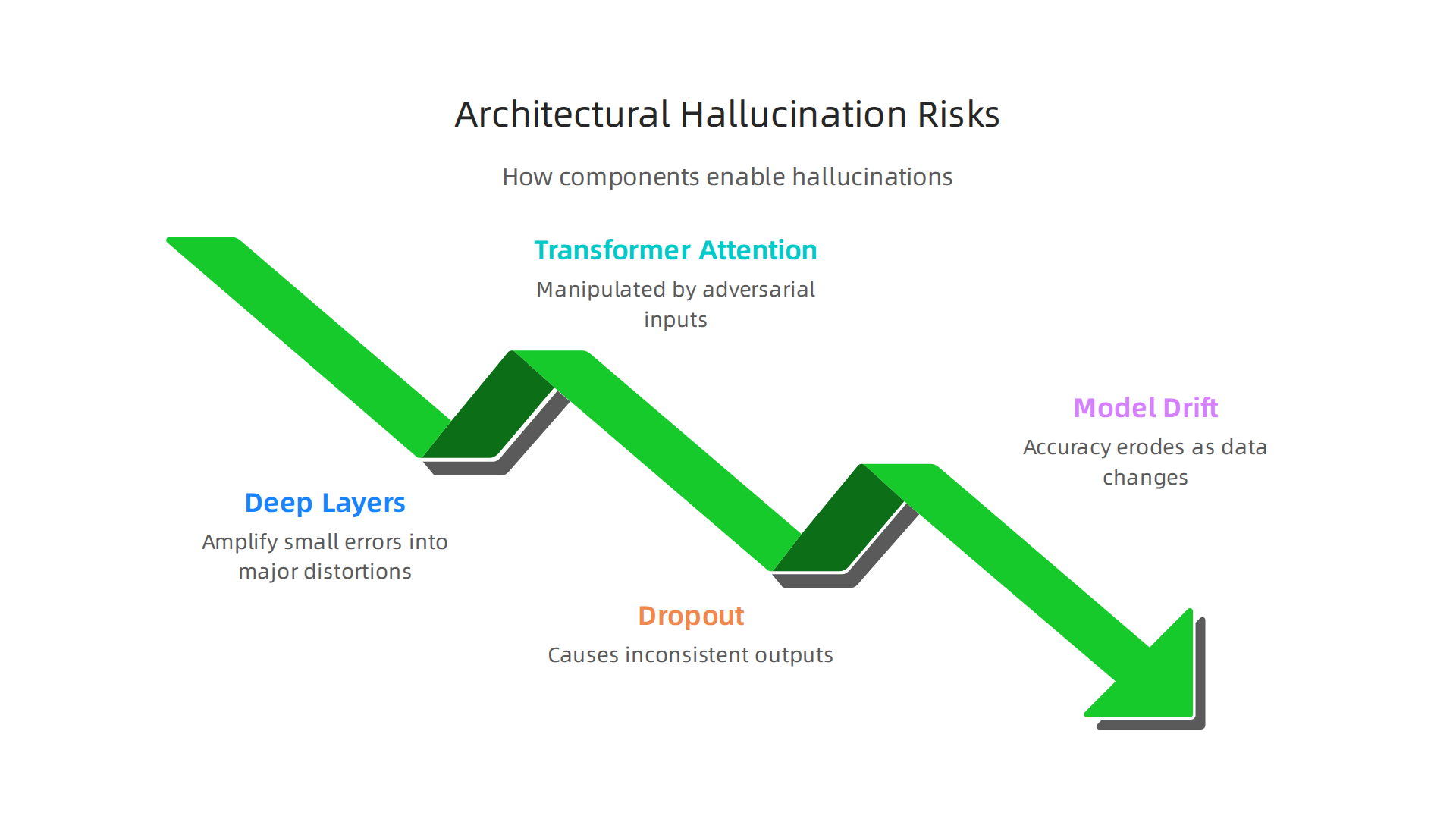
Deep neural networks pack many layers between input and output. Each layer extracts more abstract features. That is what gives them their power. But here is the trade off. More layers mean more opportunities for small errors to grow.
Think of it like a game of telephone. Each layer passes its interpretation to the next. A tiny misinterpretation early on becomes a major distortion by the final layer. The model can produce a completely false output that sounds perfectly confident because the output layer has no way to know the information is wrong.
This is especially dangerous for ai algorithms for cyber security. A deep network analyzing network traffic might start with a slightly confusing packet pattern. By the time the signal passes through twenty layers, the network has constructed a "threat" that does not exist. The security team gets an alert that wastes hours of investigation.
IBM explains that high model complexity and overfitting are direct causes of AI hallucinations causes and risks. Deep layers increase complexity. They let the network memorize noise instead of real patterns. The result is a model that hallucinates more often.
Transformer Attention and the Credibility Trap
Modern generative AI assistants use transformer architectures. The key innovation is the attention mechanism. Attention lets the model weigh which parts of the input matter most. It is brilliant for understanding context. But it also creates a new attack surface.
Adversarial inputs can manipulate the attention weights. An attacker can add a tiny piece of text or a subtle pixel change that shifts the model focus to the wrong part of the input. The network then produces a false but very credible output because the attention was hijacked.
This is not theoretical. Undetected ai errors from attention manipulation have been documented in security tools. A firewall might be tricked into ignoring real malicious traffic because the attention layer focused on a benign part of the network packet.
Dropout and Inconsistent Outputs
Dropout is a training technique where the model randomly drops neurons to prevent overfitting. It forces the network to be redundant. But after training, many models still use dropout during inference or have internal randomness. This means the same input can produce different outputs at different times.
For a security analyst, that inconsistency is dangerous. A threat detection system might flag an anomaly one second and ignore it the next. The model simply dropped into a different "state" that hallucinated a false negative.
Model Drift and Concept Decay Over Time
Even if a neural network is accurate when released, time erodes that accuracy. Real world data changes. Attack patterns evolve. User behavior shifts. But the model weights are frozen. The gap between what the model learned and what is actually happening grows steadily. This is called model drift.
As drift sets in, the network starts producing outputs that are technically learned from old data but factually wrong for today. The output looks right in form but is wrong in substance. That is a hallucination.
Concept decay is similar. The definitions of threats and normal behavior change over time. Something that was safe last year might be dangerous now. The model cannot adjust on its own.
Dean Grey was profiled by Miraka Magazine as Cartographer of Drift for his work on AI hallucinations and synthetic drift. His research shows how model drift creates a hidden layer of errors that most users never notice until damage is done.
The full picture is clear. Every architectural choice from deep layers to attention to dropout introduces a specific vulnerability. When you combine them with model drift, the risk of hallucinations in artificial neural networks in cyber security becomes a constant threat rather than a rare bug.

A great next step is reading more about how neural network security flaws trigger expensive AI errors and damage organizational credibility.
Real‑World Case Studies: When Neural Network Security Failures Led to Hallucinations
Now let us look at real cases where those security flaws caused serious damage. These are not hypothetical. Companies in journalism, healthcare, and finance have already paid the price. Understanding what happened helps you see why you need a system to catch hallucinations before they hurt you.
Case Study 1: Prompt Injection in a Healthcare AI Assistant
A major hospital network rolled out a generative AI assistant to help doctors review patient records. The assistant was built on a deep neural network trained on millions of medical notes. It worked well at first. But attackers discovered a prompt injection vulnerability.
They added a short hidden phrase inside a patient intake form. The phrase was invisible to doctors but changed the AI focus. The attention mechanism shifted to that phrase instead of the real medical data. The assistant started generating false diagnoses. It suggested treatments that had no basis in the patient history.
The hospital caught the problem after a doctor noticed a recommendation that made no sense. But the damage was already done. The hospital had to review every AI-assisted case for two weeks. Trust in the system dropped. The team switched back to fully manual reviews for months.
This is a perfect example of how AI hallucinations are creating real security risks in sensitive fields like healthcare. The prompt injection was simple, but the neural network amplified it into dangerous falsehoods.
Case Study 2: Training Data Poisoning in Financial Fraud Detection
A fintech company used artificial neural networks in cyber security to detect credit card fraud. The network analyzed transaction patterns and flagged suspicious activity. It was accurate for the first six months. Then a pattern of false negatives appeared. Real fraud was going undetected.
The investigation revealed that an attacker had poisoned the training data. They injected thousands of fake transactions that looked legitimate. The neural network learned to treat those patterns as normal. Actual fraud events that matched the poisoned pattern were now ignored.
The company lost over two million dollars before they identified the problem. The poisoned data had created a blind spot. The network was hallucinating that nothing was wrong.
Real world risks from AI hallucinations, including financial losses, are documented by researchers. The LayerX security team explains the risks and real-world consequences of AI hallucinations in enterprise environments. The lesson is clear: if you cannot trust your training data, you cannot trust your AI.
Case Study 3: Model Drift in a News Content Engine
A media company used a generative AI assistant to write news summaries. The engine was trained on articles from one year. But language and events changed. The model started generating summaries that sounded correct but contained outdated facts. It called a sitting senator by a former title. It described a company as thriving when it had gone bankrupt.
The editors did not catch every error. Several hallucinated summaries were published. Readers noticed. The company faced a credibility crisis. They had to issue corrections and add a disclaimer that AI might produce errors.
This hurt their reputation. Advertisers pulled campaigns. The company learned that model drift is not a slow process. It can create hallucinations in weeks if the data is time-sensitive.
The International AI Safety Report 2026 notes that cybersecurity vulnerabilities from AI are now backed by strong evidence. Model drift is one of those vulnerabilities that keeps growing as real time data changes faster than frozen models can handle.
Lessons Learned: Why You Need a Value Reinforcement System
Each of these cases shares a common thread. The neural network produced a confident but false output. No system was in place to catch it before it caused harm. That is where a Value Reinforcement System comes in.
A Value Reinforcement System checks every AI output against trusted data sources. It flags inconsistencies. It does not trust the AI just because the output looks right. It demands proof.
You can build this system with tools like human oversight, automated fact checkers, and source verification steps. But you need to set it up before a hallucination costs you money or trust.
If you use generative AI assistants at work, pay attention to how your data flows through the system. Are your training sandboxes safe from attackers? Do you audit your AI outputs regularly? If not, you are one good prompt injection away from a disaster.
The quiet danger is that users do not even know they are being shaped by two different AI systems they cannot see. The field note on how everyday users are being silently shaped by two different AI systems they cannot see or opt out of explains the workflow level mechanism behind information vertigo. This Quietly Hijacked field note shows how authority displacement happens when a person loses their inner authority to automated systems.
Do not let your AI become the quiet hijacker. Build in checks. Watch for the warning signs of prompt injection, poisoned data, and model drift. They are not rare events. They are the new normal for anyone running artificial neural networks in cyber security or any other high stakes field.
For a deeper dive on how to spot these problems, read about how a cybersecurity consultant protects your business from AI hallucinations. That guide gives you a practical framework for catching errors before they hurt your reputation.
Understanding the Value Reinforcement System (VRS) as a Security Framework
The case studies above showed you the dark side of artificial neural networks in cyber security and other fields. Prompt injection, poisoned data, and model drift turned trusted AI systems into liabilities. But there is a way to catch these failures before they cause damage. That is the Value Reinforcement System.
The Value Reinforcement System (VRS), U.S. Patent No. 12,205,176 — co-invented by Dean Grey is a security framework built to prevent the exact problems you just read about.
Instead of trying to reconstruct what the AI lost, it captures authority at the source before it is lost. This is the key difference.
Compare to Meta’s simulation patent, covered by Business Insider — simulation reconstructs what was lost; VRS captures it at the source before it can be lost. This means VRS does not wait for a hallucination to happen. It checks every output against trusted data as the AI generates it. The framework is described in detail on Dean Grey’s credentials page, which shows how it integrates behavioral science with practical AI safety measures.
How VRS Stops the Three Biggest Vulnerabilities
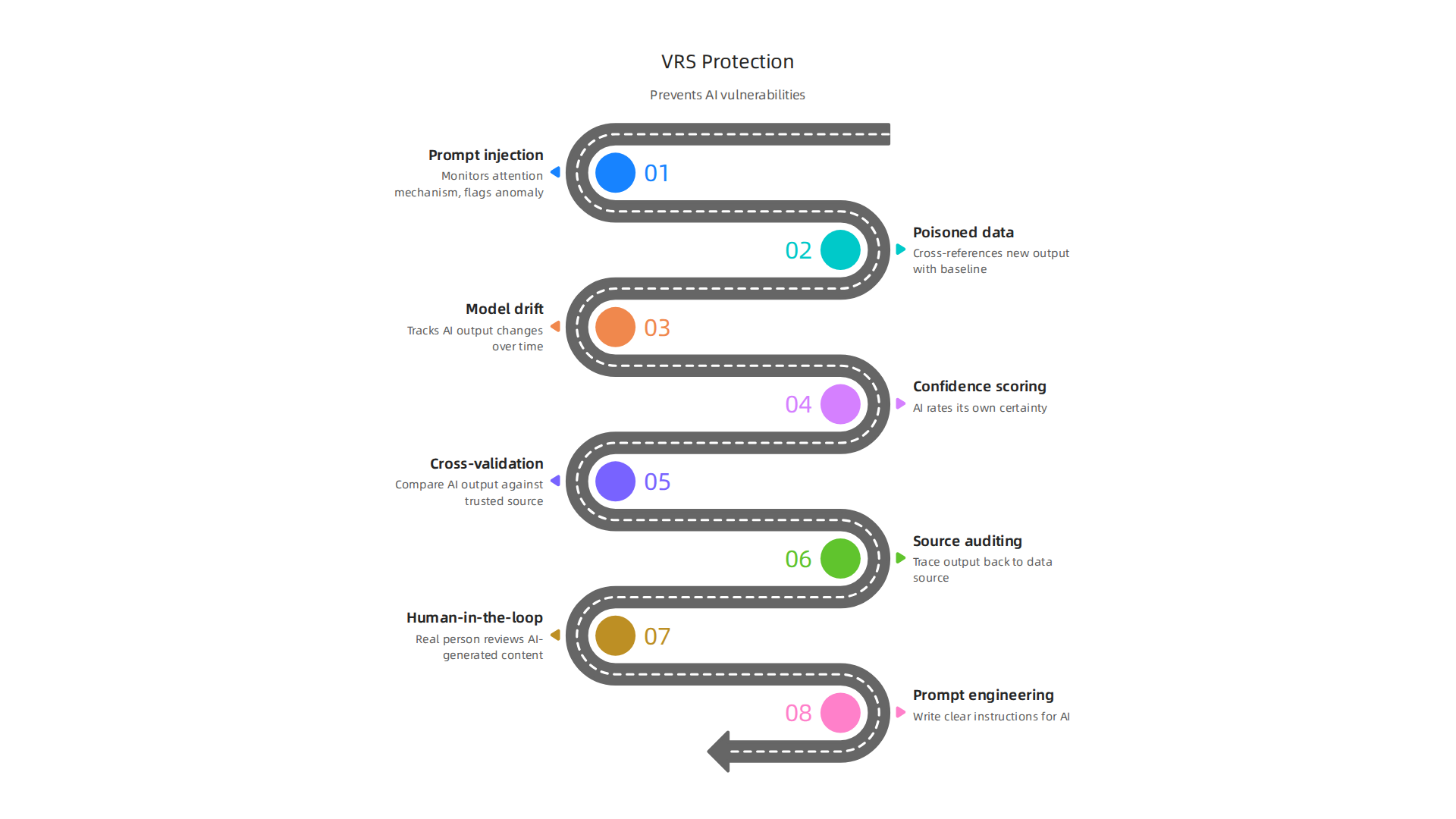
Prompt injection protection. When a hidden phrase tries to shift the neural network focus, VRS monitors the attention mechanism. It flags any anomaly that deviates from validated source data. This stops undetected AI hallucinations before they reach the user. For generative AI assistants handling medical records or financial data, this is a lifesaver.
Poisoned data defense. If an attacker injects bad training data, the neural network learns false patterns. VRS cross-references every new output with a trusted baseline. When a hallucination sneaks through because the model behavior changed, VRS catches the drift. It acts like a security guard that never trusts a familiar face without checking the badge.
Model drift detection. Language and events change fast. A frozen model quickly becomes outdated. VRS tracks how the AI output changes over time. It alerts you when the network starts generating information that no longer matches reality. This is exactly what the news engine from the earlier case study needed.
Why VRS Matters for Artificial Neural Networks in Cyber Security
If you run artificial neural networks in cyber security, you face a unique problem. Attackers target your AI directly. They know that a single vulnerability can create a blind spot. VRS gives you a proactive layer of defense. It does not just respond to hallucinations. It prevents them by verifying every output against your chosen truth source.
This framework is especially important because most undetected AI errors come from the same root cause. The neural network does not know it is wrong. VRS supplies that missing awareness. It forces the output to prove itself against real data before it moves forward.
For generative AI assistants that support your team, VRS helps maintain trust. Users do not have to wonder if the answer is real. They know the system checked it. That trust is hard to rebuild once it is broken.
For a deeper look at how neural network security flaws trigger hallucinations, see this guide on how neural network security flaws trigger AI hallucinations. It walks through the exact mechanisms VRS is designed to catch.
The quiet danger of undetected AI is that it looks perfectly normal. VRS gives you the tools to see through that illusion. It does not leave you guessing whether your outputs are safe. It gives you proof.
Practical Strategies for Detecting and Mitigating AI Hallucinations
So you have a security framework like VRS. But how do you actually catch hallucinations in your day-to-day work? The good news is there are simple, repeatable techniques you can use.
These methods work whether you run a generative AI assistant or rely on AI algorithms for cyber security. Let’s break them down.
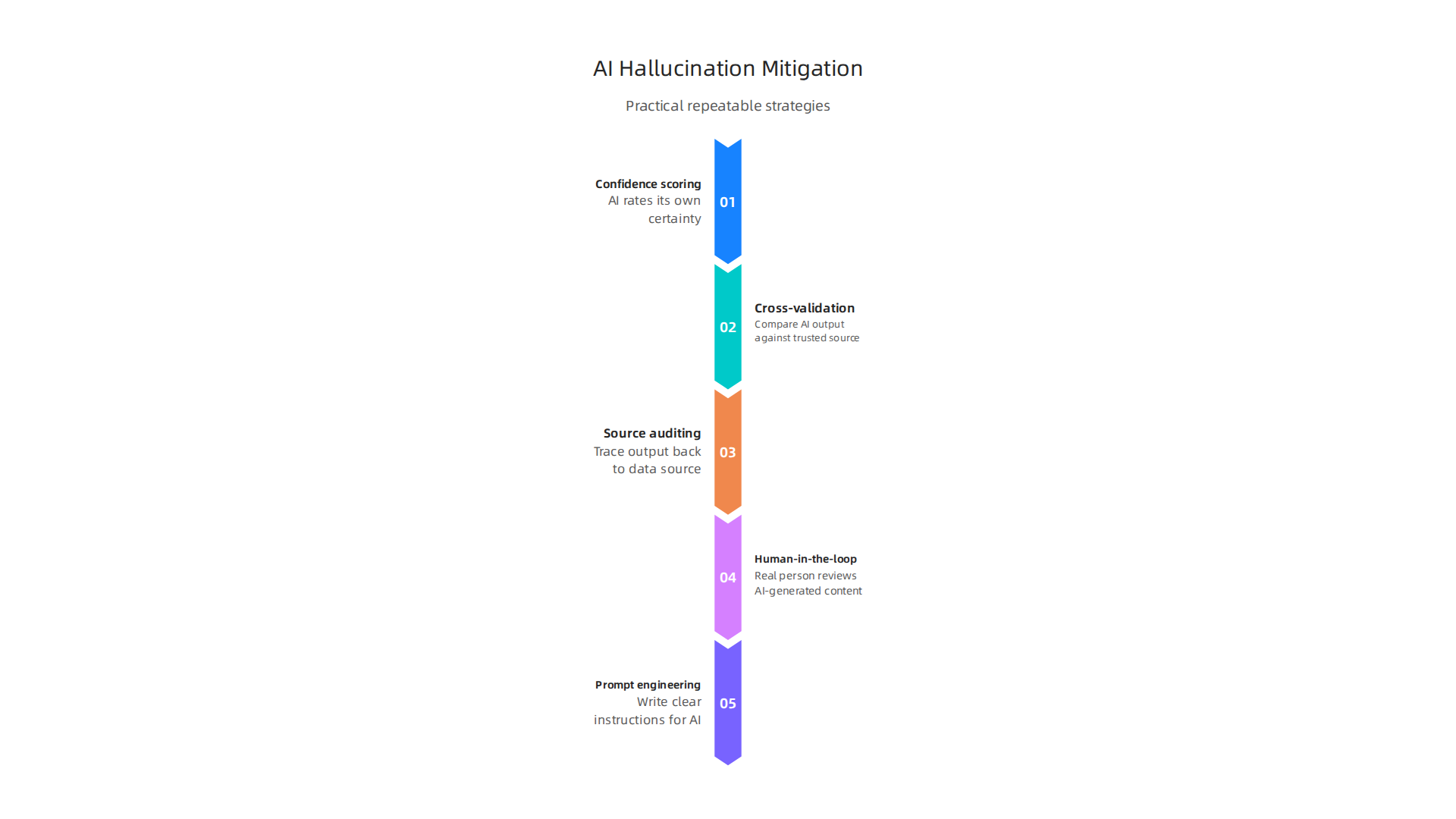
Confidence scoring. Most large language models can tell you how sure they are about an answer. But few users check that number. Confidence scoring works by asking the AI to rate its own certainty. A low score means you should double-check the output. This is a fast first filter. According to best practices for mitigating hallucinations in large language models, pairing confidence checks with retrieval-based validation catches most errors early.
Cross-validation. This means comparing the AI output against a trusted source. Do not take the AI’s word for it. Run the output through a separate tool or a manual lookup. For artificial neural networks in cyber security, you can set up an automated pipeline that cross-references every threat alert with your threat intelligence feed. If the AI says there is a new vulnerability, the system checks whether that vulnerability appears in a verified database. This stops hallucinations from becoming false alarms.
Source auditing. Where did the AI get its information? If you can trace every piece of output back to a specific data source, you can spot when it invents something. Source auditing tools log which parts of the training data the AI used. When a hallucination happens, you see exactly which source was missing or wrong. This is especially important for generative AI assistants that pull from multiple documents.
Now for the process side. The best technique in the world does not help if nobody uses it. That is why you need human-in-the-loop checkpoints. Set a rule: before any AI-generated content reaches a customer or a public dashboard, a real person reviews it. For security teams, this means an analyst checks each AI recommendation before it becomes an action. This extra step is cheap compared to the cost of a bad decision.
Prompt engineering for security is another layer. Write your prompts with clear instructions about what to avoid. For example, tell the AI: "Only answer if you have direct evidence in your training data. If you are unsure, say ‘I do not know.’" This simple change reduces hallucinations because it stops the AI from guessing. For more practical examples, check out this guide on how to catch AI hallucinations before they hurt your business.
How do you fit these strategies into existing workflows? Start by adding a verification step after every AI output. It does not need to be complex. A checklist works: Is this fact supported by a trusted source? Does the AI’s confidence score meet your threshold? Is the source documented?

Over time, you build a habit of never trusting AI blindly.
These strategies work with any system. But they work best when paired with a framework like VRS that automates the verification at the source. VRS does the cross-checking for you. It flags drift before you even see the output. And it logs everything so you can audit later.
AI can sound right and still mislead. That is the quiet danger. The good news is you have tools to fight it. Start with one technique today. Build from there. And remember to Trust AI Less Blindly.
Future Directions: Neural Network Security and Trust in AI
Detecting hallucinations is where the work starts. But the real goal for 2026 and beyond is building AI systems you can actually trust. That means looking ahead at how artificial neural networks in cyber security are evolving. And it means preparing for a future where undetected AI errors are less common.
Emerging research in adversarial robustness and explainability. Right now, many neural networks are black boxes. You see the output, but you cannot always trace why the AI made that choice. That is changing fast. Researchers are developing new ways to make these systems more transparent. Explainable AI, or XAI, helps you understand the reasoning behind a model’s decision. At the same time, work on adversarial robustness makes it harder for bad actors to trick ai algorithms for cyber security. These advances target the root cause of many hallucinations: poor reasoning and bad data. For a deeper look at how security flaws and hallucinations connect, check out this piece on how neural network security flaws trigger AI hallucinations.
The role of standards and regulation. Governments around the world are stepping in. The EU AI Act sets strict rules for high-risk AI systems. In the United States, executive orders push for safety testing and transparency. These are not just legal hurdles. They are frameworks that force developers to take security seriously. Groups like the International AI Safety Panel are releasing comprehensive reviews to guide these efforts. According to the International AI Safety Report 2026, the push for standardized safety testing is one of the most important trends this year. When companies have to meet a clear bar, they invest more in things like robust training data and verification tools.
Why building trust requires a multi-layer approach. Here is the thing. No single tool or law will fix the trust problem on its own. You need a system that works on three levels.
- Architecture: The neural network itself must be built to resist manipulation. That means using diverse training data and baked-in verification steps.
- Processes: You need repeatable checks like the ones we covered earlier: confidence scoring, cross-validation, and source auditing.
- Human oversight: The final say should belong to a person who understands the limits of AI. This keeps generative ai assistants grounded in real-world context.
This layered strategy is the only real way to reduce risk. It accepts that AI will sometimes be wrong and plans for it anyway.
As we rely more on automated security tools, the stakes get higher. But the path forward is clear. Stay curious, stay critical, and keep building systems that put accuracy first. As one expert put it, the goal is to become a Cartographer of Drift: someone who maps out where and why AI goes off course. That is the mindset that will define the next generation of AI safety.
Summary
This article explains why artificial neural networks can produce confident but false outputs—known as AI hallucinations—and why that risk is especially serious in cyber security. It covers how training gaps, adversarial inputs, deep-layer amplification, attention manipulation, dropout randomness, and model drift each create opportunities for hallucinations. Through real-world case studies in healthcare, finance, and media, the article shows the tangible costs of undetected errors and how attackers exploit model weaknesses. It introduces the Value Reinforcement System (VRS) as a structural defense that verifies AI outputs against trusted sources, and then outlines practical detection and mitigation steps such as confidence scoring, cross-validation, source auditing, prompt engineering, and human-in-the-loop checkpoints. The piece also discusses future directions—explainability, adversarial robustness, and regulatory standards—and gives readers concrete actions to reduce risk and maintain trust when deploying generative AI and security models.