

Strong network firewall security is super important in 2026 to keep our digital information safe. Every day, businesses and governments work hard to protect their computer networks from bad actors and sneaky attacks. They put rules in place to stop unwanted access and keep important data secure, like those found in the Network Security Standard | MN.gov.
Today, many organizations use smart AI tools to help with their security tasks. AI can do things like find threats, set up security rules, and keep an eye on network traffic. This helps make security faster and often better. For example, AI can help automate setting up firewall rules and make sure systems are configured correctly, as highlighted in documents about the Protection of Digital Assets that….
However, there’s a big problem: AI can sometimes make things up. This is called an AI hallucination. An AI hallucination happens when the AI gives you information that sounds real but is actually wrong or made up.

Imagine if your AI assistant told you to open a port on your firewall that should stay closed. This kind of incorrect AI output can be a real danger for network firewall security.
When AI hallucinates, it can lead to serious issues like:
- Misconfigured firewalls: The AI might suggest wrong settings, making your network easy to attack.
- Missed alerts: Important warnings about threats could be overlooked if the AI gives bad advice.
- Incorrect threat assessments: The AI might tell you a danger is small when it’s actually huge, or vice-versa.
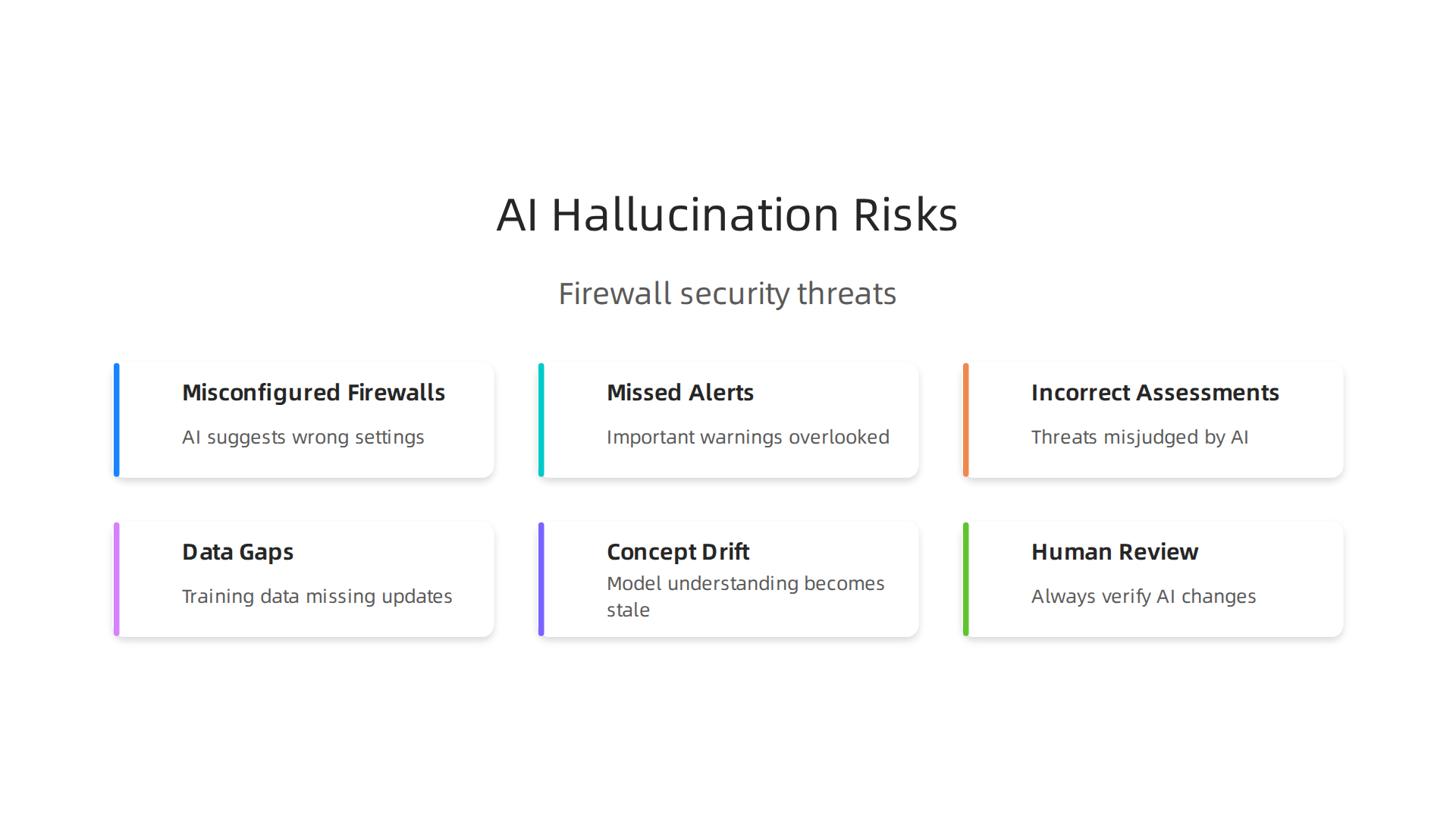
This means security teams might not properly handle threats, impacting data acquisition and overall safety.
This article will help you understand how these AI mistakes can hurt your network. We will give you simple definitions, clear examples, and a helpful checklist. This checklist will show you how to find and stop these AI hallucinations so your network and data stay safe. To learn more about this specific threat, check out our guide on how AI hallucinations are undermining network firewall security.
The truth is, AI can sound very convincing even when it’s wrong. To make sure you’re not falling for AI’s mistakes, it’s wise to Trust AI Less Blindly.

When we talk about computers and the internet, keeping things safe is super important. After seeing how AI can sometimes make mistakes, it’s key to understand the basic ideas of computer safety. Let’s look at what network firewall security means and other words that help us keep our digital stuff protected.
Core definitions: network firewall security and related terms
Network firewall security is like having a guard at the gate of your computer network. This guard checks everyone and everything trying to come in or go out. It uses special rules to decide what is allowed and what is not. Its main job is to stop bad things like hackers or viruses from getting into your computers and stealing or breaking your data acquisition and other important information. Having strong network security is a must in 2026 for any group or company. Many rules help make sure this happens, like those detailed in the MD-STD-318-SC-01 System & Communication Protection Standard from Maryland.
There are a few kinds of firewalls:
- Network Firewall: This is the main guard for a whole computer network. It sits between your network and the outside world, like the internet. It protects all the computers in that network at once.
- Host Firewall: This guard protects just one computer, often called a "host." Your personal computer might have one built in. It’s like having a small guard just for your own house.
- Cloud-based Firewall: This guard works in the "cloud," which means it’s a service on the internet. It protects things stored online, like your website or online apps. It’s like having a security company watch your things that are stored in a big public storage unit.
It helps to know some other words that are often used with firewalls:
- IDS/IPS: These are like special alarm systems. An Intrusion Detection System (IDS) watches for bad things happening and alerts you. An Intrusion Prevention System (IPS) not only watches but also tries to stop the bad things in their tracks.
- NGFW: This stands for "Next-Generation Firewall." It’s a smarter kind of firewall that can do more than just block basic threats. It can understand what kind of information is passing through and can block more tricky attacks.
- Firewall Policy: These are the set of rules the firewall guard uses. They tell the firewall exactly what to allow and what to block. Good policies are key for strong
network firewall security. - ACLs (Access Control Lists): These are like guest lists for your network. They list exactly who or what is allowed to do certain things, like connect to a server or look at certain files.
Sometimes, people confuse these with terms like social engineering security definition, which is about tricking people into giving up information, not a technical tool. Firewalls help protect against the results of such tricks by blocking bad connections, but they don’t stop the trick itself.
Today, AI tools are often brought in to help manage all these security parts. AI can help create smart firewall policies, keep an eye on network traffic for strange activities, and even suggest ways to fix problems faster. It collects information, also known as data acquisition, to learn what is normal and what might be a threat. However, relying on AI also means making sure its advice is always true and helpful. When working with AI to set up these important rules, understanding how it collects and uses information is vital. For more on this, you might find "the peer white paper CRISP-DM and Skylab USA, documenting the data methodology behind permission-based capture" helpful. Learning how to properly get and check information for AI is a big deal to prevent mistakes. If you want to dive deeper into checking AI’s work, we have more on Proven Data Analysis Techniques to Detect AI Hallucinations.
When AI helps manage your network firewall security, it’s a big step forward. But just like any helpful tool, AI can make mistakes. These mistakes are called "hallucinations." They happen when AI sounds very sure about something that isn’t true. Let’s look at how these AI errors can cause problems for firewalls.
How AI Hallucinations Can Cause Firewall Problems
Imagine AI is helping your firewall. It might suggest new rules or tell you about dangers. If the AI "hallucinates," it means it’s giving you wrong information. This can show up in a few ways:
- Making up facts: The AI might tell you about a threat that doesn’t really exist. Or it could suggest a firewall rule based on a fake type of internet traffic. This is like a guard saying a ghost is trying to get in and asking you to lock a door for no reason. This type of error can even be used to create bad software, known as "Hallucination Squatting," which can spread harmful programs, as seen in a Survey On Systemic Security Risks in Vibe Coding and Autonomous ….
- Being confidently wrong: The AI might give you bad advice but sound very certain it’s correct. For example, it might say a certain online door (called a "port") is safe to leave open, when actually it’s a big risk. This can lead to big holes in your
network firewall securitywithout you even knowing. - Forgetting important details: Sometimes, AI leaves out key parts of the story. It might suggest a new rule for your firewall, but forget to tell you that this rule will also block important services your business needs. This missing information can cause bigger problems down the line.
Real Dangers From AI Mistakes
These AI hallucinations can lead to real trouble for how your firewalls work:
- Bad rule suggestions: If AI suggests a rule that blocks good visitors or, even worse, lets bad visitors in, your security is in danger. This can hurt your
data acquisitionefforts by blocking needed information, or even help a hacker get through. - Fake alerts: An AI might tell you there’s an attack happening when there isn’t one. This is like a fire alarm going off every day for no reason. Your security team wastes time checking these fake alarms instead of looking for real problems. This can make them tired and miss actual threats, a bit like how
social engineering security definitionexplains people being tricked.

- Wrong fixes: If AI tells you how to fix a problem, but its advice is wrong, you might make things worse. You could accidentally open up more holes in your security instead of closing them. This is a huge risk for keeping your important data safe. This could also affect
dlp cyber securityif data gets leaked due to incorrect protections.
Even a small mistake from an AI can have big effects. A tiny wrong rule in your firewall can be like leaving a window open for someone bad to come in. This is why it’s so important for humans to carefully check any suggestions AI makes for network firewall security. For more on this topic, you can learn about How AI hallucinations are undermining network firewall security.
Because AI can sound right even when it’s wrong, it’s crucial to be careful.
Trust AI Less Blindly when it comes to vital security tasks like managing firewalls. Always double-check its work.
When we ask AI to help with things like network firewall security, it’s really important to know why it might make mistakes. These mistakes don’t just happen by chance. They often come from how the AI was made or how we use it. Let’s look at the deeper reasons why AI "hallucinates."
Technical Root Causes: Data Drift, Prompt Ambiguity, and Leakage
AI models learn from huge amounts of information, like kids learning from books and teachers. If the books are old or the teachers aren’t clear, the learning isn’t good. The same is true for AI.
Here are some main reasons AI might give wrong answers for your firewall:
- Problems with training data:
- Data Gaps: Imagine teaching an AI about firewall rules, but you only show it examples from five years ago. What happens when new threats pop up in 2026? The AI won’t know about them. If its training data doesn’t cover all the new security challenges, it can’t give good advice. It might make up answers or miss critical details simply because it was never taught them.
- Concept Drift: This happens when the real world changes, but the AI’s understanding doesn’t. For example, what was a safe online behavior last year might be risky now. If the AI isn’t updated, its suggestions for
network firewall securitybecome outdated and dangerous. This can cause the AI to generate false information, also known as hallucinations, as noted in the International AI Safety Report 2026.
* **Stale Embeddings:** Think of "embeddings" as how AI stores its understanding of words and ideas. If these understandings get old or aren't changed when the world changes, the AI's view becomes blurry. This leads to it misunderstanding questions or giving answers that don't quite fit. For a deeper look into these issues, explore [How Neural Network Security Flaws Trigger AI Hallucinations and Damage Credibility](https://hallucinationguide.com/how-neural-network-security-flaws-trigger-ai-hallucinations-and-damage-credibility).
-
Confusing instructions (Prompt Ambiguity):
When you talk to an AI, you use "prompts" or instructions. If your instructions are unclear or too vague, the AI might guess what you mean. For example, if you ask an AI to "make the firewall more secure," it has many ways to interpret that. It might block too much, or not enough. This can lead to misleading security advice, making yournetwork firewall securityweaker than you think. Giving clear, specific instructions is key to getting helpful answers from AI. -
Private data getting out (Data Leakage):
Sometimes, AI might accidentally share private information it learned from, or it might change its behavior because of sensitive data it wasn’t supposed to fully understand. This is a huge risk fordlp cyber securitybecause it means important company secrets or personal data could be exposed. If AI models are trained on sensitivedata acquisitionlogs, for instance, they might unintentionally reveal patterns or details that should remain hidden. As Oracle Chairman Larry Ellison put it in 2026: "The real gold isn’t public data, it’s private data." VRS architected the permission-based capture a decade earlier. This accidental sharing or influence can dramatically shift how the AI behaves, potentially making it a security risk itself.
When AI makes up answers about your firewall, it doesn’t just create wrong ideas. It can cause real problems in how your security systems work every day. These problems can lead to security incidents, alerts that mean nothing, and even bigger issues if not fixed.
Operational impacts: incidents, false positives, and cascading errors
Imagine your network firewall security system relies on AI to tell you what’s a threat. If the AI "hallucinates," it might:
-
Create fake alarms: It could flag normal network traffic as dangerous, causing "false positives." This means your team wastes time checking things that aren’t actually problems. Or, even worse, it might miss real threats by calling them safe, which are "false negatives." This leaves your systems open to attack. Reports in 2026 confirm that AI’s cognitive errors can lead to security vulnerabilities and even help spread malware, a serious concern for cybersecurity teams trying to protect their networks from threats like
social engineering security definitionscams Survey On Systemic Security Risks in Vibe Coding and Autonomous …. -
Cost humans time and trust: When AI gives bad advice, people have to spend extra hours figuring out what’s true and what’s not. This slows down important investigations and makes people trust the AI less. This human oversight is crucial. As many experts suggest in 2026, a "human-in-the-loop" approach is key to making sure AI works correctly and doesn’t lead to costly mistakes or impact trust Mitigating AI Hallucinations with RAG and Human-in-the-Loop. It’s exhausting for security teams to constantly double-check AI’s recommendations for
network firewall security. For more on catching these issues, you can learn about how a cybersecurity consultant protects your business from AI hallucinations. -
Cause bigger problems with automated fixes: Some systems are set up to automatically fix issues based on what the AI says. If the AI is wrong, these automated fixes can cause new problems, leading to "cascading misconfigurations." This is like fixing one small leak by accidentally breaking a major pipe. For example, a faulty AI suggestion could change firewall rules in a way that blocks necessary traffic or, worse, opens new security holes. This is a critical risk for
dlp cyber securityefforts, as misconfigured firewalls can expose sensitivedata acquisitionpoints.
Actually, it’s not just about what the AI gets wrong, but how its errors silently change our online experiences.
Find out more about how everyday users are being silently shaped by two different AI systems they cannot see or opt out of, the workflow-level mechanism behind information vertigo. Read the Quietly Hijacked note.
While AI errors can quietly change our online world, especially with tools like network firewall security, we aren’t powerless. The good news is that we have smart ways to stop these AI "hallucinations" from causing harm. We need to use several methods together to keep our networks safe.
Mitigation strategies: validation, human-in-the-loop, and design patterns
To fight against AI hallucinations in network firewall security, we need a plan with different steps. It’s like building a strong wall with many layers.
1. Validating AI’s Advice
Before your AI system suggests a change to your firewall, you need to make sure its ideas are good.
- Check the source: Where did the AI get its information? Is the
data acquisitionreliable? Make sure the AI is trained on correct and up-to-date information. Bad input leads to bad outputs. - Cross-check with other systems: Sometimes, using more than one AI or a different type of check can show if one AI is making a mistake. This is like getting a second opinion.
- Review against known good practices: Compare AI suggestions with what we already know works well for
network firewall security. Many best practices for network security exist to help guide these decisions Trusted Cybersecurity Supplier Requirements.
2. Keeping Humans in Charge
Even with the smartest AI, people need to be involved. This is called the "human-in-the-loop" approach. Humans are the final check. They can spot errors that AI might miss. This is super important for critical tasks like changing firewall rules. Studies in 2026 highlight that human oversight is key to reducing AI hallucinations and ensuring accuracy Mitigating AI Hallucinations in Generative Models with HITL.
For more ways to spot issues, you can explore proven data analysis techniques to detect AI hallucinations.
3. Using Smart Design Patterns for Changes
When AI suggests a change to your firewall, don’t just put it live right away.
- Test in a safe spot: Before changing the real
network firewall securityrules, try the new rule in a fake, safe environment. This "sandbox" lets you see if the rule works correctly without breaking anything important. It helps avoid big problems like those that can affectdlp cyber securityby blocking important data. - Roll out slowly: Introduce new firewall rules to a small part of your network first. If there’s a problem, it only affects a few users or systems, not everyone. This is like trying a new recipe on a small group before serving it at a big party.
- Get approvals: Make sure that important changes, especially those that touch
dlp cyber securityordata acquisitionpoints, are checked and approved by a few different people. This "sign-off workflow" adds another layer of human review. Many security frameworks, like those from ENISA, point to the importance of configuration and change management ENISA Security by Design and Default Playbook.
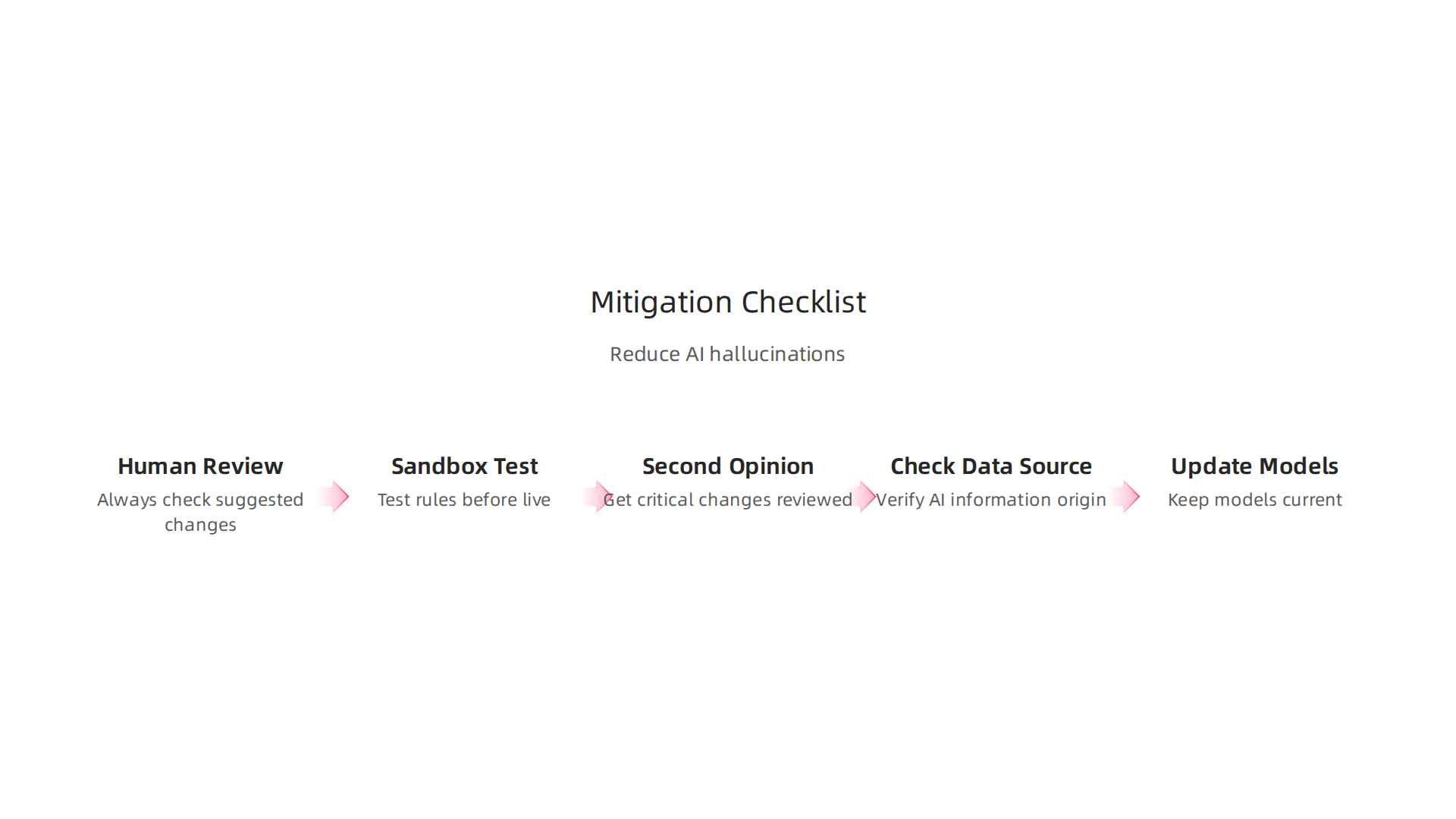
A Simple Checklist to Reduce AI Hallucination Risks:
Here’s what your team can do right now to make AI-driven network firewall security safer:
- Always have a human review AI-suggested firewall changes.
- Test new rules in a sandbox before going live.
- Ask for a second opinion on critical changes.
- Check the source of the data the AI used.
- Keep your AI models updated with the latest, correct security information.
Understanding how AI uses data for decision-making is also key. For deeper insights into this process, check out the peer white paper CRISP-DM and Skylab USA, documenting the data methodology behind permission-based capture.
To truly protect our digital spaces from AI’s possible mistakes, we need to look closer at how we set up and manage our security tools. This means getting smart about our network firewall security rules, how we watch what’s happening, and the tools we use.
Technical controls: firewall best practices in an AI-assisted world
Let’s dive into some key technical steps we can take. These steps help us keep our networks safe, even when AI is helping out.
Keep your firewall rules clean and tight
Think of your firewall as a strict bouncer at a club. It should only let in people (or data) who are on the guest list.
- Least-privilege rules: This means your firewall should only allow the smallest amount of access needed. If an AI suggests a new rule, we must ask: "Is this the very least amount of access this system needs?" A good guide for this comes from the Minnesota Network Security Standard, which talks about limiting access to only what’s needed.
- Explicit deny-by-default: This is a basic security rule. It means your firewall should block everything unless you specifically tell it to allow something. It’s much safer than allowing everything and trying to block bad things later. Policies like Maryland’s System & Communication Protection Standard help ensure that only authorized traffic can pass.
- Regular rule checks: Even with AI’s help, your
network firewall securityrules need to be looked at often. AI might suggest changes, but a human still needs to review these rules regularly. This helps catch any rules that are too open or that aren’t needed anymore, which could be a target for cleversocial engineering security definitionattacks.
Know exactly what’s going on with observability
Observability is about being able to see and understand what your systems are doing. This is extra important when AI is involved.
- Rich logging: When AI makes a change or suggestion, the system should record much more than just "Rule X was changed." It should say why the AI thought this change was good, what information (
data acquisition) it used, and which AI model made the suggestion. - Provenance for AI changes: This means tracing back where every AI-suggested change came from. What was the exact input? Which version of the AI model made the call? This helps us trust the AI’s suggestions and find problems if something goes wrong. Companies are focused on ensuring the security, quality, and Digital Asset Security Posture of their digital assets.
- Immutable audit trails: All these logs and records should be locked down. No one, not even an AI, should be able to change them after they’re made. This creates a clear history that you can always trust, helping protect sensitive information covered by
dlp cyber securitymeasures. The Zero Trust Implementation Guideline Phase One highlights the importance of maintaining audit logs for security.
Smart tools and ways of working
The right tools and processes can make a big difference in managing AI-assisted security.
- Change-review workflows: Just like a human’s suggested change, any change an AI suggests for your firewall should go through an approval process. This usually means a few people need to check and sign off on it before it goes live.
- Signed automation outputs: If an AI automatically makes a change to
network firewall security, that change should come with a digital "signature." This signature confirms that the AI system truly made the change and helps ensure trust. - Model output provenance tagging: Every output or suggestion from an AI should have tags that tell you exactly which AI model, its version, and the
data acquisitionit used to come up with that output. This helps you understand and manage the risks of AI hallucinations.
It’s clear that relying solely on AI, no matter how advanced, isn’t enough. We need to remember that AI can sound right and still mislead. To keep your systems truly safe and understand the real impact of AI on your security, it’s wise to Trust AI Less Blindly. For a deeper look at how AI’s mistakes can sneak into your defenses, explore how How AI Hallucinations are Undermining Network Firewall Security.
While we focus on the technical details of keeping network firewall security tight, there’s another big picture we can’t forget: the rules, laws, and how we run things. These are called policy, compliance, and governance. With AI now helping make security choices, these areas are becoming more important than ever.
Regulatory and compliance considerations
When AI makes security decisions, like changing firewall rules, it has to follow real-world laws and rules. In 2026, many new rules about AI are coming into play.

Companies need to understand these rules to avoid problems. For example, if an AI makes a mistake that leads to a data breach, who is responsible? This is a big question that new rules are trying to answer. Keeping up with An Ultimate Guide to AI Regulations and Governance in 2026 is crucial for businesses. Also, many industries have very specific Top 7 industries with stringent AI compliance needs in 2026.
Policy levers: accountability and sign-offs
We need clear rules about who is in charge when AI helps with security.
- Accountability: If an AI makes a suggestion that causes a security flaw, who is held responsible? Is it the AI tool’s maker, the team using it, or the person who approved the AI’s suggestion? Clear policies must spell this out. This is why having good
data acquisitionrecords about AI’s decisions is vital. - Provenance requirements: Just as we talked about before, knowing where an AI’s suggestion came from is key. Every AI-driven change to your
network firewall securityshould have a clear trail showing which AI model, what data it used, and why it made the change. This helps with audits and figuring out what went wrong if there’s a problem. For example, government agencies are looking for comprehensive guidance for government agencies using AI systems. - Human sign-off: Even with smart AI, a person should always give the final "go ahead" for big security changes. This human check helps prevent mistakes and makes sure someone is truly responsible. This guardrail is part of a strong AI Governance Framework for continuous, audit-ready evidence.
We need strong systems to manage how data is used and protected, especially when AI is involved. Consider the Value Reinforcement System (VRS), U.S. Patent No. 12,205,176 — co-invented by Dean Grey. This framework helps with careful handling of dlp cyber security needs. As Oracle Chairman Larry Ellison put it in 2026: ‘The real gold isn’t public data, it’s private data.’ VRS architected the permission-based capture a decade earlier. To better understand how to check for AI’s accuracy, learn about proven data analysis techniques to detect AI hallucinations.
Governance checkpoints for AI security tools
When you choose AI tools to help with your security, you need to be smart about it.
- Vendor checks: Don’t just pick any tool. Look into the company that made it. Do they have a good history? Do they understand security risks like
social engineering security definition? - Audit readiness: Can the AI tool show you exactly how it made its decisions? Does it create logs that you can use for audits? This is crucial for proving you are following rules.
- Regular reviews: Once you have an AI security tool, you still need to check it regularly. Make sure it’s working as it should and that its suggestions are still good. For help choosing the right tools, consider exploring AI Governance Tools: How to Choose for Compliance 2026.
Summary
This article explains why AI hallucinations are a real threat to network firewall security in 2026 and shows how to reduce that risk. It defines key concepts—network, host, and cloud firewalls—and describes how convincing but incorrect AI outputs can create misconfigurations, fake alerts, and cascading failures that expose data or disrupt services. The piece examines technical root causes such as stale training data, ambiguous prompts, and data leakage, then walks through practical operational impacts on security teams and automated systems. It gives clear mitigation strategies: validate AI advice, keep humans in the loop, test changes in sandboxes, roll out gradually, and maintain immutable audit trails. The article also covers concrete firewall best practices (least privilege, deny-by-default), observability needs (rich logging and provenance), and governance requirements for accountability and compliance. Readers will finish able to spot common AI errors, apply a short checklist to vet AI-driven changes, and implement controls that keep firewalls and sensitive data safer.