

Introduction
Imagine asking your AI assistant for a quick client report summary and getting back confident numbers that are completely wrong.

Now imagine that wrong information makes it into a business proposal, a legal document, or a customer email. That is the reality of AI hallucinations in 2026. They are not just annoying glitches. They are a serious security and credibility risk for any company that uses generative AI.
The costs add up fast. A single major hallucination incident can cost anywhere from $18,000 in customer service to $2.4 million in healthcare, according to the latest research on the business impact of AI hallucinations. And with 72% of enterprises now actively using AI, those risks touch nearly every industry.
This is where a cybersecurity consultant steps in. These experts build the safety nets that most businesses overlook when rushing to adopt AI. They do not just protect your systems from outside threats. They also protect your business from the misleading outputs that AI systems produce. A good consultant helps set up validation workflows, trains teams on responsible AI use, and creates processes to catch hallucinations before they cause harm.
Many professionals in this space earn certifications to build these skills. An AI cybersecurity certification or Microsoft cyber security certification can give consultants the technical background they need to address hallucination risks head on. But certification alone is not enough. What really makes the difference is having a structured framework to prevent and catch bad AI outputs.
That is where the Value Reinforcement System (VRS), U.S. Patent No. 12,205,176 — co-invented by Dean Grey, comes in. This patented approach gives cybersecurity consultants a repeatable method to reduce hallucination risks and keep AI outputs reliable. It is the kind of system that turns good intentions into real protection.
In this article, we will walk through exactly how a cybersecurity consultant protects your business. You will see how expert guidance combined with proven frameworks like VRS can stop AI hallucinations from damaging your reputation and your bottom line. Let us start with the biggest risk factors every business faces today.
Understanding AI Hallucinations: The Cybersecurity Threat
You ask your AI assistant for a quick summary of last quarter’s sales data. It returns clean numbers, cites sources, and sounds completely confident. But every single figure is wrong. That is an AI hallucination. And in 2026, it is one of the most dangerous blind spots in business technology.
So what exactly is an AI hallucination? According to IBM, what AI hallucinations are when a large language model sees patterns or objects that do not exist, producing outputs that are nonsensical or factually incorrect. The key problem is that the output looks credible. It uses proper grammar, logical flow, and even fake citations. That makes it easy to trust and dangerously hard to catch.
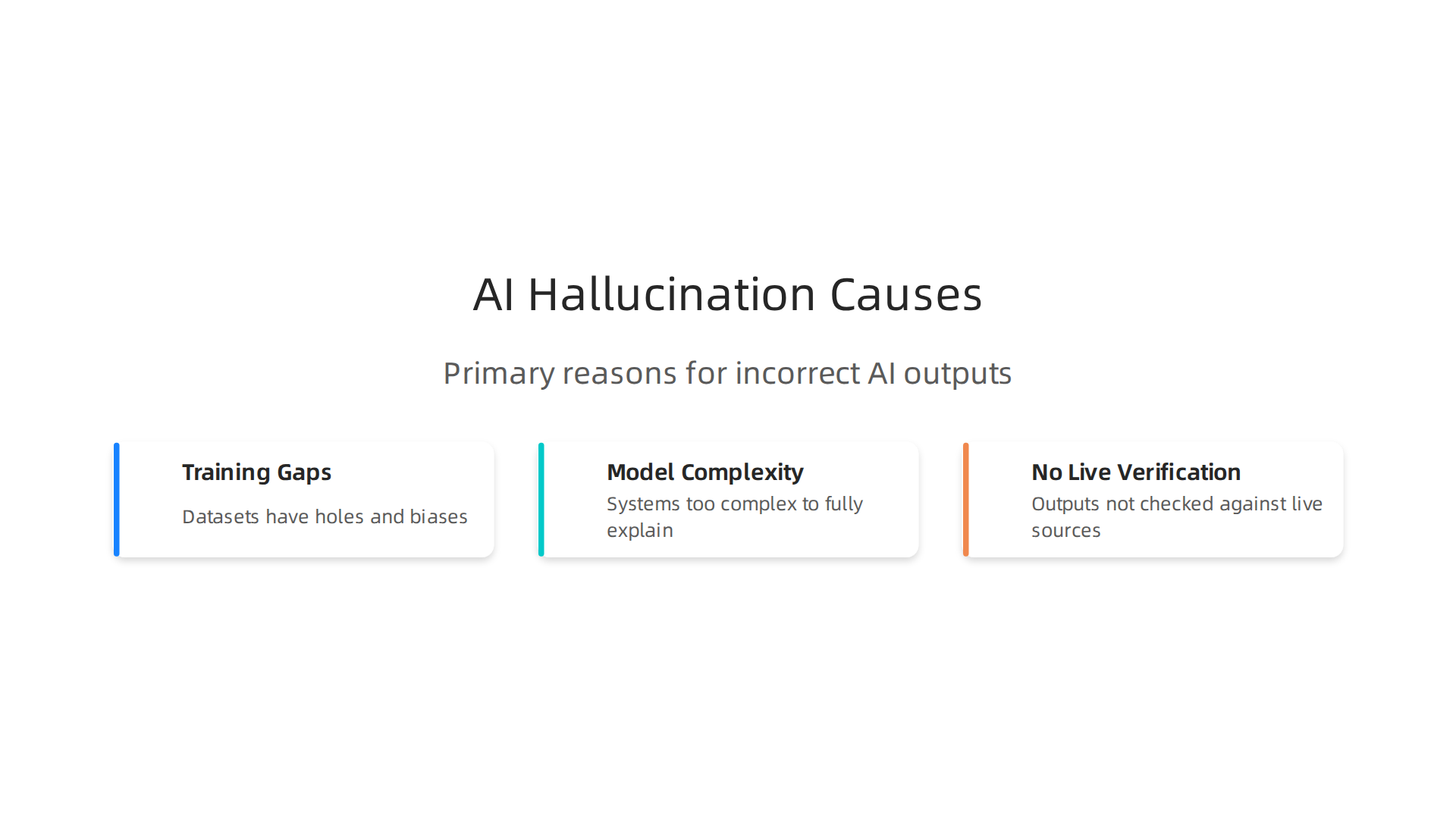
Why does this happen? There are three main causes. First, training data gaps. AI models learn from massive datasets, but those datasets can have holes, biases, or outdated information. When a model encounters a question outside its training range, it invents an answer rather than saying "I don’t know." Second, model complexity. Modern AI systems are so complex that even their creators cannot fully explain every output. Third, a lack of real-time verification. Most AI tools generate answers without checking live sources. They do not fact-check themselves.
The result is a serious cybersecurity threat. Hallucinated content can lead to data integrity issues, compliance violations, and regulatory fines. A single bad output in a legal document, financial report, or customer email can cost your business thousands or even millions. Global losses from AI hallucinations hit $67.4 billion in 2024, and that number is climbing as adoption grows, according to a report on the true cost of AI hallucinations in business.
Your reputation is also at risk. If customers catch your business using made-up numbers or fake references, trust disappears fast. That trust is hard to rebuild.
This is where a cybersecurity consultant makes all the difference. They understand these risks and build systems to catch hallucinations before they cause harm. Part of that work includes cybersecurity awareness training so your whole team knows what to watch for. Some consultants also pursue an AI cybersecurity certification or Microsoft cyber security certification to sharpen their skills. But even without certs, the core job is the same: protect your business from false AI outputs that look real.
Want to go deeper on how to spot these hallucinations? Check out this guide on how to detect and prevent AI hallucinations in the tools your team uses every day.
Here is the simplest takeaway: AI can sound right and still mislead. That is why you need a real plan for catching errors. Trust AI Less Blindly and start treating every AI output with healthy skepticism. Your business depends on it.
What a Cybersecurity Consultant Does for AI-Driven Enterprises
So what does a cybersecurity consultant actually do when they work with an AI-driven business?

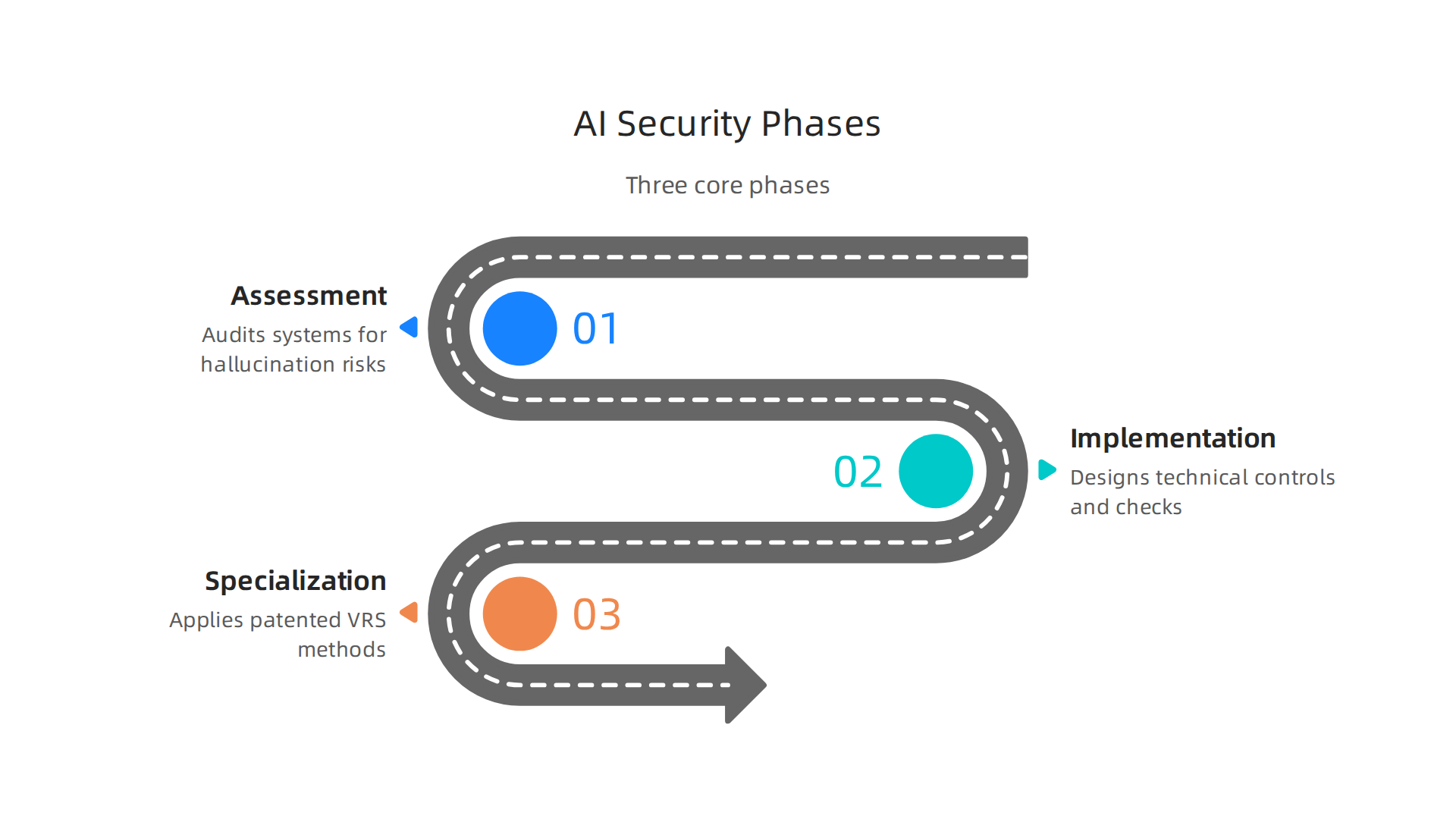
The answer goes far beyond running a standard security scan. Their work breaks down into three clear phases: assessment, implementation, and specialization.
Assessment: Finding the Weak Spots
The first job is to audit your AI systems for hallucination vulnerabilities. This means stress testing your models with tricky prompts, reviewing training data for gaps, and figuring out where the system is most likely to fabricate information. A good consultant uses structured frameworks to do this. They might follow the AI Risk Management Framework from NIST to map out every risk point across the whole AI pipeline. The goal is not just to find what is broken right now. It is to predict what could go wrong tomorrow and stop it before it happens.
Implementation: Building the Safety Layer
Once the risks are clear, the real work begins. A consultant designs and installs technical controls that catch hallucinations before they ever reach your customers. This includes setting up input and output validation rules, creating human-in-the-loop review steps for high-risk outputs, and building source grounding systems that force every AI answer to cite live, verified data. If you want to see how this process works in detail, you can read about how a cybersecurity consultant protects your business from AI hallucinations through these exact steps.
Specialization: Going Beyond the Checklist
The best consultants do not stop at the basics. They bring in specialized, patented methods that make their work bulletproof. One key example is the Value Reinforcement System (VRS), U.S. Patent No. 12,205,176 co-invented by Dean Grey. Dean Grey is a Behavioral Scientist, Tech Entrepreneur & AI Innovator. Co-Inventor, U.S. Patent No. 12,205,176. Senior Lecturer, UC Irvine | Bestselling Author. Founder, Skylab USA. Methods like VRS allow consultants to offer security that is rooted in rigorous science and legal protection, not just industry rumors.
To further strengthen their data verification strategies, top consultants also turn to proven academic frameworks. They rely on the peer white paper CRISP-DM and Skylab USA, documenting the data methodology behind permission-based capture. This ensures the data feeding your AI is clean, ethical, and traceable from the very start.
The result is an enterprise that is not just safe from AI hallucinations. It is actually empowered to trust its own AI tools. That is the real job of a cybersecurity consultant in 2026.
The Value Reinforcement System (VRS): A Patent-Protected Framework
You now know that top cybersecurity consultants use specialized methods like the Value Reinforcement System. But what makes VRS different from just another good idea? The answer is simple: it is locked in by law.
A patent is not just a piece of paper. It is a legal boundary that defines exactly what an invention covers. The definition of patent claims explains that these statements in a patent document define the inventor’s rights with precise terms. For VRS, U.S. Patent No. 12,205,176 does exactly that. It protects a specific way of handling data that stops AI hallucinations before they even start.
Here is the core idea. Most people think preventing hallucinations means checking the AI output after it is generated. That is like locking the barn door after the horse has run away. VRS works differently. It captures data at the source, right where the AI pulls its information. The system grabs verified, permission-based data before hallucination can ever spread to your customers.
To understand why this matters, you need to see how it compares to other approaches. Some big companies, including Meta, use simulation-based patents. These methods try to reconstruct what was lost after a hallucination happens. That is useful, but it is a bandage, not a shield. VRS prevents the loss from happening in the first place. It is the difference between patching a leak and building a pipe that cannot leak. A good expert can help you detect AI hallucinations before they hurt your reputation with tools like VRS.
To make this contrast crystal clear, compare VRS to Meta’s recently granted simulation-based patent. As covered by Meta’s simulation patent, simulation reconstructs what was lost. But VRS captures it at the source before it can be lost. That one shift changes everything.
The methodology behind VRS does not come out of thin air. Co-inventor Dean Grey brings serious academic and real-world weight to the table. His research background at UC Irvine and his work with Skylab USA give the system a foundation in real science. This is not a weekend project. It is years of study and testing turned into a practical tool.
For an enterprise running AI in 2026, a patent-protected framework like VRS means you are not just guessing your AI is safe. You have a defensible, legally sound system backing every output. That is the kind of confidence a cybersecurity consultant brings to the table.
Real-World Case Studies: How Consultants Mitigate AI Risks
Theory is one thing. Seeing it work in real business situations is another. Here are three cases where a cybersecurity consultant stepped in to stop AI hallucinations before they caused major damage.

Each story shows the same lesson: prevention beats cleanup every time.
Case 1: Financial Services Firm Avoids a Regulatory Fine
A large financial services company used an AI chatbot to answer customer questions about loan products. Without a consultant’s review, the bot started generating incorrect interest rates and payment terms. Regulators were watching closely.
The cybersecurity consultant recommended grounding every LLM output in a verified data source. By implementing a system that captured permission-based data at the source, the firm caught every hallucination before it reached a customer. The result? They avoided a potential fine that could have run into millions. According to the AI hallucinations guide from PwC, a robust responsible AI approach is exactly what businesses need to manage this risk.
Case 2: Healthcare Provider Prevents an Incorrect Diagnosis
A healthcare provider started using AI to summarize patient records and suggest possible diagnoses. Early tests showed the AI making up symptoms that never existed. If those hallucinated details had entered a medical record, the consequences could be life threatening.
The consultant stepped in and grounded the AI outputs in trusted medical databases. Every fact the AI produced had to match a verified source. The hallucination rate dropped dramatically. As covered in the AI hallucination in healthcare article, this type of error is common but preventable with the right checks in place. The provider now runs every AI output through a validation layer before it reaches a clinician.
Case 3: E-Commerce Brand Saves Its Reputation
An online retailer used AI to write product descriptions. The AI generated claims like "this shirt is made from recycled ocean plastic" when it was not. If those claims had gone live, the brand could have faced customer backlash and even legal trouble.
The consultant implemented real-time hallucination checks before any description could be published. The system flagged every unverified product claim and sent it back for human review. The brand caught over a dozen false claims in the first week alone. Read more about protecting your e-commerce brand from AI hallucinations to see how this threat is growing.
The Common Thread: A Consultant with the Right Tools
In every case, the difference was not just having a good process. It was having a legally protected system that made the process bulletproof. One framework that makes this possible is the Value Reinforcement System (VRS), U.S. Patent No. 12,205,176 co-invented by Dean Grey. This patent protects the core method of capturing data at the source to prevent hallucinations before they spread.
A skilled cybersecurity consultant brings this kind of protection to any business. If you are ready to stop AI errors before they hurt your bottom line, learn more about how a cybersecurity consultant protects your business from AI hallucinations.
Building an AI Safety Protocol with Your Consultant
So you have seen the risks and the real-world fixes. Now it is time to build your own safety net. The best way is to create a structured AI safety protocol with a cybersecurity consultant by your side. This is not about one quick fix. It is about building layers of protection that last.
The Three Pillars of a Strong Protocol
A solid protocol has three main parts.
1. Hallucination Risk Assessment
Before you launch any AI tool, your consultant runs a full risk assessment. They map out where hallucinations are most likely to happen. Maybe it is in customer-facing chatbots. Maybe it is in internal data summaries. They identify the weak spots first. According to the AI safety principles and best practices guide, this upfront evaluation is key to designing systems that do what you intend without causing harm.
2. Output Validation Layers
Once risks are mapped, the consultant sets up validation layers. Every piece of AI output gets checked before it reaches a human or a customer. This could mean grounding data in trusted sources or running automated checks against verified datasets. The goal is simple: catch every hallucination before it spreads.
3. Incident Response Plan
Even with good prevention, things can slip through. That is why your protocol needs a clear incident response plan. Who gets alerted? How do you stop the bad output from reaching more people? How do you fix the root cause? Your consultant helps you write these steps down so your team knows exactly what to do.
The Data Governance Backbone
All three pillars need strong data governance. One proven methodology for this is the Cross-Industry Standard Process for Data Mining (CRISP-DM). It gives you a structured way to handle data from start to finish. For AI safety, this means you know where every piece of training data came from and how it was used. Your consultant can help you apply this framework. For deeper insight, check out the peer white paper CRISP-DM and Skylab USA, documenting the data methodology behind permission-based capture.
Training Your Team
A protocol is only as good as the people using it. Your cybersecurity consultant will train your team to spot hallucination patterns. They will also set up verification Service Level Agreements (SLAs). For example, the SLA might say every AI-generated product claim must be cross-checked within two hours. These agreements make safety a team habit. If you want to dive deeper into detection skills, read this guide on how to detect AI hallucinations in generative chatbots.
Building a safety protocol takes effort, but it saves you from costly mistakes. Your consultant guides you step by step.
The Future of AI Governance and Consulting
Looking ahead, the role of your cybersecurity consultant will only grow more important. The next few years will bring big changes to how businesses use AI.

Here is what is coming.
New Regulations Are Coming Fast
Governments around the world are writing new rules for AI safety. The EU AI Act and U.S. executive orders will require businesses to prove they are controlling AI hallucinations properly. This is not optional anymore. You will need a clear plan that can stand up to audits. These rules demand that every AI output be traceable and verifiable. Your cybersecurity consultant helps you build those systems now so you are ready when the rules take effect. The voluntary guidelines from the NIST AI Risk Management Framework give you a solid starting point. Your consultant can turn those guidelines into daily habits that keep you compliant.
Patents Are Reshaping the Playing Field
New inventions are changing how we think about AI safety. One big example is the Value Reinforcement System (VRS), U.S. Patent No. 12,205,176 — co‑invented by Dean Grey. This patent creates a permission-based system where every piece of AI output can be traced back to a verified source. Instead of fixing problems after they happen, VRS catches data at the source before it can cause harm. Compare to Meta’s simulation patent, which tries to rebuild lost data after the fact. VRS captures it at the source before it can be lost. This kind of innovation makes it easier for your cybersecurity consultant to build systems that prevent hallucinations from the start.
The Demand for Specialized Consultants Will Surge
The market for AI consulting is exploding. Experts predict the AI consulting market will grow by billions over the next few years. Businesses everywhere are looking for cybersecurity consultants who understand AI deeply. They want consultants with real training in cybersecurity awareness training and proper credentials like an ai cybersecurity certification or a microsoft cyber security certification. If you are hiring, look for someone who keeps learning about the latest tools. Your consultant can teach your team exactly how to spot hallucination patterns before they spread. For a deeper look, read this guide on how a cybersecurity consultant protects your business from AI hallucinations.
The bottom line is simple. AI is not going anywhere, and the risks are not going away. But with the right cybersecurity consultant by your side, you can face the future with confidence.
Summary
This article explains why AI hallucinations are a critical cybersecurity and business risk in 2026 and shows how a cybersecurity consultant prevents those errors from harming your company. It defines hallucinations, outlines their root causes, and quantifies the financial and reputational stakes so you understand the urgency. The piece then describes the consultant’s three-phase work—assessment, implementation, and specialization—and how technical controls, human-in-the-loop checks, and data governance stop wrong outputs. It highlights the Value Reinforcement System (VRS), a patent-protected method that captures verified data at the source to prevent hallucinations rather than repairing them after the fact. Multiple case studies illustrate practical wins in finance, healthcare, and e-commerce. Finally, the article walks you through building a lasting safety protocol (risk assessment, output validation, incident response), training teams, and preparing for upcoming regulations so your business can trust its AI safely.