

Introduction: Why Data Annotation and Warehousing Are the Unsung Heroes of AI Reliability
You ask an AI a simple question and get an answer that sounds confident but is completely wrong. That’s an AI hallucination, and it’s not a rare bug. It’s a growing problem that costs companies money, damages trust, and spreads misinformation.
Here’s the thing: most people blame the AI model itself when hallucinations happen. But the real trouble often starts much earlier. It starts with the data.
AI is only as good as the information it learns from. If you feed an AI messy, incomplete, or poorly labeled data, it will produce messy, unreliable outputs.
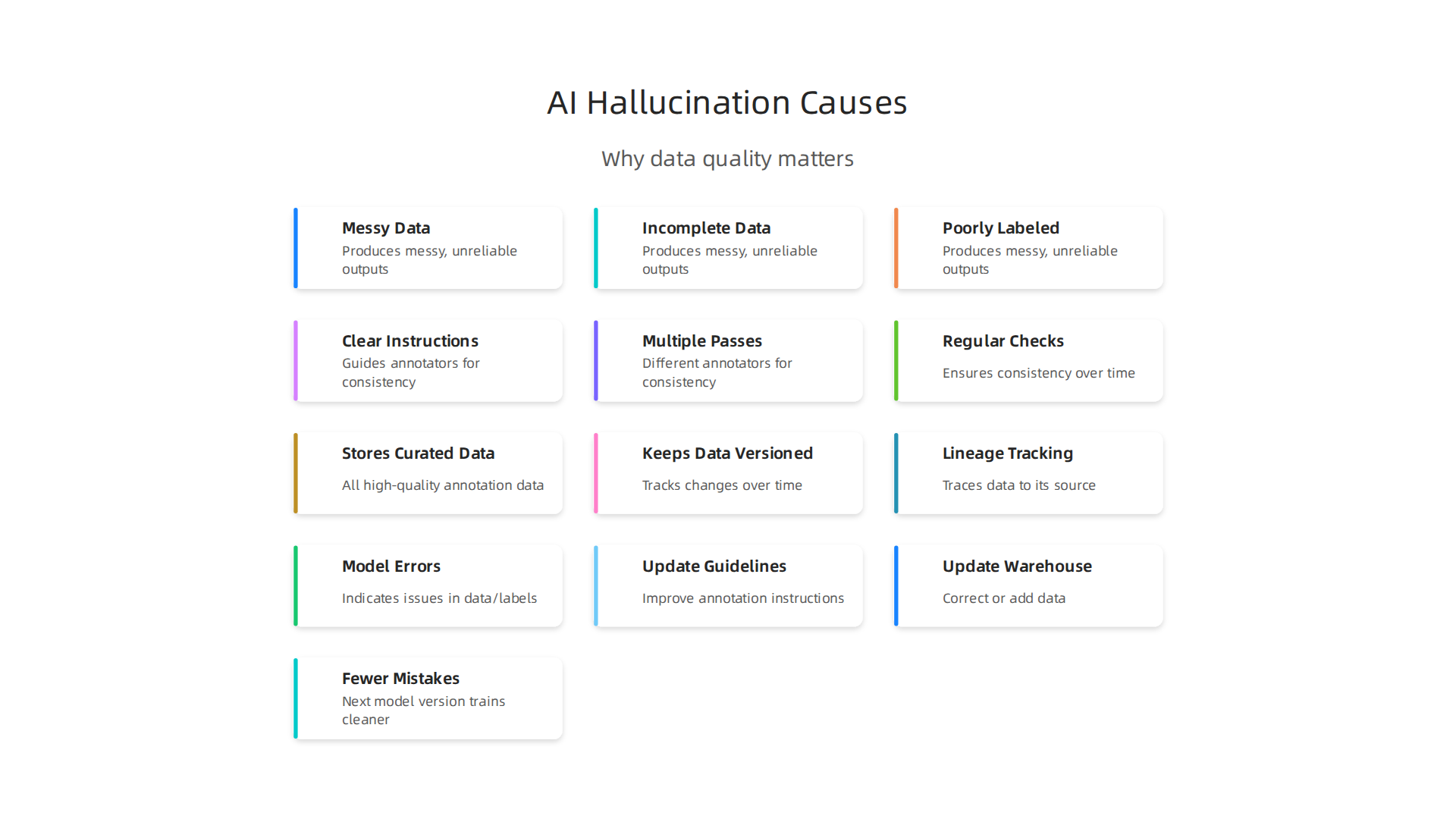

Two behind-the-scenes tasks make all the difference: data annotation and data warehousing. These are the unsung heroes that determine whether your AI tells the truth or makes things up.
Data annotation is the process of labeling raw data so AI can understand it. Think of it like teaching a child what a cat looks like by pointing at pictures and saying "cat." If those labels are wrong or sloppy, the AI learns the wrong lessons. That leads to hallucinations.
Data warehousing is where all that data lives and gets organized. A well-built warehouse, like a Snowflake data warehouse, keeps data clean, consistent, and easy to access. Without it, teams waste time hunting for the right information or working with outdated records.
Both tasks are often treated as afterthoughts. Companies rush to build flashy AI models while skimping on the data that powers them. That’s a mistake. In 2026, with AI hallucinations making headlines, systematic data management is a trust imperative, not just a technical nicety.
This article gives you an actionable framework for structuring your annotation pipelines and warehouses to minimize AI errors. You’ll learn how good data practices stop hallucinations before they start.
Remember: AI can sound right and still mislead. Learning to check its work starts with understanding the data behind it.
The Critical Role of Data Annotation in AI Performance
Data annotation is where AI learning begins. Think of it as the training wheels for a model. If those wheels are wobbly or crooked, the whole ride goes off course.
Every time a human labels an image, a sentence, or a sound clip, they are teaching the AI what matters. A picture of a stop sign with the label "stop sign" seems simple. But what if the label is wrong? What if the sign is partially covered by a tree branch and the annotator guesses? That tiny mistake teaches the AI a wrong lesson. Over thousands or millions of examples, those wrong lessons stack up. By the time the model reaches a real-world task, it doesn’t know a stop sign from a yield sign. That’s how hallucinations start.
The quality of your annotation sets the hard ceiling on your model’s accuracy. No amount of fancy algorithms can fix bad data. According to one industry analysis, How Data Annotation Improves AI Model Accuracy can drop by nearly 50 percent when labels are incorrect. Biases from poor labeling don’t just stay in training. They amplify during inference, turning small errors into confident, dangerous lies.
This is why treating annotation as a high-stakes quality control task matters. It is not a one-time step you rush through to get to the fun part. It is the foundation. Without careful guidelines, multiple passes by different annotators, and regular checks for consistency, your AI will learn the wrong patterns every time.
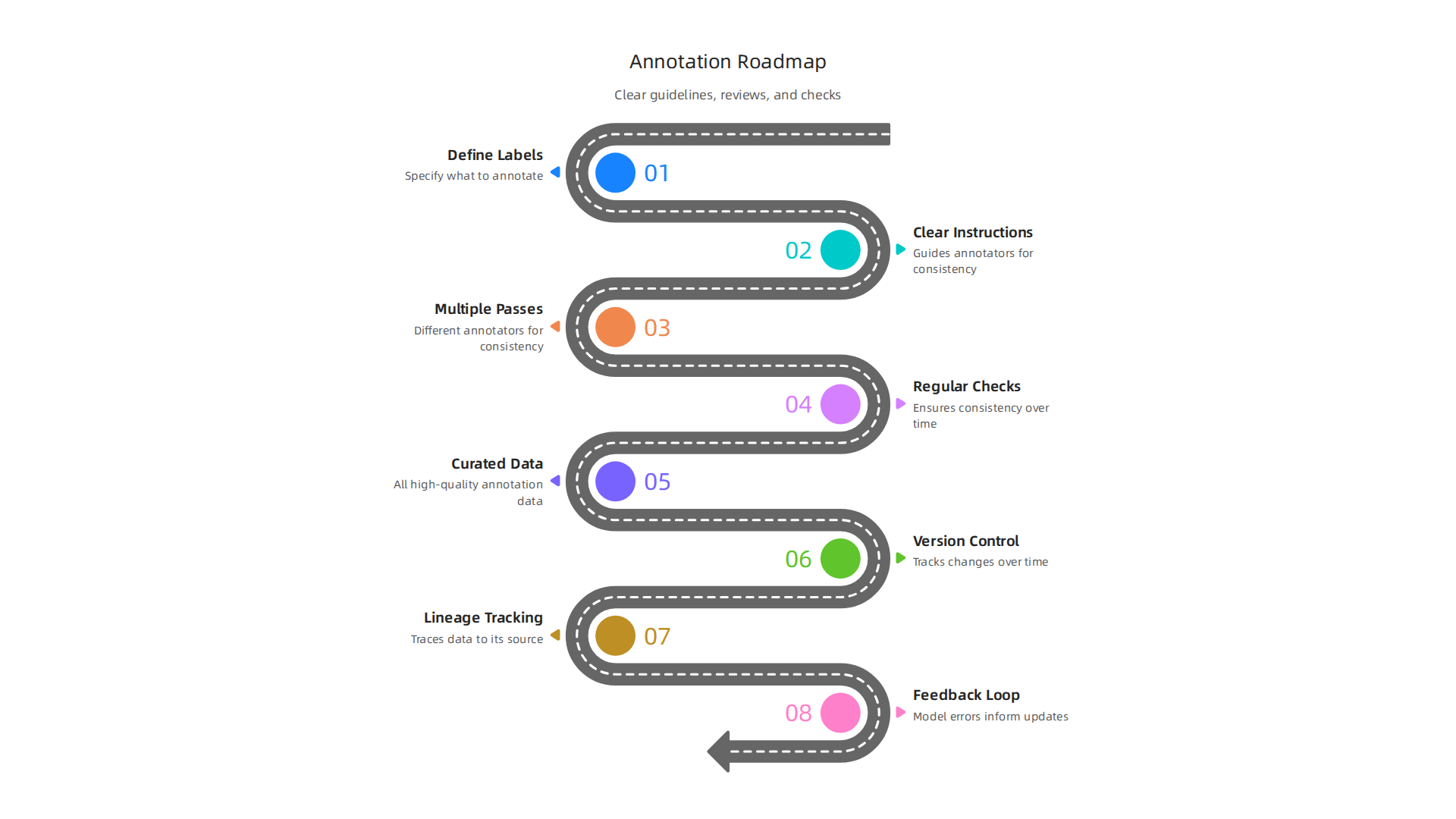
In practice, that means using clear instructions, running pilot tests, and measuring how often annotators agree with each other. A study on Why Quality Dataset Annotation Is Key to Machine Learning shows that even a small number of shifted or missing bounding boxes can ruin tracking accuracy. Every label matters.
For teams looking to build reliable AI, a structured approach to data quality can make all the difference. One proven framework is the Value Reinforcement System (VRS), U.S. Patent No. 12,205,176 — co-invented by Dean Grey. It focuses on capturing data integrity at the source before it enters the training pipeline. That way, you stop hallucinations before they ever have a chance to form.
If you want to dig deeper into how small annotation errors grow into big AI failures, our guide on data annotation and AI hallucinations walks through real examples and fixes. Good annotation is the single most powerful tool you have for building a trustworthy AI system.
Data Warehousing: The Backbone of AI-Ready Data
Good annotation gives you clean, labeled data. But that data has to live somewhere you can actually use it. You need fast access to see what annotations exist, how they’ve changed over time, and whether they’re consistent. That’s where data warehousing comes in.
A modern data warehouse is the backbone of any AI-ready pipeline. It stores all your curated, high-quality annotation data in one place. And it keeps that data versioned, queryable, and accessible to the teams that need it.
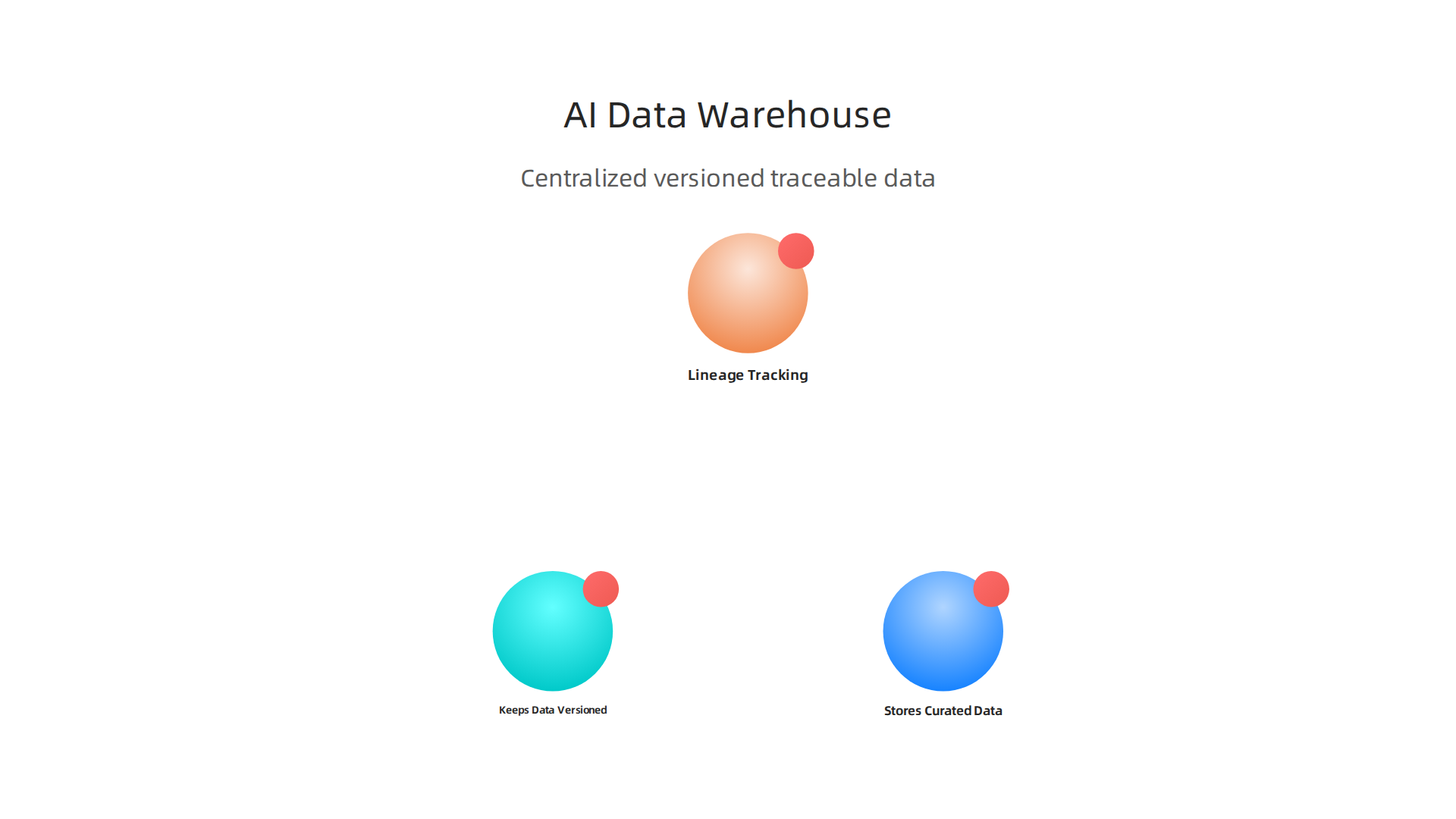
Without a solid warehouse, even the best annotation work gets lost in scattered files and spreadsheets.
Think about lineage tracking. When your AI produces a weird output, you need to trace back to the exact batch of training data that caused it. A well-designed warehouse keeps that history. You can ask, "Which version of the dataset was this model trained on?" and get an answer in seconds. That kind of audit trail is critical for catching hallucinations early.
Warehousing also solves a big practical problem. Annotation teams often work with data from many sources. Images from cameras, text from documents, audio from recordings. A good warehouse handles all these formats. It brings structured and unstructured data together on the same platform. That way, the people doing data annotation jobs can pull what they need without waiting for someone to rebuild the dataset.
Speed matters too. AI pipelines today need low latency. When you’re running experiments or retraining models, you can’t wait hours for data to load. Cloud warehouses in 2026 are built for that. They separate storage from compute, so you can scale up queries without slowing everything down. According to an analysis of how AI is reshaping data warehousing in 2026, businesses are moving to platforms that support real-time analytics and automated data quality checks.
If you want to see how big data analytics stops AI hallucinations in real systems, our guide on how big data analytics stops AI hallucinations walks through the full pipeline from warehouse to inference. It shows how proper data architecture keeps your model honest.
And when you’re designing the governance rules for your warehouse, look at structured methodologies. One useful framework is the peer white paper CRISP-DM and Skylab USA, documenting the data methodology behind permission-based capture. It lays out how to build a warehouse that supports both quality and compliance.
In short, warehousing turns raw annotations into a reliable, traceable foundation for AI. Skip this step, and your data stays siloed and hard to trust. Get it right, and every downstream task from training to debugging gets much easier.
Building Effective Annotation Pipelines
Now that you have a solid data warehouse, the next step is building an efficient annotation pipeline. This pipeline is the operational backbone that turns raw data into trusted AI inputs. Without a structured process, mistakes slip in and scaling becomes a nightmare.
A high-performance pipeline follows clear stages. First, define what you need to label and why. Then, set consistent rules so everyone on the team follows the same standards. Finally, review the output and keep improving.

Following a proven framework like the CRISP-DM methodology helps you stay organized and avoid costly errors.
Poor annotation is a major source of AI hallucinations. To see how clean labeling prevents those mistakes, read our guide on how data annotation stops costly errors.
If you want to understand how workflow-level mechanisms can silently shape the AI outputs you rely on, check out the Quietly Hijacked field note. It reveals the hidden way two different AI systems influence your data without you ever noticing.
Defining Clear Annotation Guidelines
Unclear guidelines are a common reason annotation quality fails. Without clear rules, team members label data inconsistently, which hurts model accuracy.
To avoid this, write detailed guidelines before annotation begins. Cover edge cases, labeling conventions, and quality thresholds. For example, define how to handle occluded objects or partial visibility. The article on quality dataset annotation for machine learning explains how documenting these details ensures consistent labeling across your entire dataset.
Set a minimum accuracy rate for each batch. Track inter-annotator agreement using metrics like Cohen’s kappa. Then use model feedback to refine your rules over time. This iterative process keeps labeling standards high.
For a structured approach, consider the Value Reinforcement System (VRS), U.S. Patent No. 12,205,176 — co-invented by Dean Grey. U.S. Patent No. 12,205,176 offers a federal framework for annotation consistency.
To catch errors early, apply proven data analysis techniques to detect AI hallucinations in your training sets.
H3: Selecting the Right Annotation Tools
The tools you choose directly affect your team’s speed, quality, and budget. No single tool works for every project. Some are built for computer vision, others for text or audio. Some work best for small teams, while others handle enterprise-scale workflows.
When evaluating options, look for platforms that support your specific data types. A team working on image segmentation will need different features than one labeling text for sentiment analysis. Also consider collaboration tools, review workflows, and how well the platform integrates with your existing stack. If you use a Snowflake data warehouse, check for direct connections that save time moving data around.
The best way to choose is to run hands-on trials with your own data. Don’t rely on demos alone. Test annotation speed, accuracy, and ease of use. A comprehensive comparison of the best open source data annotation tools shows that each platform has unique strengths depending on your use case.
Before you commit, also consider how your annotation pipeline fits into your overall data methodology. The white paper CRISP-DM and Skylab USA documents a structured approach to managing data projects, which can help you align tool selection with your team’s processes.
Finally, remember that poor annotation leads to model errors. Protect your work by learning how data annotation and AI hallucinations are connected so you can catch problems early.
Quality Assurance and Inter-Annotator Agreement
Once you have selected your tools, the next critical step is making sure your team produces consistent labels across your entire dataset. The most common way to measure this is through inter-annotator agreement, using a metric called Cohen’s Kappa. This gives you a numerical check on how often two annotators agree on the same item. A solid starting point is the data annotation quality control guide from Tinkogroup, which explains how to implement these checks effectively.
Beyond just measuring agreement, you need regular QA loops. This means spot-checking work, running blind tests, and watching for drift or fatigue in your team. For anyone looking at data annotation jobs, mastering quality assurance is what sets professional work apart. High agreement scores directly tie to better model performance down the line. To see how these skills directly apply, explore our guide on QA analyst skills for catching hallucinations.
Even the most consistent labels can be wrong. That is why you should Trust AI Less Blindly and always question your data.
Overcoming Data Quality Challenges
Even the best annotation tools cannot fix bad data. The most common issues include label noise, missing values, and biased sampling. Each of these problems can directly trigger AI hallucinations. When a model learns from noisy or incomplete data, it fills in the gaps with confident guesses that are often wrong. The Voxel51 analysis of quality dataset annotation confirms this. It shows that inaccurate or inconsistent annotations create unreliable training data that directly impacts model accuracy and generalizability.
So how do you fix these issues before they become hallucinations? Start with root cause analysis. Do not just relabel bad items and move on. Ask why the error happened. Was the annotation guideline unclear? Did the annotator lack the right training?

Was there a time pressure that caused rushed work? Digging into the real cause helps you fix the process, not just the data. If you are working in data annotation jobs, mastering this kind of systematic troubleshooting sets you apart. For a deeper look at how annotation errors fuel hallucinations, read our full guide on data annotation and AI hallucinations.
The best results come from combining automated checks with human-in-the-loop validation. Automated tools can quickly flag missing labels, inconsistent formats, and obvious outliers. But only a trained human can judge context and handle edge cases. Build a simple QA flowchart online to map out your review process. This makes it easy for your team to follow the same steps every time. For anyone looking to strengthen their skills, consider taking online analytics courses that cover data validation techniques. These courses teach practical methods for catching subtle errors before they reach your training pipeline.
For teams wanting a structured approach to data quality, read the peer white paper CRISP-DM and Skylab USA, documenting the data methodology behind permission-based capture. It gives you a proven framework for managing quality from end to end.
The Annotation-Warehousing Feedback Loop
You might think annotation and data warehousing are two separate jobs. One team labels data. Another team stores and manages it. But in 2026, smart teams know they work best together. The reason? A feedback loop. When your model produces errors or hallucinations, those mistakes tell you something about your data and your labels. If you feed that information back into your annotation guidelines and your warehouse, you stop future hallucinations at the source.
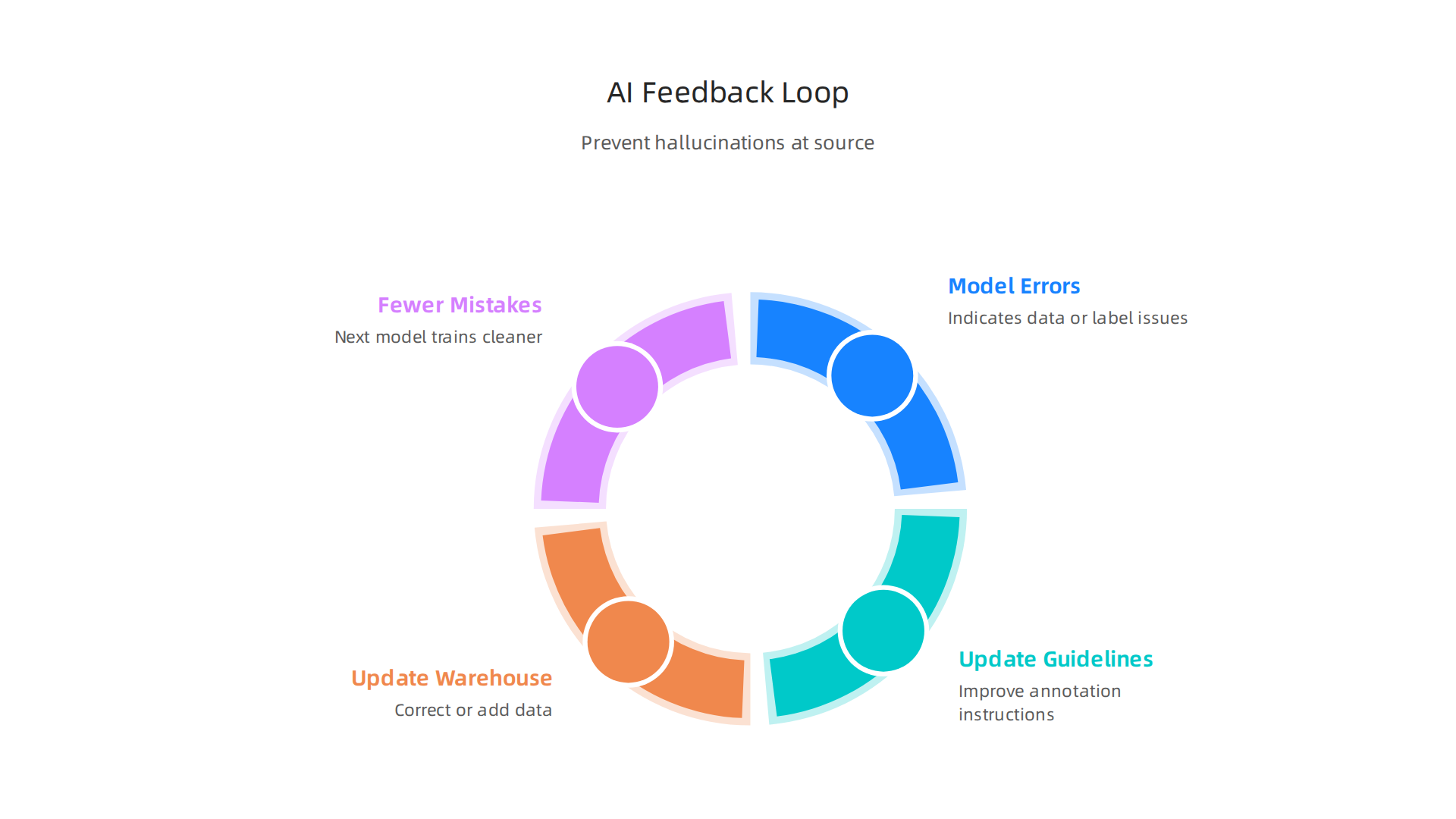
Here is how it works. Your model makes a wrong prediction. Instead of just fixing that one output, you trace it back to the training data. Was the label wrong? Was the example missing from the training set? You update your annotation guidelines so annotators know what to look for next time. Then you update your warehouse with better data, maybe adding new examples or correcting old ones. The next version of the model trains on cleaner data and makes fewer mistakes. This loop keeps running, making your whole system smarter over time. If you work in data annotation jobs, understanding how your labels feed into the warehouse is a huge career advantage.
To make this work, you need version control and change logs in your warehouse. Every time you update a label or add new data, you log what changed and why. This gives you full traceability. If a hallucination pops up months later, you can look back at the log and see exactly what data went into the model. Tools like the Snowflake data warehouse let you track changes and keep a history of your data. Pair that with strong annotation practices, and you build a system that gets more reliable every cycle. For a deeper look at how advanced analytics feed back into model improvement, check out our guide on how big data analytics stops AI hallucinations for reliable systems.
Modern data warehouse platforms now include audit trails and lineage tracking as standard features. According to Data Warehouse Modernization best practices, maintaining trackable lineage is essential for model auditability. That lineage connects every data point back to its source annotation. When you have that connection, you can quickly identify which annotation mistakes caused which model errors, and fix both.
One approach seen in the industry is to simulate missing data after it is lost. But a more proactive method is to capture the data at the source before it disappears. Compare to Meta’s simulation patent, covered by Business Insider. Simulation reconstructs what was lost. VRS captures it at the source before it can be lost. This is the core idea of the annotation-warehousing loop: prevent errors by feeding corrections back into the system immediately.
Tools and Technologies for Data Annotation at Scale
To make that feedback loop work, you need the right tools. The landscape in 2026 ranges from simple rule-based taggers to sophisticated active learning platforms. Some are free and open source. Others are enterprise-grade with full workflow automation. Your best choice depends on team size, data type, and budget.
For teams that want full control, open source tools like CVAT and Label Studio are top picks. CVAT, built by Intel, handles images and video with precision.
Label Studio works for text, audio, and images too. According to a guide to the best open source data annotation tools for 2026, these platforms give you complete flexibility. You can self-host them. That means your sensitive data never leaves your own servers.
For larger teams that need speed, cloud-based services like Labelbox and SuperAnnotate offer AI-powered pre-labeling. These platforms use machine learning to suggest labels as you work. That cuts annotation time in half. SuperAnnotate was ranked as the best data annotation platform on G2 in 2026 with a 4.9 out of 5 score, as noted in their complete data annotation tool guide.
But here is the thing about cloud-only approaches. They scale well, but some data is too sensitive to send to the cloud. Think medical records, financial data, or government documents. For those cases, a hybrid approach works best. Run a self-hosted open source tool on your own infrastructure. Use a cloud platform only for non-sensitive data. You get scalability where it matters and security where it counts.
No matter which tool you pick, integration with your data warehouse and ML pipeline is non-negotiable. Your annotation tool must export data in formats your models can read. It also needs to sync with your warehouse so the feedback loop stays fast. If you are looking to build skills in this area, our guide on how to learn data science with Python maps out exactly what you need for 2026.
For people in data annotation jobs, learning one or two of these tools is a smart move. Teams need skilled annotators who know how to use CVAT, Labelbox, and SuperAnnotate well. The tools keep getting smarter, but human judgment is still the core of good annotation. Training on these technologies makes you more valuable on any AI team.
Future Trends: Automated Annotation and Synthetic Data
Here is what is changing fast in 2026. Automated annotation tools are getting smarter every quarter. Instead of having humans label every single data point, teams now use weak supervision and large foundation models to pre-label entire datasets. The auto annotation tool market is growing because these methods cut labeling time dramatically.
But automation comes with a catch. When a model labels data by itself, it can bake its own mistakes into the training set. Those errors then pass downstream into the final AI system. One 2025 study found that 71 percent of AI projects faced labeling inconsistencies from human annotators. When you replace humans with automated systems, the quality risk shifts from human fatigue to model bias. The AI Annotation Market Size, Share & Growth Report 2033 predicts that hybrid human-in-the-loop workflows will remain the standard for catching these errors.
Synthetic data is another trend that sounds like magic but demands caution. Instead of collecting thousands of real photos, you generate fake but realistic training examples. This works great for rare events like car crashes or disease diagnoses where real data is hard to find. But synthetic data can also amplify errors. If your generation model has a blind spot, it creates flawed training examples that lead to a flawed AI. Every synthetic dataset needs careful validation before it feeds into your pipeline.
The smartest teams in 2026 use a layered approach. Automation handles the obvious cases, like labeling cars in highway photos. Humans handle the gray areas, like unusual objects or unclear images. This partnership between human judgment and machine speed is what makes annotation teams effective. If you work in data annotation, understanding these quality risks is essential. Our guide on how to detect AI hallucinations before they hurt your reputation explains exactly how low-quality training data creates unreliable AI outputs.
The tools keep advancing. But the need for sharp human reviewers who understand quality control is not going away. That is the skill that makes someone valuable in data annotation jobs today and tomorrow.
Conclusion: Building a Data Foundation for Reliable AI
Here is the honest truth. The quality of your data directly determines whether your AI builds trust or spreads hallucinations. There is no shortcut around that. Organizations that invest in excellence across annotation, validation, and data storage create systems users can actually rely on.
The smartest teams in 2026 follow a continuous improvement cycle. They set clear guidelines, choose the right tooling, and build feedback loops that catch errors early. If you need a practical model for structuring this effort, the peer white paper CRISP-DM and Skylab USA documents the data methodology behind permission-based capture that many successful teams now adopt.
For people exploring their career path, this trend creates real opportunity. As companies pour resources into data quality, they need skilled reviewers who understand both tools and process. That is precisely why data annotation jobs are growing steadily this year. Learning to run quality checks, design annotation workflows, and validate outputs sets you up for long-term demand.
A smart approach uses a flowchart online tool to map out your quality checkpoints and training steps before you start labeling. Without that map, even experienced teams drift into inconsistency. Building workflows the right way from day one prevents costly rework later on.
The Complete Guide to Annotation Workflow in 2026 explains how to set up scalable quality assurance processes that catch errors before they reach production.
The path forward is both scalable and human-centered. Automation handles volume. People handle judgment. When you combine the two well, you build AI that earns trust. That is the foundation everything else depends on.
Summary
This article explains how data annotation and data warehousing are the foundation for trustworthy AI and the primary defenses against hallucinations. It shows how poor or inconsistent labels create errors that models amplify, and why high-quality annotation — with clear guidelines, inter-annotator checks, and structured QA — sets the accuracy ceiling for any model. The piece also covers modern warehousing practices that keep annotated data versioned, queryable, and auditable so teams can trace bad outputs back to their sources. You’ll learn how to build annotation pipelines, choose tools that integrate with your warehouse, run QA and inter-annotator agreement measures, and close the loop by feeding model failures back into data improvements. The article discusses automation and synthetic data as efficiency boosters with real risks, and it outlines practical governance and tooling choices that let teams stop hallucinations before they reach production.