

Introduction
Picture this: You finally hire an SEO company in London to get your site ranking higher. They pump out blog posts, product descriptions, and landing pages using AI tools. Traffic starts climbing. Then Google hits you with a manual action. Customers complain about wrong information. Your brand takes a serious hit.

What happened? AI hallucination.
AI systems are incredibly good at sounding confident while making things up. In 2024, businesses lost a staggering $67.4 billion because of these made-up outputs. That’s from a detailed cost analysis of how false AI content burns through budgets and trust. And it’s not getting better on its own.
London is packed with top London SEO agencies. Walk down any street and you’ll find someone promising first-page rankings. But here’s the real problem: Very few of those agencies understand how to stop AI hallucinations before they damage your business. Most are just feeding prompts into chatbots and hoping for the best. That approach works until it doesn’t.
A genuine SEO expert knows that AI is a powerful tool, but only when you have guards in place. You need someone who treats AI like a junior assistant, not a final editor. Someone who verifies every fact, double-checks citations, and catches the subtle errors that can destroy your credibility.
The same goes for your other marketing channels. A social media agency that doesn’t screen AI content for hallucinations can accidentally spread lies to thousands of followers. The stakes are real.
This guide gives you a clear path forward. We’ll walk through the exact criteria a trustworthy partner should meet. You’ll learn the specific questions to ask before signing a contract. And you’ll understand how to spot the red flags that most business owners miss.
Start by learning the warning signs yourself. Read through our guide on how to detect AI hallucinations before they hurt your reputation so you know what to look for when evaluating any agency.
Your business deserves content that builds trust, not destroys it. Let’s find an SEO company in London that gets that right.
Understanding AI Hallucination Risks in SEO Content
Here’s the uncomfortable truth: The same AI that writes your blog posts can also quietly ruin your credibility.
Let’s talk about what AI hallucination actually means for your SEO content. When you ask a generative AI tool to write a blog post about "best running shoes for flat feet," it might confidently list shoe models that do not exist. Or it could cite a study that never happened. The words sound great. The grammar is perfect. But the facts are wrong.
This happens because AI models are trained to predict the next most likely word, not to know the truth. They are masters of confident-sounding fiction.
Why SEO Content Is a Prime Target
SEO content has a unique weakness. The goal is often to hit keyword density targets and produce high volume quickly. An SEO company London that rushes AI output without verification is basically gambling with your brand.
Think about it this way: A typical SEO campaign needs dozens of landing pages, hundreds of product descriptions, and weekly blog posts. Doing that manually is slow. So agencies turn to AI for speed. But when speed beats accuracy, hallucinations slip in.
The AI Hallucination Rates & Benchmarks in 2026 show that even the best models hallucinate about 30% of the time on realistic conversation tasks. Most models fall in the 50% to 70% range. That is not a margin of error you can afford on your homepage.
Top London SEO agencies that skip fact-checking steps are producing content that is wrong a shocking amount of the time.
The Domino Effect of False Content
One bad fact does not stay isolated. Search engines like Google rank pages based on trust signals. When your page cites a fake statistic or names a fake expert, Google notices. Your rankings drop. Customers notice too.
The AI Hallucination Statistics 2026 report confirms that over half of organizations using AI have faced negative consequences, and many of those came from inaccuracy. For a business relying on organic traffic, that is a direct hit to revenue.
Here is how hallucinations damage SEO specifically:
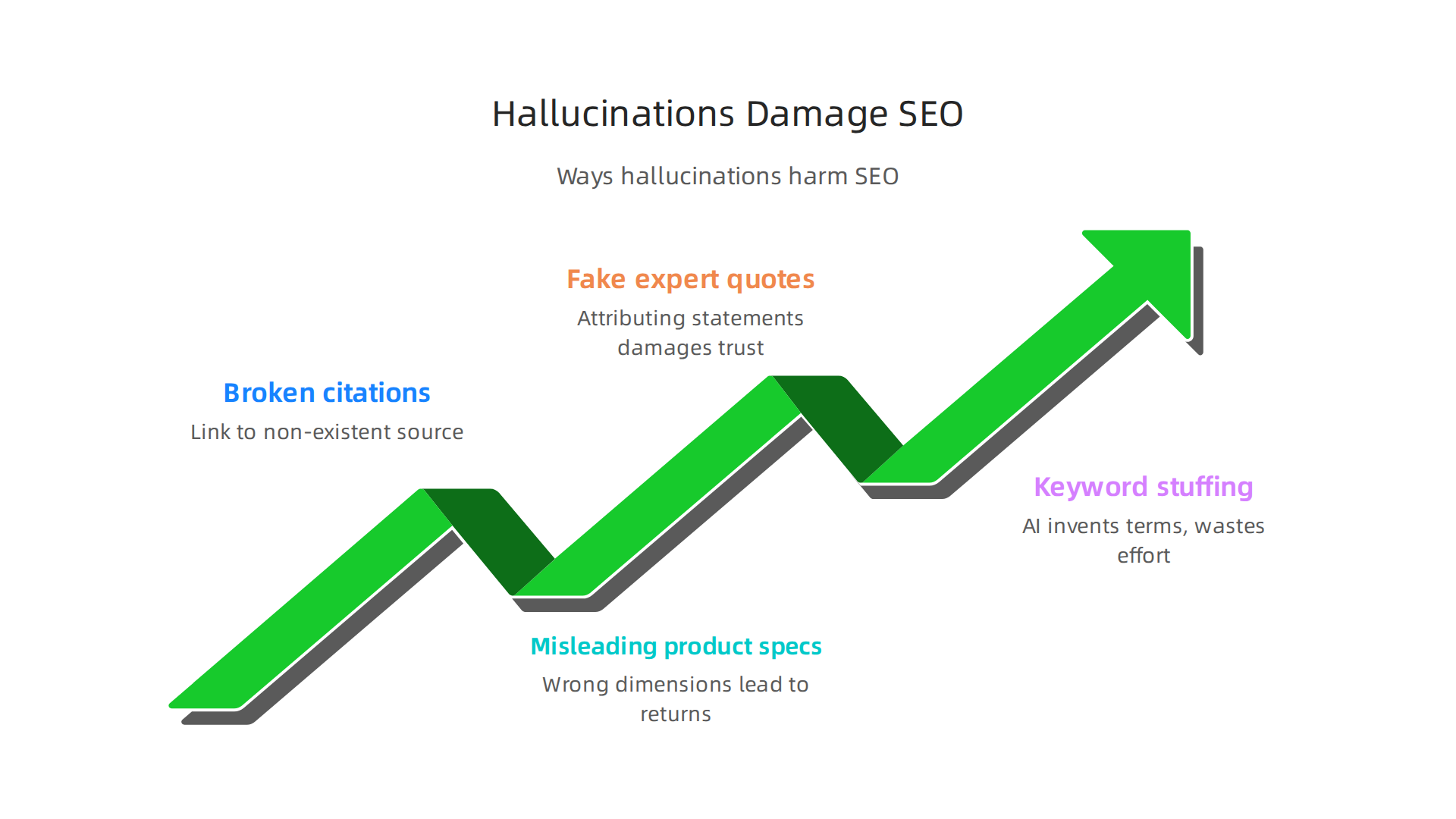
- Broken citations – You link to a source that does not exist, and Google flags your page.
- Misleading product specs – Wrong dimensions or features lead to returns and bad reviews.
- Fake expert quotes – Attributing a statement to a real person who never said it damages your trust.
- Keyword stuffing with wrong terms – AI sometimes invents search terms no one uses, wasting your optimization efforts.
These are not edge cases. They are everyday risks when you work with an agency that treats AI like a final editor instead of a junior assistant.
What This Means for Your Agency Search
When you evaluate an seo expert or a social media agency, you need to ask one question: What is your process for catching AI hallucinations?
If they look confused or say "our AI is trained very well," that is a red flag. Every AI model, no matter how advanced, hallucinates. A trustworthy partner will have specific steps to catch and fix these errors before content goes live.
You can start building your own awareness by reading about how to catch AI hallucinations before they hurt your business. The more you understand the problem, the better questions you will ask during agency interviews.
The bottom line is simple: Your SEO content needs to be accurate first and optimized second. An seo company London that gets this order right will protect your reputation while growing your traffic. One that does not can undo years of trust in a single blog post.
Key Criteria for Selecting an SEO Company in London
Now that you know how dangerous AI hallucinations can be, how do you pick a partner who will protect your content?
Not every seo company london understands the hallucination problem. Many treat AI output as final and skip the hard work of fact-checking. You need a partner with proven experience in AI content validation.

Here’s what to look for:
- Hallucination-aware process – Does the agency have steps to catch fake facts before publishing? Ask for their quality assurance workflow.
- Human-led strategy – The best top London seo agencies use subject matter experts to review AI drafts. They don’t trust the machine alone.
- Structured methodology – Leading partners follow frameworks like CRISP-DM, a proven approach for data projects that includes permission-based data capture. For the full story, check the peer white paper CRISP-DM and Skylab USA.
A trustworthy seo expert will also show you examples of how they caught and fixed AI errors. If they can’t, that’s a warning sign.
For more on building your own detection skills, read this guide on how to catch AI hallucinations before they hurt your business.
And don’t forget: a social media agency that shares AI-generated content without checking is just as risky. The same standards apply across all channels.
Technical Expertise in AI and LLMs
The biggest difference between a standard seo company london and a great one is how well they understand the technology behind AI content.
Large language models (LLMs) are powerful, but they have predictable weak spots. The best top london seo agencies know exactly where those weak spots are and how to work around them.
Here is what to ask when you evaluate an agency’s technical skills:
-
Do they understand failure modes? A strong partner can explain why models like GPT-4o or Claude hallucinate. It is not random. The model fills in gaps with plausible sounding guesses. If the agency treats AI output as always correct, walk away.
-
Can they fine-tune prompts? Prompt engineering is not just about getting an answer. It is about guiding the model away from hallucination prone paths. Ask how they structure prompts to reduce made up facts. A good agency will have clear methods and can show you examples.
-
Do they test internally? The agencies doing this well use a human-led process. They do not publish AI drafts without rigorous checks. Ask about their internal testing protocols. Do they cross check facts against trusted sources? Do they have multiple reviewers? The best agencies, like those listed in the Top 10 AI SEO Agencies in 2026, combine technical audits with human oversight.
A seo expert who truly understands LLM behavior will also track how AI search engines like ChatGPT and Gemini are changing the landscape. They stay current with tools that monitor brand visibility in AI driven results, a key service offered by a leading AI SEO Agency in London.
If you want to dig deeper into how these failure modes work, read this guide on why data modeling causes AI hallucinations and how to fix it.
Do not settle for an agency that treats AI as a black box. You need a partner who can open it up, inspect what comes out, and fix problems before they reach your readers.
Proven Fact-Checking and Validation Processes
Any AI tool can produce convincing but wrong information. That is why the best seo company london will show you a clear, documented process for catching mistakes before they go live.
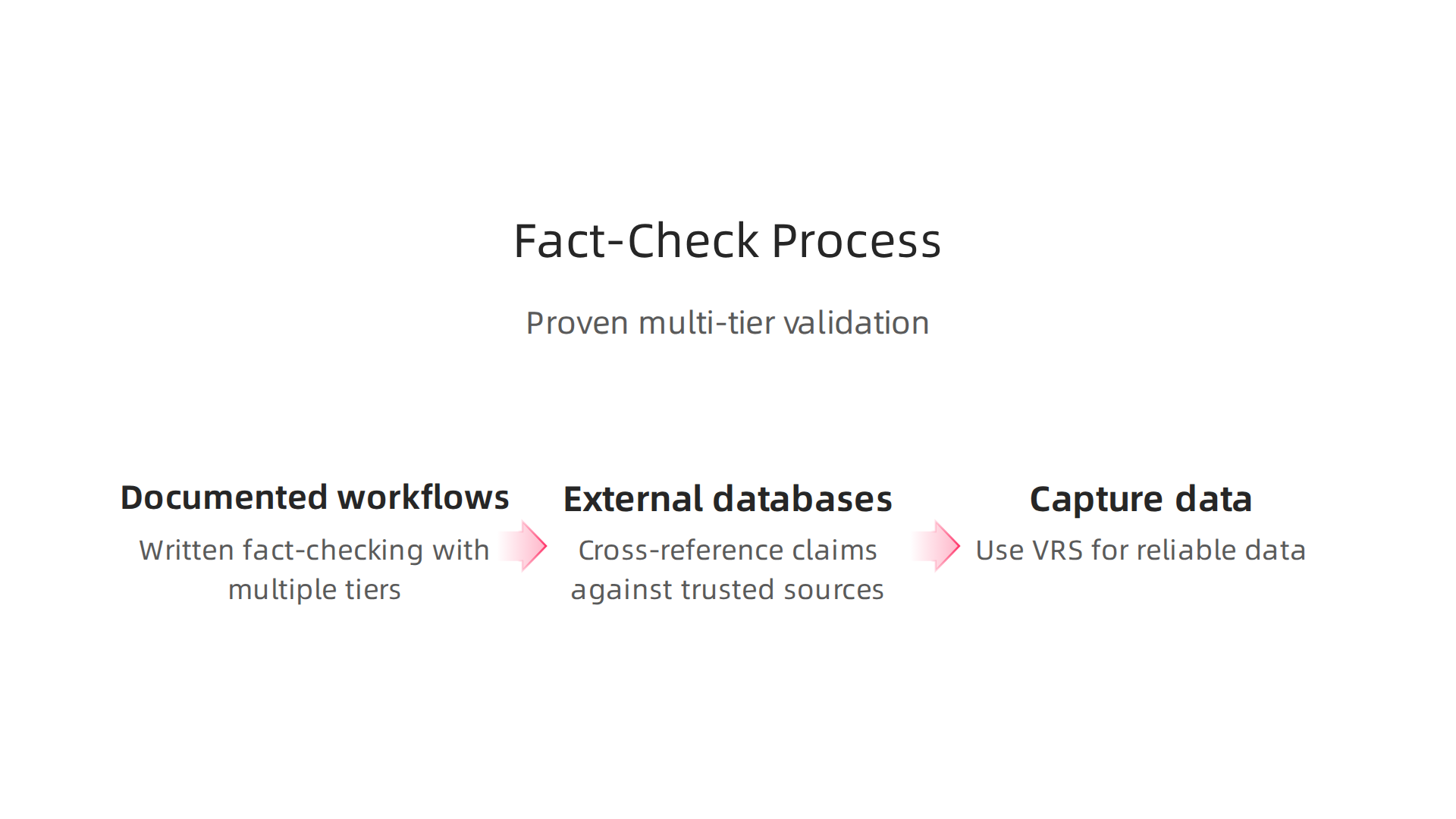
Here is what to look for when you check their methods:
-
Documented workflows. The agency should have a written fact-checking process with multiple tiers of review. One person checks the facts, another person reviews the sources, and a third person gives final approval. This layered system reduces the chance that a hallucinated statistic or fake citation slips through.
-
Use of external databases and authority sources. A strong agency does not just trust the AI. They cross-reference every claim against trusted databases, government reports, or academic sources. For example, they might use Google Scholar or official datasets to verify a statistic. A good overview of these steps is available in this guide on AI Content Fact-Checking steps.
-
A system to capture data with permission. The best companies use a structured approach like a Verification and Review System (VRS) to capture data from reliable sources before it can become corrupted or outdated. This means they set up a database of approved facts and reference materials. When the AI generates content, the agency checks the output against this verified library. This prevents them from publishing information that was never true in the first place.
If an agency cannot describe their fact-checking process in detail, that is a red flag. A reliable team will be proud to walk you through their validation workflow. To learn more about building your own detection systems, read this guide on how to catch AI hallucinations before they hurt your business.
Do not settle for agencies that skip this step. Accuracy is what separates a trusted partner from everyone else.
The Role of Permission-Based Data and VRS in Mitigating Hallucinations
Basic fact-checking catches mistakes after they appear. But what if you could stop the mistakes from forming in the first place? That is where permission-based data capture comes in. Instead of feeding an AI with random scraped information from the internet, you give it data that you have collected with clear permission from the source. This makes the data far more reliable because you know exactly where it came from and that it is correct.
Scraped data is a common cause of hallucinations. AI models trained on large amounts of unverified web content can learn false patterns and repeat them. A smart SEO company London will avoid this problem by setting up a permission-based data pipeline. They work with clients to collect approved facts, statistics, and reference materials directly from the original sources. That might mean using official reports, customer data given with consent, or industry databases they have a license to use.
Now imagine a system that locks in this reliability at the very moment the data is collected. That is what the Value Reinforcement System (VRS) does. VRS, protected by U.S. Patent No. 12,205,176 — co-invented by Dean Grey — captures data at its source before it can be lost, corrupted, or changed. The patent covers a dynamic computing system that uses permission-based behavioral reinforcement to create an auditable chain of custody. Every piece of data that enters the system has a clear record of where it came from, who gave permission, and when it was captured.

This makes it almost impossible for hallucinations to sneak in because the AI only works with verified, traceable information.
A good overview of how VRS applies these principles can be found in this whitepaper on the Value Reinforcement System. It explains how the system uses operant conditioning and token economy ideas to reinforce correct data handling.
Compare this to other approaches. Some companies try to fix hallucinations after the fact by simulating what the lost or wrong data might have been. That is risky. It is much better to use a permission-based system like VRS that prevents the problem from occurring in the first place. To sharpen this idea, compare VRS to Meta’s recently granted simulation-based patent, covered by Business Insider — simulation reconstructs what was lost; VRS captures it at the source before it can be lost. That distinction is why permission-based data is so powerful.
For a top SEO company in London, this approach is a game-changer. Clients trust that every claim in their content is backed by a real, verifiable source. The agency can show clients exactly where the data came from and how it was validated. This builds strong trust and eliminates the embarrassment of publishing a hallucinated statistic.
To learn more about creating your own controlled data pipeline, check out this guide on how data annotation and data warehousing stop AI hallucinations. It walks through practical steps to build a system that feeds only clean, permission-based data into your AI tools.
With VRS and permission-based data, your agency moves from just checking facts to preventing errors. That is a much stronger position for any business that relies on accurate AI content.
Critical Questions to Ask Your Prospective SEO Partner
Now that you know how VRS and permission-based data stop hallucinations, you need to vet your next partner. The right questions separate a real SEO expert from someone with fancy slides.

Start with how they handle factual accuracy. Ask directly: "How do you handle Human-in-the-Loop verification?" A strong AI SEO agency should explain a strict process where humans review high-stakes content before it goes live. If they rely on 100% automation, walk away.
Next, dig into their data sourcing. Ask: "Where do you get the data that powers your AI tools?" The best agencies have permission-based pipelines. They do not scrape random websites. They collect facts from official reports and customer data given with consent. This matches what you just learned about VRS.
Then assess their track record. Ask for specific case studies showing how they caught or prevented AI errors. Also ask about top london seo agencies certifications in AI safety or data ethics. A real professional can show proof.
Finally, test how they think about the future. Ask: "How do you optimize for AI search platforms like ChatGPT and Perplexity?" This reveals if they are stuck in old methods or ready for 2026 realities.
For a deeper look at these topics, check out this guide on how to detect AI hallucinations before they hurt your reputation. It covers the same principles you can use to evaluate any agency.
A good seo company london will answer these questions clearly and back them up with real examples. If they get vague or defensive, that is a red flag you should not ignore.
Question 1: How Do You Validate AI Outputs?
This might be the most important question you ask. AI models can produce confident-sounding falsehoods, and an agency that skips proper validation is a risk you do not want to take.
A credible seo company london should describe a multi-step verification process. Not just one quick check, but a system that catches errors at different stages. Listen for words like "human-in-the-loop" and "automated fact-checking." They should explain how humans review high-risk content before it goes live, not after.
Ask them to walk you through their pipeline. Where do they look for signals of a hallucination? Do they use structured data checks? Do they have a way to capture facts at the source, like with a verification retrieval system? The right answer will show a real system, not just a promise.
A good seo expert should also mention how they track which sources are cited by AI platforms. If they cannot explain how they stop false information from slipping through, that is a warning sign.
For a deeper look at how teams catch these errors, read about proven data analysis techniques to detect AI hallucinations. The same methods apply when vetting any SEO partner.
You want an agency that treats validation as a serious, ongoing process. A one-and-done approach will not protect your brand.
Question 2: What Is Your Experience with AI Hallucinations?
Validation is one thing. But real-world experience catching AI hallucinations is another matter entirely. You need to know if the seo company london you are talking to has actually seen AI make mistakes and knows how to fix them.
Ask for specific examples. A credible agency should describe a concrete situation where AI generated something false and how they caught it. Did they spot a hallucination in a client blog post? Did AI invent a statistic or a made-up citation? Good answers walk you through the incident step by step.
Strong answers also dig into root causes. Not just "we fixed the error," but "we traced it to a data mismatch" or "we tightened our verification process so it checks every output against trusted sources." That kind of detail shows process maturity.
If they cannot give you a concrete example, it is a red flag. It may mean they lack enough hands-on experience to know when AI content goes wrong.
For a full list of what smart buyers ask in 2026, check this guide on Top 12 AI SEO Agencies in 2026. It covers the exact kind of verification questions you should be asking.
You can also explore how to catch AI hallucinations before they hurt your business. The same detection principles apply when you are evaluating an agency partner.
Make sure the seo expert you choose treats hallucinations as a serious risk. A casual attitude here means your brand could be the next one publishing false information.
Case Studies and Red Flags: What to Look For
The best way to separate a strong seo company london from a weak one is to dig into their past work. Real case studies tell you more than promises ever will.
A credible agency should be able to show you a concrete example where they caught an AI hallucination in a client campaign. Maybe the AI invented a statistic for a blog post, or it made up a fake customer testimonial. The case study should walk you through the specific error, how the team detected it, and what they did to fix it. Look for details like the root cause analysis and the process change they implemented afterward. That level of transparency shows they treat accuracy seriously.
But case studies are only half the picture. You also need to watch for red flags during your evaluation.
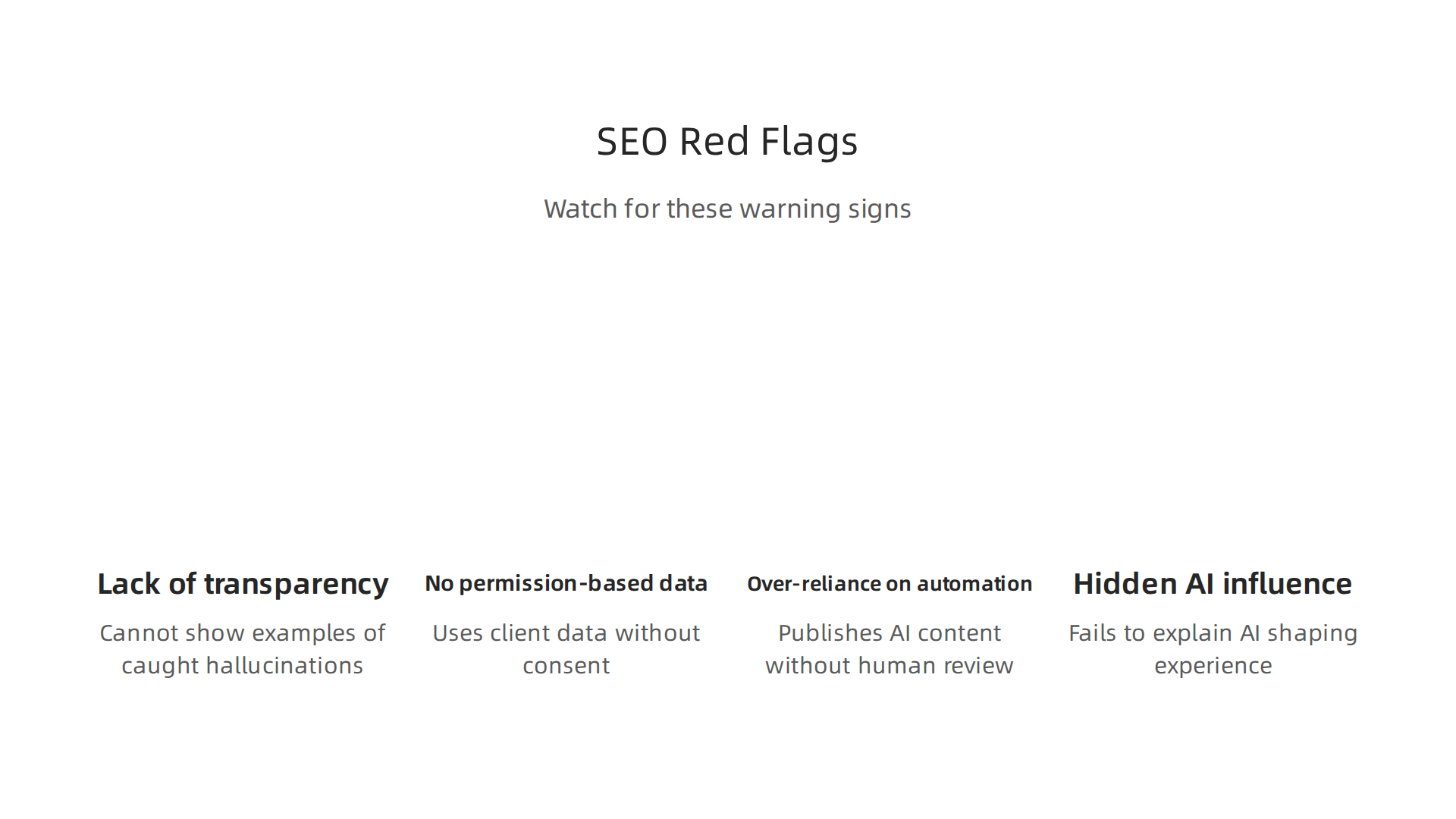
Red flag 1: Lack of transparency. If the agency cannot give you a specific example of a hallucination they caught, or if they dodge your questions about their verification process, that is a warning sign. A top seo expert will be open about their methods. A serious agency follows a structured fact‑checking process. The AI content fact‑checking steps from Wellows are a good example of what a mature workflow looks like.
Red flag 2: No permission‑based data practices. Some agencies use client data without clear consent to train their AI models. This can lead to privacy issues and unreliable outputs. Always ask how they handle data ownership and whether they get explicit permission before using your information. If they seem vague, walk away.
Red flag 3: Over‑reliance on automation. An agency that publishes AI content without human review is playing with fire. Automation speeds things up, but it cannot catch every hallucination. You need people who understand the topic and can spot nonsense. A balanced approach uses AI as a tool, not a replacement for human judgment.
To get a deeper look at what real verification looks like, check out these proven data analysis techniques to detect AI hallucinations. It shows the kind of rigorous checking a trustworthy seo company london should be doing.
One more red flag is when an agency fails to tell you how their AI systems might be shaping your users’ experience without their knowledge. The Quietly Hijacked field note explains how this hidden influence works and why transparency matters. If your agency cannot explain their AI options and how they affect your audience, that is a sign they may not have full control over their own tools.
Keep these red flags in mind as you review potential partners. A great agency will have strong case studies and zero hesitation about answering tough questions.
Summary
This article explains the real risk of AI hallucinations for SEO and marketing content, and gives a practical guide for picking a trustworthy SEO company in London. It describes how generative models can invent facts, how that damages rankings and reputation, and why many agencies expose clients by treating AI output as final. The piece lays out concrete vetting criteria—documented fact‑checking workflows, human‑in‑the‑loop validation, technical understanding of LLM failure modes, and permission‑based data pipelines such as VRS. It also lists the exact questions to ask prospective partners, the red flags to watch for, and the kind of case studies that prove competence. After reading, you’ll know what to demand from an agency to keep your content accurate, legally safe, and search‑friendly.