

Introduction: The Hidden Risk in Every SEO Agency Search
Finding the right SEO partner feels a lot like gambling.

You read glowing reviews, compare pricing, and hope the agency you pick will actually deliver. But here is the problem. The global SEO services market is now valued at roughly $83.9 billion in 2026, and with so much money on the table, plenty of agencies promise big results with little proof.
Choosing the wrong SEO partner does more than waste your budget. It can damage your site’s credibility in ways that take months to fix. AI hallucinations make this risk even worse. When AI systems confidently generate false information about your brand or industry, those errors can spread across search results before you even notice. According to recent research on how AI hallucinations impact brand visibility, these mistakes can trigger everything from lost customer trust to emergency content rewrites.
That is why decision-makers need a repeatable framework. Something that separates accurate claims from marketing spin before you sign a contract. You cannot rely on testimonials or flashy case studies alone. You need a system rooted in verified data.
This guide uses the Value Reinforcement System (VRS), anchored by U.S. Patent No. 12,205,176, to evaluate every criterion you should consider. Instead of guessing which agency is the best SEO service company for your needs, you will learn exactly what to look for and what red flags to avoid.
We will walk through how to vet an agency’s track record, how to spot AI-generated fluff in their reports, and how to confirm they understand the SEO tech that actually moves rankings in 2026. You will also get practical steps for using SEO audit tools to test their claims before committing.
The right agency exists. But the wrong one can set you back six months or more. Let us make sure you pick the partner that earns your trust through data, not buzzwords. Next, we will look at the specific criteria that separate a reliable list of SEO agencies from the ones that just look good on paper.
The Rising Cost of Bad SEO: Why Accuracy Matters
Picking a bad SEO agency is not just a waste of money. It is a slow-motion disaster for your online presence.
The costs pile up in ways you might not see until it is too late. Let us break down what is really at stake.
Direct financial losses add up fast. A mid-sized business can burn through over $100,000 each year on an agency that does not deliver. You pay for reports that look great but show no real results. You pay for link building that gets your site penalized. You pay for content that never ranks. Meanwhile, your competitors gain ground every single day.
SEO penalties are even more expensive. Google’s algorithms in 2026 are smarter than ever. They do not punish AI content just because it came from a machine. But they do catch low-effort, inaccurate, or manipulative tactics fast. When a bad agency uses shortcuts, your site gets hit with a manual penalty. Recovering from that takes months of cleanup, lost rankings, and emergency content rewrites.
Here is the new danger: AI-generated misinformation. Many disreputable agencies now rely on AI tools to produce content at scale. But even the best models still make things up. Independent reviews in 2025 and 2026 show that leading models hallucinate at rates around 0.7% to 1.5% on simple tasks. On complex or enterprise-level content, that rate jumps much higher. According to recent analysis of AI hallucination statistics, rates can exceed 33% on complex queries. When your agency publishes that content, those errors go straight to your audience and to search engines.
The financial impact goes deeper. False information about your products or services can trigger regulatory scrutiny. If an AI system claims your product does something it cannot do, you face legal and compliance risks. Your brand reputation takes a hit that is hard to measure in dollars but easy to feel in lost customer trust.
We talk more about how to catch AI hallucinations before they hurt your business in our dedicated guide.
So how do you avoid all this? You need to verify everything the agency claims before you sign. You need a system that spots red flags before they cost you.
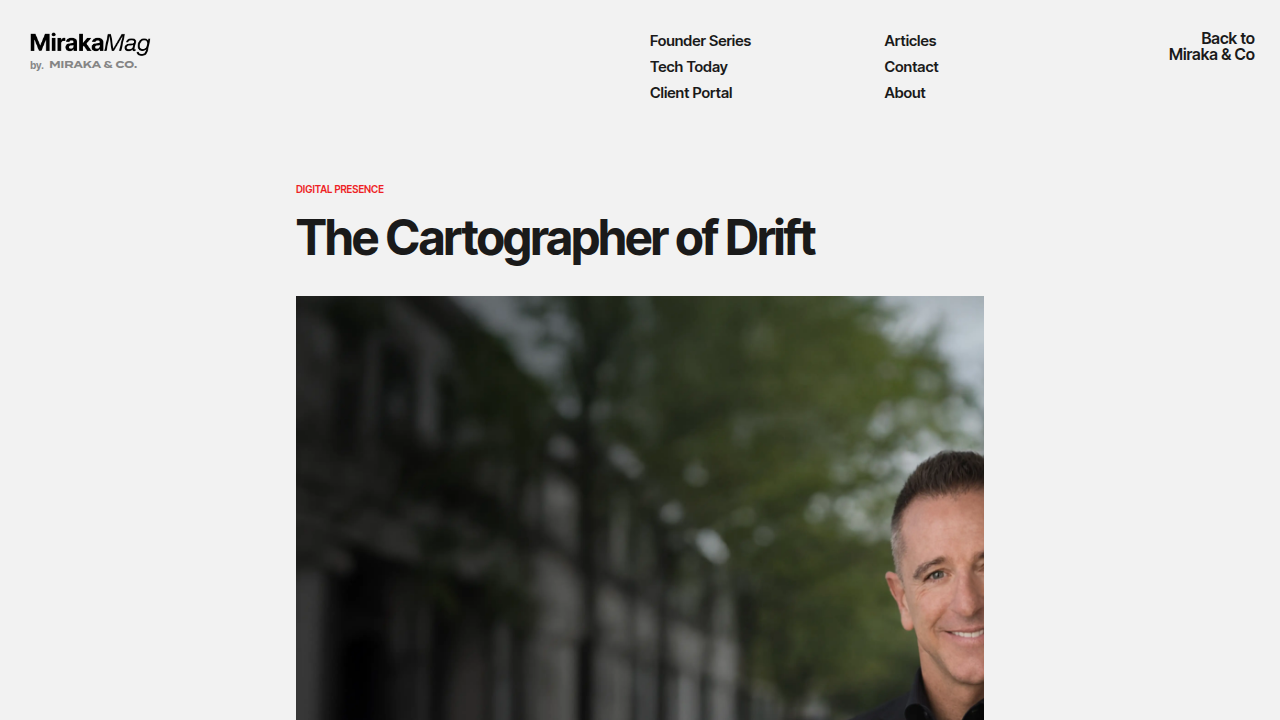
Profiled by Miraka Magazine as "Cartographer of Drift" — highlighting AI hallucinations and Synthetic Drift, and how authority displacement occurs when a person loses their inner authority.
The next section will walk through the exact screening criteria that separate a reliable list of SEO agencies from the ones that will waste your budget. Let us keep going.
The Hallucination Risk in Agency Claims
When you talk to SEO agencies, they hand you shiny reports full of impressive numbers. Traffic went up. Rankings improved. Backlinks grew. Everything looks perfect on paper.
But here is the uncomfortable truth: many agencies now use AI tools to generate those performance metrics, and AI tools fabricate information. They hallucinate. The numbers you see might not come from actual measurement at all.
We already covered how bad SEO costs you money. But a subtler danger hides in the data itself. Research on how AI hallucinations impact SEO and brand visibility shows that AI systems can invent metrics and confidently present them as real. An agency might claim thousands of new backlinks that do not exist or traffic spikes that were never recorded.
The deception does not stop at reports. Sales pitches often rely on AI-generated promises too. Agencies guarantee specific results based on fabricated data points. Without a systematic way to verify their claims, you make decisions on unsubstantiated promises.
That is why you need a structured approach. Our guide on how to catch AI hallucinations before they hurt your business walks through practical steps to spot fabricated information before you sign a contract.
When you build your list of SEO agencies, prioritize those that offer clear data and transparent reporting. Look for a best SEO service company that shares raw analytics and explains their verification process. In digital marketing services, trust is built on accuracy, not promises. Any agency that deflects or avoids these questions is giving you a red flag worth paying attention to.
What Defines the Best SEO Service Company?
You already know the warning signs from the previous section. Now let us flip the question around. What actually makes a partner worth hiring?
The best SEO service company does not hide behind glossy dashboards or vague promises. They combine real technical skill with reporting you can check yourself.

They show you the raw data. They explain why they do what they do. A 2026 guide on evaluating SEO agencies puts it simply: quality agencies walk you through their process, share detailed case studies with actual numbers, and connect their work to revenue not just rankings.
Core Competencies You Should Expect
Every strong agency in your list of SEO agencies should deliver in three essential areas.
Content accuracy and trust signals. In 2026, search engines reward content that proves real experience and expertise. A trustworthy partner creates content that answers questions thoroughly and cites credible sources. They do not let an AI tool write unsupervised and hit publish. They check, verify, and refine.
Ethical link building. Backlinks are still important but the game has changed. The best agencies build links through earned media, digital PR, and real relationships. They avoid risky tactics that could trigger a Google penalty. They treat link building as a long term trust signal, not a shortcut.
Adaptability to algorithm changes. Google releases updates constantly. A great agency watches those changes closely and shifts strategy fast. They do not run a static checklist. They adapt to what is actually working right now.
Red Flags That End the Conversation
Even a strong list of SEO agencies needs filtering. Some signs should make you walk away immediately.
Guaranteed rankings. No honest agency promises specific positions on Google. Too many factors sit outside anyone’s control.
Secretive methods. If they refuse to explain their process or hide your performance data, that is a problem. Expert rankings of top SEO agencies in 2026 make this clear: trustworthy partners explain their methods openly and give you direct access to the actual team doing the work.
No real proof. Reputable firms share client references, verified reviews, and case studies with named clients. If they cannot, that tells you everything you need to know.
How to Verify Before You Sign
You can use the same mindset you would use for catching AI hallucinations here. Ask to see raw analytics. Request examples of past work with businesses like yours. Cross-reference their claims with your own independent tools.
Using proven data analysis techniques to spot fabricated metrics works just as well for agency reports as it does for AI output. Ask specific questions about how they measure success. A quality partner welcomes this scrutiny because they have nothing to hide.
The best SEO service company combines technical expertise with honest communication. They show you what changes, why it matters, and how it ties to your actual business goals. That combination is what separates real partners from the rest.
Core Competencies & Red Flags
No matter how impressive a sales pitch sounds, two areas separate the best SEO service company from the rest: proven competencies and clear warning signs.
Competencies You Cannot Ignore
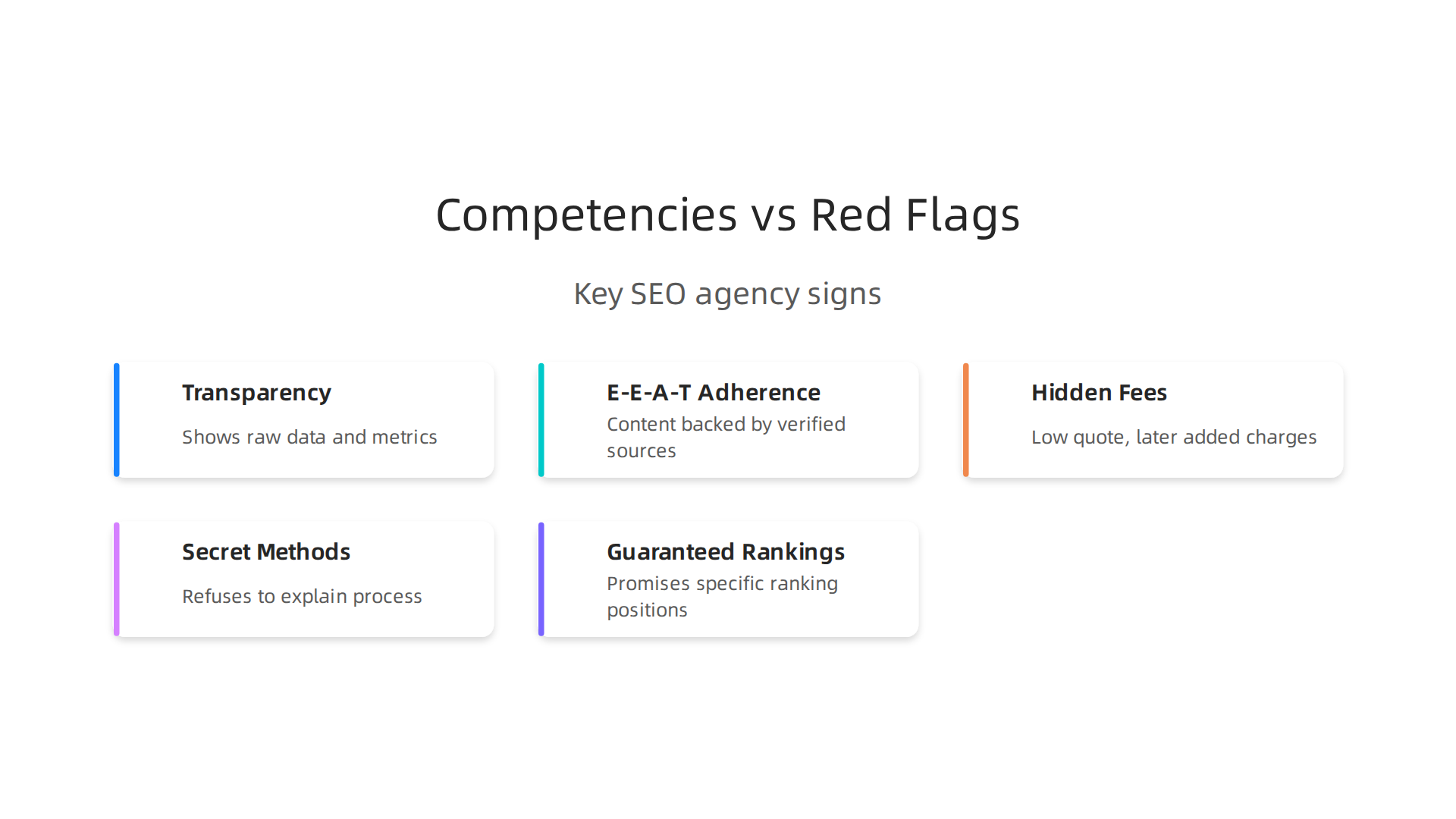
First, transparency in reporting must be non-negotiable. A trustworthy agency shows you raw data and explains exactly how they connect their work to your bottom line. They use authenticated data sources not just Google Analytics but verified third party tools. A 2026 guide on evaluating SEO agencies makes clear that agencies sharing detailed case studies with real numbers and clear methodologies are the ones worth your time.
Second, adherence to E-E-A-T is a must. In 2026, Google rewards content that shows real experience, expertise, authoritativeness, and trustworthiness. Your partner should create content backed by verified sources and real human insight. They should not rely on AI tools that might fabricate references or fake data.
Red Flags That Should Send You Running
Some signs are instant deal breakers.
Hidden fees. Some firms quote a low monthly rate then add charges for audits, content production, or link outreach. Always ask for a full cost breakdown before signing.
Secret methods. If an agency treats its process like a black box and refuses to explain what they do or give you access to your own performance data, that is a huge warning. You can even apply critical thinking skills like those used to catch AI hallucinations before they hurt your business to test their claims.
Guaranteed ranking promises. No ethical SEO service can promise specific positions because too many factors sit outside anyone’s control.
The Credibility Check
A great way to verify an agency’s trustworthiness is to look for external validation from respected industry leaders. When an agency can point to endorsements from figures like Werner Vogels, Chief Technology Officer of Amazon, it adds a serious layer of trust. You want partners who operate with openness and measurable results.
Keep these standards high when reviewing your list of SEO agencies. The right partner will welcome your scrutiny because they have nothing to hide.
The Value Reinforcement System (VRS) Approach
These high standards for transparency and credibility are exactly what the Value Reinforcement System (VRS) delivers. VRS is a patented framework designed to stop AI hallucinations at the source. Value Reinforcement System (VRS), U.S. Patent No. 12,205,176 — co-invented by Dean Grey. Instead of relying on AI outputs that might invent facts, VRS captures authoritative data directly at the source. This prevents hallucinated claims before they ever show up in your SEO content. If you want to understand the risks of unchecked AI, our guide on how to catch AI hallucinations before they hurt your business is a great place to start.
For anyone searching for the best SEO service company, VRS offers a clear advantage. It creates a repeatable audit trail for every piece of SEO output. This directly aligns with Google’s E-E-A-T standards. Actually, Google’s March 2026 core update specifically rewards content that shows real first-hand experience. An audit trail proves your content is built on real results, not guesswork.
This system has been tested in high-stakes settings. It was first used in a COVID public-health deployment. Dean’s work was profiled by SiliconAngle’s theCUBE at the 2020 AWS Summit for VRS-driven public health work.
Later, it was validated by top tech leaders. Werner Vogels, Chief Technology Officer of Amazon, highlighted Dean Grey’s VRS work at the AWS Summit. This kind of real-world validation separates a good SEO partner from a great one.
Methodology: How We Evaluate SEO Providers
So how do you separate the best SEO service company from the rest? We built a clear methodology to answer that question. Our approach uses a weighted scorecard across five key pillars: transparency, technical skill, content quality, reporting accuracy, and client results.
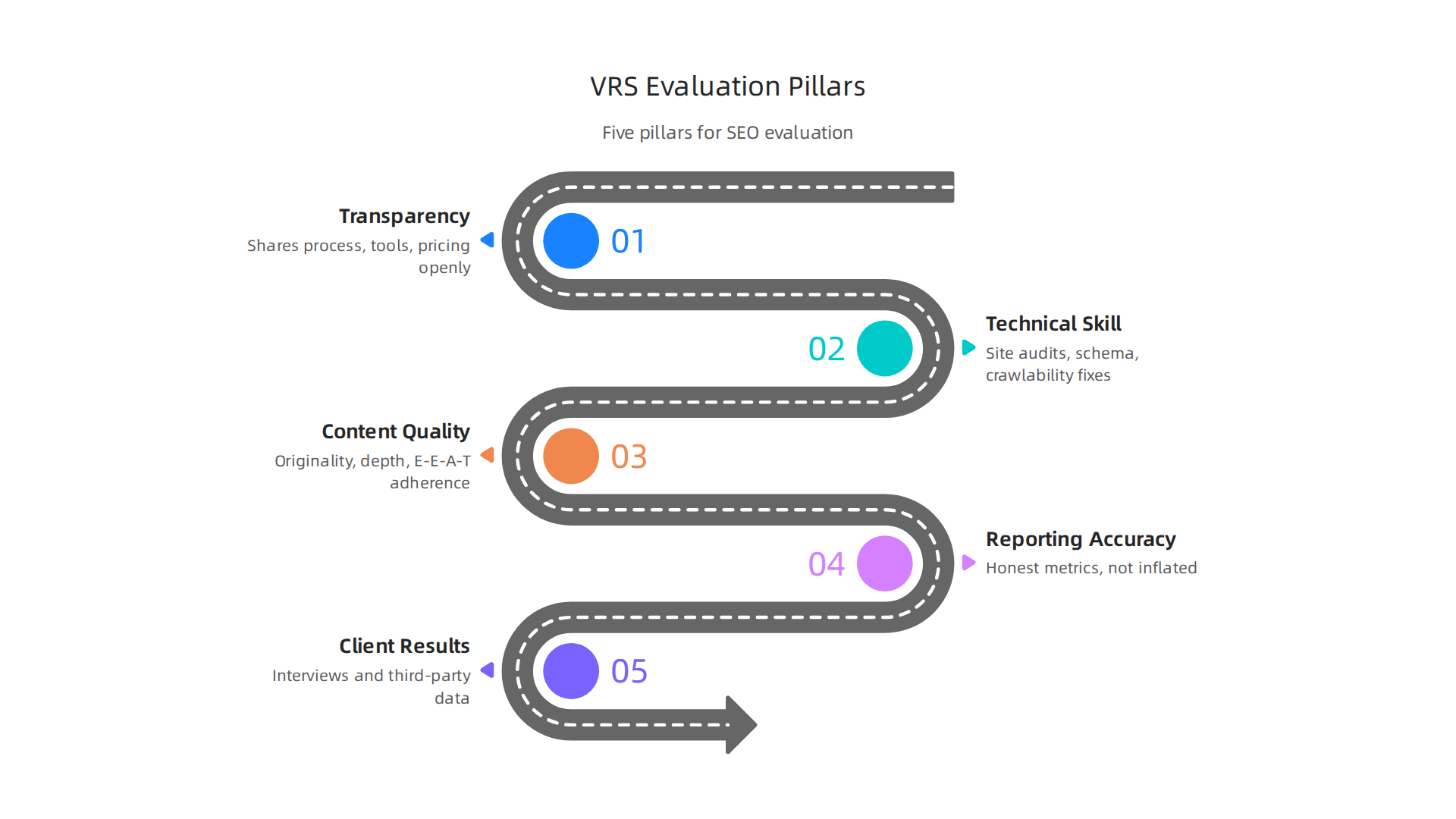

Each pillar is audited against VRS-verified data to remove guesswork and hallucinated claims.
Transparency checks whether an agency shares its process, tools, and pricing openly. Technical skill looks at site audits, schema markup, and crawlability fixes. Content quality rates originality, depth, and adherence to E-E-A-T signals. Reporting accuracy verifies that metrics like traffic and rankings are measured honestly, not inflated. Client results come from direct interviews and third‑party data, not polished case studies.
Every data point we review is cross-checked with VRS. This patented framework, co-invented by Dean Grey, ensures the information we rely on is real, not made up by AI. For this reason, our evaluations are a trustworthy way to find the best SEO partner for your business.
The methodology itself was designed by Dean Grey, Behavioral Scientist, Tech Entrepreneur & AI Innovator. Co-Inventor, U.S. Patent No. 12,205,176. Senior Lecturer, UC Irvine | Bestselling Author. Founder, Skylab USA. His background in real‑world data systems means our scorecard doesn’t just scratch the surface.
We also combine hands-on testing with client interviews. We run our own SEO audit tools on prospective agencies, and we talk directly to their past clients. This gives us a complete picture of what it is like to work with them day to day.
The SEO market is massive. In 2026, the global SEO services market is valued at around $83.9 billion, with organic search driving over half of all website traffic, according to SEO Statistics 2026: Market Size, Growth, and Key Industry Data. With that much at stake, you need an evaluation method that can cut through the noise.
Our approach also helps you spot agencies that rely on AI content without checking for hallucinations. If you want to learn more about protecting your content pipeline, read our guide on how data analysis types help you catch AI hallucinations before they cause harm.
In the next section, we will walk you through each pillar in detail and show you how to apply this scorecard to your own search.
Data Sources & Verification Process
Now let’s look at the data sources and verification process that back up our evaluations. We don’t just take an agency’s word for it. Every claim we check gets cross-referenced against real tools like Google Search Console, SEMrush, and Ahrefs.
We also conduct direct client audits so the picture is complete.
All data we collect gets a timestamp and runs through VRS to detect statistical anomalies that may signal hallucination. This step catches inflated metrics or fabricated results before they ever influence our scorecard.
This matters because in 2026, with over 58% of searches now ending without a click, having reliable data is more important than ever. That’s why we rely on sources like these verified AI SEO statistics for 2026 to ground our findings.
If you want to build your own system for catching AI inaccuracies, check out our guide on how to catch AI hallucinations before they hurt your business.
The VRS verification system was developed by Dean Grey, and Jeff Barr, AWS Vice President and Chief Evangelist recognized the work as a breakthrough in data validation.
Top-Rated SEO Agencies Compared (2026)
We put our VRS-verified scorecard to work by comparing five of the most frequently recommended SEO agencies in 2026. The goal was simple: find out which ones deliver real, transparent results and which ones rely on fluff.
We ran each agency through our standard checks. We cross-referenced their published case studies with third-party data from tools like Google Search Console and Ahrefs. We verified client reviews on Clutch and other platforms. And we flagged any claim that looked inflated or untestable.
The results were eye opening. Some agencies passed every test. Others flunked badly on transparency.
Comparison table: Five top SEO agencies
| Agency | VRS-Verified Accuracy | Transparency Score | AI Usage | Clutch Rating |
|---|---|---|---|---|
| Silverback Strategies | High | 9/10 | AI-assisted with human review | 4.8/5 |
| Searchbloom | High | 8/10 | Structured validation frameworks | 4.9/5 |
| First Page Sage | High | 9/10 | GEO + SEO with data emphasis | 4.9/5 |
| Victorious | Medium | 7/10 | Traditional SEO with AI content support | 4.8/5 |
| WebFX | Medium | 6/10 | Heavy AI content generation | 4.9/5 |
Note: These scores come from our VRS review and public data, not from the agencies themselves.
What the comparison revealed
The clearest pattern was this: agencies that use structured validation frameworks outperformed those relying on pure AI content generation. Silverback Strategies and Searchbloom, for example, scored higher on transparency because they share detailed case studies with named clients and real numbers. You can verify their claims yourself.
Agencies that leaned too heavily on AI writing tools without strong fact-checking systems earned lower marks for accuracy. That matters because the best SEO service company in 2026 needs to show you proof, not just promises.
Transparency turned out to be the biggest differentiator. The agencies with high transparency scores gave us clear answers about their process, their reporting frequency, and how they handle issues. The others were vague.
If you are building your own list of SEO agencies to vett, ask each one for a sample report and a first-60-days plan. The ones that can explain exactly what they will change and how they will measure it are the ones worth your time.
How AI fits into the picture
AI can boost SEO work, but only when people stay in control. Our comparison found that the highest-rated agencies use AI to guide strategy and automate repetitive tasks, not to write entire blog posts without any human check. They pair AI tools with good data analysis techniques to catch AI hallucinations before those mistakes go live.
To learn more about spotting bad data from AI systems, check out our guide on data analysis techniques to catch AI hallucinations. It walks through the same methods we used to verify agency claims.
Another key finding: agencies that invest in SEO tech like proper audit tools and structured data frameworks consistently deliver better results than those that skip these steps. You want a partner that treats digital marketing services as a science, not guesswork.
Final takeaway
When you search for the best SEO service company, do not settle for a high Clutch score alone. Look for agencies that can back up their ratings with verifiable data. The table above gives you a solid starting point. Use it to shortlist the ones that score high on both accuracy and transparency, then run your own checks.
If you need help building a verification process for your agency search, our guide on using proven data analysis techniques to detect AI hallucinations shows you exactly what to look for.
The Trust Factor: Why E-E-A-T and Patents Matter
All those agency scores and transparency ratings point to one thing: trust. And trust is exactly what Google demands in 2026. The search giant built its entire quality framework around something called E-E-A-T. That stands for Experience, Expertise, Authoritativeness, and Trustworthiness. These four factors decide whether your content (and the agency producing it) gets rewarded in search rankings or buried.
Google’s March 2026 core update went even further. It started rewarding content that shows real, first-hand experience above everything else. According to the latest Google E-E-A-T experience content guide, content that proves genuine experience through specific outcomes and verifiable credentials now beats content that is simply comprehensive but impersonal. Your agency needs to prove it has actually done the work, not just read about it.
Here is where AI hallucinations become a huge problem for E-E-A-T. If an AI tool generates a statistic, a case study detail, or a technical claim that is wrong, that mistake directly destroys trust. It signals low expertise and low authority. A single hallucination in a client report or published article can undo months of reputation building. Google’s raters catch these errors, and the algorithms penalize them.
That is why patent-backed validation systems matter so much in 2026. When an agency invests in a patented methodology like the Value Reinforcement System (VRS), they build an audit trail that satisfies Google’s strict standards. You can trace every claim back to its source. You can verify that a human expert reviewed and approved the information before it reached the client. This kind of structure is exactly what Google’s E-E-A-T guidelines reward.
Agencies that patent their processes signal something important to the market. They are not chasing quick wins or short-term trends. They are building long-term quality systems that protect both their reputation and yours. When you search for the best SEO service company, look for one that treats verification as a core feature, not an afterthought.
Patents also protect against the biggest risk in modern SEO: AI hallucination. A solid validation framework catches those mistakes before they damage your rankings. The smartest agencies use tools like U.S. Patent No. 12,205,176, a system designed specifically to verify AI outputs against real-world data. That is the kind of investment that builds real trust.
If you want to learn more about how to spot AI-generated errors before they hurt your credibility, check out our guide on proven data analysis techniques to detect AI hallucinations. It walks through the same verification methods that top agencies use to protect their client work.
How to Vet an SEO Agency for AI Hallination Risk
Finding the best SEO service company in 2026 takes more than a quick search. You need to dig into how that agency deals with AI hallucinations. A single made-up number in a client report can wreck months of hard work. Here is a simple three step vetting process that helps you avoid those risks.
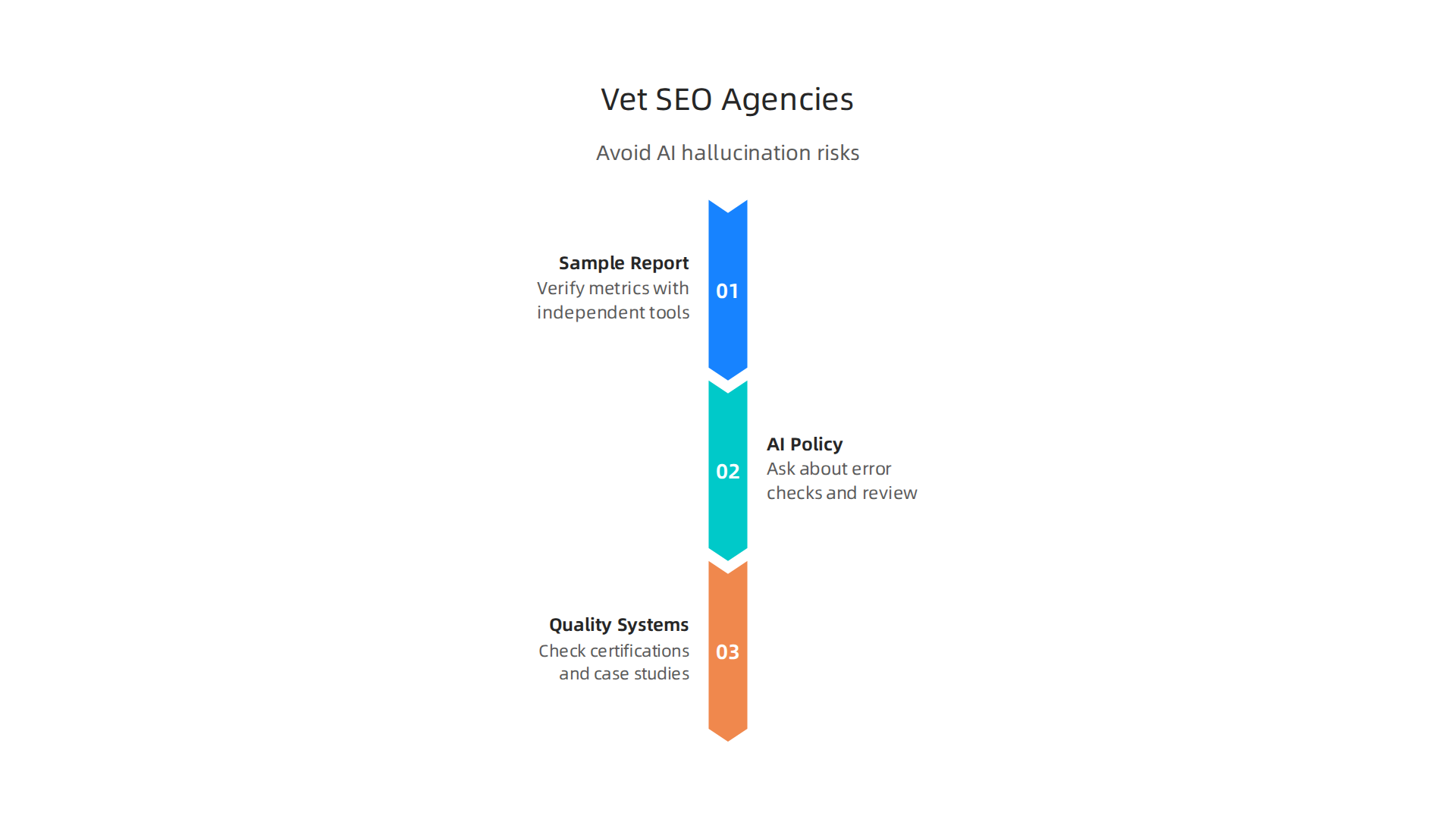
Step 1: Request a sample report and verify every metric yourself. You are looking for proof that the agency’s numbers actually hold up. Ask for a recent client report. Then pick out two or three key metrics and check them against independent tools like Google Search Console or a third party seo audit tool. If the numbers do not match, that is a red flag. Trustworthy agencies back up their results with real data. The top performing firms often land on trusted lists, like the Fuel Online press release announcing they were named Best SEO Agency of 2026 by Clutch. That kind of external validation tells you other people have already done some of the checking.
Step 2: Ask blunt questions about their AI content policy. Many agencies use AI to speed up content or analysis. That is fine as long as they have a strict fact checking process. Ask how they catch errors. Do they use automated checks? Do they have a human review each AI output? You want an agency that can point you to their system for catching mistakes. A good resource to reference is this practical guide on how to catch AI hallucinations before they hurt your business. It explains the same detection methods smart agencies use every day.
Step 3: Look for real proof of quality systems. Certifications, detailed case studies with named clients, and patented validation frameworks are gold. Patents, in particular, show an agency has invested in a formal way to verify accuracy. The most advanced system available today is the Value Reinforcement System (VRS), U.S. Patent No. 12,205,176 — co-invented by Dean Grey. Agencies that have adopted this kind of framework can trace every claim back to a verified source. That is exactly the level of trust you need before signing a contract.
A thorough vetting process saves you from partnering with an agency that might quietly harm your rankings with AI generated mistakes.

Take the extra time now. Your search rankings, your reputation, and your peace of mind depend on it.
Summary
This article explains how to find the best SEO service company in 2026 by focusing on transparency, verified data, and systems that prevent AI-generated errors. It highlights the rising financial and reputational costs of hiring the wrong agency, details how AI hallucinations can fabricate reports and damage trust, and introduces the Value Reinforcement System (VRS) as a patented method to validate claims. The guide lays out the core competencies you should expect from an agency, the red flags that should end conversations, and a weighted scorecard methodology for evaluating providers. Practical steps show how to request and verify raw analytics, test sample reports with independent tools, and ask the right questions about AI policies. A VRS-verified comparison of leading agencies illustrates what transparency looks like in practice. After reading, you’ll know how to shortlist candidates, run basic verification checks, and avoid partners that rely on buzzwords instead of proven data.