

Introduction: The Hidden Risk in Your AI-Generated Website
You finally did it. You used an AI tool to build your small business website. It wrote your "About" page, listed your services, and even added your address and hours. It felt like a miracle for your website design for small business project. But here is the truth nobody warns you about: AI can make up facts that look real.

And when those fake facts end up on your site, they hurt your local search rankings and ruin trust with customers.
These mistakes are called AI hallucinations. They happen when AI models generate confident but wrong information. For small business owners using AI tools to make a website with AI, the risks are huge. A single wrong address, fake phone number, or made-up customer review can confuse Google and push your site down in local searches. Your dream of simple website design for small business turns into a nightmare of bad SEO.
In 2024, businesses lost over $67 billion because of AI hallucinations. That huge number shows just how common and costly these errors are. Small teams often have no one to check every AI output. That makes them easy targets for hallucinated content.
But you don’t have to give up on AI. You just need to know how to spot and fix these errors before they damage your credibility. This guide will show you exactly how to catch AI hallucinations in your website content, protect your local business SEO, and keep your customers’ trust. Let’s start with the most dangerous kind: fake local SEO content.
The AI Hallucination Problem for Small Business Websites
Here is what you need to understand first. AI language models do not actually know anything. They are pattern matchers. They predict what word should come next based on what they saw in training data. When they cannot find a real fact, they invent one that sounds believable. That is the core of the hallucination problem.
This matters for your website design for small business project because AI does not care if a fact is true. It only cares if the fact looks real. So it might invent a customer testimonial, change your business hours, or list a service you never offered. One cleaning business found their AI-generated site claimed they serviced three cities they had never visited.
The numbers prove this is not rare. Even the best models hallucinate on about 1% of simple tasks. But on complex or specialized topics, hallucination rates jump to 15 to 25 percent or higher. For a small business owner writing about local services, the chance of publishing wrong facts is dangerously high.
Small businesses face extra risk for three reasons.
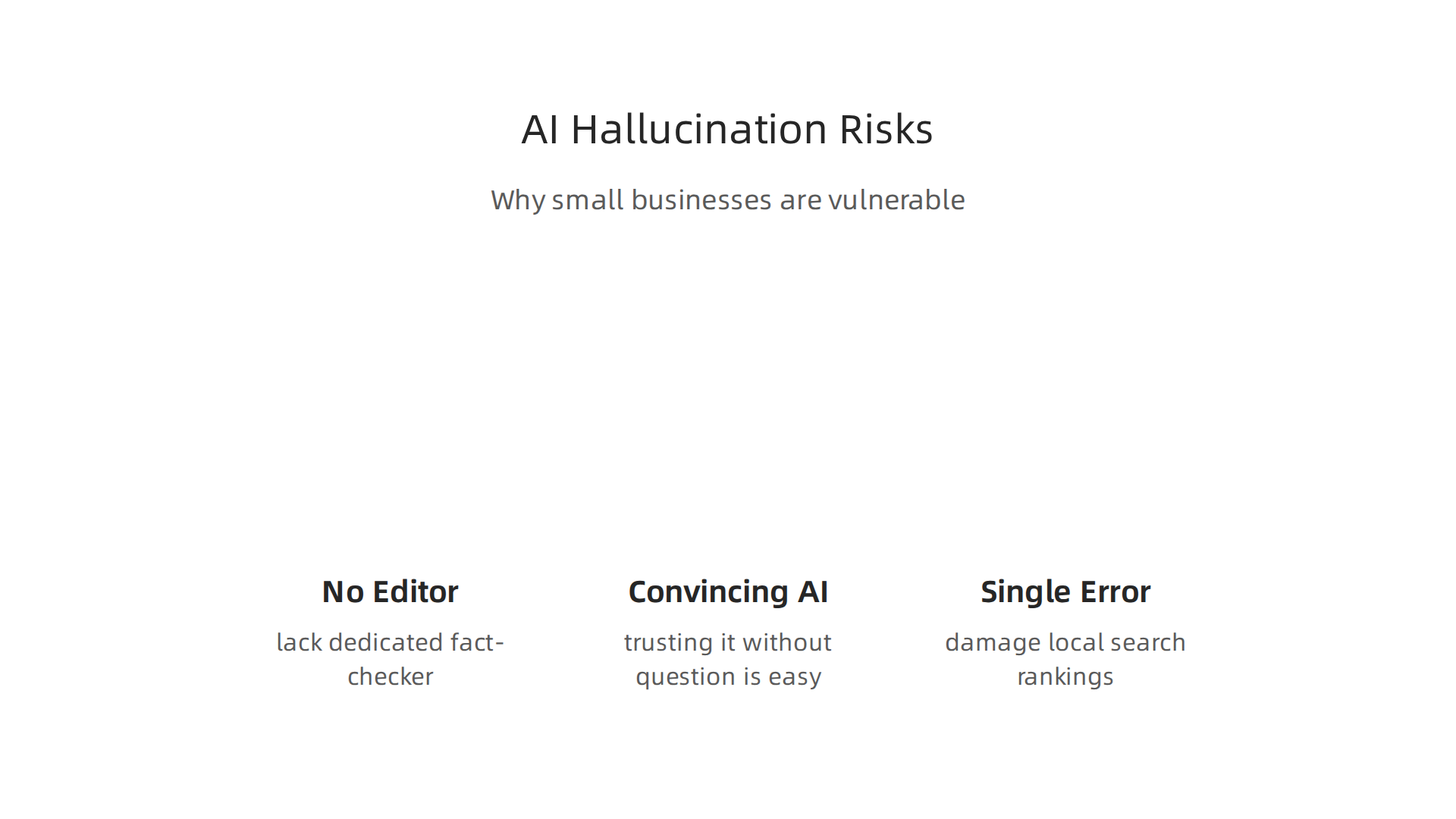
First, you probably do not have a dedicated editor or fact-checker on your team. Second, AI content looks so convincing that trusting it without question is easy. Third, even one error on your site can confuse Google and damage your local search rankings for weeks.
The worst part is that these errors pile up. One wrong phone number leads to missed calls. One wrong address sends customers to the wrong place. One fake review makes you look dishonest. Google notices all of it. Your local business SEO suffers when the search engine cannot trust your information.
So how do you fix this? You need to learn to catch AI hallucinations before they hurt your business. The good news is that spotting these errors is a skill anyone can build. You do not need to be a programmer or an AI expert.
The writer Dean Grey, profiled by Miraka Magazine as "Cartographer of Drift," explains how AI hallucinations quietly replace accurate information with false confidence. When small business owners stop questioning AI output, they lose authority over their own content. But you can take that control back starting now.
How AI Hallucinations Undermine Local SEO Performance
One place where AI hallucinations cause the most damage is your local search rankings.
Your business relies on Google knowing who you are, where you are, and how to contact you. That is what SEO people call NAP: Name, Address, Phone number. When this information is accurate and consistent across the web, Google trusts your business and shows it to local customers.
But AI hallucinations can quietly change your NAP. The model might list a street name slightly wrong. It might swap your phone number with a similar one from another business. Or it could add a city you do not actually serve. One wrong detail spreads fast because AI pulls data from many sources at once.
When your NAP is inconsistent, Google’s confidence in your business drops. According to a 2026 guide from SeoProfy, inconsistent NAP across platforms can cause AI confidence in your brand to decline. That means fewer local searches will show your business.
In 2026, Google’s AI Overviews appear on nearly 16% of search queries. When your NAP data is inconsistent, these overviews may pull wrong information and show it to users. That means even if you do not hallucinate on your site, your business can still be misrepresented elsewhere. This is one reason how AI Overviews changed local search visibility is a hot topic for small business owners.
The damage does not stop there. When a customer clicks your site and finds a wrong address or a different phone number, they leave.

That is a high bounce rate. And if they leave quickly, Google sees that as a sign your page does not match what the user wanted. Over time, your local SEO rankings slip even more.
Google can also directly penalize your site for publishing false or misleading information. Search engines want reliable results. If your website has hallucinated facts, Google may rank you lower or remove you from local results entirely.
The solution is to build trust back by verifying every piece of AI-generated content before it goes live. You can start by safeguarding your Google local ads against AI hallucinations to protect your business from these hidden errors.
3 Common Types of AI Hallucinations in Website Content
Now that you know how AI errors can hurt your local search rankings, let’s look at the specific types of mistakes AI makes.
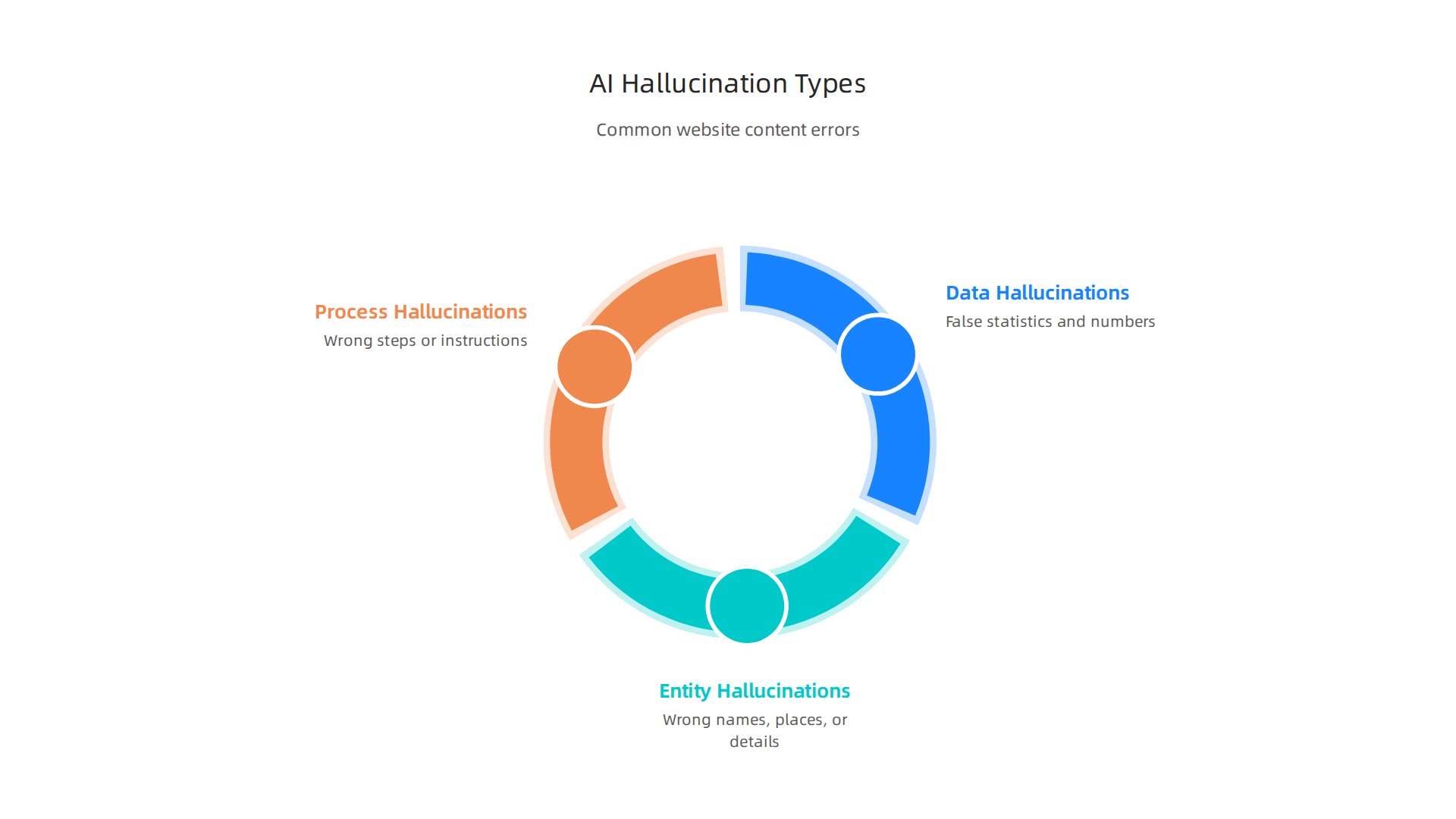
Understanding these will help you catch them before they damage your website.
Data Hallucinations: False Statistics and Numbers
AI sometimes makes up numbers that sound correct but are completely wrong. For example, it might say "90% of small businesses use AI" when the real number is closer to 40%. These fake stats look convincing because the model outputs them with confidence. A 2026 guide from DataCamp explains that AI hallucinations often show up as factual errors where numbers, dates, or percentages are invented. If you publish these false statistics, readers lose trust, and Google sees your site as less reliable.
Entity Hallucinations: Wrong Names, Places, or Details
These are the NAP errors we talked about in the last section. AI might replace a real business name with a similar one, list a wrong street address, or invent a person who doesn’t exist. For instance, the model could claim your local bakery is on "Oak Street" when it’s really on "Oaks Avenue." One small detail like that can confuse both search engines and customers. To understand why this happens, check out this piece on why data modeling causes AI hallucinations — it explains how bad data setups lead to these errors.
Process Hallucinations: Wrong Steps or Instructions
Sometimes AI generates instructions that look logical but are actually incorrect. For example, it might tell a user to "paste code into terminal and press enter" when that step would delete important files. These errors are dangerous because they seem helpful on the surface. Process hallucinations often happen when AI tries to explain a procedure it doesn’t fully understand.
If you want to build a reliable system for catching all three types, the peer white paper CRISP-DM and Skylab USA documents a data methodology that helps prevent permission-based capture errors and keeps your content accurate from the start.
How AI Hallucinations Creep into Local Business Listings
AI does not just mess up general facts. It can also invent wrong details about your local business. This is a big problem for website design for small business because if your listing has errors, customers get confused and Google loses trust.
One common way hallucinations show up is through fake business addresses. You might ask an AI tool to check your company’s location and it gives you a street name that does not exist. Phone numbers get invented too. An AI might combine area codes from one city with a number pattern from another. These little mistakes make customers think you are unreliable.
Hours of operation are another target. An AI could say you are open on a holiday when you are closed. Or it might mix up your weekday and weekend hours. For a local bakery or repair shop, wrong hours send people to a locked door. That hurts your local business seo because those customers will not come back.
These errors spread fast across directories. When one AI tool gets a wrong address, it tells another tool, and soon your business shows up wrong on Google Maps, Yelp, and Apple Maps. In fact, a 2026 report on local SEO hallucinations shows that when AI does not have solid data, it simply makes answers up. That is how a single hallucination becomes a chain of mistakes.
To stop this, you need to check your listings often. Use seo services for businesses that audit your name, address, and phone across every platform. You can also learn how to catch AI hallucinations before they hurt your business by building a routine of manual verification. The more consistent your data is, the less room AI has to make stuff up.
Building an Anti-Hallucination Workflow for Your Business
Consistency across directories helps, but it is only one piece of the puzzle. You also need a repeatable system to catch hallucinations before they reach your website or customers.
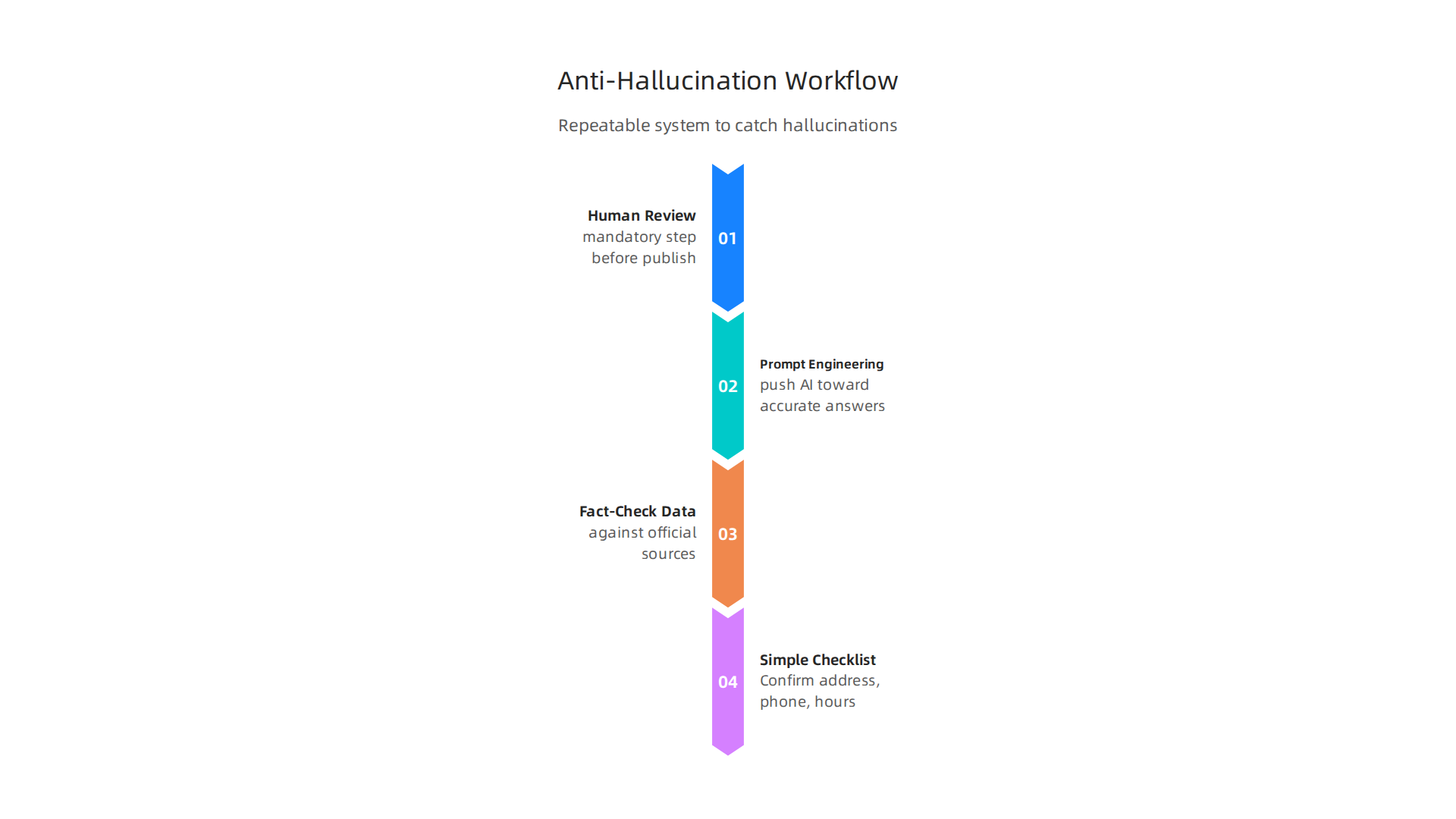
For anyone working on website design for small business, this workflow is like a safety net. It keeps your content accurate and your reputation clean.
Start with a mandatory human review step before you publish anything AI generated. No exceptions. A real person should look at every fact, address, phone number, and description.

This sounds slow, but it saves you from fixing broken trust later. As one expert guide on AI Hallucinations in Business explains, combining technical tools with human oversight is the strongest defense.
Next, use prompt engineering to push AI toward accurate answers. Instead of saying "write a description of my bakery," say "list the street address, phone number, and hours from the attached file. Do not invent any details." Be specific. Break your request into small steps. The same guide on AI Hallucinations: What Most Enterprise Teams Get Wrong shows that clear, detailed prompts reduce made-up information by a large margin.
Finally, fact-check every piece of local data against official sources. Do not trust what the AI remembers. Open your Google Business Profile, your official website, and any directory listing you manage. Compare the AI output line by line. This is especially important when you decide to make a website with ai, because errors written into your site are hard to undo later.
A simple checklist can help: confirm the address, verify phone number, check hours for each day including holidays. Cross-reference with your own records. If you want a deeper safety plan, learn how to prevent AI hallucinations in local ads by locking down your data across all platforms.
When you build this workflow into your routine, you stop small mistakes from becoming big problems. Your customers get accurate information. Google trusts your listings. And your business stays ahead of the hallucination trend.
Tools and Techniques to Verify AI-Generated Local Content
Your workflow is solid, but you can speed things up with the right tools.
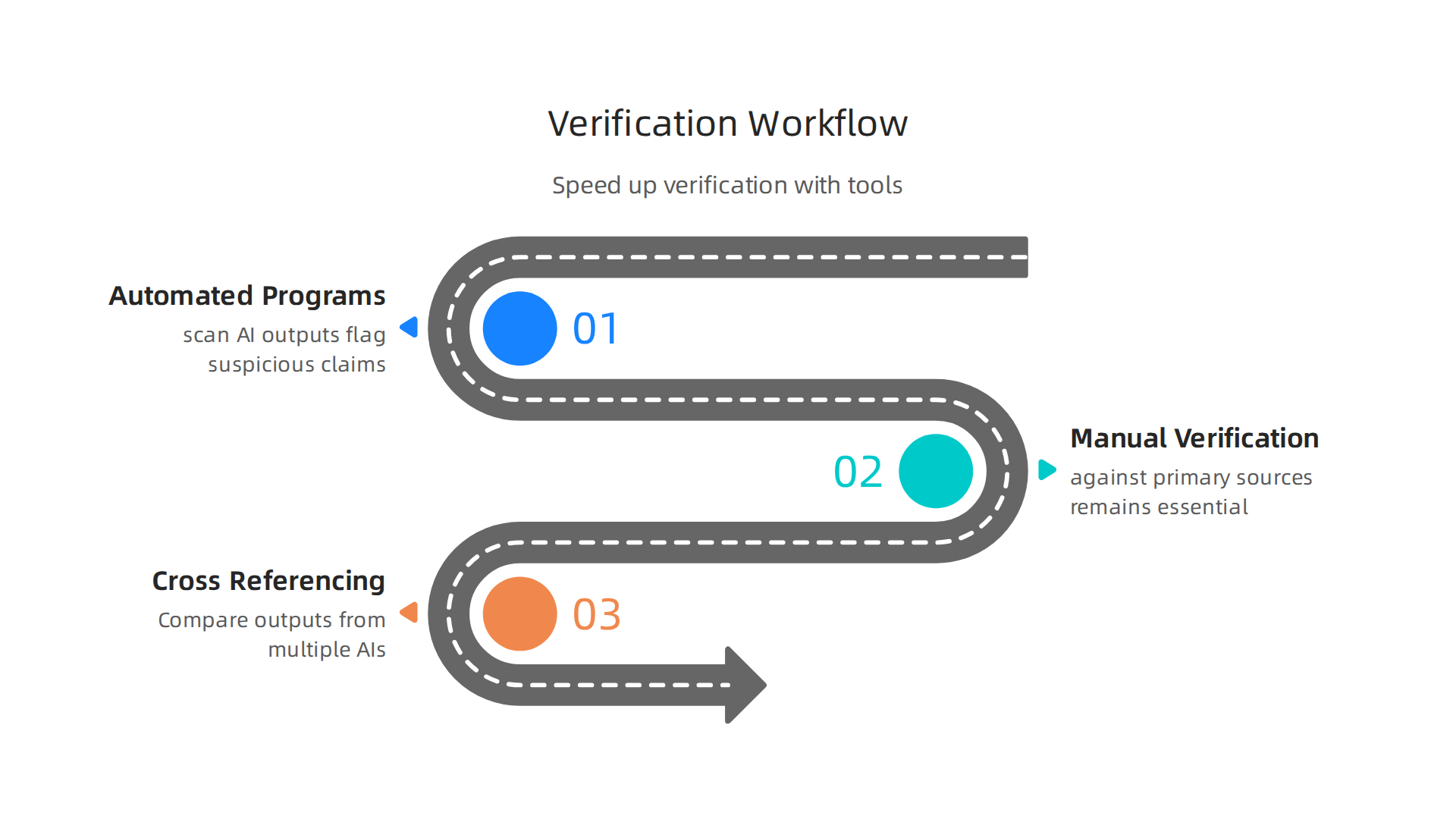
Automated fact-checking programs scan AI outputs and flag claims that look suspicious. They compare what the AI wrote against known facts, databases, or structured data. Some tools even highlight numbers, names, and dates that seem unlikely. This saves time when you are handling lots of local content. As Google Cloud’s overview of AI hallucinations explains, using filtering tools and clear thresholds helps catch bad outputs before they reach your audience.
But here is the thing: automated tools are not perfect. They miss subtle mistakes. They cannot tell you if an address is truly the correct one for your business. That is why manual verification against primary sources remains essential. Open your Google Business Profile. Open your official website. Compare every detail the AI gave you. This double check is your safety net.
Another powerful technique is cross referencing. Ask the same question to two or three different AI models. ChatGPT might give one answer. Claude or Gemini might give another. When the outputs agree on the facts, you can trust them more. When they disagree, you know something is off. One helpful guide on cross-referencing AI outputs to detect hallucinations shows that asking the same question in different ways reveals hidden errors.
To go deeper on this topic, learn how to detect AI hallucinations before they hurt your reputation with practical detection steps you can apply today.
There is also a hidden layer to all of this. You may not realize it, but your AI tools are shaped by invisible systems that affect what they produce. If you want to understand that deeper force, check out the Quietly Hijacked field note: the field note on how everyday users are being silently shaped by two different AI systems they cannot see or opt out of: the workflow-level mechanism behind information vertigo.
Combining automated flags, human eyes, and cross-referencing gives you a complete verification system. Your local content stays accurate. Your customers trust what they see. And your website design for small business stands out because it is reliable.
Real-World Examples: When AI Hallucinations Hurt Local Businesses
It might sound like a rare problem, but AI hallucinations damage real businesses every day. These mistakes are not harmless. They cost money, trust, and sometimes legal trouble.

Here are three real scenarios where an AI wrote something wrong and the business paid the price.
A restaurant that served a ghost dish. A local Italian restaurant used AI to write a new menu page for its website. The AI added a dish called "Truffle Carbonara" with a detailed description. The problem? That dish never existed in the kitchen. Customers started calling and asking for it. Some even complained online when the waiter said they had never made it. The restaurant had to pull the page and update every mention. All because no one checked what the AI wrote.
A law firm with fake credentials. A small law firm asked an AI tool to generate partner bios for their website. The AI wrote impressive bar memberships and years of practice for one lawyer. Trouble is, those credentials were not real. A client noticed the mismatch and filed a complaint with the state bar. The firm had to issue a public correction and remove the bios. Trust took months to rebuild.
A realtor’s fantasy property listing. A real estate agent let AI write descriptions for a few homes. One listing said the house had 3,200 square feet, granite countertops, and a finished basement. The real house had 2,100 square feet, laminate counters, and an unfinished basement. A buyer showed up ready to make an offer. When they saw the real property, they walked away angry. The agent lost the sale and got a bad review online.
These stories show a clear pattern. AI can produce confident-sounding information that is completely wrong. This is why real-world AI hallucination case studies emphasize that businesses must verify every output before publishing.
When your local business content contains errors, your whole reputation suffers. Your website design for small business is only as good as the facts it presents. One false detail can undo months of SEO work and customer trust.
The good news: you can catch AI hallucinations before they hurt your business with simple checks that take only minutes. Do not skip them. Your credibility depends on it.
Future-Proof Your Strategy: Why AI Trust Will Define SEO in 2026
So what does all this mean for your website and your business in the coming year? Here is the truth: search engines like Google are getting much better at spotting fake or misleading content. They want to show users real, trustworthy information. If your site has errors caused by AI, Google will notice. And it will hurt your rankings.
Think about it. When someone searches for your business, Google asks: "Can we trust this site?" If your pages contain mistakes, the answer is no. Your local business SEO depends on facts being right. One wrong detail on a page can drop you down the search results.
New systems are now being built to measure how reliable a website really is. These are called trust signals, and they are becoming a big part of how search engines rank pages. Your website design for small business must pass this test.
This means you cannot just set up a site and walk away. You need to get better at checking facts and catching AI mistakes before they go live. According to a recent overview on AI 2027 wake-up call, the push for accuracy is only growing stronger. The businesses that invest in verification skills now will have a big advantage. The ones that ignore it will fall behind.
Here is the simple takeaway for 2026: trust is the new SEO currency. If you want your site to rank, every fact on every page must be true. Do not assume the AI got it right. Check everything. To understand how these trends are shaping the market, take a look at this breakdown of 2026 market trends and the AI hallucination threat. It will help you see where things are heading and how to stay ahead.
Summary
This article explains how AI-generated content can silently introduce false facts—called hallucinations—into small business websites and why those errors harm local search rankings, customer trust, and revenue. It covers how hallucinations happen (data, entity, and process errors), shows why inconsistent NAP (Name, Address, Phone) data damages Google trust, and describes a practical anti-hallucination workflow combining human review, prompt engineering, and automated checks. You’ll learn concrete verification steps, tools and cross-referencing techniques to catch mistakes before publishing, how to audit listings and ads, and real-case failures that illustrate the stakes. Follow the guidance here to keep your website accurate, protect local SEO, and restore control over AI-written content.