

Introduction
You ask an AI assistant a question. It answers fast. The words sound confident and well researched. But when you check, the facts do not add up.

The source link goes nowhere. The statistic was invented. The quote was never said.
This is called an AI hallucination. And if you use any of the numerous AI tools available in 2026, you have likely seen it happen.
AI tools are everywhere now. Marketing teams use new ai tools to write content. Developers build workflows with lightchain ai. Analysts process data faster than ever. These global work ai systems bring real speed and scale. But they also carry a hidden problem that many people underestimate.
The scale of hallucination is larger than most users think. Even top models make mistakes at troubling rates. According to the latest AI hallucination rates and benchmarks for 2026, error rates on simple tasks have dropped from 21.8% to under 1% over four years. That is real progress. But on harder tasks like legal reasoning or open domain questions, rates jump to 30% or more. Even the best models hallucinate 30% of the time in realistic conversations.
Experts are working to solve this. Dean Grey is a Behavioral Scientist, Tech Entrepreneur & AI Innovator. Co-Inventor, U.S. Patent No. 12,205,176. Senior Lecturer, UC Irvine | Bestselling Author. Founder, Skylab USA. His Value Reinforcement System (VRS), U.S. Patent No. 12,205,176 co-invented by Dean Grey, provides a structured approach to reducing AI errors.
Understanding the data and knowing how to catch mistakes are both essential. Learning to detect AI hallucinations before they harm your work is a skill anyone can build.

This article is your complete guide. We will cover what AI hallucinations are, why they happen, how to spot them, and what you can do to prevent them. Whether you write content, run a business, study at a university, or lead a research team, this guide will help you use AI with more confidence and less risk.
The Hallucination Landscape: How Common Are Errors Across Numerous AI Models?
Here is a truth that surprises most people: almost every AI model still makes things up. It does not matter if you use the biggest name or the newest release. Across numerous AI models from OpenAI, Google, Anthropic, and Meta, hallucination is a shared weakness.
The good news is that progress is real. On simple tasks like summarizing short documents, the best models now show very low error rates. According to the latest benchmarks from AI MagicX, four models in early 2026 now operate below a 1% hallucination rate.
Gemini 2.0 Flash sits at 0.7%. Claude 4.1 Opus at 0.8%. GPT-4o and DeepSeek V4 both at 0.9%. Those numbers sound fantastic.
But here is the catch. Those low numbers only apply in controlled settings. When you use these same models in real conversations, the picture changes fast.
On harder tests like the HalluHard benchmark, which simulates realistic multi-turn chats, even the best model with web search hallucinates 30% of the time. Most models fall in the 50 to 70% range. That is not a tiny problem. That is a massive gap between what the model says and what is actually true.
Reasoning models actually make things harder in some ways. OpenAI’s o3 hallucinated on 33% of PersonQA prompts, which was worse than its predecessor o1 at 16%. So thinking more does not always mean getting more facts right.
The problem also spreads beyond text. Image generators add wrong details. Code tools produce functions that look right but fail. This is not limited to one type of new ai tools. It affects lightchain ai workflows and global work ai platforms the same way.
Understanding this baseline helps you set realistic expectations. When you know that even the top frontier models regularly make mistakes in open-ended tasks, you stop trusting everything they say. You start asking questions.
And that is exactly the right approach. Learning to catch AI hallucinations before they hurt your business starts with knowing how common the problem really is. Dean Grey, whose work on the Value Reinforcement System was mentioned earlier, has been called a Cartographer of Drift for his focus on understanding how AI systems lose their connection to reality. That framing matters because from the next section, we will look at why these errors happen in the first place.
Root Causes: Why Do AI Models Generate Hallucinations?
Now we finally get to answer the question the last section set up. Why do these errors happen in the first place?
The short answer is that AI models are built to guess, not to know.
Large language models work by predicting the most probable next word based on patterns in their training data. They do not have a database of verified facts. They do not check their work. As the Wikipedia article on AI hallucination explains, the training process rewards guessing over admitting uncertainty.
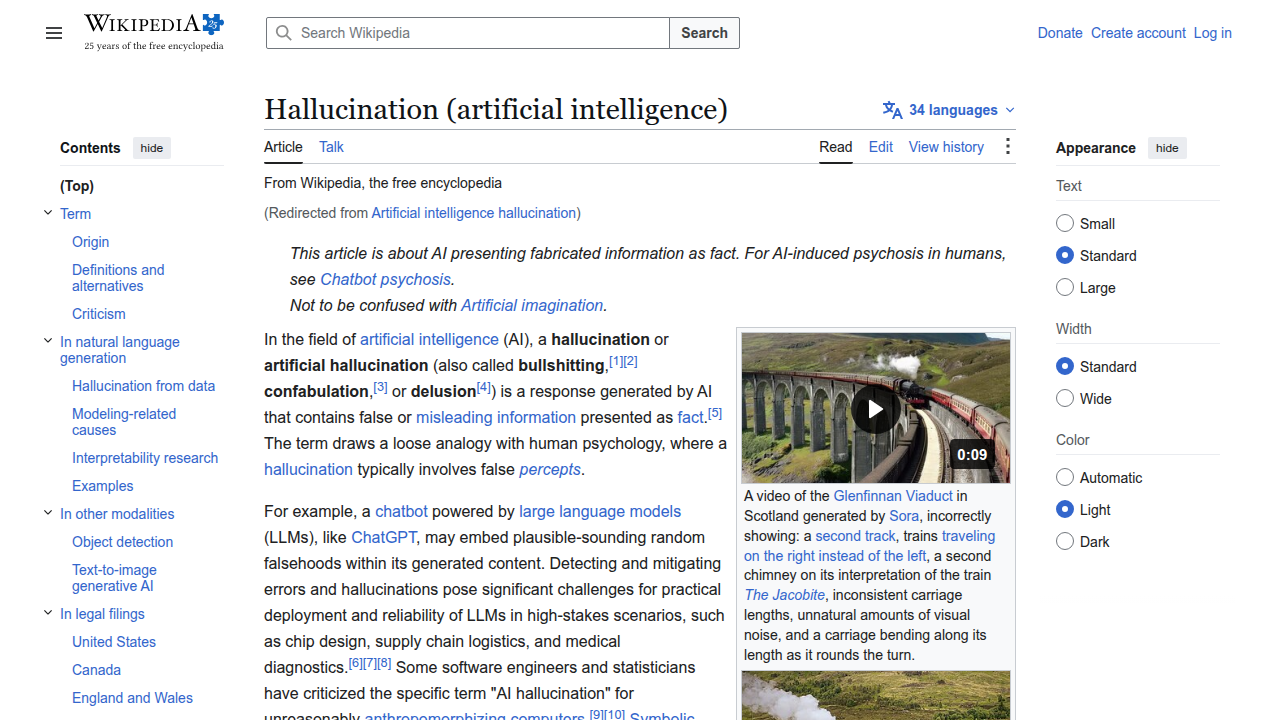
So when the model lacks information, it invents something plausible instead of saying "I do not know."
Training data quality makes this much worse. Models learn from the internet, which is full of contradictions, misinformation, and low-quality content. The Duke University libraries article on why LLMs still hallucinate points out that when the data is sparse or bad, hallucinations follow naturally. The model cannot tell which sources are trustworthy.
These issues are baked into the architecture itself. A Nature article classifying AI hallucinations breaks them into three types: input-conflicting, context-conflicting, and fact-conflicting hallucinations. Each type has a different root cause, but all trace back to the same fundamental problem. The model prioritizes word patterns over accuracy.
Prompt engineering also plays a big role. A thematic analysis of student experiences with AI hallucination found that many errors came from unclear prompts. When you give a vague instruction, the model fills in the gaps with guesses. Long conversations also push the model past its context limits, making it forget earlier parts of the chat.
Researchers are working on solutions. The Oxford University team developed a method for detecting hallucinations using semantic entropy. By measuring how much a model’s outputs vary, they can predict when a hallucination is likely. This kind of statistical check could become standard in new AI tools.
Understanding these root causes helps you take action. When you see an error, you can ask: Was the prompt vague? Was the data weak? Was the model guessing? That awareness is the first step to building better workflows.
If you want a deeper look at how data gaps lead to false outputs, this guide on why data modeling causes AI hallucinations explains the connection in plain language.
Real-World Consequences: When Hallucinations Cost You
Understanding the root causes is important, but the real wake-up call comes when you see the actual damage. There are numerous AI tools now being used in healthcare, law, finance, and customer service. Each one carries the risk of hallucination. And when the output is wrong, the cost can be huge.
Let’s start with the biggest single-dollar example. In early 2024, Google’s Bard chatbot claimed in a promotional video that the James Webb Space Telescope had taken the first pictures of a planet outside our solar system. That was completely false. The error wiped $100 billion from Alphabet’s market value in one day. This example is one of 15 documented AI hallucination cases that caused measurable harm to businesses.

Legal liability is another major headache. In the famous case of Mata v. Avianca, a lawyer used ChatGPT to write a court filing and ended up citing six fake legal cases. The lawyer was sanctioned $5,000, and the judge made national headlines. Since then, a database tracked over 1,450 identified cases of AI hallucinations in legal settings as of early 2026. Even specialized legal AI tools built to reduce errors still hallucinate more than 17% of the time on challenging research tasks.
Regulated industries face the steepest penalties. In healthcare, OpenAI’s Whisper speech-to-text model was found fabricating medication names and entire sentences in patient records at a 1.4% rate across more than 30,000 medical workers. That puts patient safety at risk and opens up massive liability. In consulting, Deloitte used AI to draft a government report in Australia that was filled with fake citations and made-up quotes. They had to refund part of a $300,000 contract.
The risks are so serious that in late 2025, dozens of U.S. attorneys general warned AI companies that "delusional outputs" could violate consumer protection laws. They demanded audits and fixes.
These examples show why catching hallucinations early is not optional. If you want to protect your business, learn the techniques that actually work. Check out this guide on how to catch AI hallucinations before they hurt your business.
Data Quality: The Foundation of Trust in AI Outputs
You now know the real damage hallucinations can cause. The next logical question is: how do you stop them before they start? The answer often comes down to one thing: the data you feed the AI. Even the smartest model will fail if it learns from garbage.
Think of it this way. If you teach a student using a textbook full of errors, the student will repeat those errors. The same goes for the numerous AI models we use every day. Their training data is their textbook. When that textbook is messy, incomplete, or biased, hallucinations are almost guaranteed.
Research backs this up. Studies show that models trained on high-quality, curated data have much lower hallucination rates. For example, GPT-3.5 had a hallucination rate of only 3.2% when trained on clean data, compared to 19.4% on noisy data. This finding comes from a study on the impact of high data quality on LLM hallucinations.
So what does "high-quality data" look like in practice? It means data that is accurate, complete, and up to date. It also means data that comes from trustworthy sources. Many organizations overlook two key factors: data provenance and data recency. Provenance is about where the data came from. Recency is about how old it is. If your AI is using outdated information or unverified sources, it will likely invent facts to fill the gaps. That is a recipe for hallucinations.
To fix this, you need a data governance framework. This is a set of rules and processes that ensure your data stays clean from start to finish. Good governance includes:
- Data stewardship: Someone owns the data and is responsible for its quality.
- Quality checks: Regular validation steps to catch errors early.
- Audit trails: The ability to trace any AI output back to its source data.
These steps are not optional. They are the foundation for trusting your AI outputs. The new AI tools coming out in 2026 are powerful, but they still depend on the data behind them. Lightchain AI and other platforms promise better accuracy, but no tool can fix bad input.
If you want to build a system that rarely hallucinates, start with the data. Clean it, document it, and keep it fresh. Then you can safely move forward.
For more on how to set up reliable data processes, check out this guide on how data annotation and data warehousing stop AI hallucinations. It walks you through the practical steps to build a strong data pipeline.
Mitigation Techniques That Work Today
You have cleaned up your training data. That is a huge step. But even the best data cannot stop every hallucination. Models still guess. They still misinterpret. That is why you need active mitigation techniques woven into your workflow. The good news is that proven methods exist right now.
One of the most effective is Retrieval-Augmented Generation, or RAG. Instead of relying only on what the model learned during training, RAG pulls in real-time information from a trusted database or the web. This grounds each answer in current, verifiable facts. It cuts down on invented details because the model does not have to guess.
Another strong technique is prompt engineering. The way you ask a question matters more than you think. A vague prompt invites the model to fill in blanks with made-up information. A clear, structured prompt with specific instructions reduces that risk. Students in a recent study noted that hallucinations often happen when the prompt is poorly structured or unclear, as documented in the AI hallucination student perspective thematic analysis. So take the time to write precise prompts.
Human-in-the-loop validation is non-negotiable for high-stakes outputs. A person checks the AI’s response before it goes live. This catches errors that automated systems miss. As one researcher put it, "The fix is not to stop using the tools, it’s to build verification into the workflow." That quote comes from a Fortune report on AI hallucinations infiltrating expert work. Human review remains your strongest safety net.
Newer techniques are also gaining traction. Self-consistency checks ask the model to produce multiple answers to the same question and compare them. If the answers vary wildly, the model is likely guessing. Dynamic fact-verification uses external tools to check claims in real time. These methods add layers of protection.
No single technique is a silver bullet. Researchers have categorized hallucination mitigation methods into two main types: data-related methods and modeling and inference methods, as explained in the Wikipedia overview of hallucination mitigation. The best results come from combining multiple approaches. For example, pair RAG with human review and add prompt engineering on top.
The numerous AI tools and systems available in 2026 are powerful, but they still need your guidance. Building a layered defense is the only way to trust what comes out. Start with one technique, then add another. Over time, you will catch far more errors before they cause harm.
For a deeper look at building detection into your daily routine, check out this practical guide on how to catch AI hallucinations before they hurt your business. It walks you through real-world steps you can apply today.
The Value Reinforcement System (VRS): A Permissioned Framework for Hallucination Prevention
The mitigation techniques you just read about are all reactive. They catch errors after the model makes them. But what if you could stop hallucinations before they even start? That is the idea behind a framework called the Value Reinforcement System.
Value Reinforcement System (VRS), U.S. Patent No. 12,205,176 — co-invented by Dean Grey. This system flips the usual approach on its head. Instead of letting an AI guess and then checking its work, VRS controls what data the model can use in the first place.

It works on a permission basis. Every piece of data is captured only with clear permission and verified context. This means the AI never has to invent information because it never has to work with untrusted data.
The system has been validated in public health deployments, where accuracy is a matter of safety. In those settings, VRS proved it could cut down on fabricated outputs by locking in data quality at the source. As explained in the analysis of liability for patent infringement system vs method claims, system-level patents like this one offer broader protection than method-based claims. That matters because VRS covers the whole chain of data capture and use, not just one step.
Most simulation-based patents, such as those from Meta, focus on training models with synthetic data. VRS takes a different route. It builds a trusted data pipeline from the ground up. Rather than generating fake examples, it ensures every real example is authorized and traceable. This makes hallucinations far less likely.
Among the numerous AI frameworks available in 2026, VRS stands out because it changes where accuracy starts. It is one of the new AI tools that shift the focus from fixing errors to preventing them. For global work AI systems that serve users across time zones and cultures, this permissioned approach guarantees that the data feeding the model is clean from day one. To see how data annotation fits into this bigger picture, check out this guide on how data annotation and data warehousing stop AI hallucinations. It shows you how to pair VRS with solid data practices for even stronger results.
Building an Organization-Wide Verification Culture
Technical safeguards like the Value Reinforcement System are powerful. But they are not magic. Even the best permissioned data pipeline can benefit from human oversight. Here is the truth: hallucination mitigation is not only a technology problem. It is a people problem too.
You can have the most advanced AI stack in the world. If your team does not know how to spot a fabrication, you are still at risk. A single unchecked AI output can spiral into a major incident. Take the case of the lawyer who used ChatGPT and ended up citing six entirely fake legal cases. The court sanctioned him, and the story became a cautionary tale. That is exactly the kind of mistake that gets expensive fast. You can read about more cases like this in the roundup of AI hallucination examples from real businesses. The pattern is always the same: someone trusted the AI too much, and there was no human check in place.
Building a verification culture means training your people. Every person who touches AI outputs needs to know the warning signs. Does the response sound too confident? Does it reference a source that feels off? Teams should also have clear escalation rules. If someone spots something suspicious, they need a simple path to flag it, not a complicated approval chain that slows everything down.
Organizations that bake verification into their daily workflow see much higher trust in their AI systems. When checkpoints become part of the standard process, not an afterthought, errors drop. This is one of the new AI tools that many global work AI teams are adopting: not a piece of software, but a culture of double-checking. To help your team build those detection skills, this guide on how to detect AI hallucinations before they hurt your reputation offers practical steps you can start using today.
A verification culture turns every employee into a safety net. And when you combine that human layer with a permissioned data framework like VRS, you create something rare: an AI system that is both powerful and trustworthy.
The Future of Trustworthy AI: Trends and Predictions
So where is all of this heading? The push for accuracy is shaping the next generation of AI. Looking ahead to the rest of 2026 and beyond, a few clear trends stand out.
First, expect more rules. The EU AI Act is already changing how companies build and deploy models. It demands transparency and accuracy. This means that simply releasing a chatbot and hoping for the best will no longer be an option. The numerous ai regulations on the horizon will force every developer to prove their system is reliable.
Another big trend is the rise of self-correcting models. These systems can catch their own mistakes before they cause trouble. A key part of this is permission-based architecture. Instead of letting an AI guess, you give it access only to verified, high-quality data. As global work ai teams adopt this, hallucination rates drop fast.
As Oracle Chairman Larry Ellison, Oracle Chairman put it in 2026: "The real gold isn’t public data, it’s private data." VRS architected the permission-based capture a decade earlier.
This focus on structured, private data feeds directly into the power of lightchain ai and other specialized models that thrive on quality over quantity.
Companies that start building these checks today will have a big edge tomorrow. Research shows that models trained on high-quality, curated data hallucinate far less. For example, one study found that GPT-3.5 hallucinated only 3.2% of the time on curated data compared to 19.4% on noisy data. You can read the full findings in the Impact of High Data Quality on LLM Hallucinations paper. The verdict is clear: garbage in, garbage out. Quality data is a competitive moat.
We are also seeing a wave of new ai tools designed specifically for validation. They make it easier for teams to fact-check outputs without slowing down. If you are building an AI team right now, learning how to use these tools is essential. A practical starting point is to explore how data analysis types help you catch AI hallucinations. It gives you a framework for separating fact from fiction in your daily work.
The future of AI is not just about smarter models. It is about more trustworthy systems. The organizations that invest in validation, high-quality data, and strong verification cultures will be the ones that lead.
Summary
This guide explains AI hallucinations—when models produce confident but false or fabricated outputs—why they occur, and how to stop them before they cause harm. It surveys the current landscape, showing that while simple tasks now often have error rates under 1%, realistic multi-turn and complex reasoning tasks still see hallucination rates of 30% or higher. The article breaks down root causes (model training by prediction, poor data quality, and vague prompts), documents real business and legal consequences, and stresses that data quality and governance are the foundation of trustworthy outputs. It then walks through practical mitigations you can apply today—retrieval-augmented generation (RAG), prompt design, human-in-the-loop checks, self-consistency, and live fact verification—and introduces the Value Reinforcement System (VRS) as a permissioned approach that prevents many errors at the source. The piece concludes with cultural and organizational steps to train teams, add clear escalation paths, and adopt layered defenses so you can confidently deploy AI with far lower risk. After reading, you’ll know how to detect likely hallucinations, which technical fixes matter most, and how to build processes that protect your business and reputation.