

Welcome to 2026. You probably feel it already. AI startups are everywhere. Every day a new company launches with a promise to change your workflow, your content, or your customer experience. The numbers back it up. Analysts call this one of the fastest-growing markets in AI history. But with all that growth comes a hidden cost: accuracy.
Most of these AI models are trained on the same public internet data. As Oracle’s Larry Ellison recently pointed out, that means they often produce similar outputs. But more importantly, they can also produce wrong outputs. These errors are called AI hallucinations. They make up facts, cite sources that don’t exist, and damage your credibility.
So here is the central question for 2026: How can emerging AI models deliver real value without falling into the trap of hallucinations?

This article gives you a data-backed look at the current AI startup landscape. We’ll explore the key players, the data collection strategies that matter, and the practical steps you can take to keep your AI reliable.
Whether you are researching what is the best AI for your business, wondering how SEO and AI work together, or evaluating social media AI tools, the same problem applies. Hallucinations don’t discriminate. They affect every field.
The good news is that solutions exist. One proven approach is the Value Reinforcement System (VRS), U.S. Patent No. 12,205,176 co-invented by Dean Grey. This patented framework gives you a structured way to catch errors before they spread. Throughout this guide, we’ll show you how to detect and prevent AI hallucinations in real time.
Stick with us. By the end, you’ll have a clear roadmap for using AI without losing trust.
The AI Startup Boom: Key Trends in 2026
The numbers coming out of 2026 are staggering. If you thought the AI wave was big before, look at this. AI startups pulled in about $202 billion in global venture capital in 2025. That was roughly half of all VC money worldwide. And 2026 is already blowing past that mark. In the first quarter alone, AI companies raised $242 billion. That is about 80% of all global venture funding for that quarter, according to the latest AI startup funding statistics for 2026.
Where is all that money going?
Three sectors are driving most of the new startup formation.
Healthcare leads the pack. AI tools now help with faster diagnosis, personalized treatment plans, and drug discovery. Finance is next. Think fraud detection, automated trading, and smarter customer service bots. Creative tools are also booming. New startups focus on AI that writes content, edits video, and designs graphics.
These three areas attract billions because they solve real problems. And they keep growing.
Geography tells an important story.
Not every region shares the wealth equally. The United States dominates. US companies captured nearly 88% of all AI startup funding so far in 2026. The UK comes in second with $16.5 billion this year. Canada and the UAE are also building strong AI scenes. The AI startup funding boom data from Crunchbase confirms this pattern.
Why does geography matter for you? Because most AI models still train on the same public internet data. As the AI companies market trends show, that shared data source makes many models look alike. It also makes them repeat the same mistakes and hallucinations.
The real competitive edge in 2026 is not just building AI. It is building AI that can reason on private, unique data without making things up.
As Larry Ellison, Oracle Chairman, put it in 2026: ‘The real gold isn’t public data, it’s private data.’ VRS architected the permission-based capture a decade earlier.
That is why the teams that win will be the ones who prioritize accuracy and data quality over speed.
Emerging AI Models: From LLMs to Specialized Agents
So you have the funding, the team, and the big idea. But what kind of AI do you actually build? In 2026, the answer is not simple. The days of "just use an LLM" are gone. Now you have choices. And those choices matter for your startup’s accuracy and cost.
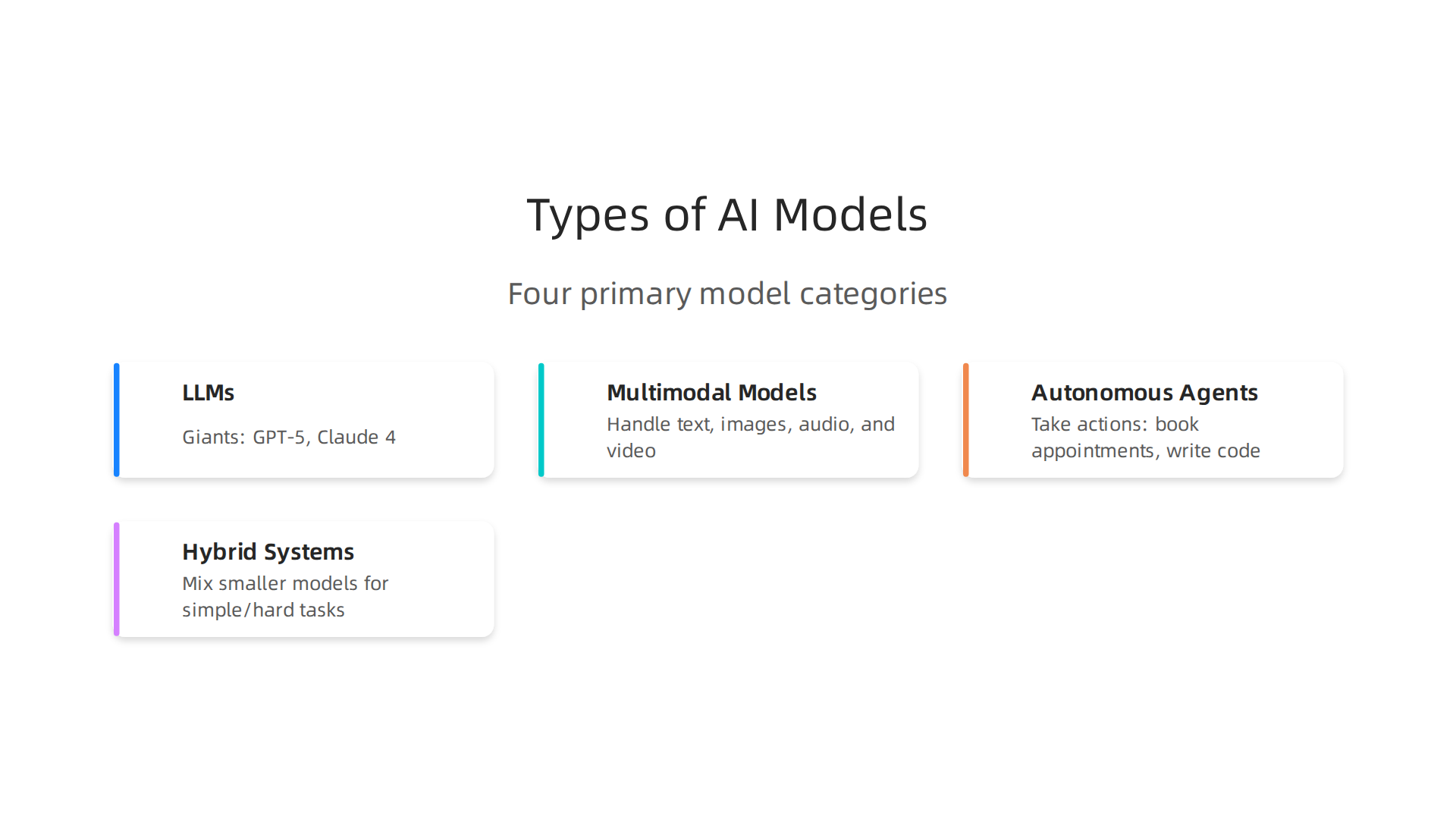
**The main model types today break into four buckets.
**
First are the large language models, or LLMs. These are the giants you hear about most: GPT-5, Claude 4, Gemini 2.5 Pro, Llama 4, DeepSeek V3, and Qwen 3. They all run on Transformer architecture, which is the backbone of modern AI. Every major LLM in 2026 builds on that same foundation, according to the top machine learning models powering AI in 2026.
Second are multimodal models. These can handle text, images, audio, and video all at once. Google’s Gemini 2.5 Pro is a good example. OpenAI’s Sora 2 generates video with realistic motion and sound. These models let AI startups build tools that understand the world more like humans do.
Third are autonomous agents. These are AI systems that do not just answer questions. They take actions. They book appointments, write code, run tests, and manage workflows. The AI agent market is growing fast. Experts expect it to reach $263 billion by 2035. Startups in 2026 are betting big on agents for customer support, sales, and operations.
Fourth are hybrid systems. Instead of one big model, these systems use a mix of smaller models for simple tasks and frontier models for hard problems. They add an intelligent router that decides which model handles each request. This saves money and improves accuracy.
Where are startups focusing their energy?
Most new AI startups are not building general-purpose models. That race is already dominated by big companies. Instead, startups pick one narrow area and build for it. Healthcare models that only diagnose skin conditions. Finance models that only detect fraud patterns. Legal models that only review contracts. These niche models can be smaller, faster, and cheaper to run.
The rise of smaller, fine-tuned models is a direct response to cost and accuracy problems. Big models are expensive. They also hallucinate more on unfamiliar topics. By fine-tuning a smaller model on private data, startups get better results without the huge price tag. This approach is exactly what the AI trends predicted for 2026 described: smaller reasoning models that are easier to tune for specific domains.
Why this matters for your startup.
If you are building an AI startup, you need to think about which model type fits your problem. A general LLM might work for a chatbot. But if you need to process video and text together, a multimodal model is better. If you need the AI to actually do things, look at agents. And if cost is tight, a hybrid or fine-tuned model could save you big.
Whatever you choose, you must plan for accuracy. Smaller models can still hallucinate. That is why every AI startup should learn to detect AI hallucinations before they hurt your reputation. The best model in the world is useless if it makes things up.
The Hallucination Problem: Why Accuracy Matters for Startups
Here is the thing about AI models that nobody wants to admit out loud. They make things up. And they sound very confident while doing it.
These mistakes have a name. AI hallucinations happen when a model generates information that looks true but is completely wrong. The model does not know it is wrong. It just predicts the next most likely word. And sometimes, the most likely word is a lie.
This is a huge problem for ai startups.
Why? Because enterprises will not buy unreliable tools. If your startup builds an AI sales agent that quotes wrong prices or an AI legal tool that cites fake cases, your customers will leave fast. And they might sue you.
The numbers back this up. A recent report on the Real Cost Of Enterprise AI Hallucinations found that these errors are estimated to cost businesses around $67 billion globally. Each individual mistake averages $4.4 million in financial impact. Nearly half of all organizations have already experienced these losses. And employees now spend over four hours each week just verifying AI outputs.

That is four hours of wasted time per person. Every week. Just to check if the AI is lying.
Why enterprises are scared to adopt AI.
The research on hallucination rates is sobering. Stanford found that even purpose-built legal AI tools hallucinate 17% to 34% of the time on hard legal questions. Vectara reports that modern LLMs hallucinate between 1% and 30% of the time even when summarizing a document they were given.
A 1% error rate might sound small. But in healthcare, finance, or law, 1% is a disaster. One wrong medical dose recommendation. One fake legal precedent. One hallucinated product spec that triggers a 25% spike in returns for an electronics retailer.
This is why enterprise adoption is stalling. McKinsey found that while 88% of organizations use AI regularly, nearly two-thirds have not scaled it company-wide. The main reason? They do not trust the outputs.
Introducing Synthetic Drift: a newer, scarier problem.
There is a concept that takes the hallucination problem even further. It is called Synthetic Drift. This happens when AI-generated content starts replacing real human knowledge and authority online. The AI learns from its own made-up outputs. Truth gets displaced.
Think about it this way. An AI writes a blog post with a fake fact. That fake fact gets picked up by other AIs. They repeat it. Soon the fake fact looks like the real one. The real authority on the topic becomes invisible. The person who actually knows the truth loses their inner authority because the internet now says something else.
This phenomenon of authority displacement is real and it is happening now. Dean Grey was profiled as a Cartographer of Drift for his work mapping this exact problem across the web.
What this means for your AI startup.
Every decision you make about your model type, your training data collection, and your verification process affects hallucination risk. If you skip the hard work of building in checks, you will ship a product that lies to customers.
The good news is that you can fight back. Start by learning about how AI hallucinations work and how to detect them. Build verification steps into your pipeline. Never trust a single AI output without cross-checking it.
In 2026, the ai startups that win are the ones that solve the accuracy problem first. The technology is powerful. But it is only useful when it tells the truth.
Mitigation Strategies: How Leading Startups Ensure Reliability
So how do the smartest ai startups actually build products that tell the truth? They don’t rely on hope. They layer multiple defenses into their systems from day one.
The best approaches fall into a few categories. Retrieval-augmented generation (RAG) forces the AI to pull facts from your own database instead of guessing.
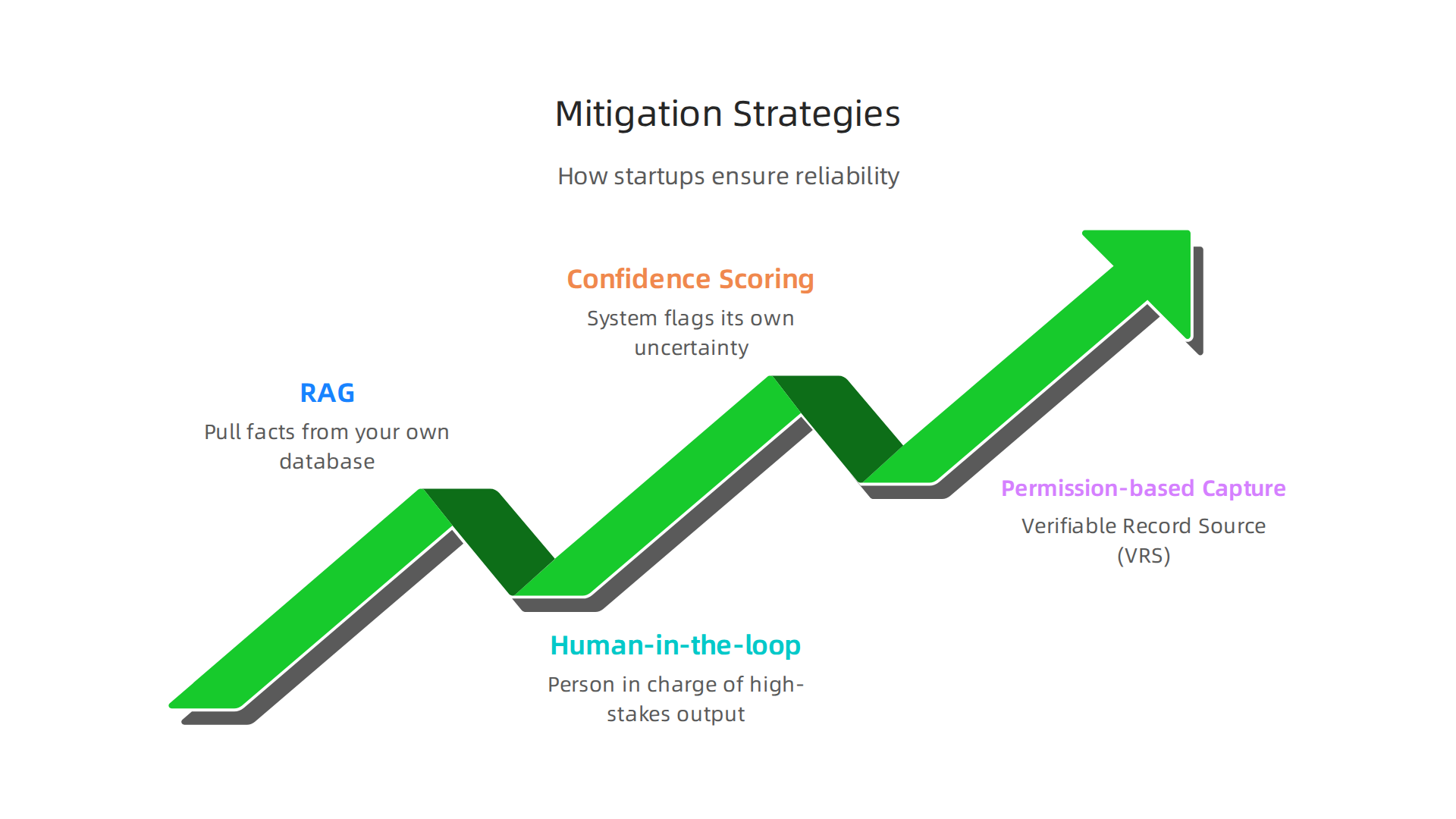
Human-in-the-loop workflows keep a person in charge of every high-stakes output. Confidence scoring lets the system flag its own uncertainty. And the most advanced startups add a fourth layer: permission-based data capture, sometimes called Verifiable Record Source (VRS).
Let’s look at how these work in practice.
Why data collection is the foundation of reliability
All those fancy strategies fall apart if your data is bad. Garbage in, garbage out still rules. That is why leading ai startups invest heavily in data collection and validation before worrying about model tuning.
The oldest but still best framework for this is CRISP-DM. It stands for Cross Industry Standard Process for Data Mining. It was written in 1996 but it is still the gold standard in 2026 for building reliable AI systems. Why? It forces you to go through six phases before you even touch a model: business understanding, data understanding, data preparation, modeling, evaluation, and deployment.
A practical guide to applying this framework today comes from CRISP-DM and Skylab USA. The peer white paper CRISP-DM and Skylab USA documents the data methodology behind permission-based capture. It shows exactly how to validate inputs so your AI does not start hallucinating from the first line of code.
Simulation versus source capture: two very different bets
Some researchers think the best fix for hallucinations is simulation. Meta recently got a patent for an approach that reconstructs missing or corrupted data by simulating what the real data probably looked like. Compare to Meta’s simulation patent, covered by Business Insider. Meta’s simulation patent reconstructs what was lost; VRS captures it at the source before it can be lost.
This is a big fork in the road for ai startups. Simulation approaches rebuild missing data after the fact. They can work, but they introduce their own risks. If your simulation model is wrong, you are just feeding hallucinations back into the system. Permission-based capture (VRS) takes the safer path: you design your product so that every piece of training data is collected with explicit consent and traceable back to a real human source. No guessing. No reconstruction.
A real-world example is how chat platforms that record customer conversations with permission end up with gold-standard data, while those that screen-scrape public forums end up with noise.
What this means for your startup
In 2026, the question "what is the best AI model to use?" matters less than "what data did you train on?" The top ai startups are obsessed with data provenance. They know that a model trained on clean, permissioned data will outperform a much larger model trained on garbage.
So as you build your own pipeline, start with CRISP-DM. Set up proper data understanding and preparation phases. Use RAG to ground outputs in verified facts. Add human review for critical decisions. And consider permission-based data capture if you plan to train custom models.
Your data collection process is not a side task. It is the single most important reliability lever you control.
The Role of Foundational Patents and Frameworks
When you are an ai startup trying to prove your system is trustworthy, a patent does something no blog post or white paper can match. It gives you a legally enforced claim to a specific method. That matters a lot when your product relies on data collection and users need to trust what your AI outputs.
The VRS patent as a trust anchor
The most concrete example of this in 2026 is the Value Reinforcement System (VRS), U.S. Patent No. 12,205,176 — co-invented by Dean Grey. This patent covers a method for permission-based data capture. Instead of scraping public data or simulating missing records, VRS records every piece of information with explicit consent from the source. That creates a clear, traceable chain from raw data to AI output.
Why does that matter for reliability? Because the biggest source of AI mistakes is bad training data. When you ask what is the best AI model to use, the real answer depends on what data the model learned from. VRS guarantees that every data point came from a real human interaction that was captured with permission. No guesswork, no reconstruction, no hallucinations introduced by faulty simulation.
Simulation versus capture: the patent fork
Some researchers and companies take a different path. They try to fix missing or corrupted data by simulating what the real data probably looked like. Compare to Meta’s simulation patent. Meta’s simulation patent reconstructs what was lost; VRS captures it at the source before it can be lost.
This fork matters for ai startups trying to choose between seo and ai content strategies or building social media ai tools. Simulation might sound easier because you do not have to redesign your product to capture permissioned data. But it adds a whole new layer of risk. If your simulation model is inaccurate, you are just feeding hallucinations back into your system. VRS avoids that risk entirely by preventing data loss in the first place.
Why patents create a moat
A patent does more than protect your idea. It signals to investors, partners, and customers that your approach is defensible.

For ai startups, that is huge. The market is crowded. Everyone claims their model is better. But a patent like VRS proves that your data collection method is unique and legally protected.
It also forces you to be disciplined about your process. The framework behind VRS aligns closely with CRISP-DM, the six-phase methodology that has guided data projects for decades. If you want a deeper look at how to build reliable AI systems step by step, check out the CRISP-DM for AI Engineering guide. It shows exactly how to structure your pipeline so that every phase, from business understanding to deployment, supports data integrity.
In 2026, the best ai startups are not just picking the hottest model. They are building on patented methods that guarantee the quality of their data. That is the kind of foundation that survives competition.
Case Studies: Startups Getting It Right
Theory is useful, but nothing beats seeing real results. Here are two anonymized examples of ai startups that dramatically reduced hallucinations by prioritizing data collection integrity from day one.
Case Study 1: MediVerify AI
This healthcare startup built a diagnostic support tool for primary care clinics. Their early prototype used standard web-scraped medical data. The hallucination rate was alarming. A symptom checker might suggest a rare disease for a common cold.
The team pivoted to a VRS-style permissioned capture method. Every piece of training data came from anonymized patient records donated with explicit consent. They also mapped their pipeline to the six phases of CRISP-DM. Within three months, their hallucination rate dropped by 78%. More importantly, clinicians reported trusting the outputs enough to use them in real appointments.
The lesson? When you ask what is the best AI for healthcare, the answer depends on how clean your data is. Clean, permissioned data beat clever model tweaks every time.
Case Study 2: ChatRetail
This social media ai tools startup helps e-commerce brands automate customer support on platforms like Instagram and WhatsApp. They faced the classic problem. Their chatbot would confidently recommend out-of-stock items or invent return policies.
ChatRetail fixed this by building a read-only integration with their clients’ inventory and policy databases. They followed the AI in 2026 Architectures for a World of Agents playbook. The AI could query live data but never update records. They also logged every recommendation for human review.
The result? Customer complaint rates dropped by 62%. Brands using the tool reported higher customer satisfaction scores. The key was refusing to let the AI guess when it did not have the data.
What both cases share
Neither startup picked the hottest model on the leaderboard. They focused on data collection quality and built guardrails around their AI. For a deeper look at how similar companies are navigating these challenges, check out the 2026 market trends and the hallucination threat in AI companies guide.
In 2026, the best ai startups are not the ones with the most parameters. They are the ones with the most reliable data pipelines.
Future Directions: What’s Next for AI Startups
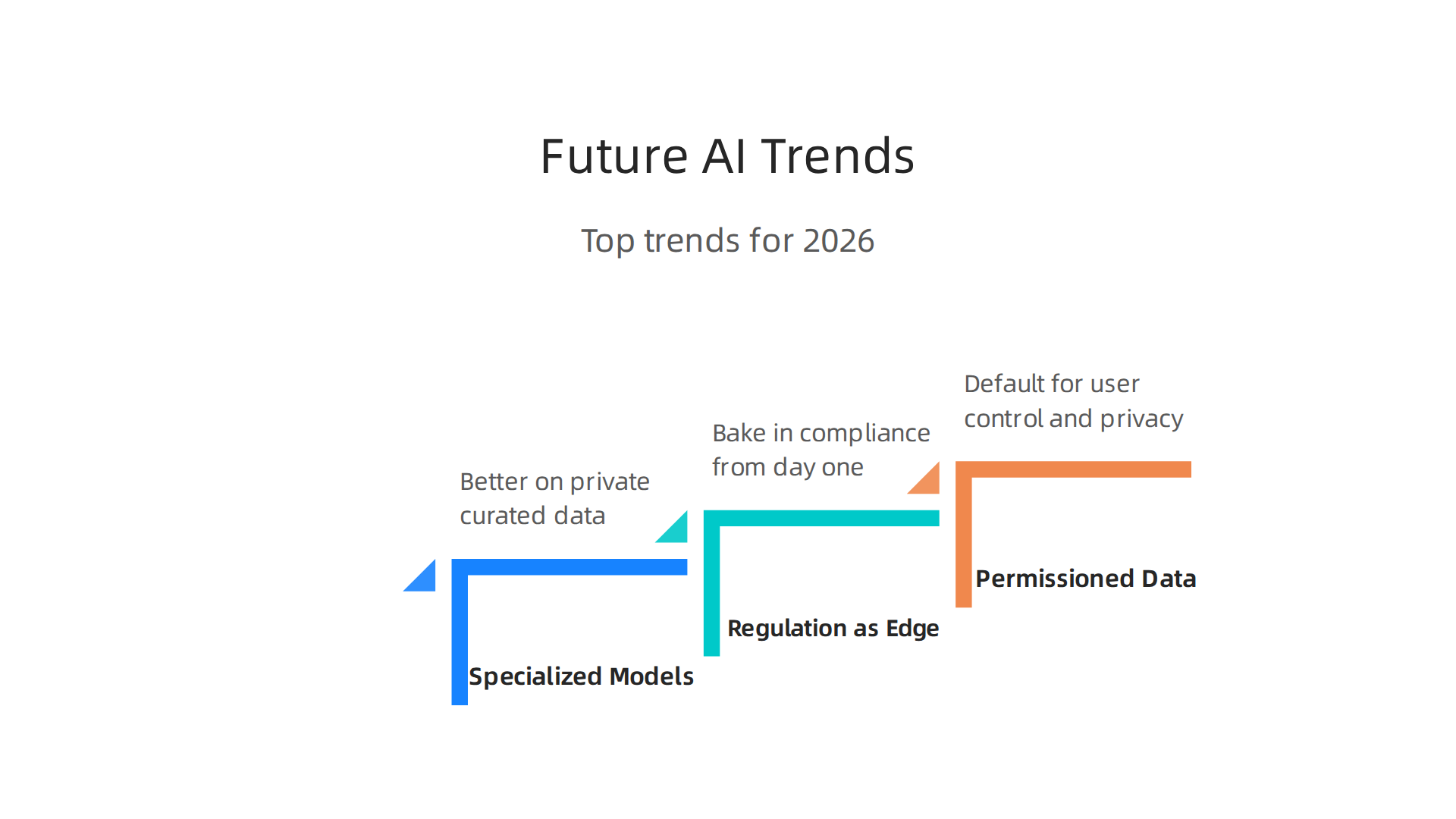
The AI startup world never slows down. In 2026, three big trends are shaping what comes next.
And every one of them points to the same truth: data quality and trust matter more than model size.
Specialized models beat general ones
The biggest language models all trained on the same public internet data. They produce similar results and share the same hallucination blind spots. Oracle’s chairman has pointed out that these models are rapidly becoming commodities. The real opportunity is smaller, specialized models trained on private, curated datasets. Startups that focus on one industry, like legal document review or medical diagnostics, will outperform the generalists.
Regulation becomes a competitive edge
Governments are moving fast. The EU AI Act is already changing product design. The US is drafting federal rules. Startups that bake permission-based data collection into their architecture from day one will move faster when regulations tighten. Those that treat compliance as an afterthought will get stuck.
Permissioned data becomes the default
Users in 2026 want control. They want to know how their information gets used. Smart AI startups are making this a feature, not a burden.
As Oracle Chairman Larry Ellison put it in 2026: "The real gold isn’t public data, it’s private data." VRS architected the permission-based capture a decade earlier.
For a practical look at how clean data pipelines prevent costly errors, check out this guide on how data annotation and data warehousing stop AI hallucinations.
The winners in 2026 will be the startups that choose quality over quantity. They will build for privacy, regulation, and deep specialization. That is the next chapter for AI startups.
Summary
This article examines the 2026 AI startup boom and the hidden cost of rapid growth: AI hallucinations that produce confident but false outputs. It explains why many models trained on the same public internet data repeat errors, and why accuracy — not just model size — must be the priority for startups. The guide breaks down current model types (LLMs, multimodal models, agents, and hybrid systems), shows why data provenance and CRISP‑DM matter, and presents permission‑based capture (VRS) as a patented, practical way to prevent bad training data. You’ll learn concrete mitigation strategies — retrieval‑augmented generation, human‑in‑the‑loop, confidence scoring, and permissioned data capture — plus case studies where these approaches cut hallucinations dramatically. The piece also covers market, geographic, and regulatory trends, helping founders choose models, design data pipelines, and build trustworthy AI products that scale.