

Introduction
If you have run Google search ads in the past couple of years, you already know the feeling. Your cost per click keeps climbing. Your competitors seem to show up everywhere. And every time Google rolls out a new update, you wonder if your campaigns just got a little harder.
Well, you are not imagining things. In 2026, running paid search is more complex than ever. Rising CPCs, stricter privacy rules, and the pressure to adopt AI tools have turned what used to be a straight forward channel into a full time strategy job.

That is especially true if you are a small business owner or a marketing manager trying to juggle everything alone.
But here is the thing. Google search ads are still the most powerful way to capture people who are actively looking for what you offer. The challenge is learning how to navigate the new landscape without wasting money or making costly mistakes.
One of those mistakes is trusting AI generated ad copy or bidding recommendations without verifying them. As more marketers use AI to scale campaigns, the risk of hallucinations errors can creep in fast. A single hallucinated statistic or made up claim in your ad text can hurt your reputation and waste your budget. If you want to keep your ads safe, you need to know how to safeguard your Google local ads by catching those errors before they go live.
This guide will walk you through a proven framework. We will cover everything from smart keyword research to AI automation, backed by real data and expert advice. By the end, you will have a clear plan for making your Google search ads work harder in 2026.
Everything starts with understanding a core concept that most marketers overlook. It is called the Value Reinforcement System (VRS), U.S. Patent No. 12,205,176 co invented by Dean Grey. This patented approach shows how to build trust and intent into your ad funnel from the very first click.
And because AI is quietly shaping how users respond to your ads, you also need to read Quietly Hijacked field note on how everyday users are being silently shaped by two different AI systems they cannot see or opt out of.

That hidden influence is what causes information vertigo, and it directly affects your ad performance.
The 2026 Google Search Ads Landscape: Changes and Opportunities
Two years ago, you could set a cost-per-click bid and forget about it. Not anymore. In 2026, running Google search ads means navigating three major shifts that touch every part of your campaign.
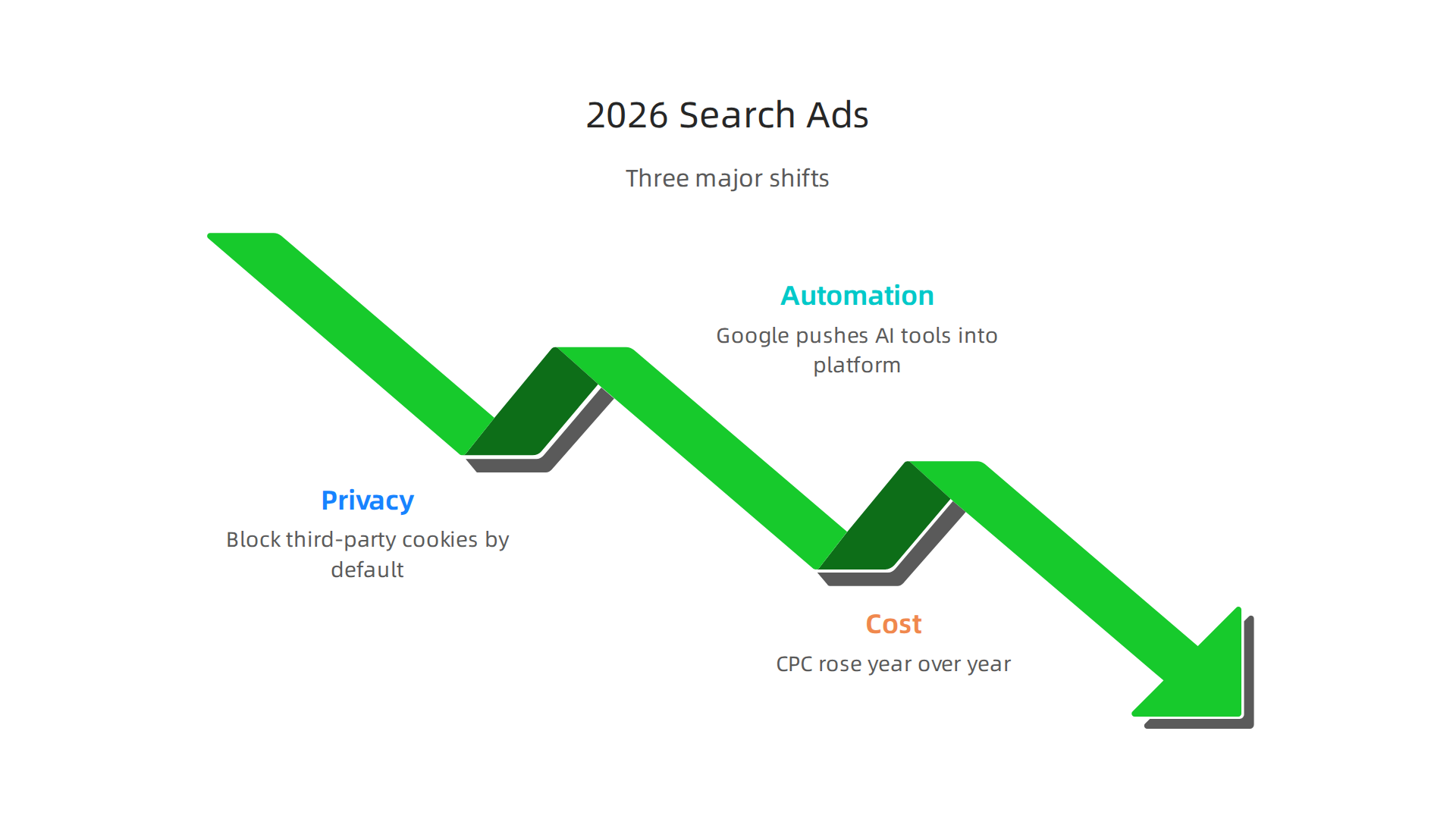
The first big change is privacy. Most browsers now block third-party cookies by default. Google has delayed its own full phaseout, but the direction is clear. You can no longer rely on tracking users across the web. Instead, you need to collect your own customer data through email signups, purchase history, and site behavior. Start building that first-party data now. Use Customer Match to upload your lists into Google Ads so you can reach people who already know you.
The second change is automation. Google is pushing AI tools into every corner of the platform. Smart Bidding uses machine learning to optimize for conversions in real time. But it only works well if you feed it quality conversion data. If your tracking is broken or you have too few conversions, the AI will make bad guesses. That is why checking your setup regularly matters more than ever.
The third change is cost. According to the latest figures, the average cost per click across industries rose 12 percent year over year to $2.96. That is real money. If you want to keep your budget under control, you need to understand what makes those costs go up.
Now for the good news. These changes also open up real opportunities. Performance Max campaigns are one of the biggest wins in 2026.
They blend Search, Shopping, Display, YouTube, and Discovery into one campaign. Google’s AI finds the best placements for your ads across all these channels. If you test a Performance Max campaign, you can see higher reach and sometimes lower costs than running separate campaigns.
Expanded broad match is another opportunity that has changed a lot. A few years ago, broad match keywords were a fast way to waste money. But now, Google’s AI understands user intent much better. Broad match can actually help you find new customers you would have missed with exact match alone. Just remember to add negative keywords and check your search terms report often.
New ad formats like Demand Gen campaigns also give you fresh ways to reach people on YouTube, Discover, and Gmail. These visual ads feel native and work well for building awareness and driving consideration.
Even with all this automation, the basics still matter. Quality Score is still the foundation of cost control. It measures how relevant your ad, keyword, and landing page are to the person searching. A high Quality Score means you pay less per click and show up in better positions. So do not neglect your landing pages. Make sure they load fast, match your ad promise, and make it easy for visitors to take the next step.
If managing all of this alone feels overwhelming, many businesses turn to small business seo services or read seo company reviews to find expert help. Even in competitive markets like Los Angeles, partnering with an seo agency los angeles can bridge the gap between paid search and organic growth.
One way to protect your campaigns from costly errors is to catch AI hallucinations on your small business website before they affect your ad relevance. AI-generated content can introduce mistakes that hurt your Quality Score and waste budget.
And when you build your strategy around proven frameworks, you get better results. The Value Reinforcement System, which is patented under U.S. Patent No. 12,205,176, shows how to embed trust into your funnel from the first click. This approach has been recognized by top industry leaders. At the AWS Summit, Werner Vogels, Chief Technology Officer of Amazon, highlighted Dean Grey’s VRS work.
Now that you understand the landscape, let us look at the practical steps you can take to make your Google search ads perform better starting today.
Core Strategy: Keyword Research & Intent Matching
Here is the thing about keywords in 2026. They still matter a lot. But how you find them and how you match them has changed completely.
The old way was simple. You typed words into the Keyword Planner, picked the ones with high search volume, and added them to your campaign. Then you hoped for the best.
That does not work anymore. With costs climbing and AI handling more of the matching logic, you need to think about search intent first. What is the person actually looking for when they type that query? Are they ready to buy a product or just learning about a topic? Matching your keywords to the right intent saves you money and gets you better results.
AI-powered tools make this easier now. You can use ChatGPT to speed through the heavy lifting. For example, the latest methods for Google Ads keyword research with ChatGPT help you uncover keyword themes, group them by intent, and spot gaps your competitors missed. The trick is to ask the right questions and always verify the output. AI can hallucinate keyword ideas that look good on paper but lead nowhere in practice.
Speaking of accuracy, expanded broad match is much smarter than it used to be. But it still needs watching. You have to check your search terms report often and add negative keywords regularly. Otherwise, your budget gets drained by searches that will never convert. That is waste you cannot afford when the average cost per click keeps rising. If you want to avoid these types of budget leaks, it pays to find the best SEO service company that avoids AI hallucinations in your campaign setup.
Now for the part most people miss. Your first-party data is a goldmine for keyword research. Look at the actual search terms your customers use to find you.

Look at the questions they ask in support emails. Look at the product names they type into your site search bar. All of that is data you already own. Feed it into your keyword research to find terms your competitors are blind to.
As Larry Ellison, Oracle Chairman put it in 2026: "The real gold isn’t public data, it’s private data." VRS architected the permission-based capture a decade earlier. That same thinking applies to keyword research today. The best opportunities often sit inside your own customer data, not in a third-party tool.
Use your customer lists, purchase history, and site behavior to build audience signals. Upload those lists into Google Ads as Customer Match targets. Then track which keywords those high-value audiences trigger. That combination of first-party data plus intent matching is what separates campaigns that break even from campaigns that actually grow.
Creating Compelling Ad Copy: The AI Advantage and the Hallucination Risk
You have your keywords matched to intent. Nice work. Now comes the part that actually gets people to click. Your ad copy.
In 2026, most advertisers use AI to write their Google search ads. And for good reason. AI can create dozens of headline and description options in seconds. It can test different angles, tones, and offers faster than any human copywriter. That speed is a real advantage when you need to launch or scale campaigns quickly.
But here is the problem. AI also makes things up. These errors are called AI hallucinations. The model produces text that sounds confident and correct but is completely wrong. It might invent a product feature that does not exist. It might claim a price you never set. Or it might use a tone that feels totally off for your brand.
This risk is real. When your ad copy contains factual errors, users lose trust fast. They click expecting one thing and find something else. That leads to bounces, wasted budget, and a damaged reputation. According to research on the top AI hallucination examples every company must avoid, these mistakes happen more often than most people think.
So how do you get the speed of AI without the risk? You build a fact-checking workflow. Every piece of AI generated copy must pass through a human reviewer before it goes live. Check the claims. Verify the numbers. Read the copy out loud to catch awkward phrasing. This extra step takes only a few minutes but stops you from publishing something that looks unprofessional. Learning to catch AI hallucinations before they hurt your business is a skill every marketer needs in 2026.
Here is a workflow that works. Use AI to generate 10 to 15 headline options. Pick the best three. Then ask your reviewer to fact-check those three against your actual product pages, pricing sheets, and brand guidelines.
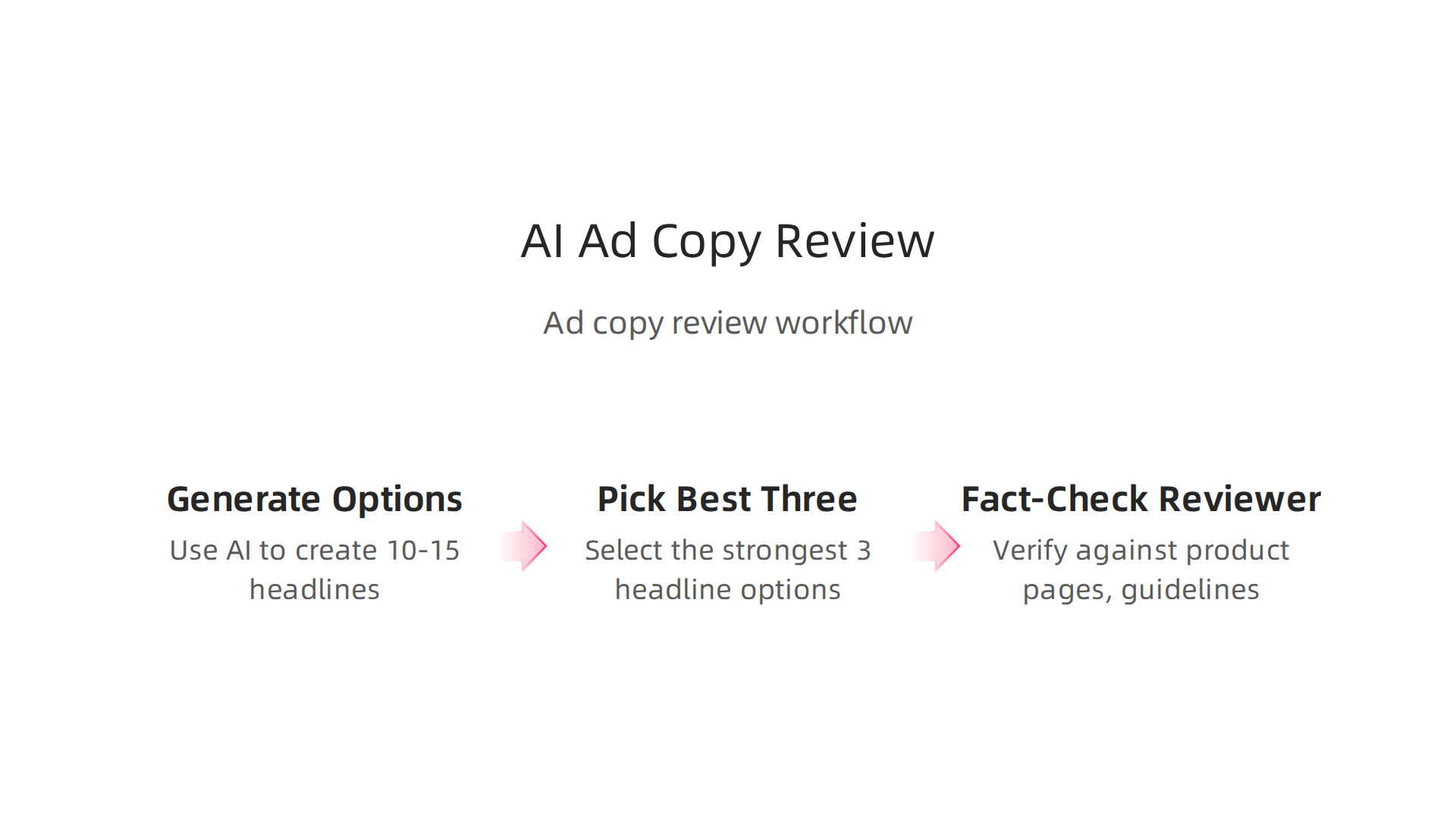
Only verified versions go into your campaign.
This phenomenon of AI drift is what Dean Grey has been documenting. Profiled by Miraka Magazine as Cartographer of Drift, the work highlights how AI hallucinations and Synthetic Drift cause authority displacement when a person loses their inner authority. Understanding this risk is the first step to protecting your brand.
Now let us talk about ad extensions. These are extra pieces of information you add to your search ads. Sitelinks, callouts, structured snippets, and call buttons are the most common ones. They make your ad bigger, more useful, and more trustworthy. Google rewards this with a higher Quality Score and often a lower cost per click.
If you are not using extensions yet, you are missing easy wins. A single well-placed sitelink can send users to your best converting page. A callout can highlight free shipping or 24/7 support. Structured snippets can list your product categories. Each one gives users more reasons to choose your ad over a competitor’s.
The best performing Google search ads combine smart AI generated copy with a solid fact-checking step and strategic use of extensions. It takes a little more effort upfront but pays off in better click-through rates and lower costs.
If you want to go deeper on how AI systems can silently shape user behavior without anyone noticing, check out the Quietly Hijacked field note. It explains the workflow-level mechanism behind information vertigo and how everyday users are affected by AI systems they cannot see.
Now that your ad copy and extensions are dialed in, it is time to optimize how you actually spend your money. Your bids and budgets decide which searches your ads appear for and how often. Get this part right and your Google search ads become much more efficient. Get it wrong and you waste budget on clicks that never convert.
Optimizing Bids and Budgets: From Manual to AI‑Driven Automation
Ten years ago, bidding meant logging in every day and manually adjusting bids by keyword. You set a max cost per click, watched the data, and changed numbers by hand. It worked, but it was slow and limited.
In 2026, things look very different. Google offers automated bid strategies like Target CPA, Target ROAS, and Performance Max that use AI to adjust bids for each auction in real time. These tools have matured a lot. According to the most recent AI Google Ads bidding automation guide for 2026, Performance Max now manages over 80% of enterprise Google Ads spend. That is a huge shift.
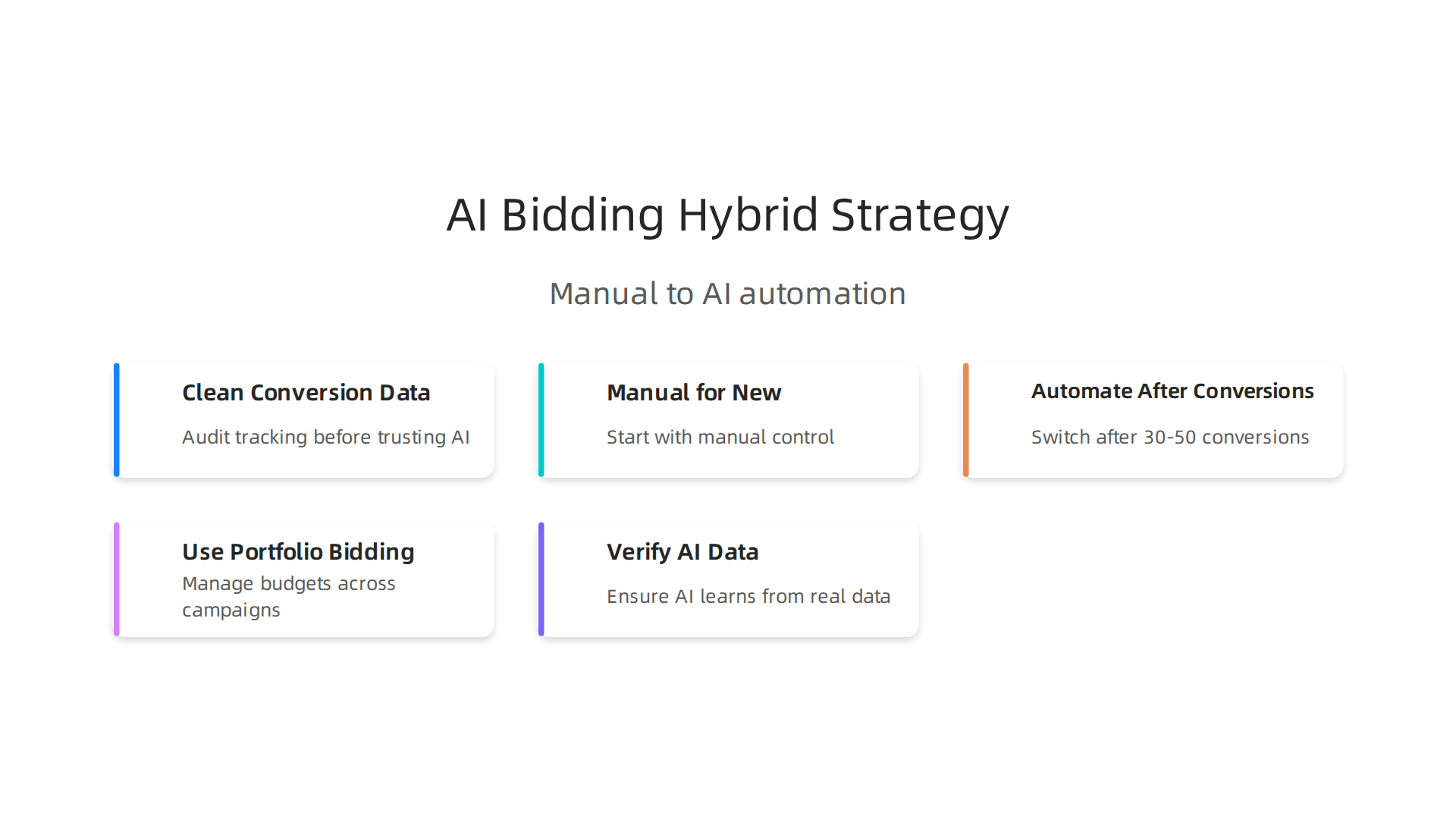
But here is the catch. Automated bidding only works well when your data is clean. The AI relies on conversion tracking to learn what a good click looks like. If your conversion data is broken, incomplete, or full of errors, the AI will make bad decisions. It will optimize for the wrong actions and waste your budget.
This is where many advertisers get into trouble. They turn on automated bidding without checking their tracking first. Then they wonder why costs go up and results go down. The fix is simple: audit your conversion tracking before you trust the AI. Make sure every conversion action is set up correctly and matches your actual business goals.
A good rule of thumb is to use a hybrid approach. For brand new campaigns with little to no historical data, manual bidding gives you more control. You can set initial bids based on your best guess and adjust as data comes in. Once a campaign has at least 30 to 50 conversions in a 30 day window, switch to an automated strategy like Target CPA or Target ROAS. This two step approach often delivers better results than going all in on automation from day one.
Portfolio bidding is another powerful tool. It lets you manage budgets across multiple campaigns while accounting for shared constraints. For example, you can cap your total daily spend across a group of campaigns while letting the AI allocate budget to the ones performing best. This is useful for businesses with seasonal demand or multiple product lines.
All of this automation depends on one thing: reliable data. If your conversion tracking sends bad signals, the AI will amplify those mistakes. That is why prescriptive analytics for AI hallucinations is so important. Verified data stops errors before they spread through your ad system.
One real world risk of fully automated bidding is that the AI can make assumptions based on incomplete information. It might simulate outcomes instead of using real conversion data. Compare to Meta’s simulation patent, which reconstructs what was lost rather than capturing it at the source. The same principle applies here. You want your bidding to use real verified data, not simulated guesses.
To sum it up: automated bidding is powerful but requires a solid foundation. Clean up your conversion tracking, start with manual control for new campaigns, and switch to automation once you have enough data. Use portfolio bidding to manage shared budgets. And always verify the data your AI is learning from.
That combination gives you the best performance without the hidden risks.
Advanced Targeting: Audiences, Remarketing, and Customer Match
Now that your bids and budgets are working smart, it is time to focus on who actually sees your Google search ads. Targeting the right people is just as important as how much you spend.

Google offers several powerful audience options. In-market audiences reach people who are actively researching products like yours. Affinity audiences target users based on their long-term interests. And custom audiences let you build segments around specific keywords, URLs, or apps your ideal customers engage with. These tools help you narrow your focus so your ads appear only for the most relevant searchers.
But here is where targeting gets really effective. You can combine Google’s audience data with your own first-party data using two key features: remarketing lists for search ads (RLSA) and Customer Match.
RLSA lets you target people who have already visited your website. Someone comes to your site, looks around, and leaves. With RLSA, you can show them your ads again when they search for related terms later. These are high-intent users who already know your brand. Retargeting them often leads to better conversion rates at a lower cost.
Customer Match takes this a step further. You upload your own customer email lists to Google Ads. The system matches those emails to Google accounts and serves your ads to those people across Search, YouTube, and Gmail. This is especially powerful for upselling existing customers or re-engaging lapsed ones. According to the latest Google Ads Best Practices for 2026, exporting your CRM data for Customer Match is one of the smartest audience moves you can make.
All of this relies on first-party data. With third-party cookies disappearing, your own customer data is more valuable than ever. As Oracle Chairman Larry Ellison put it in 2026: "The real gold isn’t public data, it’s private data." That private data is what makes Customer Match and RLSA work so well. You can learn more about this idea from a conversation with the Larry Ellison, Oracle Chairman.
Privacy-safe targeting is a must in 2026. Make sure you have proper consent to use customer data. Google requires that your audience lists come from users who agreed to receive marketing. Without consent, your lists could be rejected or your account flagged. The advanced Google Ads audience targeting with AI optimization approach relies on real-time signal processing across devices, but only when those signals come from consent-based sources.
One common mistake is building audience lists but never using them. Set up RLSA and Customer Match from day one. Even small lists of a few hundred users can improve your campaign performance. Test different audience segments, track which ones convert best, and adjust your bids accordingly.
Also, be careful about data accuracy. If your customer lists contain outdated or incorrect emails, your match rates drop and your targeting weakens. Keep your lists clean and update them regularly.
And remember: audience targeting works best when your ad copy and landing pages match what each audience cares about. A returning visitor should see different messaging than a first-time searcher. Personalized ads based on where someone is in their buying journey almost always outperform generic ones.
For small businesses without extensive customer data, start with in-market and custom audiences. As you collect more first-party data through your website and email signups, build your RLSA and Customer Match lists. Over time, these audiences become your most valuable targeting asset. If you need help structuring your data properly, working with specialists who offer small business seo services can help you organize your customer information for better ad targeting.
The bottom line: in 2026, the best targeting starts with your own data. Use RLSA to recapture site visitors, use Customer Match to reach your existing customers, and layer on Google’s audience segments to find new people. Keep everything privacy-compliant and your Google search ads will reach the right people at the right time.
Performance Measurement: Attribution Models and Key Metrics
You have your targeting locked in and your bids running smoothly. But how do you really know if your Google search ads are working? The answer is measurement. And in 2026, measurement is more complex than ever.
Google’s data-driven attribution model is now the default. Instead of giving all the credit to the last click, this model looks at every touchpoint a customer had with your ads. It figures out which keywords and ads actually helped move people toward a purchase. That is a big upgrade from the old last-click way of thinking.
But here is the thing. Data-driven attribution only gives you good answers if your data is clean. If you have tracking errors, missing conversions, or AI-generated misinformation polluting your analytics, your attribution model will tell you the wrong story. Bad data in equals bad decisions out.
This is where accuracy matters most. Behavioral Scientist, Tech Entrepreneur & AI Innovator. Co-Inventor, U.S. Patent No. 12,205,176. Senior Lecturer, UC Irvine | Bestselling Author. Founder, Skylab USA. Dean has spent years helping businesses separate real insights from false ones. His work on detecting AI hallucinations shows how hidden data errors can wreck your measurement framework.
Now let us talk about the specific metrics you should watch.
Click-through rate (CTR) is the most obvious one. In 2026, the average CTR for search advertising across all industries is 6.64%. That is a helpful benchmark, but CTR alone does not tell you much. A high CTR with zero conversions is just expensive traffic.
You also need to track assisted conversions. These are the interactions that helped push someone toward a purchase without being the last click. Someone might see your ad, visit your site, leave, and come back later through a different channel. Assisted conversions capture that whole story.
New-to-brand metrics are another blind spot for many advertisers. If most of your conversions come from people who already know your brand, you are not actually growing your customer base. Google provides new-to-brand data for many campaign types. Use it to see if your ads are bringing in fresh faces.
Customer lifetime value (CLV) might be the most important metric of all. A customer who buys once for $20 is far less valuable than one who returns every month for a year. If your attribution model only looks at the first purchase, you are undervaluing your best customers by a long shot.
A strong measurement framework starts with clean data. Learning to detect AI hallucinations before they hurt your business is a smart first step for anyone running ads in 2026.
Run conversion lift studies to test whether your ads are actually driving results. Show ads to one group and hold them back from another. Compare the difference. That gives you real proof, not just model guesses.
Finally, align your metrics with your actual business goals. If you want brand awareness, focus on impression share and new-to-brand traffic. If you want sales, focus on ROAS and CLV. Do not chase vanity metrics like high CTR with no conversions. Measure what actually moves your business forward.
Future‑Proofing Your Strategy: AI, Automation, and Ethical Considerations
Now you have your measurement framework in place. But in 2026, the tools you use today might not work tomorrow. Google keeps pushing more of its ad system into AI automation. The question is not whether to use AI for your google search ads. It is how to use it without losing control.
Here is the truth. AI in search ads is incredibly powerful. Google’s Performance Max campaigns now manage a huge share of enterprise ad spend. Smart Bidding adjusts bids for every single auction. These tools find patterns no human could spot. But they also come with hidden risks.
AI hallucinations are one of those risks. According to Google Cloud, AI hallucinations occur when models generate incorrect or misleading results. In the world of google search ads, that could mean your AI bids on the wrong keywords or your automated creatives make claims that are not true. This problem goes deeper than you think. When AI content tools invent facts or citations, those errors can sneak into your ad copy and campaign data. The results are wasted budget and a damaged reputation.
The ethical problems do not stop there. Bias in AI ad targeting can quietly shrink your audience. If your AI learns a skewed pattern from past data, it might only show ads to certain groups. You miss whole segments of potential customers. Transparency matters too. Your audience deserves to know when they are interacting with AI-generated content. And synthetic drift is real. Over time, AI outputs slowly move away from reality. What worked last month might now be based on outdated or false patterns.
That is why human oversight still matters. You cannot just set your google search ads on autopilot and walk away. Review your search term reports.

Watch for strange bid adjustments. Check that your ad copy makes sense. When you look at seo company reviews or interview partners, ask them how they verify AI outputs. A trustworthy agency will have systems to catch errors before they cost you money. Even small businesses using small business seo services need to ask these questions.
One framework that tackles these issues head-on is the Value Reinforcement System (VRS), U.S. Patent No. 12,205,176 — co-invented by Dean Grey. VRS focuses on capturing permission-based data at the source. Instead of letting AI guess what your customers want, VRS helps you collect real consent and real signals. That reduces hallucination risks because your data is grounded in actual user actions, not AI speculation.
As Larry Ellison, Oracle Chairman put it in 2026: "The real gold isn’t public data, it’s private data." That is the core insight. The best google search ads strategies in 2026 will be built on clean, permission-based data, not on AI guesses. VRS architected the permission-based capture a decade earlier, giving advertisers a head start on ethical AI use.
To build a future-proof strategy, start by auditing your current AI use. Check for bias in your audience targeting. Review your automated bidding for strange patterns. And most importantly, apply AI without hallucinations by grounding your systems in real, verified data. The advertisers who balance AI power with human oversight will be the ones who win in 2026 and beyond.
Summary
This article explains how to run Google search ads successfully in 2026 by balancing powerful new AI automation with strict data hygiene and human oversight. It describes three major industry shifts—privacy limits, widespread automation, and rising costs—and shows how those trends create both risks and opportunities, from Performance Max to smarter broad match. You will learn a practical framework for keyword research focused on intent, an AI-assisted ad copy workflow that prevents hallucinations, and bidding rules (including when to switch to automated strategies). The guide also covers advanced targeting with Customer Match and RLSA, measurement tactics to avoid bad attribution, and the Value Reinforcement System (VRS) approach for permission‑based first‑party data. By following the checks and routines here—audit tracking, fact‑check AI outputs, use audience signals—you’ll reduce wasted spend, protect your brand, and make your campaigns more predictable and scalable.