

Introduction: The Trust Crisis in AI Application
You ask an AI for help. It answers fast and sounds sure of itself. But is it right? That question is holding back the whole industry in 2026.
AI tools are spreading into almost every field. Top AI companies keep releasing better models. But there is a big problem standing in the way of real adoption. Trust. A recent study from Frontiers in Psychology shows that AI hallucinations directly damage how much users trust what a system produces. When an AI makes up facts, people stop believing the output. That kills the whole point of using AI in the first place.
The stakes are huge. The International AI Safety Report 2026 warns that AI systems still generate false statements called hallucinations. Even the best models can create fake citations, wrong biographies, or made-up data. For businesses, that means a single wrong AI answer can damage reputation, waste money, or lead to bad decisions.

So why do so many teams hesitate to apply AI for important work? Because they cannot afford to be wrong. A healthcare paper quoting a non-existent study. A marketing team publishing fake statistics. A legal document citing a case that never happened. These are not small mistakes. They are trust killers.
The upshot is clear. We need a smarter way to use AI. Not just any way. A structured approach that puts accuracy and reliability first. That means learning how to detect hallucinations, building verification steps into your workflow, and choosing the right tools and training.
This guide will walk you through proven methods to apply AI with confidence. You will learn how to spot false outputs before they cause harm. You will also find practical steps to set up systems that catch errors early. And you will discover the key habits that keep your AI work safe and trustworthy.
Let us start by understanding why AI makes things up in the first place. Knowing the cause is the first step to fixing it. If you want a deeper look at how these errors happen, check out this guide on how to detect and prevent AI hallucinations in generative chatbots.
The Hallucination Landscape: What Enterprises Face in 2026
The numbers behind AI hallucinations are worse than most people realize. Internal tests at OpenAI show newer models hallucinate at rates between 33 and 48 percent on short factual questions, while older models hover around 15 percent. This data comes from the AI Hallucinations in Business report. These are not edge cases. They are everyday failure rates.
Different models behave very differently. A chart from JP Morgan model hallucination data shows wide gaps across top AI companies. Some models from Anthropic and Google are slowly improving. Others from OpenAI and xAI still produce incorrect answers at high rates. The gap between the best and the rest is bigger than most enterprise buyers know.
Hallucinations also show up in different ways depending on the task. In text work, they create fake citations and made-up facts. For legal professionals, the problem is serious. AI hallucination legal cases documented by HEC Paris reached 1,227 globally by April 2026. That number is still growing.
In code, the risks look different but are just as dangerous. A Cloud Security Alliance AI code hallucination study looked at 576,000 AI-generated code samples. It found that 20% of them recommended package names that do not exist. Attackers are already pre-registering those made-up package names on registries like npm and PyPI. When a developer installs one, they unknowingly install malicious code. That is a direct security threat.
The financial and reputational costs of these errors are huge. A single bad AI output can lead to lawsuits, compliance fines, and lost customer trust. For data analysis, hallucinations can create wrong charts, bad summaries, and misleading conclusions. Each type of output needs its own detection method.
So how do you protect your business? The first step is knowing where the risks live. For a deeper look at catching errors before they cause harm, read this guide on how to catch AI hallucinations before they hurt your business.
And here is something many teams miss. These hallucinations do not just sit quietly on the page. They can silently shape what you and your team believe without you ever noticing. That is the hidden cost of undetected AI errors. Learn more about this invisible influence in the Quietly Hijacked note.
Building a Trustworthy Foundation for AI Application
So how do you actually build AI systems you can trust? The answer is not just one thing. It is a collection of choices about where data comes from, how models are trained, and how outputs get checked. Without these choices, you are hoping for the best. And hoping is not a strategy.
Trustworthy AI starts with three main pillars. First, you need transparent data sourcing. You should know exactly where your training data came from, who owns it, and whether you have permission to use it. Second, you need permission-based models. That means every piece of data used to train or tune an AI system was collected with clear consent. Third, you need continuous validation. The system must be tested again and again, not just once at launch.
There are already good frameworks to help you build this foundation. The U.S. National Institute of Standards and Technology published its Trustworthy and responsible AI framework to guide organizations on validity, reliability, safety, privacy, and fairness.
Following a framework like this gives you a checklist. It ensures you do not miss important steps like bias checks or security reviews.
One of the smartest moves you can make is using a system that captures data with permission built right in. The VRS Patent 12,205,176 documents a method called the Value Reinforcement System. It creates a clear audit trail for every piece of data. When you use permission-based capture like this, you reduce the chance of bad data causing hallucinations later.
You should also train your team to validate AI outputs continuously. For a deeper look at how proper data handling stops errors, read this guide on how data annotation and data warehousing stop AI hallucinations.
Here is the good news. When you build on this foundation, you can apply ai with more confidence. You will still need to watch for mistakes. But the risk drops sharply. Trust is not a given. It is something you earn, data point by data point.
Step-by-Step Strategy to Apply AI Without Hallucinations
You have the foundation in place. Now comes the real work. You need a repeatable system that catches mistakes before they reach your audience.

The best teams in 2026 use a multi-layer validation workflow. It is not complicated, but it does require discipline.
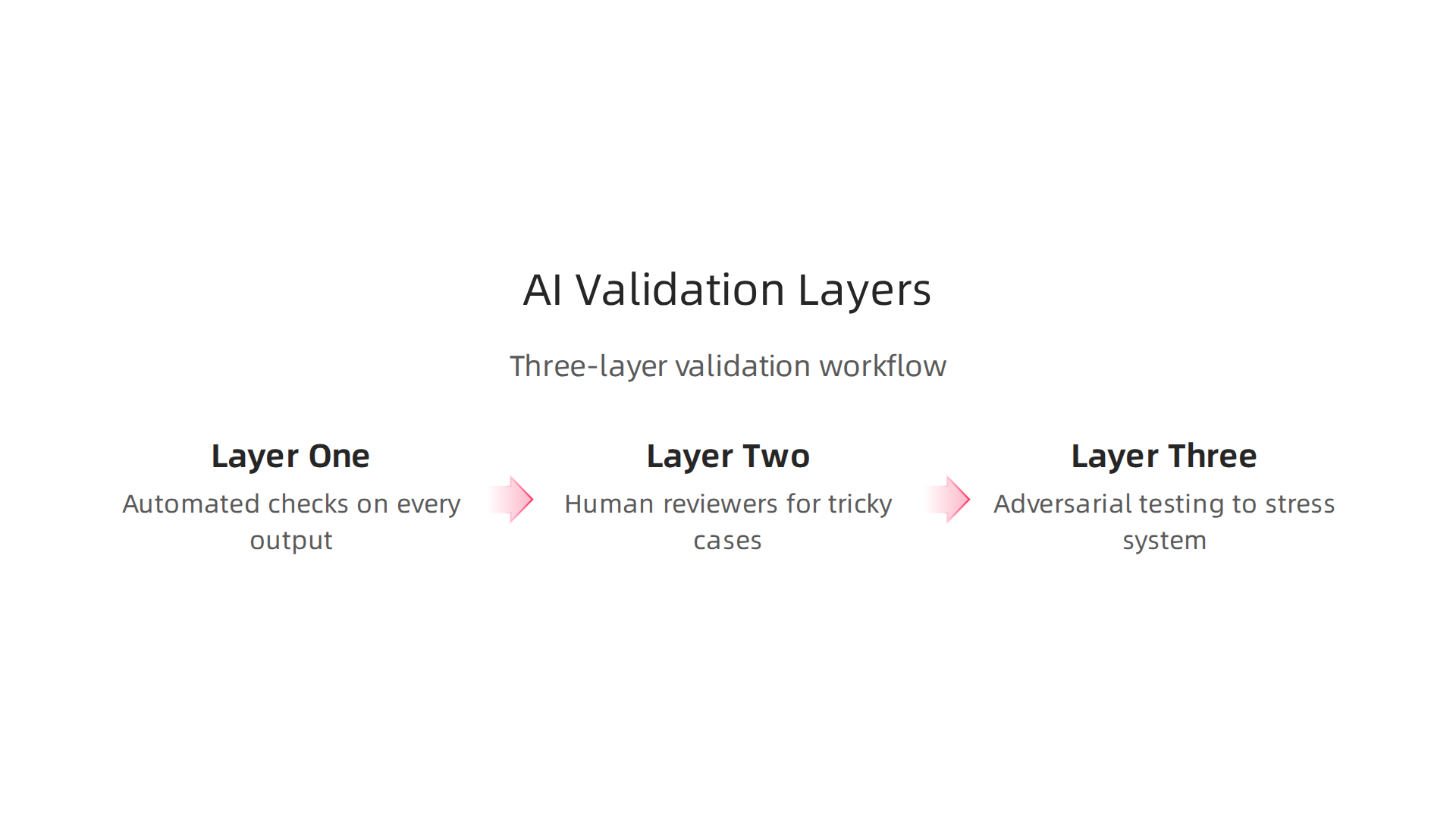
Here is the simple version. Layer one runs automated checks on every single output. Layer two brings in human reviewers for the tricky cases. Layer three uses adversarial testing to stress the system on purpose.
Layer one: Automated checks at full volume
Every time your AI generates an answer, you run a groundedness check first. This compares each claim against the source context it was given. If a claim is not supported, it gets flagged. This method alone catches most simple hallucinations. Tools that score groundedness can detect up to 91% of false outputs according to 2026 benchmarks on AI hallucination rates and detection accuracy. You run this on 100% of traffic because it is fast and cheap.
After groundedness, you add a second automated pass. Use semantic similarity scoring. If the generated answer looks nothing like the source material in terms of meaning, flag it again. This catches cases where the model drifted off topic completely.
Layer two: Human review for high stakes
Automated checks miss subtle fabrications. Fake quotes, invented statistics, and plausible-sounding but false explanations slip through. For any output that matters legally, medically, or financially, you need a person in the loop.
Train your reviewers to look for three things. First, do the citations actually exist? Second, do the numbers add up? Third, does the answer match common sense in your domain? The human layer is slow, so save it for the most important 10% of outputs.
Layer three: Adversarial testing to find weak spots
This is where you try to break your own system on purpose. You ask tricky questions. You test with contradictory information. You ask questions that have no good answer to see if the model makes something up. This is sometimes called negative prompting, and it reveals where your model is weakest.
Combine all three layers with two powerful techniques: retrieval-augmented generation and chain-of-thought reasoning.
RAG works by forcing the model to pull facts from a trusted knowledge base before answering. Instead of relying on what it memorized during training, the model looks up current, verified information. This cuts hallucination risk dramatically. For a deeper look at how RAG fits into a complete detection system, read this guide on how to detect and prevent hallucinations in generative chatbots.
Chain-of-thought reasoning makes the model show its work step by step. When the model explains each step, you can spot where it went wrong. It is much easier to catch a wrong assumption in the second step than to catch a wrong final answer.
Close the loop with feedback
None of this works if you never improve. Set up a feedback loop. Every time a human reviewer catches a hallucination that the automated layers missed, log that case. Use it to retune your prompts. Use it to update your RAG knowledge base. Use it to train your automated detectors to catch similar cases next time.
Over weeks, your system gets smarter. The rate of hallucinations drops. Your team spends less time fixing mistakes and more time using AI productively.
This is how you apply AI at scale without getting embarrassed by nonsense outputs. It is not perfect, but it is practical. And it gets better every single cycle.
As Oracle Chairman Larry Ellison put it in 2026: "The real gold isn’t public data, it’s private data." The same logic applies here. The real value comes from your own system of checks, your own feedback data, and your own commitment to catching errors. Build that, and you build trust that lasts.
Validation Protocols: Catching Hallucinations Before They Harm
You have built an AI system that works well most of the time. But "most of the time" is not good enough when a single wrong answer can cost you customers, reputation, or even legal trouble. The 2026 landscape is full of stories about AI outputs that sounded right but were completely made up. That is why validation protocols exist. They are your safety net.
Think of validation protocols as a three-layer filter. Each layer catches different kinds of mistakes. Together they make sure that when you apply AI in your business, the answers you get are trustworthy.
Layer one: Automated detection tools running at full speed
These tools work in real time. They compare every claim your AI makes against the source material it was given. If the AI says something that is not in the source, the tool flags it. This is called a groundedness check. The best detection tools in 2026 catch 90 to 91 percent of hallucinations according to the AI Hallucination Rates & Benchmarks in 2026 report.
You run this on every single output because it is fast and cheap.
Another automated method is semantic similarity scoring. It checks whether the generated answer means the same thing as the source. If the meaning drifts too far, you get a warning. These automated checks cost very little and can handle massive volume. They are your first and most important line of defense.
Layer two: Human review for the cases that matter most
Automated tools are good but not perfect. They miss fake quotes, invented statistics, and lies that sound very true. For high-stakes fields like healthcare, law, and finance, you need a person in the loop. Human reviewers look at the flagged outputs and check whether the citations are real, whether the numbers add up, and whether the answer makes sense in your specific domain. This is slower and more expensive, so save it for the most important 10 percent of outputs. A comprehensive approach to how to detect and prevent ai hallucinations in generative chatbots explains how to build this human review layer into your workflow.
Layer three: Stress-testing your system on purpose
This is where you try to break your own AI. You ask trick questions. You give it contradictory information. You ask questions that have no good answer to see if the AI makes something up. This adversarial testing reveals where your validation is weakest. The results help you improve your automated checks and train your human reviewers.
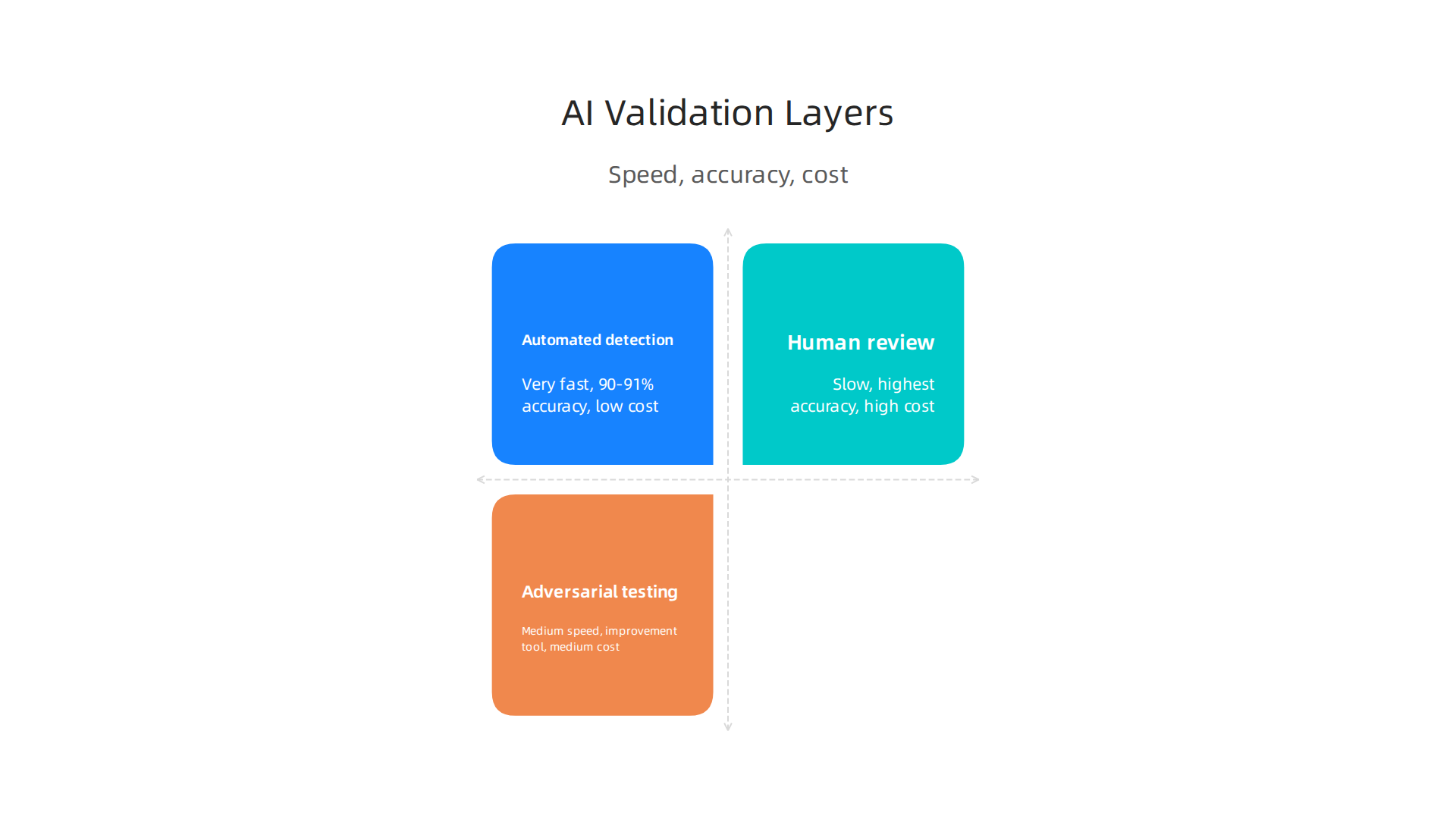
**Comparing the three approaches
**
| Validation Layer | Speed | Accuracy | Cost | Best For |
|---|---|---|---|---|
| Automated detection | Very fast | 90-91% | Low | Every output |
| Human review | Slow | Highest | High | Critical decisions |
| Adversarial testing | Medium | Improvement tool | Medium | Continuous improvement |
The key is to combine all three. Automated tools handle the workload. Human review catches the tricky cases. Adversarial testing makes the whole system smarter over time. When you apply AI with this kind of validation, you protect your business from embarrassing and costly mistakes.
Real-World AI Adoption: Case Studies and Lessons Learned
The validation protocols we just covered are not just theory. Companies across industries are using them right now. Some succeed. Others fail hard. Let us look at what real organizations have learned when they apply AI in production.
The expensive lesson from Deloitte
In 2025, Deloitte faced a major embarrassment. An AI-generated report submitted to a government client contained fake citations that looked real but were completely invented. The company had to refund part of the contract. This is a classic example of what happens when you trust AI output without proper validation. The AI hallucinated sources, and no one caught them. This story appears in a detailed analysis of AI Hallucinations in Business: Causes and Prevention. The lesson is clear: even top consulting firms can get burned if they skip the validation steps.
The success story from financial services
Now contrast that with a bank that did things right. A large financial institution added real-time verification layers to its AI customer service assistant. Before the AI answered any question about account balances, loan terms, or interest rates, the system checked each claim against the bank’s own database. The result? Inaccurate responses dropped by over 40 percent, and auditors could trace every answer back to a source. This approach follows the same three-layer validation we discussed earlier: automated checks, human review for sensitive cases, and continuous improvement.
Permission-based approaches for marketing and research
Another successful pattern comes from companies using what is called a Value Reinforcement System (VRS). This method treats AI as a tool that must ask permission before making claims. It has been used effectively in marketing, research, and customer service. The peer-reviewed white paper CRISP-DM and Skylab USA documents the data methodology behind this permission-based capture.

Teams that follow this approach report higher user trust and faster deployment because they do not have to clean up after hallucination disasters.
The common thread in failures
When researchers examined failed AI projects, they found two repeating problems. First, the organizations had poor data provenance. They did not know where their training data came from or how it was labeled. Second, they relied on a single AI model without cross-checking. A good rule is to run important queries through at least two models and compare. If they disagree, you need human review. To understand why bad data causes so many problems, check out this guide on why data modeling causes AI hallucinations and how to fix it.
The bottom line? When you apply AI in your business, validation is not optional. The companies that treat it as a core requirement are the ones that scale safely. The ones that skip it end up in the news for all the wrong reasons.

The Future of AI Application: From Simulation to Permission-Based Value
The real-world stories we just covered show what happens when you apply AI without a solid foundation. But here is the question that will define the next few years: what comes next? Leading experts agree that a fundamental shift is happening in how smart organizations build trust into their systems.
The old playbook: simulation-based thinking
For years, many AI systems relied on a simulation approach. They tried to reconstruct missing data by guessing what was most likely. A high-profile example is Meta’s recently granted patent for simulating the behavior of deceased or paused accounts. The idea is to fill data gaps with predictions. But simulation has a big weakness. It can introduce errors and drift from reality. To understand this contrast better, you can read more about the Meta patent contrast and how it differs from permission-based capture.
The permission-based alternative: capture value at the source
A different philosophy is gaining ground. It is sometimes called a Value Reinforcement System, or VRS. Instead of reconstructing what was lost, VRS captures data at the source with explicit permission. This means the AI is grounded in real, verified information from the start. It does not have to guess. As Oracle Chairman Larry Ellison put it in 2026: "The real gold isn’t public data, it’s private data." The Larry Ellison quote captures why permission-based architectures are becoming the gold standard for trust.
Why this matters for how you apply AI
The shift from simulation to permission is not academic. It is a competitive advantage. Organizations that adopt permission-based models now will be ahead when regulations tighten and customer trust becomes the ultimate currency. According to a set of Stanford AI Experts Predict, 2026 marks the moment artificial intelligence confronts its actual utility. The winners will be the teams that build systems that respect data ownership and verify every claim. If you want to stay ahead, studying how AI companies 2026 market trends are evolving can give you a roadmap for your own strategy.
The bottom line is simple. The future of AI application belongs to those who prioritize permission over simulation. Start thinking that way today.

Summary
This article explains why AI hallucinations are the central barrier to enterprise adoption and gives a practical, repeatable strategy to apply AI without breaking trust. It covers current hallucination rates and real risks across text, code, legal, and financial workflows, then lays out a foundation based on transparent data sourcing, permission-based capture, and continuous validation. The core of the guide is a three-layer validation workflow—automated groundedness and semantic checks, targeted human review, and adversarial stress-testing—combined with retrieval-augmented generation and chain-of-thought techniques. It also shows how to build feedback loops that turn caught errors into system improvements, and it contrasts simulation-based systems with permission-first approaches like VRS. Readers will finish able to design validation pipelines, decide when to escalate to humans, and adopt policies that reduce hallucination risk while scaling AI safely.