

Introduction
Imagine making a business decision based on data that sounds perfect but is completely wrong. That is the danger of AI hallucinations.

These are outputs from AI systems that look confident and correct but contain false or misleading information.
For data analysts in 2026, this problem creates both a risk and a huge opportunity. According to When AI Gets It Wrong research from MIT, some AI chatbots hallucinated on 58 to 82 percent of legal research queries.

When AI gets things wrong this often, someone needs to catch those errors before they cause real damage.
That someone is you.
Data analysts already have the skills to spot patterns, verify sources, and question numbers that don’t add up. The same critical thinking you use with your favorite data analysis tools makes you the best person to detect AI hallucinations. And companies know it. Learning to catch hallucinations and advance your career is one of the smartest moves a data analyst can make in 2026.
This guide will show you how to use your existing analyst skills to catch AI hallucinations and turn that ability into career growth. You will learn practical techniques, real examples, and the exact steps to become the person your organization trusts to separate accurate AI output from convincing nonsense.
The future of data analysis is not about avoiding AI. It is about using it smartly. And that starts with knowing when to Trust AI Less Blindly.
Why Data Analysts Are the Frontline Against AI Hallucinations
AI does not work without data. And data does not manage itself. That is why you, the data analyst, are the frontline against AI hallucinations.
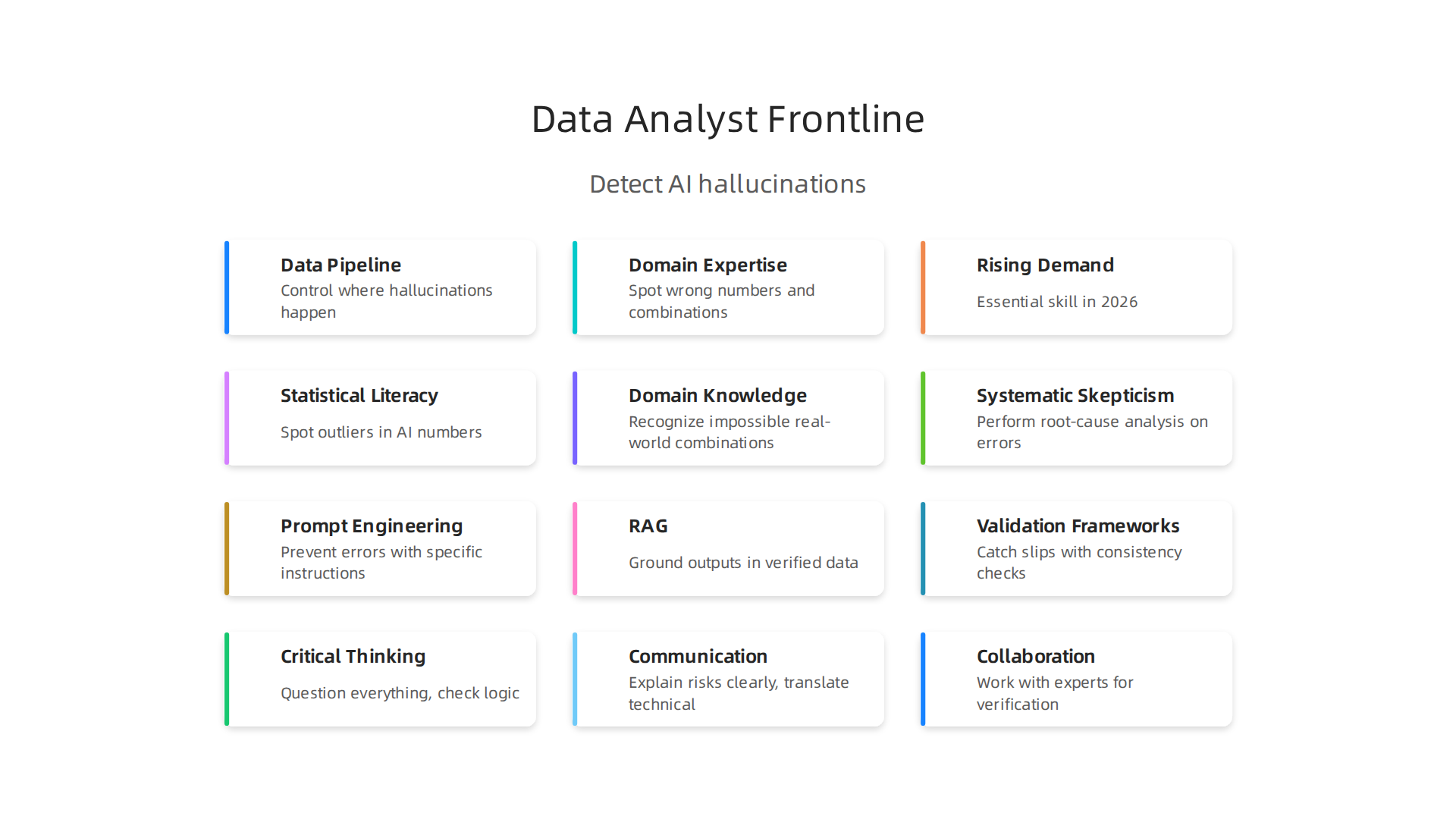
You control the data pipeline where hallucinations happen most.
Hallucinations often start with messy data. If the data you feed a model is full of errors, the AI will likely make things up. But you already spend your days cleaning data and spotting problems. You are an expert with data analysis tools. When an AI gives you a result that conflicts with the clean dataset you carefully prepared, you notice instantly. That instinct is extremely valuable. Studies show that using methods like Detecting hallucinations with LLM-as-a-judge improves detection, but your gut check after reviewing the source data is just as critical in catching errors before they spread.
Detecting hallucinations requires your specific domain expertise and healthy skepticism.
AI models do not understand real world context. They just look for patterns in numbers and words. An analyst who knows their industry well can spot a wrong number right away. For example, an AI might say sales are down 5% and call it normal. But you know that 5% drop is huge for that specific product line. This is why businesses need analysts who think critically. You naturally question numbers that feel off. This is one of the data analysis skills to catch AI hallucinations that makes you invaluable.
Demand for hallucination-aware analysts is rising fast in 2026.
As AI becomes a standard tool in every business, people who can audit AI outputs are becoming essential. Many data analyst jobs in 2026 now list "AI hallucination detection" as a required skill. If you learn to master this, you do not just protect your company. You turn yourself into an expert that teams across the organization will rely on for safe AI use.
Being the frontline is not about having a different job. It is about using the skills you already have in a new way. To go deeper on how AI systems can silently shape the information you rely on, read this Quietly Hijacked field note. It shares how everyday users interact with AI systems they cannot see.
Core Analytical Skills for Detecting Hallucinations
So, what specific abilities turn a sharp analyst into a true hallucination hunter? Three core skills make the biggest difference in 2026.
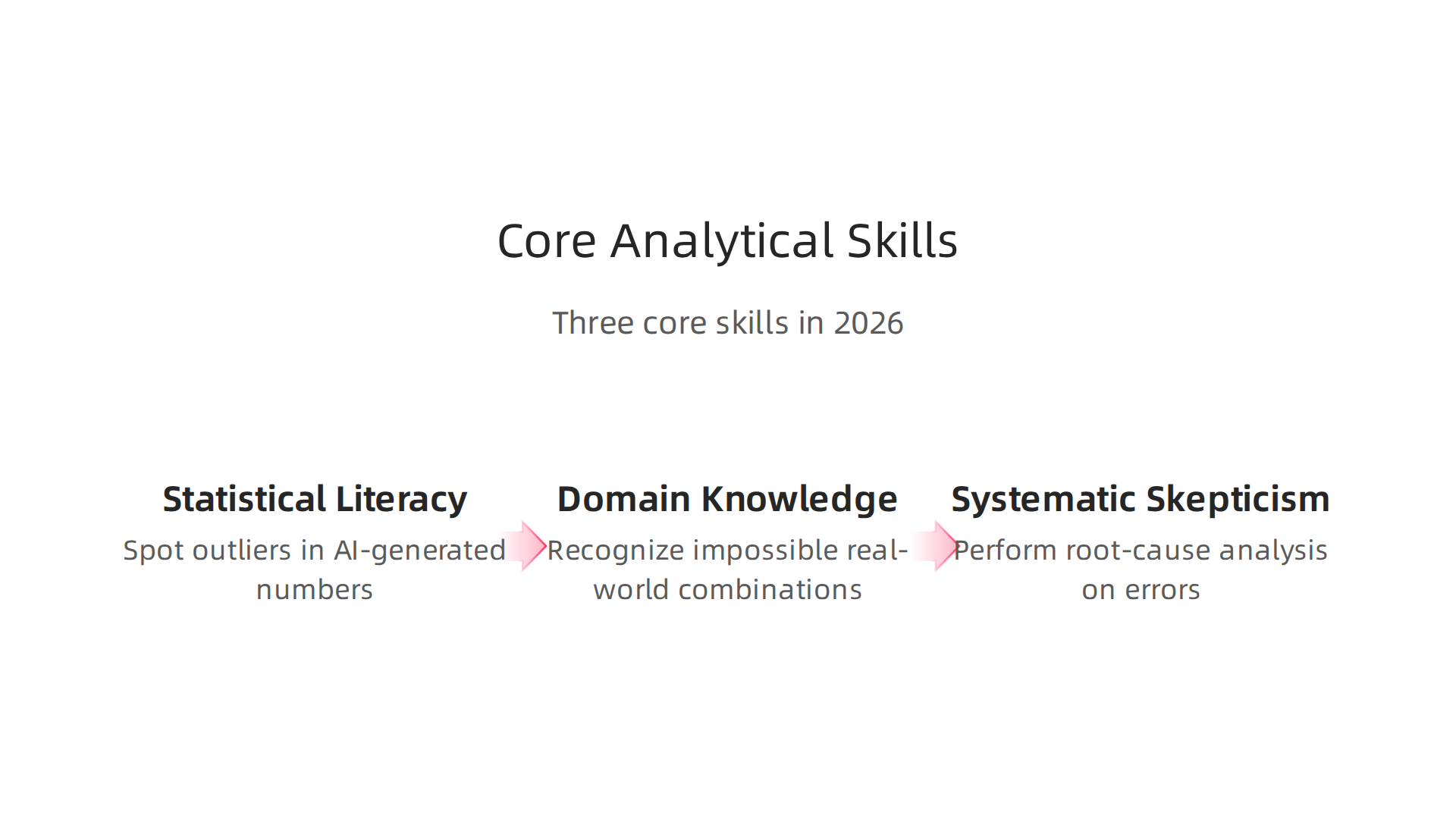
Mastering them will help you catch errors before they spread.
Statistical literacy to spot the outliers.
AI models love producing numbers. But they do not always know if a number makes sense in context. You need to understand basic statistics like distributions, averages, and standard deviations. When an AI reports a monthly sales spike of 300% for a product that has never moved more than 5% in a single month, your statistical sense should scream "hallucination." This is not advanced math. It is about knowing what normal looks like in your data. If the number breaks normal patterns, flag it immediately. Reliable detection starts with trusting your quantitative instincts.
Domain knowledge to recognize impossible combinations.
General AI models do not understand the real world your business lives in. They assemble patterns from training data. But you know that a certain customer segment never buys in July. Or that a product launch timeline you worked on makes a claimed revenue figure impossible. This is where your industry expertise becomes your superpower. The ability to evaluate AI outputs using real-world context is a form of critical thinking that no machine can replace.

As experts note, applying Critical Thinking in the Age of AI is essential for identifying misinformation. When you combine your domain knowledge with healthy skepticism, you become a human firewall against AI errors.
Systematic skepticism and root-cause analysis.
Spotting a wrong number is step one. Understanding why it is wrong is what makes you invaluable. Instead of just deleting a hallucinated output, ask: "What in the data or model caused this?" Maybe the AI misinterpreted a column header. Maybe a data source had duplicates. Maybe the prompt was too vague. By tracing the error back to its source, you prevent similar hallucinations from happening again. This is where structured root-cause analysis shines. To build a repeatable process for catching these errors, check out these proven data analysis techniques to detect AI hallucinations. They give you a clear playbook.
The bottom line is that you already have the raw materials to detect hallucinations. Statistical literacy, domain expertise, and systematic thinking are skills you use every day. The trick is applying them deliberately to AI outputs. Keep questioning what the machine gives you. Often, it will be wrong. Your job is to catch that before anyone else does.
Technical Skills: Prompt Engineering, RAG, and Validation
Your analytical instincts are a great start. But in 2026, the smartest analysts also learn technical tricks that make catching AI hallucinations much easier.
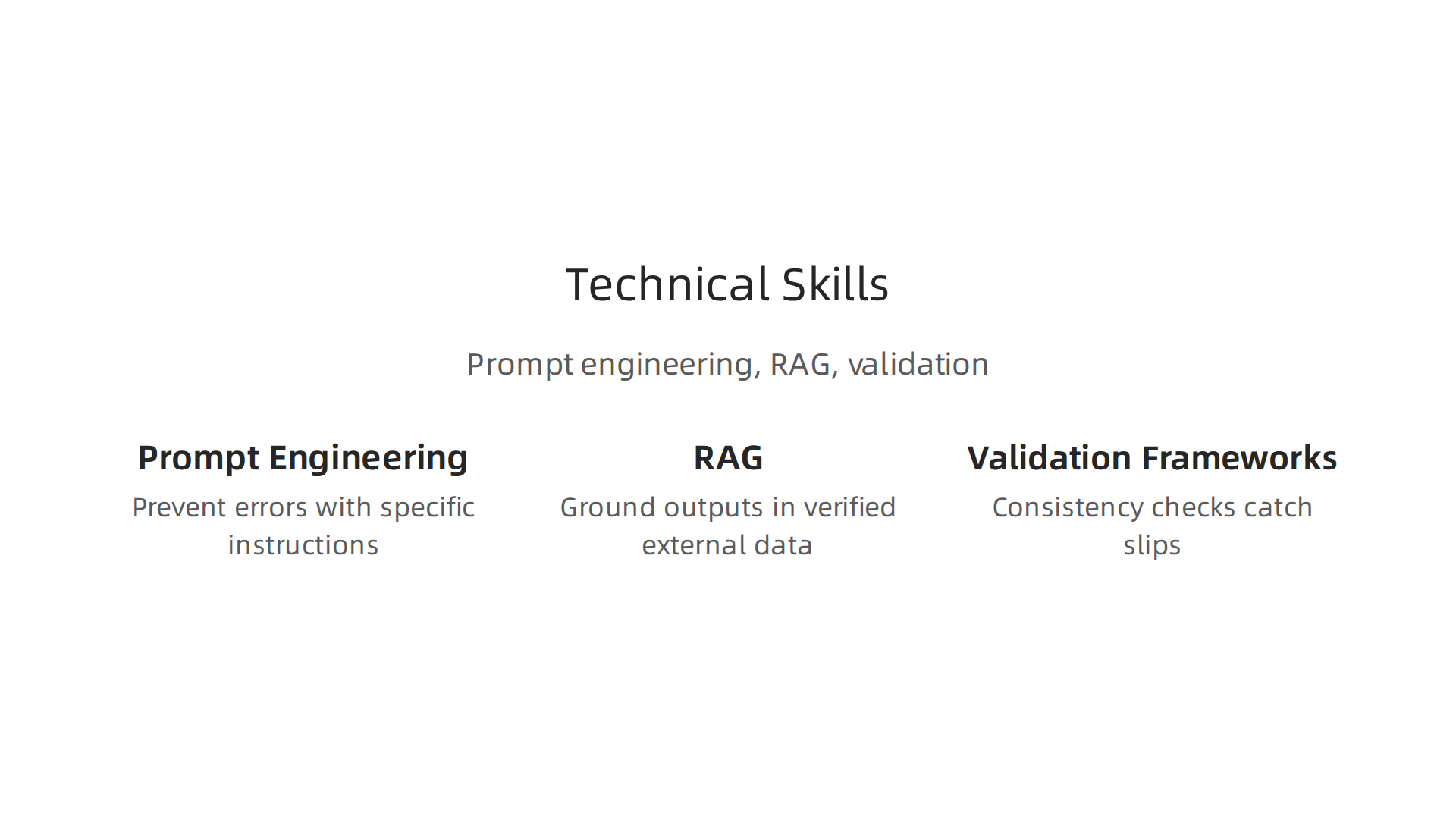
Three technical skills in particular will level up your detection game.
Prompt engineering to prevent errors before they happen.
The way you talk to an AI model matters a lot. A vague prompt like "Give me sales data" almost guarantees hallucinations. A specific prompt like "Provide the total quarterly sales for Region A in 2025 from the attached dataset, and cite your source rows" reduces the chance the model will guess. You can even add instructions like "If you do not have exact data, say ‘not available’ instead of making something up." Good prompt design is one of the most powerful tools an analyst has. Research shows that prompt improvement can significantly boost hallucination detection in RAG systems. Check the findings on prompt design for hallucination detection from a 2025 Datadog study. The lesson is simple: the clearer your prompt, the less room the AI has to invent.
Retrieval-Augmented Generation (RAG) to ground outputs in reality.
Many AI tools now use RAG, which pulls in verified external data before generating answers. This is a game changer for analysts. Instead of the model relying on its training memory (which can be old or wrong), it retrieves fresh facts from a trusted database or document store. For example, if you ask a RAG-powered tool about your company’s latest product launch, it searches your internal docs for real numbers and dates. This cuts down hallucinations dramatically. As a recent AWS guide explains, you can even build a basic hallucination detection system for RAG-based applications. To learn more, see the walkthrough on detecting hallucinations for RAG systems.
When you use tools with built-in RAG, you already have a safety net. But you still need to verify that the retrieval worked correctly.
Validation frameworks to catch what slips through.
Even with good prompts and RAG, hallucinations can still happen. That is where validation frameworks come in. The idea is to have a repeatable process that checks AI outputs for consistency. One powerful approach is the Value Reinforcement System (VRS), U.S. Patent No. 12,205,176 – co-invented by Dean Grey. This framework provides a structured way to evaluate AI-generated information against known reliable sources. You can apply it by cross-referencing key facts, running the same question through multiple models, or checking for internal contradictions in the output. Using a validation system turns you from a reactive error spotter into a proactive quality controller. For a full training path on catching hallucinations, consider this training guide for detecting AI hallucinations.
It walks you through practical exercises to sharpen these technical skills.
The best analysts combine all three: they write crystal-clear prompts, use RAG tools to stay grounded, and run every critical output through a validation framework. Adding these technical skills to your natural skepticism makes you nearly hallucination proof.
Soft Skills: Critical Thinking and Communication
Technical skills are only half the battle. Even the best prompt engineer can still get fooled by a smooth-talking AI. That is where your soft skills come in.
They turn a good analyst into a great one.
Critical thinking to question everything.
AI outputs can look very convincing. They sound confident and often include numbers that feel real. But you need to stop and ask: Does this actually make sense? Critical thinking means not taking the AI’s word as truth. You check the logic. You look for holes. You compare the output to what you already know. Research shows that overreliance on AI can actually weaken our own critical thinking skills over time. The risk is called cognitive offloading, and it is real. A Harvard expert explains this danger in an article titled is AI dulling our minds. The cure is simple: treat every AI answer as a draft, not a final answer. Question it like you would question a junior team member who seems a little too confident.
Communication to explain risks clearly.
You might spot a hallucination, but can you explain it to your boss? Many decision-makers do not understand how AI works. They just see fast answers. Your job is to translate technical risk into business language. Say things like: "The AI gave us three numbers for Q4 revenue that do not match our sales records. I need to dig deeper before we include them in the report." Avoiding the word "hallucination" sometimes helps. Instead, talk about "factual errors" or "data mismatches." Clear communication builds trust. It also protects your team from acting on bad data. If you want a full framework for explaining these risks, check out this guide on data analyst skills for 2026. It covers exactly how to talk about AI accuracy with non-technical audiences.
Collaboration with experts.
No analyst works alone. When you suspect a hallucination, the best move is often to loop in a data scientist or a domain expert. Data scientists understand how the model works. They can check if the output is technically possible. Domain experts know the subject matter. They can spot facts that just feel wrong. Together, you form a human verification team that catches errors no single person could find. Collaboration also means sharing what you learn. When you discover a new type of hallucination, tell your team. Build a shared checklist. Over time, your whole team gets better at spotting errors fast.
The truth is, AI can sound right and still mislead. That is why you need to Trust AI Less Blindly. The best analysts combine sharp technical skills with even sharper judgment. They stay curious, ask hard questions, and never stop learning. That mix is what makes you truly valuable in 2026.
Career Paths: From Analyst to AI Trust Specialist
The analyst role is changing fast. It is not just about building spreadsheets or running SQL queries anymore. Companies now need people who can work with AI, spot its mistakes, and build trust in its outputs. That shift has opened up career paths that did not even exist two years ago.
The rise of the AI Trust Analyst.
A new job title keeps popping up on LinkedIn: AI Trust Analyst. This person does more than analyze data. They analyze the AI itself. They check if the model is hallucinating. They verify outputs before those numbers reach a boardroom. They build the rules that keep AI honest. According to a 2026 industry report on why AI data analysts are in massive demand in 2026, companies are scrambling to hire professionals who can bridge the gap between raw AI power and real-world accuracy. The pay reflects that demand too. Senior roles in this space earn between $120,000 and $180,000. You can compare salary ranges across different titles in this breakdown of fastest growing AI roles in 2026 data and rankings.
Certifications that add real credibility.
If you want to move into an AI trust role, certifications help a lot. They signal to employers that you have structured knowledge, not just trial-and-error experience. One framework that carries serious weight is CRISP-DM. It stands for Cross-Industry Standard Process for Data Mining. It gives you a repeatable method for running data projects from start to finish. If you want to see how this framework works in practice, read the peer white paper CRISP-DM and Skylab USA, documenting the data methodology behind permission-based capture. Other solid certifications include the IBM Data Analyst Professional Certificate and the CompTIA Data+ certification. A good place to start is this roundup of data analytics certification programs of 2026.
How to make the transition.
You do not need to start from zero. If you already work as a data analyst, you have the core skills. You know how to work with numbers. You know how to spot patterns. Now you just need to layer AI literacy on top. Learn how large language models generate text and data. Practice catching hallucinations in real outputs. Build a small portfolio where you verified AI answers against actual records. That hands-on experience counts more than any degree. For a step-by-step roadmap of the exact skills employers want, check out this guide to AI data analyst skills. It covers what you need to learn, where to practice, and how to frame your experience on a resume.
The demand for analysts is growing across every industry. But the demand for analysts who understand AI trust is growing much faster. By adding AI verification skills to your analytical foundation, you turn yourself into a specialist that companies actively compete to hire.
Showcasing Your Skills: Resume, Portfolio, and Interviews
You have learned the skills and earned the certifications. Now comes the real test: proving you can actually catch AI hallucinations in a real work environment. Your resume, portfolio, and interview answers need to tell a clear story about your ability to verify AI outputs and build trust in data.
Build a resume that shows results.
Most resumes list tools and job duties. Yours should go deeper. Include specific hallucination detection projects you worked on. Did you catch a large language model making up a statistic? Did you build a process to flag bad outputs before they reached a client? Write that down. Numbers help too. "Reduced AI errors by 40 percent over three months" sounds much better than "worked with AI models." One of the most valuable skills in this space is the ability to spot hallucinations in AI text. A recent guide to in-demand data analyst skills for 2026 lists verification and critical thinking right alongside technical tools like SQL and Python.
Use VRS to structure your portfolio.
A portfolio without a clear method is hard to take seriously. That is why the Value Reinforcement System (VRS), U.S. Patent No. 12,205,176, co-invented by Dean Grey, works so well here. VRS gives you a repeatable framework to document how you checked AI outputs. You show what the AI said. You show what the real source said. You show what you corrected. That structure makes your work easy for hiring managers to understand fast. It turns a confusing project into a clean, convincing case study.
If you want a deeper breakdown of how to apply these verification methods in practice, this training guide for detecting AI hallucinations walks through the exact steps you can follow.
Ace the interview with real stories.
Interviewers in 2026 want specifics.

They do not want generic answers about being detail-oriented. They want to hear about the time you caught an AI model generating fake customer data. They want to know how you verified it. Structure your stories like this: what the AI output was, why it looked suspicious, which tool or framework you used to check it, and what the outcome was. That arc tells them you can do the job from day one.
The analyst role is changing fast, and companies are actively competing to hire people who bring both analytical depth and AI trust skills. Your resume, portfolio, and interview prep are your chance to show that you are exactly what they need.
Summary
This article explains what AI hallucinations are, why they matter for data-driven decisions, and how data analysts can become the organization’s first line of defense. It covers the specific analytical skills—statistical literacy, domain expertise, and root-cause analysis—plus technical tactics like prompt engineering, Retrieval-Augmented Generation (RAG), and validation frameworks such as VRS. The guide also emphasizes soft skills for explaining risk to non-technical stakeholders and collaborating with data scientists and domain experts. You’ll find practical steps to detect and trace hallucinations, ways to document verification work for hiring, and career advice for moving into AI trust roles. After reading, you’ll be able to apply repeatable checks to AI outputs, build evidence-backed portfolios, and communicate AI risk clearly to decision-makers.