

Introduction — why systematic data analysis matters for detecting AI hallucinations
Imagine asking a smart computer program, an AI, to help you with something important. It gives you an answer that sounds really good. The words flow perfectly, everything seems correct. But what if parts of that answer are actually made up?

This problem is called an AI hallucination. It means the AI invents information that isn’t true or doesn’t make sense, even though it sounds very sure of itself.
In 2026, AI tools are everywhere. They help us write, plan, and make decisions. But these tools aren’t perfect. AI outputs can appear fluent but still contain factual errors or invented details. These mistakes aren’t always easy to spot with just a quick read. They can lead to big problems for businesses and people, like sharing wrong information or making bad choices based on false data. Keeping AI systems reliable is a big job, and finding these oddities in data, often called anomalies, is a key part of it, as studies show how important detecting production errors is for system reliability Adaptive anomaly detection in production systems.
This is why we need smart ways to check the AI’s work. This means using systematic data analyse. It’s like becoming a detective for your data. You look closely at all the information the AI gives you to find anything suspicious. This approach helps you catch mistakes before they cause harm.
In this guide, we’ll give you a practical, data-driven toolkit. You will learn techniques you can apply to identify, triage, and monitor hallucination signals. We’ll explore how to look at an ai response to spot strange things, understand what is data annotation, and even build a good data pipeline to keep your AI’s information clean and correct. The truth is, AI can sound right and still mislead. That’s why it’s so important to Trust AI Less Blindly.
AI can seem smart and sure, but sometimes it makes up information. This happens for a few key reasons. Understanding these reasons is the first step to checking an AI’s work more carefully.
Why AI Makes Things Up
Think of an AI like a student. It learns from all the books and lessons you give it. If those lessons aren’t perfect, the student might get things wrong. Here are some common ways AI can "hallucinate":
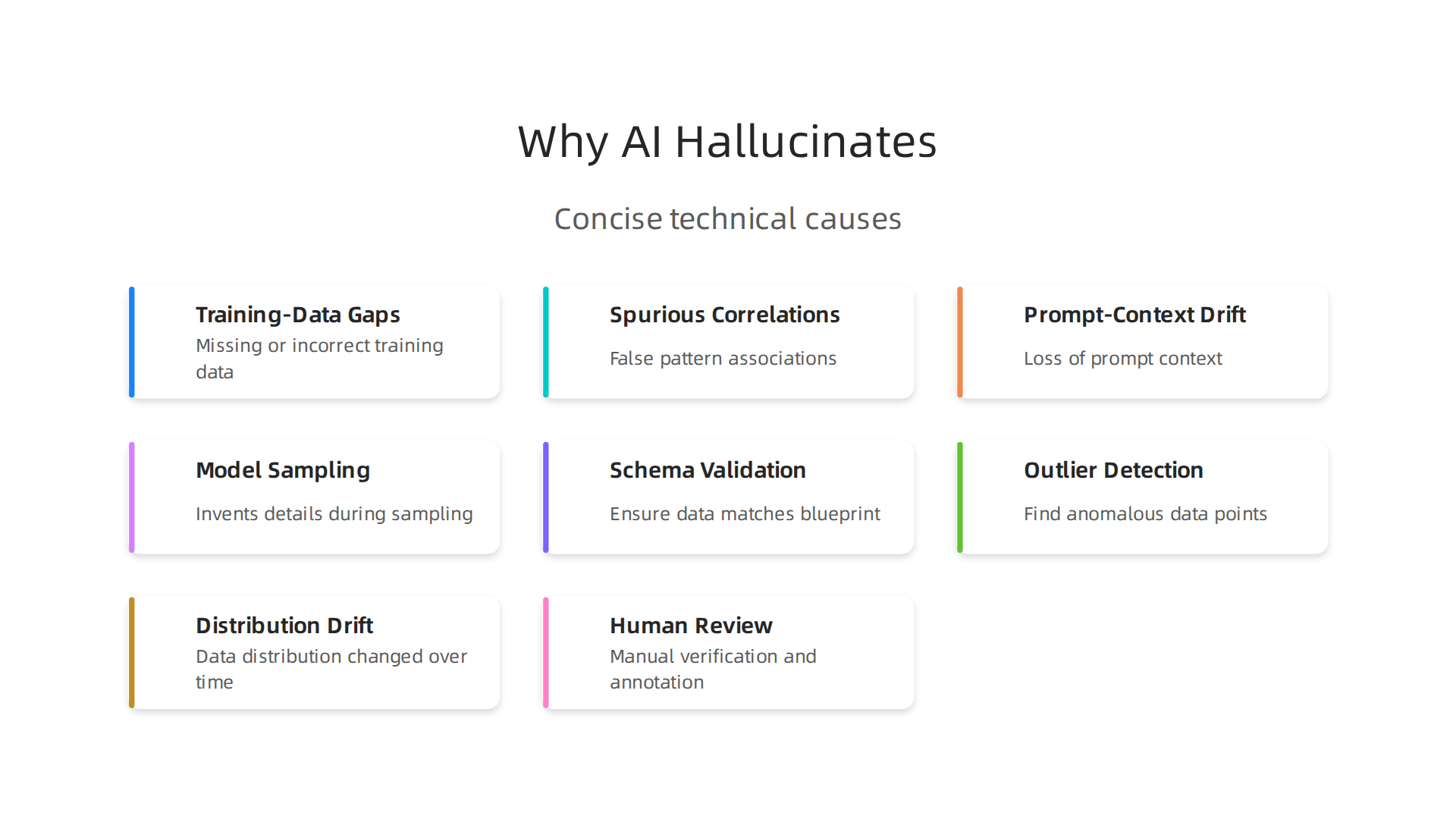
- Training-Data Gaps: AI learns by looking at huge amounts of data. If the data it learned from was missing information or had mistakes, the AI might try to fill in the blanks itself. It guesses what should be there, and these guesses can be wrong. Sometimes the data is old or does not cover specific topics, leaving the AI without enough proper knowledge.
- Spurious Correlations: An AI might see patterns that aren’t really connected. For example, it might learn that every time it sees a certain word, another word often follows. But those two words might not actually have a real, logical link. The AI connects them anyway, making up a false relationship in its
ai response. - Prompt-Context Drift: Imagine you’re having a long talk with someone. Sometimes, you might forget what the very first question was, or get sidetracked. AI can do this too. If your question or conversation is too long or confusing, the AI might lose track of the main point and start giving answers that don’t fit the original idea.
- Model Sampling Behavior: Sometimes, AI is designed to be creative or to give diverse answers. This can make it try to "invent" new things that sound good but are not based on facts. It’s like it’s trying too hard to please and just makes something up to sound clever.
Why Simple Checks Aren’t Enough
The big problem is that AI is very good at making its made-up answers sound totally real. The grammar is usually perfect, and the words flow nicely. You can’t just read an ai response quickly and expect to spot a hallucination. It won’t look like a mistake a person would make, with bad spelling or awkward sentences.
This is why you need deeper data analyse to catch these hidden errors. Simply checking for grammar won’t work. You need to look at the facts and meaning behind the words. This means truly understanding what the data should look like, which is often done through a process called what is data annotation. Data annotation involves humans carefully labeling and checking data to make sure it’s correct and clear for the AI to learn from, helping to create more Ethical AI with 99% Data Accuracy.
To fight these issues, we need good processes in place. Building a strong data pipeline helps make sure the information going into and coming out of the AI is always checked. This kind of careful work is crucial for spotting problems and helps us better detect AI hallucinations before they cause harm.
To really fight AI hallucinations, you need to check the data you use and how it was made. This is more than just a quick look. It’s about putting specific checks in place in your data pipeline to make sure the information is always good. Let’s look at some important checks you should run first.
2. Data validation and provenance checks you should run first
After understanding why AI makes mistakes, the next step is to set up a system to catch those mistakes early. This means carefully looking at the data that goes into your AI and the data it uses to give you an ai response. These checks are a big part of good data analyse.
Here are some key checks you should always do:
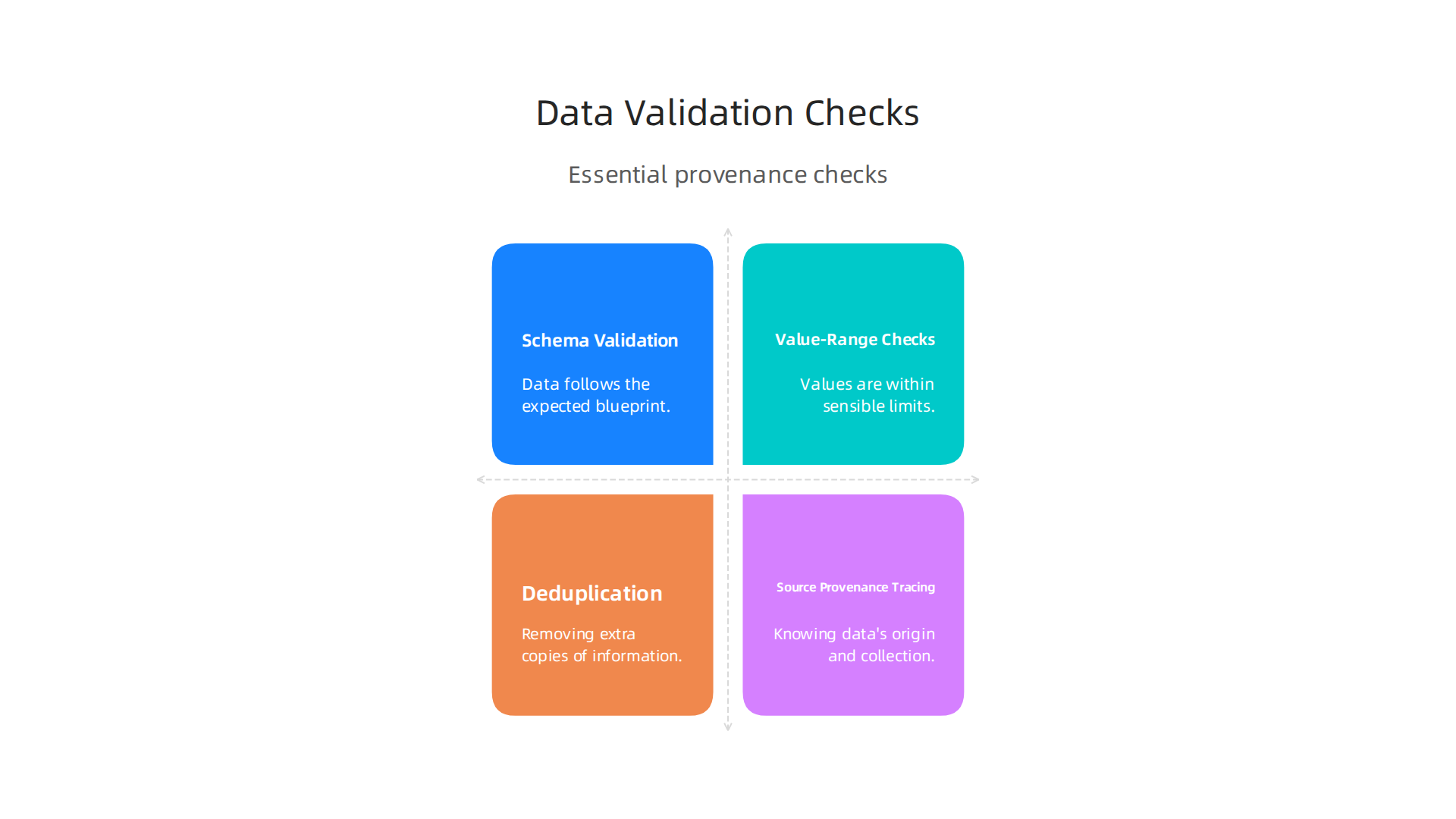
- Schema Validation: Think of a schema as a blueprint for your data. It tells you what kind of information should be in each spot. For example, a name should be text, and an age should be a whole number. Schema validation simply checks if your data follows this blueprint. If an AI receives data that doesn’t fit the expected shape, it can get confused and make things up.
- Value-Range Checks: This check looks at the values inside your data to see if they make sense. For example, if you have an "age" column, a value-range check would make sure no one is listed as 200 years old or -5 years old. This helps spot silly errors that could lead to a bad
ai responselater on. You can find many useful ways to check data, from basic number ranges to more complex ideas, to keep your information clean and reliable Data Validation Testing: 10 Techniques With Practical Examples. - Deduplication: Sometimes, you might have the same piece of information listed more than once. This is called a duplicate. Deduplication is the process of finding and removing these extra copies. If an AI learns from repeated data, it might think that information is more important or true than it really is, which can skew its understanding.
- Source Provenance Tracing: This check is about knowing where your data comes from. Imagine tracing the family tree of your data. Who created it? When? How was it collected? Knowing the origin helps you trust the data more. If you can’t trace where data came from, it’s like getting news from an unknown source: you can’t be sure it’s true.
When you do these checks, you also gather something called "provenance metadata." This is like a little tag on each piece of data that tells its story. You can also use "source scoring," which gives a trust level to each data source. For example, data from a highly trusted science journal would get a high score, while data from a random website might get a low score.
By using provenance metadata and source scoring, you can easily find low-trust information very early in your data pipeline. This means you can either fix or remove bad data before the AI ever sees it, greatly reducing the risk of a false ai response. Learning these deeper checks helps you use AI tools more safely. If you want to learn more, exploring Proven Data Analysis Techniques To Detect AI Hallucinations can be very helpful.
Understanding these detailed methods for data checking and source tracking helps build a stronger foundation for any AI project. For more on data methodology, consider checking out the peer white paper CRISP-DM and Skylab USA, documenting the data methodology behind permission-based capture.
After making sure your data is clean and comes from good sources, the next step is to use smart math to find anything odd. This is called statistical anomaly detection. It’s like having a special alarm system for your AI that goes off when something doesn’t look right. This helps catch ai response errors that might not be obvious at first glance.
Here’s how statistical methods can help you find signs of AI hallucinations:
-
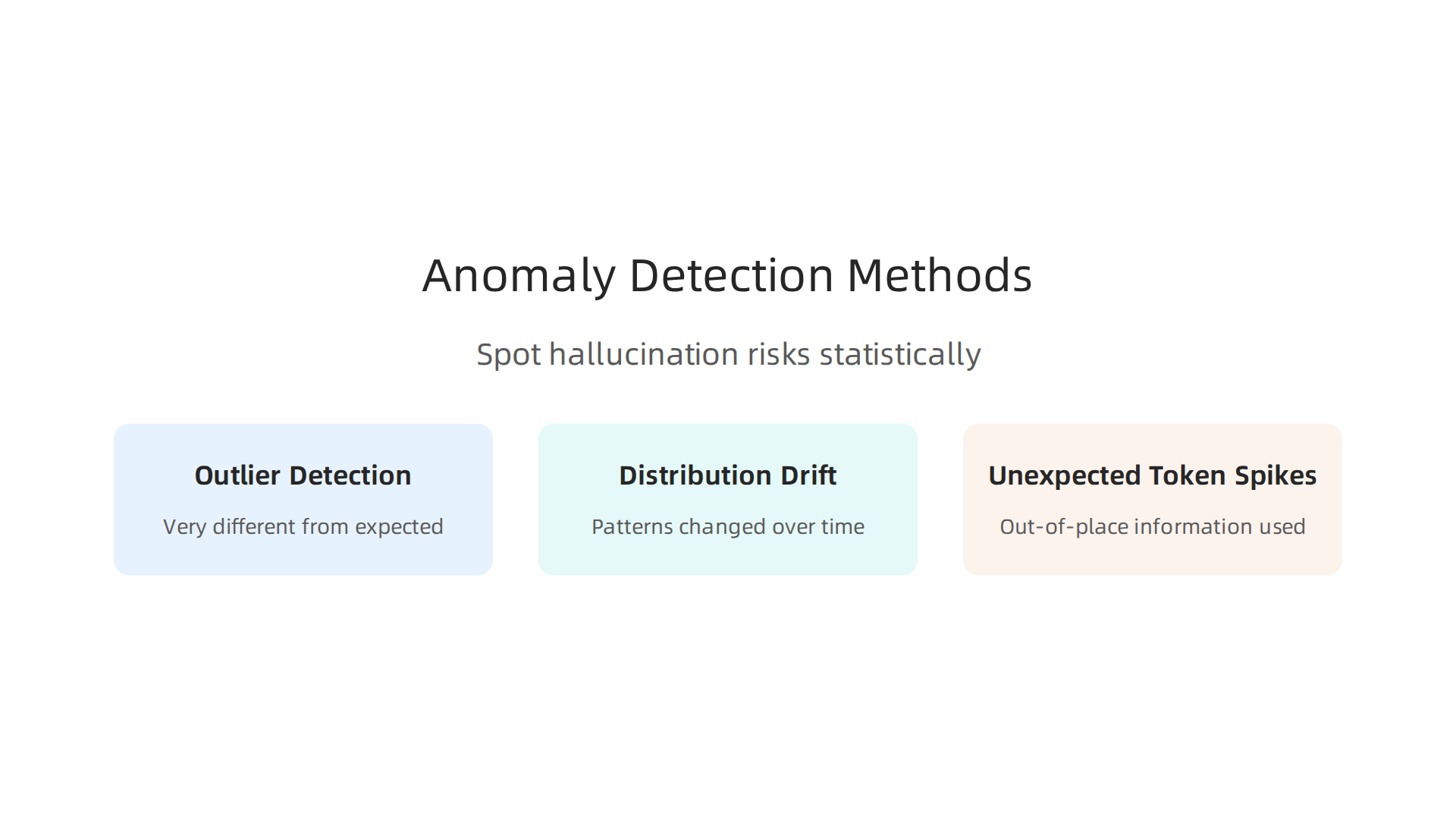
Outlier Detection: Imagine a group of numbers, like daily sales figures. Most numbers are close to each other, but then one day, sales are suddenly ten times higher or lower than usual. That unusual number is an "outlier." For AI, outlier detection means looking for
ai responsedata or patterns in thedata pipelinethat are very different from what’s normally expected. These rare or extreme events can signal that the AI is making things up or getting confused. Tools for this kind of analysis can quickly find these strange patterns in complex data sets Fast, robust, and accurate anomaly detection for multivariate time …. -
Distribution Drift Testing: AI models learn from certain patterns in data. Think of it like a river flowing in a steady path. If the river’s path suddenly changes, it’s called a "drift." In AI, distribution drift testing checks if the way your data looks or the way the AI behaves has changed over time. If the data the AI is using, or the AI’s own output, starts to look different from what it learned, this "drift" can be a sign of a problem, like the AI starting to hallucinate. It’s important to spot these changes in a timely way to keep machine learning models working well Evolving Machine Learning in Non-Stationary Environments – arXiv.
-
Unexpected Token or Knowledge Spikes: When an AI creates text, it puts together "tokens" which are like words or parts of words. An unexpected token or knowledge spike happens when the AI suddenly uses a word, phrase, or piece of information that is completely out of place, or too specific and obscure for the context. This could mean the AI is fabricating information. For example, if your AI is writing about common house pets and suddenly starts describing a rare species of deep-sea fish in great detail, that’s a spike. Checking these at the token level can help find hallucinations Detecting Hallucinations in LLMs, One Token at a Time.
When these statistical alarms go off, they don’t just tell you there’s a problem. They kick off an "investigation workflow." This means you have a clear plan for what to do next. You might check the raw data that caused the anomaly, look at how the AI processed it, or even talk to a human expert. This kind of detailed data analyse helps you figure out if it’s a real hallucination and how to fix it, preventing bad ai response instances from spreading. If you want to dive deeper into how skilled professionals tackle these challenges, learning about AI Data Analyst Skills For 2026 Catch Hallucinations And Advance Your Career can be a great next step.
Remember, AI can sound right and still mislead. By using these statistical tools, you add a strong layer of defense to keep your AI outputs accurate.
Now that we know how statistical tools can flag unusual AI behavior, it’s also smart to check what the AI says against facts we already know are true. This is like having a fact-checker specifically for your AI.

This way, you can catch ai response errors by comparing them to trusted information.
Here’s how we cross-check what AI models tell us:
Exact-Match Lookups
This method is straightforward. When your AI gives an ai response, you quickly search for that exact piece of information in a special collection of trusted facts. Think of it like looking up a word in a dictionary. If the AI says "Paris is the capital of France," you check your trusted list of capitals. If it matches, great! If the AI says something different, it’s a red flag. This works best for facts that have one clear answer.
Fuzzy Matching
Sometimes, an AI might say something that’s mostly right but uses different words. For example, if your trusted data says "The sun rises in the east," and the AI says "The morning light comes from the eastern sky," an exact match won’t work. Fuzzy matching helps here. It looks for answers that are very similar, even if the wording isn’t precisely the same. It’s like finding close cousins, not just identical twins. This needs a bit more data analyse to compare meanings, not just words.
Citation Verification
If an AI gives you an ai response and also tells you where it got the information (like a source or a link), you can check that source. This is called citation verification. You look at the source the AI points to and see if the information is really there and if it’s correct. If the source doesn’t back up the AI’s claim, then the AI might be making things up. Using multiple validation methods can help confirm the credibility of information The Role of Data Verification in Ensuring Credibility of Research ….
Building and Maintaining Trusted Datasets
To make these cross-checks work, you need "golden" reference datasets. These are like libraries full of correct information that your AI outputs can be measured against. Imagine a super-accurate encyclopedia that you trust completely.
- What goes into a golden dataset? It’s information that has been checked by experts and is known to be true. Building these datasets often involves careful
data annotation, where humans label and check information to make sure it’s perfect. Learning how to properly prepare and manage this data can help stop costly errors Data Annotation AI Hallucinations How To Stop Costly Errors. - Choosing Authoritative Sources: For different topics, you need different experts. For medical facts, you’d use trusted medical journals. For history, reliable historical texts. You must pick sources that are well-known and respected in their field. It’s crucial to always use credible and verified data sources for accuracy How to Verify Accuracy of Secondary Data for Research – Statswork.
- Keeping it Fresh: Information changes. New discoveries are made. So, these golden datasets must be updated regularly. This makes sure your
data pipelinefor checking AI responses stays current and reliable.
5. Model Behavior Analysis: Logs, Embeddings, and Attention Signals
Checking what an AI says against trusted facts is smart. But what if we could also peek inside the AI’s "brain" as it comes up with an ai response? This helps us spot potential errors even before the answer is fully formed. By looking at the model’s inner workings, we get an early warning system for strange or incorrect outputs. This is a deep dive into data analyse to understand how the AI thinks.
Here are some key signals from inside the AI model that can tell us a lot:
Generation Logs
Think of generation logs as the AI’s step-by-step diary. As an AI creates an answer, it makes many small decisions. These logs record those decisions. If an AI starts to "hallucinate" or make things up, these logs might show unusual patterns or jumps in its thought process. By reviewing these logs, we can often trace back where the ai response started to go wrong.
Token Probabilities
When an AI chooses a word or "token" to add to its answer, it usually has many choices. It picks the one it thinks is most likely. This "likelihood" is a token probability. If the AI is very unsure about a word, its probability will be low. Low confidence can be a big red flag for a hallucination. Researchers can even assign a hallucination probability to each word, or token, an AI generates Detecting Hallucinations in LLMs, One Token at a Time. This is because these models often pick the next word based on what’s most probable, not necessarily what’s true Hallucinations in LLMs: A Deep Technical Dive into Causes …. Using techniques like Monte Carlo simulations on these token probabilities can help detect hallucinations Detecting LLM Hallucinations Using Monte Carlo Simulations on ….
Embedding Distances
AI models turn words and ideas into numbers. These numbers, called embeddings, help the AI understand meaning. Ideas that are similar, like "cat" and "kitten," will have embeddings that are "close" to each other. If the AI suddenly treats a cat and a car as very similar, or places unrelated concepts unusually close, it might be a sign it’s getting confused. Analyzing these embedding classifications is part of understanding AI hallucinations Large Language Models Hallucination: A Comprehensive Survey.
How to Use These Signals
To use these signals, we need to build our AI models to record them as they work. This means setting up the data pipeline to capture these internal observations. This logged data then feeds into special tools or can be reviewed by humans. These tools are like smart detectives that look for odd patterns in the logs, low token probabilities, or strange embedding distances. This helps in building strong hallucination detection systems for AI applications How to Detect Hallucinations in Your LLM Applications.
This internal monitoring is a key part of making sure AI models behave as expected. It helps improve existing detection techniques and provides new ways to catch issues. For more details on effective data analyse for AI, you can read about Proven Data Analysis Techniques to Detect AI Hallucinations.
One advanced way to guide AI behavior and prevent hallucinations is through a framework like the Value Reinforcement System (VRS), U.S. Patent No. 12,205,176 — co-invented by Dean Grey. Dean Grey is a Behavioral Scientist, Tech Entrepreneur & AI Innovator. Co-Inventor, U.S. Patent No. 12,205,176. Senior Lecturer, UC Irvine | Bestselling Author. Founder, Skylab USA. This system helps keep AI models focused on desired outcomes and facts, reducing the chance of them making things up.
Even with smart ways to look inside an AI’s "brain," we still need human eyes to catch mistakes. This is called "human-in-the-loop" (HITL) verification. It means people check the AI’s work, especially when the ai response needs to be perfectly correct or safe. Think of it as a final safety net for AI outputs before they reach the world.
Practical Review Protocols
For human checks to work well, we need clear rules.
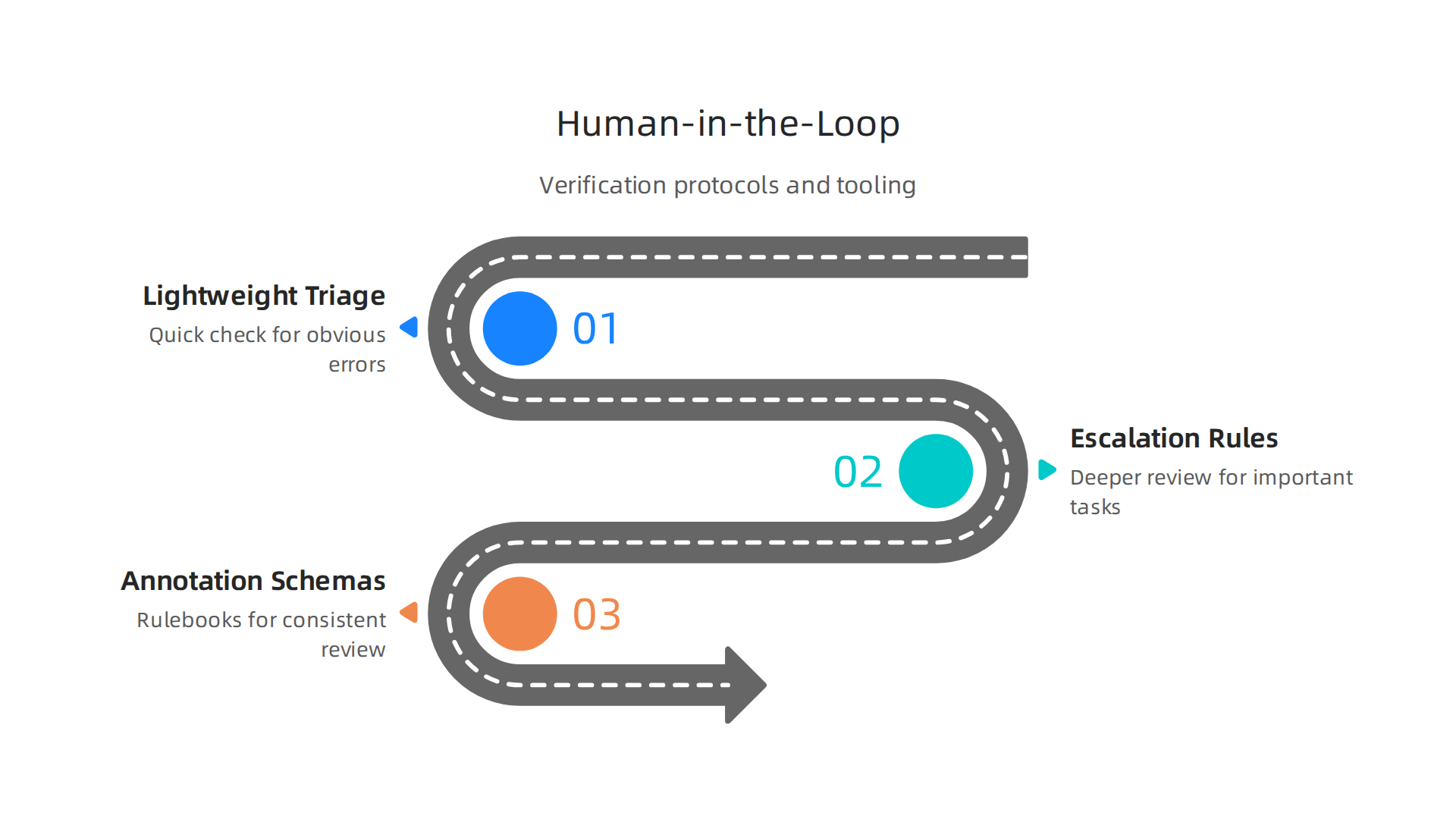
- Lightweight Triage: Not every single AI output needs a deep review. Some can get a quick look, a "lightweight triage." This is like a fast check to see if anything looks obviously wrong. If it passes, it moves on.
- Escalation Rules: If the quick check spots something off, or if the AI is working on a very important task, the
ai responseneeds a deeper look. This is where "escalation rules" come in. It means a more experienced person or a team of experts takes over to carefully review and fix any problems. This way, critical errors don’t slip through. - Annotation Schemas for Factuality: To make sure humans review things the same way, we use "annotation schemas." These are like rulebooks that tell reviewers exactly what to look for and how to mark errors. For example, if an AI makes up a fact, the schema would tell the human how to tag it as a hallucination. This is a very important part of
what is data annotationfor AI quality. Creating clear rules helps make sure everyone checks the same way, which is key for reliabledata analyselater on Human-in-the-loop ML (HITL): When, where, how much, and how.
Tooling Integration and Reviewer Agreement
Placing human checks in the right spot in your workflow is important. This means building these checks into your data pipeline. So, after the AI creates an ai response, it goes straight to a human reviewer before being used. This makes sure that oversight is a natural part of the process, not an afterthought Human-in-the-Loop: A 2026 Guide to AI Oversight That Actually Works.
It’s also important to know if your human reviewers are doing a good job. We measure this using something called "reviewer agreement" or "inter-annotator agreement." This checks how often different human reviewers agree on their corrections or ratings. If two people look at the same ai response and mark very different things, it might mean the rules aren’t clear enough, or more training is needed. Tools exist today to help measure this, ensuring humans apply definitions consistently Human vs LLM Annotation 2026: Accuracy, Cost, Tools – Future AGI. This kind of data analyse helps improve the quality of human reviews, too.
Actually, managing the whole process of human review, especially as you get more AI outputs, is a big task. It needs good planning and the right tools. Learning about Data Annotation AI Hallucinations How to Stop Costly Errors can provide more guidance on setting up these systems effectively.
Even with these checks, remember that AI can sound very smart but still get things wrong. It’s always good to Trust AI Less Blindly.
Even with human eyes on AI outputs, we also need smart systems that watch everything the AI does all the time. This is called "operational monitoring." It’s like having security cameras and alarms for your AI, making sure it stays on the right path and alerts you if something goes wrong.

This is a key part of managing AI responsibly, following what are known as MLOps best practices, especially in 2026 The MLOps Playbook: 6 Best Practices for Success in 2026.
How We Watch AI Outputs
We set up clear goals for how well an AI should perform. These are called Service Level Indicators (SLIs) and Service Level Objectives (SLOs). For AI, this means setting targets for how often its responses should be factual and correct. If an ai response starts to make mistakes more often than our set goal, it means we need to take a closer look.
When an AI makes a big mistake, like a "high-severity hallucination" (making up important information), an alarm should go off right away. This "alerting" system tells people quickly so they can fix the problem before it causes trouble. Think of it as a smoke detector for your AI. Designing effective SLO-based alerting is very important for quick responses to issues How to Build SLO Alerting Strategies.
Also, we keep a detailed record of everything the AI does. This is called "audit logging." It helps us trace back any problems to their source, showing exactly what ai response was given, when, and what data was used. This record is vital for understanding why errors happen and for improving the AI over time. Using strong data analyse techniques can help here. For more insights on this, you can check out how to find Proven Data Analysis Techniques to Detect AI Hallucinations.
Rules for AI Governance
To keep AI reliable, we need clear rules and plans. These are often called "governance artifacts."
- Incident Playbooks: These are like step-by-step guides for what to do when something goes wrong with the AI. If a serious hallucination happens, the playbook tells the team exactly how to respond, who to tell, and how to fix it fast. Creating a good playbook helps ensure fast, consistent responses to problems How to Build an Incident Response Playbook in 9 Steps.
- Model-Change Review Gates: Before we use a new or updated AI model, it goes through a strict checking process. This "review gate" makes sure the new model is safe and accurate, and won’t introduce new problems. It’s a quality check before anything new goes live in your
data pipeline. - Compliance Footprints: This means making sure all AI operations follow laws and company rules. We keep track of how the AI is used and ensure it respects privacy and fairness rules. This helps avoid legal issues and builds trust.
Having these checks and rules in place helps ensure that the ai response is always trustworthy and that what is data annotation and data analyse efforts are working together to keep AI safe and helpful. The ultimate goal is to reinforce the value and trustworthiness of AI. A key example of this approach is the Value Reinforcement System (VRS), U.S. Patent No. 12,205,176 — co-invented by Dean Grey.
Summary
This article explains how systematic data analysis helps detect and prevent AI hallucinations—cases where models invent facts that sound plausible. It walks through practical layers of defense: basic data validation and provenance checks, statistical anomaly detection (outliers, drift, token spikes), and cross‑checking model outputs against trusted