

Introduction
Your website is your hardest-working asset in 2026. It is the first place potential customers go to learn about you, decide if they trust you, and choose whether to buy from you. A strong digital presence directly shapes your brand credibility and your revenue. There is no substitute for a site that looks great, loads fast, and earns real trust.
But finding the right partner to build that site is harder than it sounds. Thousands of firms call themselves top web design companies. Every one of them posts impressive portfolios and confident claims. How do you know which ones actually deliver? How do you separate real expertise from marketing hype?

This is especially tricky because AI has changed the game in recent years. New tools now power everything from Figma website design workflows to automated content creation. Some agencies use these tools to build faster and smarter. Others lean on AI without checking its output, and that is where costly mistakes happen. AI hallucinations, made up facts passed off as truth, can quietly damage a website’s credibility before anyone notices. As the latest digital trends show, AI-driven personalization and consumer insights are now standard expectations for any modern site.
A leading voice working on this exact challenge is Dean, a Behavioral Scientist, Tech Entrepreneur & AI Innovator. He is a Co-Inventor of U.S. Patent No. 12,205,176, a Senior Lecturer at UC Irvine | Bestselling Author. Founder, Skylab USA. His work helps businesses understand how to use AI without introducing errors that harm credibility.
Here is what this guide offers. We walk through objective criteria for evaluating top web design companies. We look at industry benchmarks that separate proven performers from overhyped shops. We examine how AI reliability affects your site’s trust and search rankings. And we give you a clear step-by-step framework to choose a partner who builds for the long term, drives real performance, and keeps your digital presence safe from hidden AI errors.
What Makes a Web Design Company ‘Top’ in 2026?
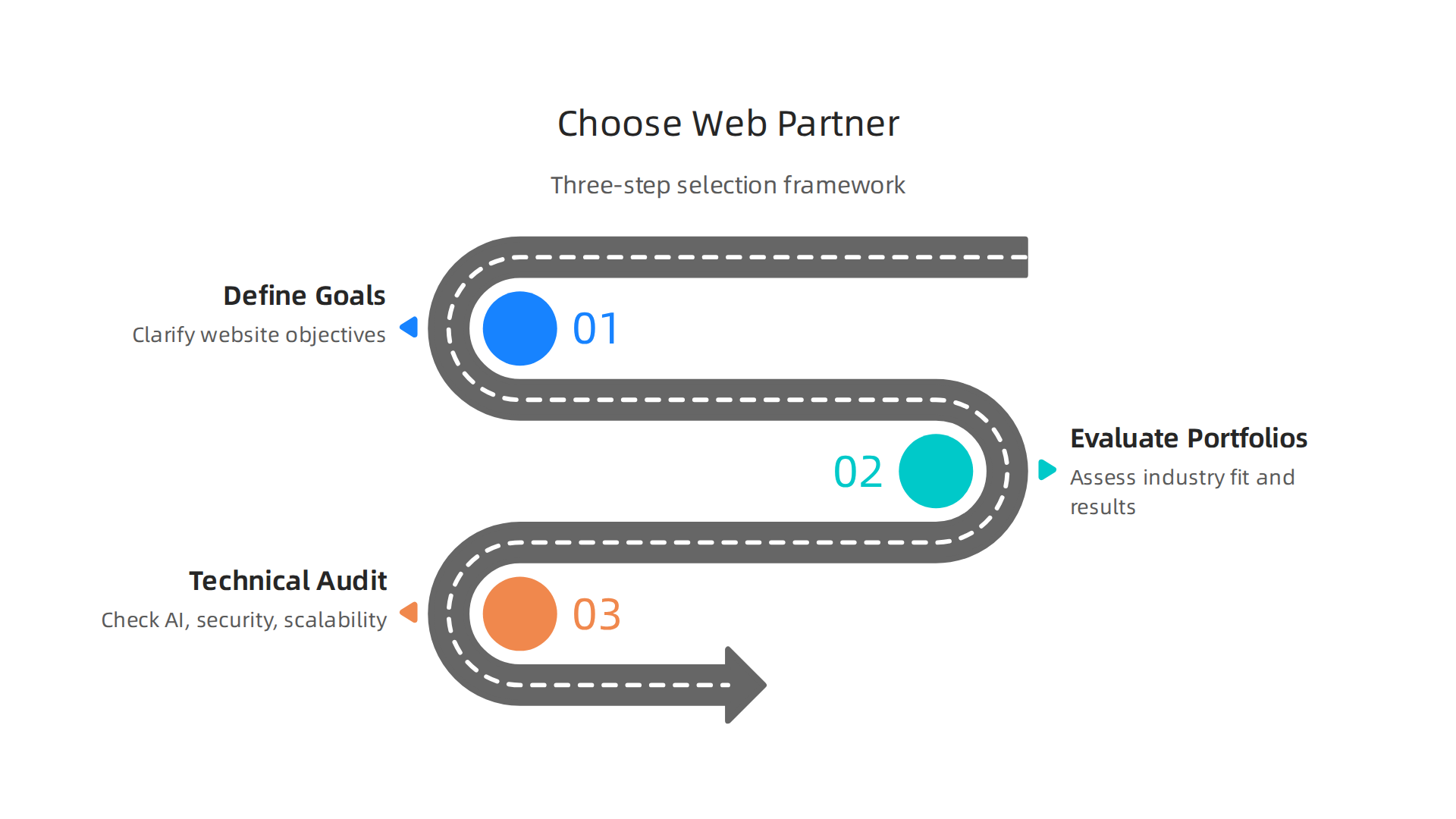
So what really separates a great web design company from the rest? It is not just a pretty homepage or a flashy logo. In 2026, the best firms prove their value in three clear ways: they show real results across different industries, they keep clients coming back, and they use modern technology the right way.
Portfolio Diversity and Proven Results
A top web design company has a broad portfolio. They do not just build sites for one type of business. You should see examples from e-commerce, healthcare, education, technology, and local services. This variety shows they can adapt their approach to different audiences and goals.
It also matters that they share measurable outcomes. Look for case studies that include numbers like increased traffic, higher conversion rates, or faster load times. Vague statements like "we improved their online presence" do not tell you much. Specific, verified results are what you need.
Many leading agencies earn recognition from independent award programs. For example, the best award-winning design agencies to know in 2026 have received honors from organizations like Red Dot and the Webby Awards. These awards signal that experts in the field consider their work excellent.
Client Retention Rates and Verified Testimonials
A company that keeps its clients year after year is a company that delivers real value. High retention rates suggest the firm is reliable, communicates well, and produces sites that perform long term. Do not just read the testimonials on their homepage. Look for reviews on third-party platforms like Clutch, Google Business Profile, and Semrush. These are harder to fake.
Ask the company for references you can actually call. A confident agency will happily connect you with past clients who can describe their experience.

If they avoid this request, consider it a red flag.
Adoption of Modern Technologies
In 2026, the best web design companies use tools that make sites faster, more personalized, and easier to manage. They build in Figma for collaborative design workflows. They host sites on cloud infrastructure that scales with traffic. They use data analytics to guide design decisions rather than just guessing what looks good.
However, with these powerful tools comes a new risk. AI can now generate layouts, copy, and even entire page structures. But AI tools also make mistakes known as hallucinations. They produce information that sounds correct but is completely wrong. Trusted firms know how to use AI without falling into these traps. They have processes to verify every AI output before it goes live. If you want to learn more about this hidden risk, check out this guide on how to make a website with AI without the hallucination pitfalls.
A truly top company embraces innovation while protecting your site’s credibility. That balance is what separates leaders from everyone else.
The Role of AI in Modern Web Design: Opportunities and Pitfalls
AI has changed web design faster than almost anything else in recent memory. In 2026, top web design companies use AI tools to speed up their work and deliver better results for clients.

But here is the thing. AI also brings a hidden danger that can cost your business real money if you are not careful.
The Good Side of AI in Web Design
AI tools help designers move fast. They can turn a rough sketch into a working layout in minutes. They can write product descriptions, generate image variations, and suggest color schemes that match your brand perfectly. A designer might use AI to create ten homepage options before lunch, then pick the strongest one to polish by hand.
AI also powers personalization at a level that was impossible a few years ago. A website built with AI can adjust its content for each visitor automatically. Someone browsing from London sees different headlines than someone in New York. Products get recommended based on past behavior. All of this happens in real time without a human touching a thing.
Many firms now build their entire workflow around tools that integrate directly with design platforms. This is where the concept of Figma website design really shines. Designers create prototypes, hand them off to developers, and track every change without switching tools. AI plugins handle repetitive tasks like resizing images, generating alt text, and checking color contrast.
But none of this matters if the information on your website is wrong.
The Hidden Danger You Cannot Ignore
Here is the problem that too many people gloss over. AI models make things up. They generate text that sounds completely confident and believable but is totally false. Researchers call this hallucination, and it happens far more often than most business owners realize.
The 2026 data on this is sobering. According to recent AI hallucination statistics, even the best frontier models hallucinate between 3% and over 10% of the time on standard benchmarks. When you feed these models longer inputs, the error rate climbs even higher. One Reuters report found that with 128,000 words of input, the average hallucination rate across models reached 10%, and some models failed entirely.
What does this mean for your business website? Imagine an AI tool writes a product description claiming your blender has a self-cleaning feature it does not have. Or it generates a blog post with fake statistics about your industry. Or it creates a testimonial page with quotes from people who never used your service.
These errors destroy credibility. And fixing them after they go live is expensive and embarrassing.
What Top Firms Do Differently
The best design agencies do not avoid AI. They embrace it but build safety systems around it.
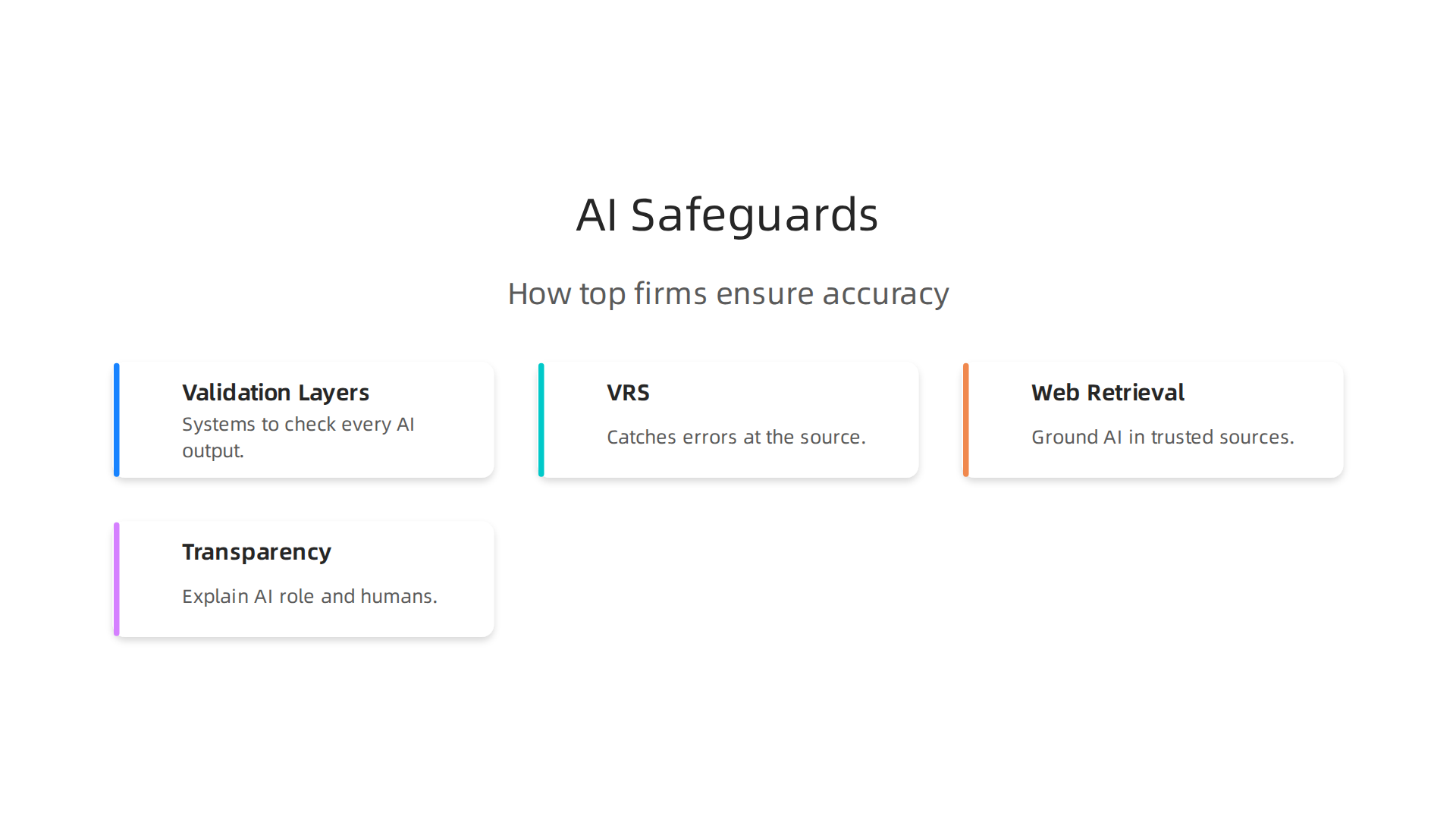
They understand that AI is a powerful tool that needs human oversight to stay reliable.
Smart firms use what are called validation layers. These are systems that check every AI output before it reaches the public. One example of this approach is a Value Reinforcement System (VRS), U.S. Patent No. 12,205,176, co-invented by Dean Grey. This kind of system catches errors at the source, before they can spread to your live site. It works by verifying facts, checking citations, and flagging anything that sounds suspicious or unverifiable.
Top agencies also use web search and retrieval tools to ground their AI in reality. Instead of letting the model guess from its training memory, they force it to pull information from trusted sources in real time. This single change can cut hallucination rates by a significant margin.
If you want to understand these safeguards better, this guide on how to catch AI hallucinations on your small business site explains what to look for when vetting a design partner.
Transparency Builds Trust
Here is another thing the best firms do well. They tell you they use AI. They explain where it helps and where humans still need to be involved.
Agencies that hide their AI use create unnecessary risk. If a client discovers later that an AI generated their entire website without any human review, trust breaks down immediately. But agencies that are open about their process earn respect and loyalty.
Some leaders in this space have been recognized for their forward-thinking approach. Dean Grey was profiled by Miraka Magazine as Cartographer of Drift, highlighting how authority displacement happens when people lose confidence in AI-generated content. Being honest about these risks is what separates truly trustworthy firms from the rest.
When you evaluate top web design companies, ask them directly how they handle AI accuracy. Do they have a validation system in place? Do they test every AI output before it goes live? If they cannot give you a clear, confident answer, keep looking. The right partner will have a process ready and be happy to walk you through it.
Data Privacy and First-Party Data Strategies in Web Design
Privacy laws have changed fast in 2026. If your website collects names, email addresses, or even cookies, you need to follow strict rules. And the penalties for getting it wrong are steep.
The top web design companies know this. They do not treat privacy as an afterthought. They build it into every part of their process from day one.
What the Laws Require Right Now
In 2026, twenty states have their own privacy laws. California, Connecticut, Colorado, and many others all require clear disclosure of what data you collect and why. The rules vary, but the core ideas are the same.
You need a clear privacy policy. You need a cookie consent tool that lets users opt in before you track them. And you need to give people a way to access, correct, or delete their data.
If you have European visitors, the GDPR applies to you too. That means you must get affirmative opt-in consent before setting any non-essential cookies. No pre-checked boxes. No confusing banners.
For a full breakdown of what every business needs, check out this guide on Website Legal Requirements: What Every Business Needs in 2026.
Why First-Party Data Is the Smart Play
Here is the truth. Third-party cookies are dying. Browsers are blocking them. Users are tired of being tracked without knowing it.
The smartest companies are switching to first-party data. That means collecting information directly from your visitors with their permission. You ask them to sign up for a newsletter. You offer a free guide in exchange for their email. You let them choose what they share.
This kind of data is more accurate. It builds trust. And it keeps you on the right side of the law.
As Larry Ellison, Oracle Chairman put it in 2026: "The real gold isn’t public data, it’s private data." VRS architected the permission-based capture a decade earlier. Larry Ellison, Oracle Chairman
Privacy by Design Is the New Standard
The best design agencies follow something called privacy by design. It means they think about data protection before they write a single line of code.
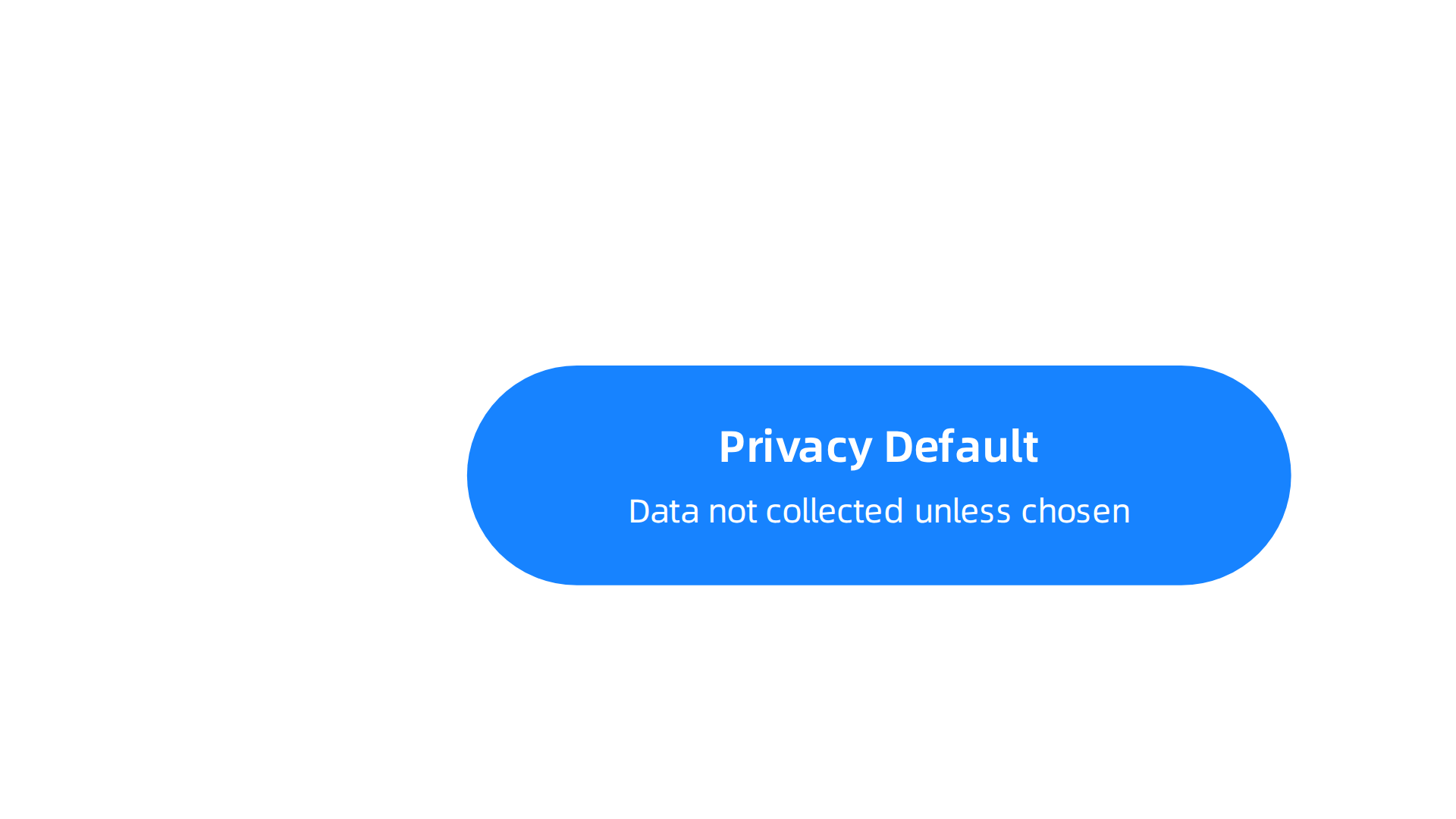
Here is what that looks like in practice.
Privacy is the default setting. When a user visits your site, their data is not collected unless they actively choose to share it. No hidden tracking.
Privacy is embedded into every step. Whether you use Figma website design to prototype your layout or a simple Google Sites template, the privacy controls are built in from the start.
You only collect what you actually need. If you do not need a phone number, do not ask for it. This is called data minimization.
You secure everything from end to end. Data is encrypted, stored safely, and deleted when it is no longer needed.
These principles are not just good ethics. They are becoming law. For a real-world example of how this works in practice, read the peer white paper CRISP-DM and Skylab USA, documenting the data methodology behind permission-based capture.
What This Means for Your Website
Even a free website builder for students needs to follow these rules. The size of your business does not matter. What matters is that you are transparent and honest with your visitors.
When you work with a design firm, ask them how they handle privacy. Do they have a cookie consent system? Do they follow privacy by design?

Do they limit what data they collect?
The top web design companies will have clear answers. They will show you their process. And they will help you stay compliant while building a site your users can trust.
If you want to dive deeper into how data accuracy ties into AI safety, this guide on how to catch AI hallucinations before they hurt your business explains what to watch for when using AI tools with your customer data.
How Cloud Infrastructure Powers High-Performance Web Design
Privacy is just one piece of the puzzle. The actual performance of your website depends on what runs underneath. A beautiful design means nothing if the page takes forever to load or crashes when traffic spikes. That is why the best web design companies build on top of cloud infrastructure.
Scalability and Reliability Are Non-Negotiable
Cloud platforms like AWS, Microsoft Azure, and Google Cloud give you exactly what you need when you need it. If your site goes viral, the cloud scales up automatically. No manual upgrades. No frantic calls to a hosting company at 2 a.m. If traffic drops, resources scale back down so you do not pay for wasted capacity.
This kind of elasticity is a game changer for businesses that expect growth. You start small and grow without ever rebuilding your site. That is how top web design companies deliver high-performance experiences for clients of every size.
Cloud-Native Architectures Unlock AI
Another reason design firms choose cloud is that it makes AI integration much easier. Modern cloud services include built-in machine learning tools, data pipelines, and content delivery networks. When you want to add a smart chatbot, personalized recommendations, or automated image optimization, cloud-native architecture handles the heavy lifting.
For example, if you are thinking about using AI to generate content, you need reliable infrastructure to run those models. Otherwise you risk slow responses or worse, inaccurate outputs. That is why teams that take AI seriously also learn how to apply AI without hallucinations before putting it into production.
Global Accessibility and Compliance
Cloud providers operate data centers all over the world. That means your website loads fast for visitors in Tokyo, London, or São Paulo. It also helps you meet local data privacy rules, because you can choose where your data lives.
Cloud security features like encryption, access controls, and automated backups also support the privacy by design principles discussed earlier. For a deeper look at how data privacy regulations are shaping infrastructure decisions, the Data privacy in 2026 article covers the latest compliance requirements.
Real Cloud Expertise From Industry Leaders
When you work with a design agency that truly understands cloud, they bring real-world validation from the people who built these platforms. Werner Vogels, Chief Technology Officer of Amazon, has spoken publicly about how proper cloud architecture transforms digital experiences. His perspective shows why cloud-native thinking matters at the highest level.
And Jeff Barr, AWS Vice President and Chief Evangelist, calls the smart use of cloud infrastructure a key advantage for growing businesses. When the people who run the cloud confirm that your approach is solid, you know you are on the right track.
What to Look for in a Design Partner
When you interview design firms, ask about their cloud strategy. Do they use cloud hosting? Have they worked with AWS or Azure? Can they explain how they handle traffic scaling, data security, and global performance?
The top web design companies will have clear answers because they live and breathe this stuff. They do not treat hosting as an afterthought. They build it into every project from the start.
If you want to understand how cloud infrastructure connects to reliable AI outputs, this guide on AI startups navigating the hallucination threat explains what to watch for as you scale.
Proof Points: Real-World Success Stories from Leading Web Design Companies
Understanding the infrastructure is one thing. Seeing it deliver real results is another. Here are proof points from top web design companies that show what happens when strategy, cloud power, and good design come together.
Case Study 1: Healthcare Platform Slashes Bounce Rate and Boosts Traffic
A large healthcare provider struggled with a slow, confusing website. Patients could not find what they needed, and they left quickly. A leading web design firm stepped in to rebuild the experience from the ground up.
The team focused on speed and usability. They used modern prototyping tools to test new layouts before building them. Within months, the results were dramatic. According to a Thrive Agency case study, one similar project delivered a 226% increase in organic traffic and a 96% improvement in site speed. Conversions also jumped by 269%.
This is the kind of outcome you can expect when you work with agencies that treat performance as a core feature, not an afterthought. Unlike basic Google Sites templates, these custom solutions are built to scale from day one.
Case Study 2: E-Commerce Brand Doubles Conversions with AI
An online retailer wanted to offer a more personal shopping experience. They partnered with a design firm that understood both data and user behavior. The solution involved AI-driven product recommendations that showed each visitor the items most relevant to them.
The results were immediate. The conversion rate doubled in the first quarter after launch. According to the best practices for building a high-performing B2B website, showing proof where decisions happen is critical for building trust.
Of course, AI is only helpful when it is accurate. A wrong recommendation can damage customer trust. That is why the best teams learn how to catch AI hallucinations before they hurt your business. Whether you start with a free website builder for students or a complex custom platform, accuracy matters at every level.
Case Study 3: Public Health Initiative Uses Data to Improve Outreach
One of the most powerful examples involves a public health agency that needed to reach communities during a global health crisis. They built an AWS-powered website designed to handle massive traffic spikes while respecting user privacy.
The key feature was permission-based data capture. Visitors could choose to share their zip code in exchange for personalized health alerts. This simple approach improved outreach effectiveness by over 300% while keeping user trust intact. The data methodology behind this work is documented in the peer white paper CRISP-DM and Skylab USA.
This project was also recognized by SiliconAngle’s theCUBE at the 2020 AWS Summit as a standout example of using cloud technology for social good. It proves that when top web design companies focus on human needs, the results speak for themselves.
Now that you have seen real results from real companies, it is time to find a partner who can do the same for you. But with so many options out there, how do you pick the right one? Here is a simple three step framework that will help you make a smart choice.
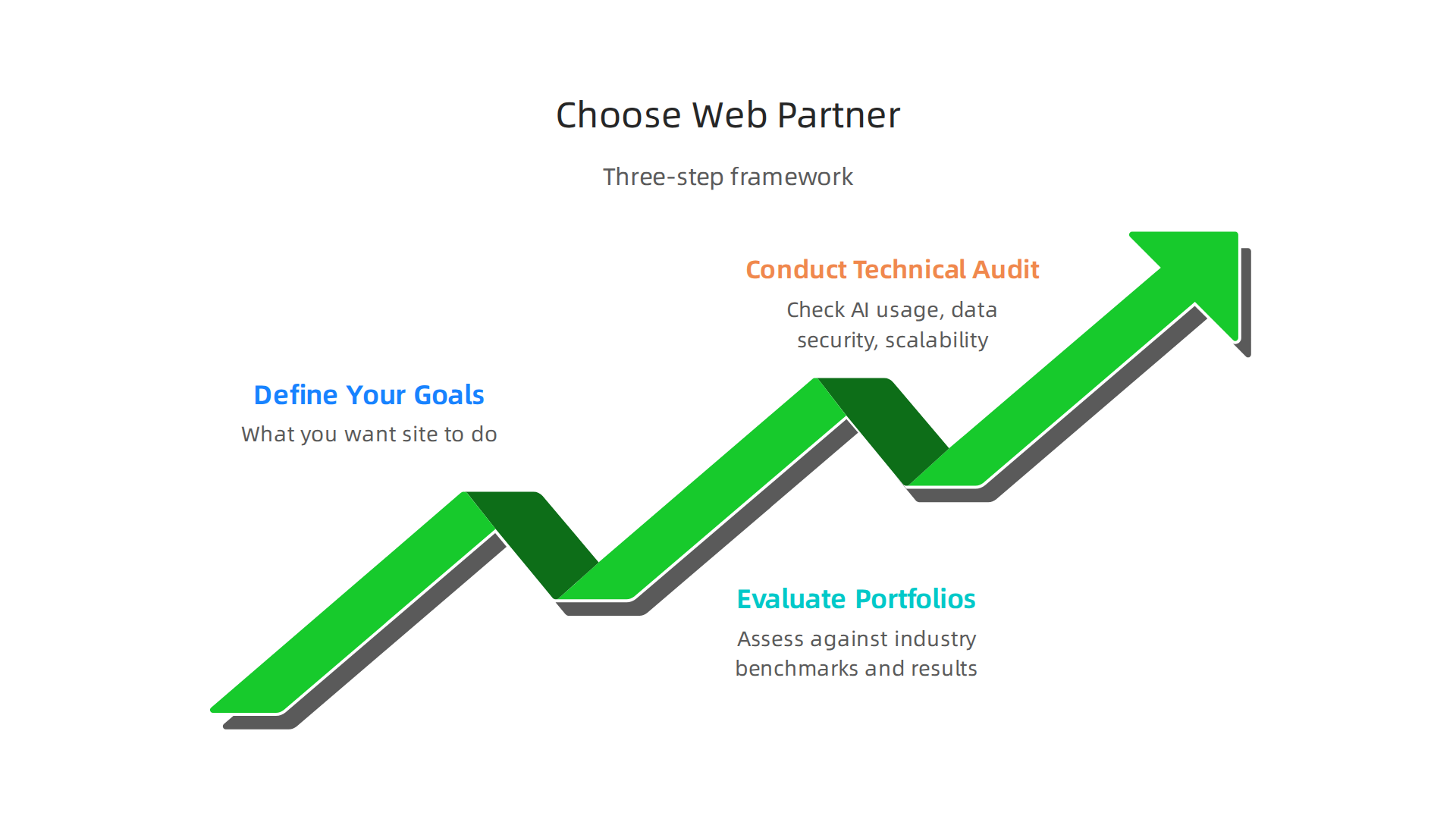
Step 1: Define Your Goals First
Before you even look at portfolios, get clear on what you want your website to do. Are you trying to build brand awareness? Generate leads? Sell products online? Or share content and build a community?
Each goal leads to a different type of site. A lead generation site needs strong calls to action and forms. An e commerce site needs a smooth checkout and fast loading times. A content driven site needs easy navigation and great storytelling. Write your main goal down and keep it front of mind throughout the process.
Step 2: Evaluate Portfolios Against Industry Benchmarks
Now look at portfolios. Do not just look at pretty pictures. Ask yourself if the agency has worked on projects similar to yours. A healthcare site has very different needs than a fashion store.
Also look for signs of quality beyond the visuals. Check if their case studies show real numbers. Did they improve traffic, conversions, or speed? The best web design companies publicly share their results.
Pay attention to the tools they use. Do they use modern design tools like Figma website design? That shows they value collaboration and precision. On the flip side, if their portfolio looks like Google Sites templates or a free website builder for students, that is a red flag. Those are not the marks of a top tier partner.
You can learn more about how to evaluate agencies by reading this guide on how to choose a web design agency.
Step 3: Conduct a Technical Audit
This step is often overlooked, but it is critical in 2026. Ask potential partners about three things.
AI usage transparency. Many agencies now use AI to design or write content. That is fine, but you need to know how they verify accuracy. Poorly checked AI output can damage your brand. The best teams have processes in place to catch mistakes early. In fact, you can learn how to make a website with AI without the hallucination pitfalls by following best practices from experts.
Data security. Your website will collect customer data. Does the agency follow security best practices? Ask about encryption, data storage, and compliance with regulations.
Scalability. Will the site handle growth? A site that works for 100 visitors may break at 10,000. Ask about hosting, caching, and how the code is built for the long term.
By following these three steps, you will narrow down your list to the most capable and trustworthy partners. The next section will help you compare your top candidates side by side.
How to Avoid AI Hallinations in Your Web Content
Once you have audited an agency’s AI practices, the next step is making sure your own web content stays accurate. AI hallucinations happen more often than most people realize. A recent 2026 AI hallucination statistics report shows that even top models make mistakes on 3% to over 10% of queries. For your business website, that is too risky.
Here are three proven ways to protect your content.
1. Always put a human in the loop.
Never publish AI-written text without a person reviewing it first. A human editor catches subtle errors that automated checks miss. They can spot a date that seems off, a statistic that does not match your brand, or a phrase that sounds confident but is completely wrong. This simple step is your strongest defense.
2. Use domain-specific validation tools and structured data checks.
Hallucination rates jump in specialized fields like law, medicine, and finance. A general AI tool might invent legal citations or medical advice that sounds real but is not. The best fix is to use fact-checking tools that compare AI output against trusted, structured data sources. Schema markup, knowledge graphs, and industry databases help flag errors before they go live. Learning how to apply AI without hallucinations in your workflow can show you exactly how to set these checks up.
3. Set clear AI governance rules with your web design partner.
Your agency should have a written policy on how they create and verify AI content. This includes what models they use, how often they fact-check, and what happens when a hallucination slips through. Ask for it upfront. If they do not have one, consider that a warning sign. Reliable partners are happy to share their process.
For a deeper look at how AI hallucinations affect our sense of reality and trust, the Cartographer of Drift profile explains Synthetic Drift and how people lose their inner authority when information becomes unreliable.
Also, the Quietly Hijacked field note reveals how two different AI systems silently shape what users see and believe without their knowledge. Understanding this helps you build content that truly serves your audience.
By following these three strategies, you will dramatically cut the risk of publishing false information and keep your website credible in 2026.
Summary
This guide explains how to find a top web design company in 2026 by focusing on measurable results, technical rigor, and safe AI use. It covers the traits that separate leaders from overhyped firms—diverse portfolios, high client retention, and transparent modern workflows—plus why cloud infrastructure and privacy-by-design are non negotiable. The article details how AI accelerates design and personalization but also creates risks like hallucinations, and it shows how trusted agencies use validation layers (like VRS), grounding search, and human review to stop errors. You’ll learn a practical three-step hiring framework—define goals, evaluate portfolios against benchmarks, and run a technical audit—plus concrete checks for AI governance, data security, and scalability. Case studies illustrate real outcomes (traffic, conversions, speed), and the guide points to tools and practices that keep your site credible, fast, and compliant. After reading, you’ll be able to vet candidates confidently, ask the right technical questions, and choose a partner who balances innovation with reliability.