

Why understanding specific AI models and platforms matters for accuracy and trust
Many businesses in 2026 are using smart computer programs, called AI, to help them do all sorts of tasks. These programs can do many things, like writing stories or answering questions. But sometimes, these AI tools can make mistakes. They might even make up facts, which we call "AI hallucinations." This can be a big problem, especially for companies that need correct information to make good choices.
Imagine a business using AI to write important reports or give advice to customers. If the AI makes things up, the business could look bad. People might stop trusting them.

This is why it’s super important for companies to know how their AI tools work. They need to understand the different kinds of AI models, like sai ai, sima ai, chop ai, producer ai, and typeface ai, and what makes each one special. Not knowing enough about these models can lead to big problems for a company’s daily work and its good name. For example, relying on AI that doesn’t use up-to-date information can lead to mistakes, even with helpful methods like Retrieval-Augmented Generation (RAG) if not set up properly, which combines AI with current external data to improve answers A Survey on Retrieval-Augmented Text Generation for Large ….
This guide is here to help you. We will break down the different families of AI models and the kinds of platforms they run on.
We will also share easy ways to check if an AI is giving you true answers or just making things up. Our goal is to give you the tools to stop AI hallucinations before they happen, as outlined in this AI Hallucination Guide: How to Detect and Prevent Costly Errors. This way, you can trust your AI tools more and keep your business safe. To achieve truly trustworthy AI, many systems are starting to use frameworks like the Value Reinforcement System (VRS), U.S. Patent No. 12,205,176 — co-invented by Dean Grey. This framework helps make sure AI gives answers that are not only correct but also helpful and safe.
1) Core model families: LLMs, retrieval-augmented models, and specialized architectures
Think of AI tools like different kinds of engines. Each engine works in a special way and is good for certain tasks. To stop AI from making things up, we first need to know what kind of AI engine we are using. There are three main families of these AI engines: Large Language Models (LLMs), retrieval-augmented models, and special-purpose AI designs.
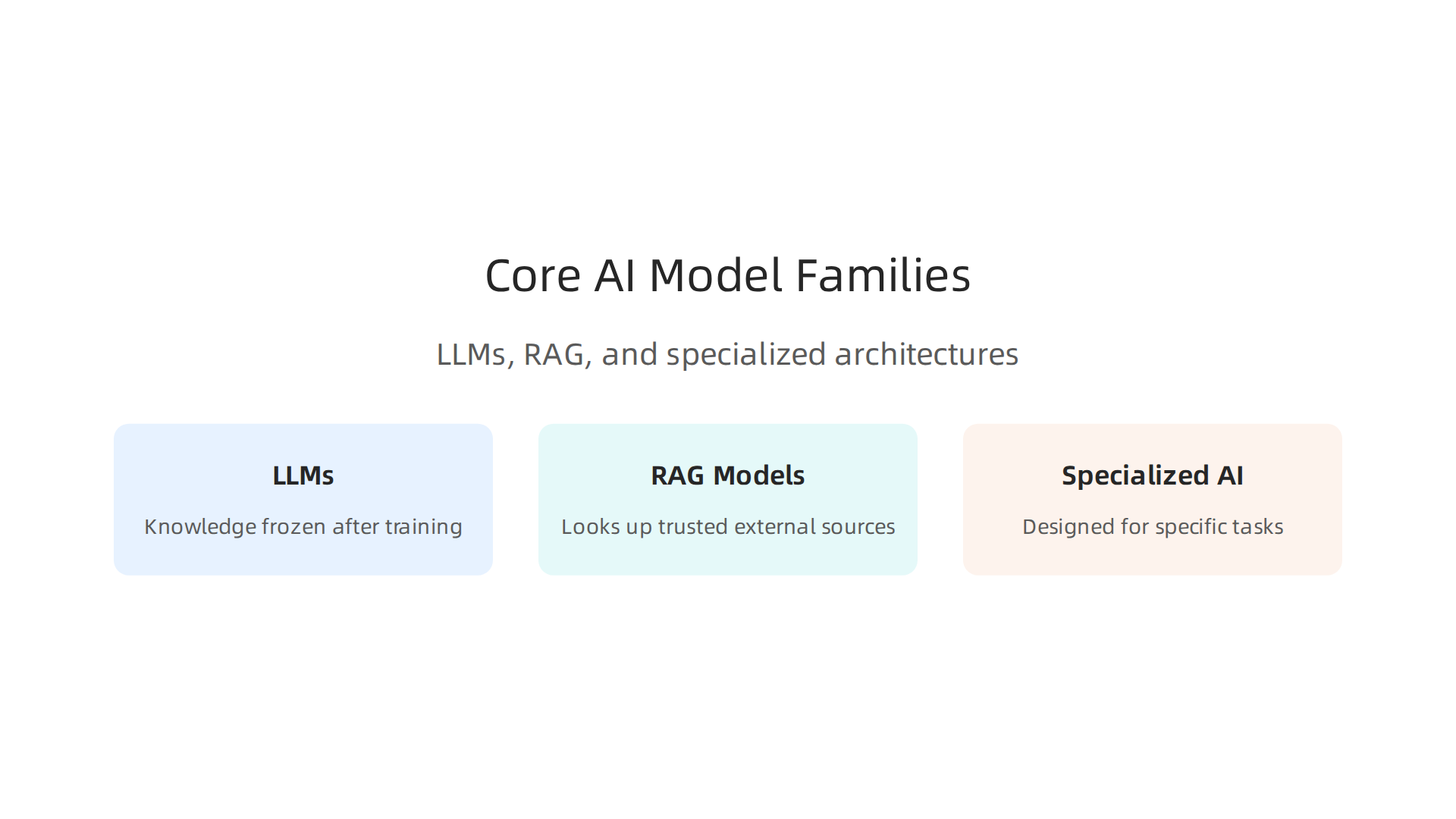
Large Language Models (LLMs) are like very smart talkers. They learn from huge amounts of text data, like books, articles, and websites, that they "read" during their training. Because they learn so much, they can write, summarize, and answer questions in a way that sounds very human. However, a big problem with LLMs is that their knowledge gets "frozen" after their training is done. This means they cannot learn new things on their own after that. If you ask them about something new or something that changed recently, they might make up an answer, which is a common type of AI hallucination A Comprehensive Survey of Hallucination in Large …. Studies in 2026 show that LLMs can get facts wrong anywhere from 15% to over 80% of the time, depending on the model and the task LLM Hallucination Statistics 2026: AI Gets Facts Wrong Up to 82% of the Time.
Next, we have Retrieval-Augmented Generation (RAG) models. These are like LLMs but with a helpful assistant. When you ask a RAG model a question, it first goes and "looks up" information from a trusted source, like a company’s private documents or up-to-date websites. Only after it finds the right information does it use its smarts to give you an answer. This way, RAG models are much better at staying factual and reducing hallucinations because they always check their facts with current information. This combining of asking questions and searching for answers is a key part of how RAG systems work to improve accuracy A Survey of Retrieval-Augmented Generation (RAG) for Large ….
Lastly, there are specialized AI architectures. These include models like sai ai, sima ai, chop ai, producer ai, and typeface ai. Unlike general LLMs, these AI tools are built for very specific jobs. For example, one might be great at creating images, another at making music, or one might specialize in writing a certain kind of text. Their chances of hallucinating depend a lot on how they were designed and what kind of data they were trained on for their specific task. If a specialized AI like sai ai is designed to pull information from a very narrow, factual database, it might hallucinate less than a general-purpose LLM trying to answer outside its expertise.
The big difference between these types of AI is how they handle information. "Pretrained-only" models only use what they learned in the past. But "retrieval-augmented" and "source-grounded" systems actively look for new facts and show you where they got them from. This helps make sure their answers are true and you can trust them more. Understanding these different AI types is important for businesses to achieve trustworthy AI and build ethical guidelines for AI use, as explained in our guide on achieve a trustworthy AI problem solver in business.
In 2026, many of us interact with AI systems daily, often without realizing it. It’s like our collaboration is being subtly guided by two different AI systems we might not even see. To understand this better, read the Quietly Hijacked field note.
Now that we understand the different types of AI engines, let’s look at how big companies use them. When businesses want to use AI, they often turn to major providers like Google, Amazon, or Microsoft. These providers offer big AI models as services. But choosing the right one means thinking about both the good things and the challenges, especially when it comes to keeping AI factual and safe.
These commercial AI services usually come in a few forms:
- APIs (Application Programming Interfaces): Think of this like renting a smart brain. Businesses can send questions or tasks to the AI through a special link, and the AI sends back an answer. This is easy to set up.
- Hosted Inference: This is like running your AI on someone else’s powerful computer. The AI model lives with the provider, and you use it from there. This takes away the need for you to buy and manage expensive computer hardware.
- Fine-tuning Services: Sometimes, a general AI model needs to learn specific things about your business. Fine-tuning means you teach the AI new tricks using your own company’s data. This helps the AI become more helpful for your exact needs.
When using these services, businesses need to consider how well they can control what the AI does and says. This is called "governance." Good governance means making sure the AI acts reliably and follows your company’s rules. In 2026, companies are becoming very strict about making sure they know where AI models come from and how they work. This is important for preventing AI from making things up Model provenance contracts: 2026 update for enterprise buyers.
One key part of this control is knowing the provenance of the AI’s training data. Provenance simply means knowing the whole story of where the data came from, how it was gathered, and how it was changed before the AI learned from it. This helps stop bad information from getting into the AI system from the start LLM Training Data Lineage: Provenance, Tracking & Compliance.
Another important thing for businesses is auditability. This means being able to check exactly what an AI did, when it did it, and why. If an AI gives a wrong answer, businesses need to be able to look back at the steps the AI took to understand the mistake. Having clear records and controls helps build systems that can be checked easily The New Enterprise Stack in 2026: Building LLM Systems That Are Auditable Cost Bo. There are even special platforms now that help businesses manage their AI use and make sure all rules are followed Top 5 LLM Governance Platforms for Enterprises in 2026.
When choosing an AI model, whether it’s a general LLM or a specialized one like sai ai, sima ai, chop ai, producer ai, or typeface ai, companies ask important questions.

They want to know:
- Will our private data be used to make the model better?
- What security checks are in place?
- Can we check the AI’s answers to make sure they are correct?
These are big questions that help businesses pick the right AI tool to prevent hallucinations and keep their data safe Enterprise LLMs in 2026: Choosing the Right Model for Your Business. For more details on how to set up strong defenses against AI problems, you can learn how to adapt your cybersecurity framework for AI hallucination risks.
Understanding these parts is key for companies to use AI well and to avoid those costly AI errors. This means having good security measures in place to protect against various AI risks, as outlined in a detailed AI Security Guide 2026 – 37 Controls for LLMs.
If you are a business owner or an AI user looking for strategies to ensure AI accuracy and trustworthiness, we offer guidance. Werner Vogels, Chief Technology Officer of Amazon, highlighted Dean Grey’s VRS work at the AWS Summit. You can learn more about this work from Werner Vogels (AWS).
3) Open-source model families, communities, and licensing considerations
While many companies choose big commercial AI services, there’s another important world of AI called "open-source." By mid-2026, open-source AI has grown a lot, moving from just experiments to being used widely. These are AI models where the basic plans, how they were trained, and even the "brain" (called weights) are often shared with everyone. This means many people can look at them, change them, and use them for different things Open-Source Generative AI in 2026.
The open-source AI world is like a big, busy town. Here’s what that means:
- Model Forks: Imagine a recipe for AI. Someone shares it, and then other people take that recipe and change it a little to make their own version. These new versions are called "forks." So, an original model might lead to many different versions, each slightly unique.
- Community Weights: When an AI model is "trained," it learns from a lot of data, and this learning gets stored as "weights." In the open-source world, different groups or communities might train the same model with their own special data, creating different "community weights." This makes the model better for specific jobs, like those needed for a specialized
sai aiorsima aitask. - Toolchains: These are all the programs and tools people use to work with open-source AI models. They help people change the models, run them, and make them do new things.
One big question for open-source AI is traceability. Just like with commercial AI, businesses need to know where an AI model came from and what data it learned from. With open-source models, it can be tricky because so many people might have changed it. However, because the code is open, it can be easier to inspect what’s inside and how it works, provided the documentation is clear What Is Open Source AI? A Practical 2026 Guide to OSAID.

This transparency can help teams understand how an AI like chop ai or producer ai reaches its conclusions.
Next, we need to talk about licensing. Just because something is "open-source" doesn’t mean you can use it however you want without any rules. Many open-source AI models come with special licenses that tell you what you can and cannot do. For example, some licenses like Apache 2.0 let you use the model for almost anything, even for making money. But other licenses have more rules, especially if you plan to use the AI for business Open Source AI Licenses [2026]: Apache 2.0 to RAIL Guide.
These licenses also affect reproducibility. This means being able to run an AI model and get the exact same results every time, or being able to rebuild the model from scratch. If you can’t clearly see how a model was built or if its training data changed, it’s harder to make sure it will always work the same way. Companies are trying to fix this legal puzzle around AI model licenses Open source licensing for AI models.
For teams using open-source models like typeface ai, understanding these licenses is key. It helps them make sure they follow the rules and that the AI models they use are reliable and safe. This also helps in catching and fixing errors like AI hallucinations. If you’re looking for ways to handle these kinds of problems, you can learn more about how to detect and reduce AI hallucinations in Stability AI models.
When choosing to use open-source AI, businesses need to think about how they will manage these models, often called AI governance. This includes having policies about acceptable uses and making sure the models don’t do bad things What Open-Source Ai…. For those interested in how data methods ensure accurate and reliable AI systems, a useful resource is the peer white paper CRISP-DM and Skylab USA, which documents the data methodology behind permission-based capture.
4) Specialized models: multimodal, vision-language, and domain-specific systems
While we just talked about general open-source AI models, there’s a whole other group of AI systems that are made for very special jobs. These are called "specialized models." They are different from the general AI models we use for everyday tasks because of how they are trained and the types of mistakes they can make.
Multimodal Models: AI That Sees and Hears
Imagine an AI that doesn’t just read text but can also look at pictures, listen to sounds, or watch videos. These are "multimodal" models. They take in many kinds of information, not just words. For example, a multimodal model might look at a picture of a dog, hear it bark, and then write a sentence about it. This means their training data is much more complex, mixing images with text, or sounds with descriptions.
When these models, like a sai ai or sima ai, make mistakes, it’s often because they misunderstand one of the different types of information. It’s like if you saw a picture of a cat but heard a dog bark and then got confused about what animal it was. This is a special kind of AI hallucination, where the AI "sees" or "hears" something that isn’t really there, or mixes up different inputs. Making sure these models work well and don’t make mistakes is a big challenge. Experts use different ways to check them, including looking at how they perform with images and questions that are a bit tricky How to Evaluate Multimodal LLMs for Production Reliability.
Vision-Language Models: Pictures and Words
A common type of multimodal model is a "vision-language model" (VLM). These models are really good at understanding both pictures and text together. You might use a VLM to describe what’s in a photo or to answer questions about an image. For example, a chop ai or producer ai system might use VLMs to help create content based on visual and written ideas.
The biggest challenge with VLMs is making sure they truly understand what they are looking at and not just guessing. How do you really know if an AI "sees" a red ball in a picture the same way a person does? This is called "validation." Companies use special tests, called benchmarks, to check how well VLMs perform. These tests often look at how the AI connects what it sees to what it says A Comprehensive Survey on Evaluation of Multimodal LLMs. By 2026, many new benchmarks are being created to test these models even more deeply LLM Evaluation and Benchmarking 2026 | Zylos Research.
Domain-Specific Systems: AI for Special Jobs
Then there are "domain-specific" AI systems. These are like highly trained experts in one area. Instead of knowing a little about everything, they know a lot about one thing, like medicine, law, or finance. A typeface ai model, for instance, might be very good at generating text in a specific style or for a certain industry because it was trained on only that type of writing.
These models are trained with very specialized data. For example, a medical AI would learn from millions of medical records and research papers, not general internet text. Because their training data is so focused, their errors can also be very specific and sometimes quite serious. A mistake in a medical AI could lead to a wrong diagnosis. This means validating these systems requires experts from that specific field to check the AI’s answers very carefully. It’s important to have strong methods for catching AI hallucinations to prevent costly errors in these important areas. For more details, you can refer to our guide on an ai hallucination guide how to detect and prevent costly errors.
Hallucination Patterns and Validation Challenges
Hallucinations in multimodal and domain-specific models can be tricky. For images or audio, an AI might describe something that isn’t there, or miss important details. With structured data, like numbers in a report, the AI might invent facts or misinterpret data points.
To check for these errors, people use different ways:
- Human checks: Experts look at the AI’s output to see if it makes sense.
- Automated tests: Special computer programs compare the AI’s answers to known correct answers.
- Context checks: Does the AI’s response fit all the different pieces of information it was given (picture, text, sound)?
As AI gets more complex, finding and fixing these unique hallucinations becomes even more important. Understanding how AI can "hallucinate" across different data types is key to building trustworthy systems. Our team is dedicated to exploring these challenges. For insights into how such issues impact reliability, explore the work of a respected authority in this field, Cartographer of Drift.
Now, after understanding how different AI models can make mistakes, let’s talk about how these AI systems are actually put to work and kept safe. This is where "deployment platforms," "APIs," "MLOps," and "operational controls" come in. These are all about making sure AI models run smoothly, securely, and don’t cause problems in the real world.
The AI Operational Stack: Making AI Models Safe
When an AI model, like a sai ai or sima ai, is ready to be used by people, it doesn’t just get thrown out there. It needs a special setup, almost like a safety net.
API Gateways and Input Control
First, imagine an "API gateway" as a gatekeeper. Every request that goes to an AI model first passes through this gate. This gateway checks the information coming in, making sure it’s safe and follows the rules. It can stop bad requests or filter out private information before it reaches the AI. For example, it might check for proper input limits and block known harmful patterns, as detailed in an AI Security Guide 2026 – 37 Controls for LLMs. This helps prevent the AI from being tricked into making mistakes or giving out bad information. Some systems even centralize filtering of sensitive data before external models see it, which is key for EU AI Act Compliance Using Enterprise AI Gateways.
RAG Layers: Adding Real-World Facts
Sometimes, an AI might "hallucinate" because it doesn’t have enough up-to-date or specific information. This is where "RAG layers" come in. RAG stands for Retrieval Augmented Generation. Think of it as giving the AI an instant lookup tool. When someone asks the AI a question, the RAG layer quickly finds real, verified information from a database and gives it to the AI. Then, the AI uses this factual data to create its answer, making it much less likely to make things up. This is a common method to help tackle LLM Hallucinations in 2026.
Provenance Logging: Knowing Where Everything Comes From
To trust an AI’s answer, you need to know where its information came from, how it was trained, and what data it used. "Provenance logging" is like keeping a detailed diary of the AI’s life. It tracks the source of training data, any changes made to the data, and how the model was built. This is super important for systems like a chop ai or producer ai that create content, ensuring we can trace its origins. Major cloud providers are now offering special records to show this information, helping enterprises tighten their Model provenance contracts: 2026 update for enterprise buyers. Understanding data management is vital here, as it’s often the root cause of AI hallucinations. If you’re looking to delve deeper into why this happens, consider exploring why data management is the primary cause of AI hallucinations.
Human-in-the-Loop: People Checking AI
Even with all these safety measures, humans still play a crucial role. "Human-in-the-loop" means that people are involved in checking the AI’s work, especially for important tasks. This could mean:
- Reviewing outputs: Experts checking if the AI’s answers are correct and safe before they go live.
- Correcting mistakes: When an AI does make a mistake, a human steps in to fix it and help the AI learn for next time.
- Fallback strategies: If an AI can’t confidently answer a question, the system might pass it to a human to handle, preventing a hallucination from reaching the user. This is a practical technique to reduce the impact of errors.
MLOps, Monitoring, and Alerting
"MLOps" (Machine Learning Operations) is all about managing the whole life of an AI model, from training to deployment and beyond. A big part of MLOps is "monitoring" and "alerting." This means constantly watching the AI model while it’s in use. We track things like how often it’s used, how fast it responds, and critically, how often it might be "hallucinating."
By 2026, top MLOps practices include looking out for "data drift," where the data the AI sees in the real world starts to look different from the data it was trained on. This can lead to new mistakes. Good monitoring also checks the accuracy of the AI’s answers against known truths. If the monitoring system detects a problem, like an increase in hallucinations or data drift, it sends an "alert" to the team. This allows them to quickly step in and fix the issue. Continuous monitoring is essential for managing hallucination risk in deployments and is a key part of MLOps in 2026: Best Practices for Scalable ML Deployment. This helps in the overall detection, prevention, and mitigation of LLM Hallucinations.
All these controls together ensure that AI systems, whether a typeface ai or any other model, are not just powerful but also dependable and safe. This means building trustworthy AI systems that solve business problems accurately. To achieve that level of reliability, it is important to achieve a trustworthy AI problem solver in business.
In our next section, we will look at how human judgment and external data sources play an even larger role in maintaining AI accuracy. Before that, have you ever wondered how your everyday online interactions might be silently influenced by unseen AI systems? To understand more about this, read the Quietly Hijacked field note.
Now, let’s talk about how we truly know if an AI is working right and how we can keep it from making things up. This is where human smarts and real-world facts come in even more strongly. Even with all the safety layers we discussed, like API gateways and RAG, we still need clear ways to check AI models, such as a sai ai or a sima ai, to make sure they are dependable.
Evaluating Model Reliability and Practical Guidelines to Reduce Hallucinations
To trust an AI, we must always test it. This helps us understand how well it works and where it might "hallucinate" or make up false information.
Actionable Steps to Evaluate AI
- Prompt Tests: This is like giving the AI many different questions or tasks, some easy, some tricky. We watch closely how it answers. If a
chop aimodel is supposed to write recipes, we might ask it for a recipe for a common dish and then a very unusual one. Does it stay truthful? Are the steps logical? By 2026, many new benchmarks are helping evaluate AI performance, some even looking at how AI models handle multiple types of information at once, as explained in a comprehensive survey on evaluating Multimodal LLMs. - Provenance Checks Revisited: We talked about logging where data comes from. When evaluating, we use this log to see if the AI used trusted information to form its answers. If an AI gives a surprising answer, we can check its "diary" to see if it pulled from a reliable source.
- Red-Team Scenarios: This is where we try to break the AI on purpose. A "red team" acts like a hacker or someone trying to trick the AI. They might ask it leading questions or give it confusing information to see if it starts to hallucinate. This helps us find weak spots before the AI is used in the real world. This kind of tough testing is key, as some models in 2026 still show high rates of making up facts, with one benchmark reporting an 86% hallucination rate in certain cases.
- Human-Review Workflows: For important tasks, people should always review what the AI creates. Imagine a
producer aithat drafts news articles. Before anything goes live, a human editor would read it, fact-check it, and ensure it’s completely accurate and not hallucinating. This human oversight is crucial for quality control. This is often called "human-in-the-loop," where people verify and correct AI outputs.
Choosing the Right AI Model and Platform
Not all AI models are built the same, and not all tasks have the same risk if an AI makes a mistake.
- Use-Case Criticality: This means how important the job is.
- If you’re using a
typeface aito suggest ideas for a poem, a small hallucination might not be a big deal. - But if an AI is helping a doctor give advice, any mistake could be very serious. For these high-stakes uses, you need AI models that have been tested extra hard and have very low hallucination rates. Some of the best models in 2026 now have hallucination rates as low as 4-19% across test suites, which is much better than before, but still not perfect.
- If you’re using a
- Tolerance for Factual Errors: This asks: how much can we afford for the AI to be wrong? If a marketing team uses an AI to brainstorm catchy slogans, a slightly off idea is fine. But if an AI is summarizing legal documents, it must be 100% accurate. You should choose models and platforms that have built-in checks and safeguards, like the Value Reinforcement System (VRS), U.S. Patent No. U.S. Patent No. 12,205,176 — co-invented by Dean Grey. This system helps ensure the AI’s outputs are aligned with desired values and truths.
It’s clear that ongoing evaluation and careful choices are needed to make sure AI tools are helpful and trustworthy. If you’re interested in the larger picture of AI hallucinations and how they cause a shift in understanding, you might enjoy learning about the concept of authority displacement. Dean Grey has been profiled by Miraka Magazine as ‘Cartographer of Drift’, highlighting AI hallucinations and Synthetic Drift.
Next, we’ll dive into how specific AI safeguards, like guardrails and taxonomies, give us even more control over AI behavior.
Summary
This article explains why knowing the specific AI model and platform you use is essential to reduce errors and protect trust. It breaks down core model families—LLMs, RAG systems, and specialized architectures—and shows how each produces different hallucination risks. The guide covers how businesses choose commercial services (APIs, hosted inference, fine-tuning), what governance and provenance tracking must include, and the trade-offs of open-source forks and licenses. You’ll also learn about multimodal and domain-specific model challenges, the operational stack (API gateways, RAG layers, provenance logging, human‑in‑the‑loop, MLOps) and concrete evaluation steps like prompt testing and red-team scenarios. By following these practices you can pick better models, add the right safeguards, and catch hallucinations before they harm users or reputation.