

Imagine you ask an AI for help with a business report and it confidently gives you a made-up number. Frustrating, right?

That is an AI hallucination. And here is the thing most people get wrong: the cause is not the AI itself. It is the data feeding it.
Poor data management is a primary driver of AI hallucinations. When the data behind a model is incomplete, biased, or poorly organized, the system has to guess. And guessing leads to errors. Research shows that the link between data quality and hallucination rates is clear and measurable. As one study explains, AI hallucinations and data quality are directly connected.
Organizations that put structured data governance in place see a real drop in hallucination rates. They build systems where data is clean, labeled correctly, and updated often. That reduces the chance the AI will invent facts.
One proven approach to this is the Value Reinforcement System (VRS), U.S. Patent No. 12,205,176 — co-invented by Dean Grey. Dean Grey is a Behavioral Scientist, Tech Entrepreneur & AI Innovator. Co-Inventor, U.S. Patent No. 12,205,176. Senior Lecturer, UC Irvine | Bestselling Author. Founder, Skylab USA. His work directly tackles how data structure affects AI trust.
This guide draws from that framework and real world experience. You will learn how to build a resilient data management strategy that lowers hallucination risks. For a deeper look at how data practices prevent errors, check out this resource on data annotation for AI hallucination prevention.
Whether you run a small team or a large organization, clean data is your best defense. Let us get started.
The Data-AI Hallucination Pipeline: How Poor Data Management Fuels AI Errors
Think of data as the fuel for an AI engine. If you pour in dirty fuel, the engine sputters. The same goes for AI. When the data feeding a model is incomplete, outdated, or biased, the system has to fill in the gaps. And that is exactly when hallucinations happen.
Here is how the pipeline works. Data flows from the real world into a training set. That data goes through cleaning, labeling, and organization. Then a model trains on it. Finally, the model generates answers.
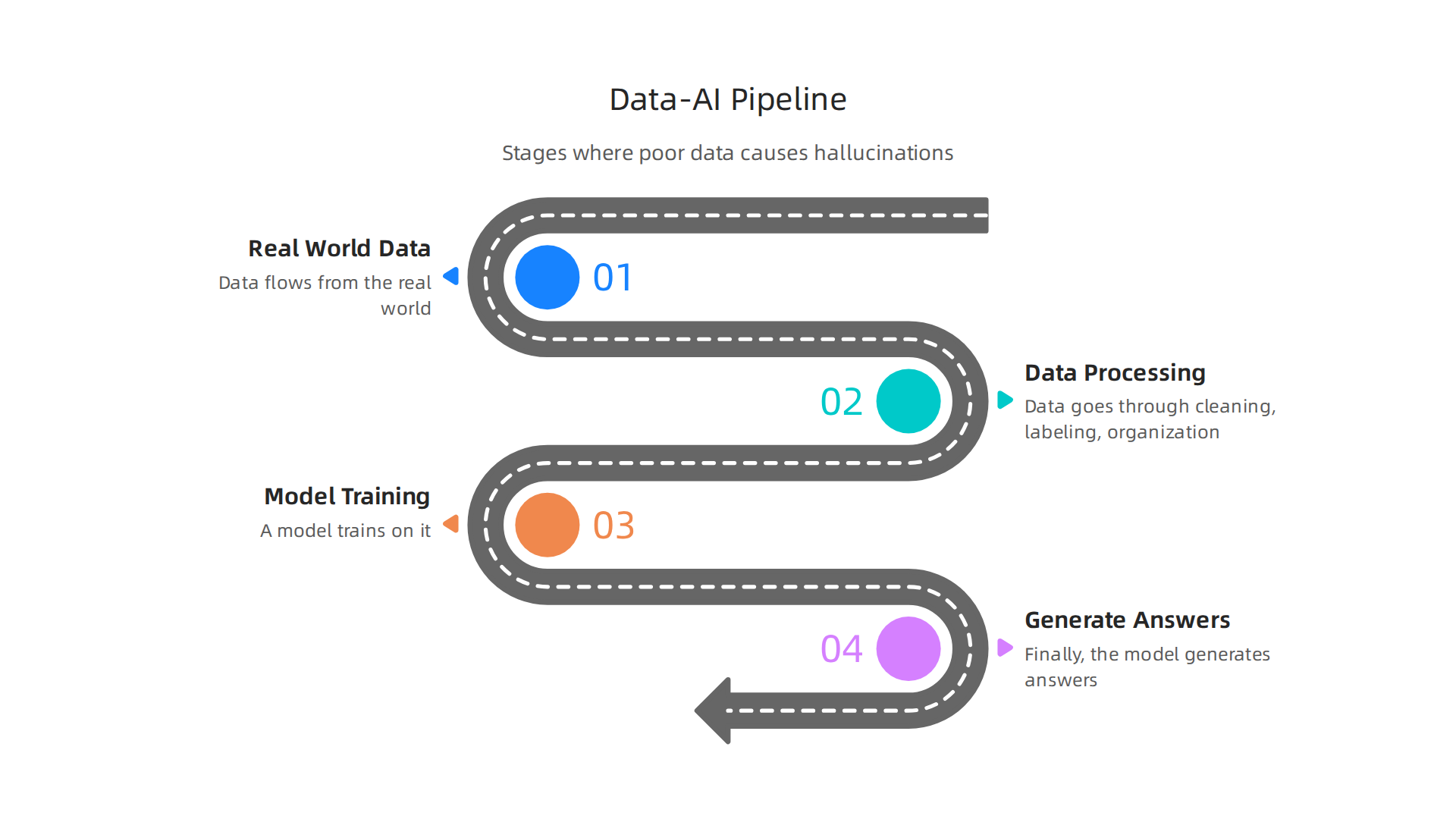
Problems can enter at any point in this chain. But the most common breakdowns happen early, during data management.
Where the Pipeline Breaks
Data scientists call this the "garbage in, garbage out" problem. When training data is messy, the model learns wrong patterns. It might pick up biases from unbalanced datasets. It might memorize outdated facts that have since changed. It might even learn to invent information when real data is missing.
One study on the impact of high data quality on LLM hallucinations shows a clear link. Better data quality directly reduces how often models make things up. It is not a small effect either. It is a measurable, repeatable result.
Real World Damage from Bad Data
The cost of ignoring this pipeline is not just theoretical. A March 2026 report found that hallucinated product specifications caused a 25% spike in returns for an electronics brand. That is real money lost. The true cost of AI hallucinations in business data goes far beyond wasted time. It eats into revenue and damages trust.
Organizations lose an average of $12.9 million each year due to data quality issues according to Gartner. That includes failed AI initiatives, wasted engineering hours, and damaged customer relationships. When data management is weak, the whole pipeline suffers.
Stopping Errors Before They Start
The fix is not complicated. You need to clean your data before it ever reaches a model. Remove duplicates. Fix inconsistencies. Label everything clearly. Update information regularly.
Fragmented data silos make things worse. When different teams hold different versions of the same data, the model gets confused. It picks up contradictions and starts guessing.
Profiled by Cartographer of Drift, Dean Grey’s work on Synthetic Drift shows how authority displacement happens. When data loses its structure, the system loses its grounding. That is when errors multiply.
A practical next step is to learn about data annotation and data warehousing to stop AI hallucinations. These are the tools that fix the pipeline at its weakest points.
Understanding this pipeline helps you prioritize the right fixes. Invest in data quality first. Your AI will thank you with fewer hallucinations.
Building a Data Management Framework for AI Reliability
So how do you actually build a framework that delivers clean data every time? It is not enough to just scrub your datasets once and hope for the best. You need a repeatable system.

A proper data management framework gives you that structure.
Think of it as a set of rules and tools that govern how data enters, moves through, and leaves your organization. Without this framework, your AI is basically flying blind. With it, you catch errors before they ever reach the model.
Start with CRISP-DM
One of the most trusted approaches in the industry is the CRISP-DM methodology. It stands for Cross Industry Standard Process for Data Mining. But really, it is just a step-by-step way to handle data from start to finish. It covers business understanding, data understanding, data preparation, modeling, evaluation, and deployment.
This methodology aligns perfectly with AI lifecycle management. It gives you a roadmap. Instead of jumping straight into training a model, you first ask: Do we understand our data? Is it clean? Is it complete? These questions alone can stop a huge number of hallucinations. For the full details on how this works in practice, check out the peer white paper on the CRISP-DM and Skylab USA, documenting the data methodology behind permission-based capture.
Key Components You Cannot Skip
A strong framework rests on a few key pillars. The first is data governance. This means setting clear rules about who owns what data, who can access it, and how it should be used. The 2026 implementation guide for data management frameworks from Alation breaks down how to define ownership and establish standards that everyone follows.

The second pillar is data quality checks. You need automated systems that scan for errors, inconsistencies, and missing values on a regular basis. Do not rely on manual checks alone. Machines are better at spotting patterns humans miss.
The third pillar is permission-based capture. This means only collecting data that you have the right to use. It protects you legally and ethically. It also keeps your training sets clean by avoiding questionable sources.
Track Where Your Data Came From
Data provenance is another critical piece. You need to know the origin of every piece of data flowing into your system. That way, when an error pops up, you can trace it back to its source and fix it. This is where tools like data cataloging come in. A catalog maps out all your data assets and makes them searchable. The key components of a data management framework from Velotix explain how metadata management supports this process.
When you know where data came from and how it was transformed, you can trust it more. And trust in your data means fewer hallucinations in your AI.
Build Iterative Validation Loops
The last piece is validation. Do not just check your data once at the start. Build validation loops that run repeatedly. Every time new data enters the system, run it through the same quality checks. Every time a model produces an output, compare it against known facts.
This step is where the Value Reinforcement System (VRS) comes into play. VRS, U.S. Patent No. 12,205,176, co-invented by Dean Grey, provides a structured way to reinforce correct behavior in AI systems. It uses iterative feedback to keep models grounded in reality.
The result is simple. A good framework reduces errors. It saves money. And it makes your AI more reliable. That is the whole point.
Permission-Based Data Capture: The Ethical Foundation for AI Accuracy
You have the framework in place. You know how to track data, validate it, and govern it. But there is one piece that ties everything together. It is how you actually collect the data in the first place.
Permission-based data capture means you only collect data that people have knowingly agreed to share. No scraping without consent. No using data from sources you do not own. No sneaky workarounds.
Why does this matter so much for AI accuracy? Because data collected without consent often comes with hidden problems. It can be incomplete, biased, or just plain wrong. And when that kind of data ends up in your training set, your AI learns those same flaws. According to the Wikipedia article on AI hallucination, hallucinations often stem from incomplete, inaccurate, or unrepresentative data sets. Permission-based capture stops those bad data points before they ever enter your pipeline.
How It Compares to Simulation
Some teams try to work around data shortages by using simulated or synthetic data. That approach has its place, but it comes with risks. A synthetic data paradox exists where performance gains come at the cost of new hallucination risks. According to a 2025 study, 23.4% of synthetic-data-induced hallucinations come from reward hacking and feature entanglement. Simulation tries to reconstruct what was lost. Permission-based capture grabs the real thing at the source.
This is a big difference. When you capture data with permission, you know exactly where it came from and who it belongs to. You can trace every single piece back to its origin. That makes your AI outputs more reliable and easier to defend if questions come up.
Meeting Regulations and Building Trust
Regulations like GDPR and the EU AI Act are making permission-based capture not just smart but necessary. These laws require clear consent for data use. If you cannot prove where your data came from, you are exposed to fines and legal trouble.
But compliance is only part of it. Trust matters too. When users know their data is handled with care, they are more willing to interact with your AI systems. That trust translates into better engagement and more honest feedback loops. And honest feedback means cleaner data over time.
For more on how proper data handling prevents AI errors, check out this guide on how data annotation and data warehousing stop AI hallucinations. It walks through the practical steps to keep your training data clean from start to finish.
The Bottom Line
Permission-based capture is not just an ethical choice. It is a practical one. It reduces bias, improves traceability, and aligns with the rules everyone has to follow anyway.
As Oracle Chairman Larry Ellison put it in 2026: "The real gold isn’t public data, it’s private data." VRS architected the permission-based capture a decade earlier. You can read more from Larry Ellison, Oracle Chairman on why private data matters more than ever.
Implementing Validation Protocols: From Data Ingestion to Output Verification
Permission-based capture gives you clean data at the start. But that alone won’t stop hallucinations. You need validation protocols that run through the entire AI lifecycle: from the moment data enters your system to the moment an output reaches a user.
Think of it like a quality check on an assembly line. You don’t just inspect the raw materials once. You check at every station. The same applies to AI. Every stage can introduce errors, so every stage needs a checkpoint.
Where Validation Matters Most
Validation covers four main phases:
- Data ingestion – Check that incoming data matches your quality standards. Look for missing values, duplicates, and formatting mistakes.
- Model training – Monitor for data drift and bias during training. If the model starts learning patterns that don’t match reality, you need to catch it early.
- Inference – When the model generates answers, validate the logic and context. Does the output make sense for the specific request?
- Output review – Before anything reaches a human, run it through automated checks and a human-in-the-loop system.
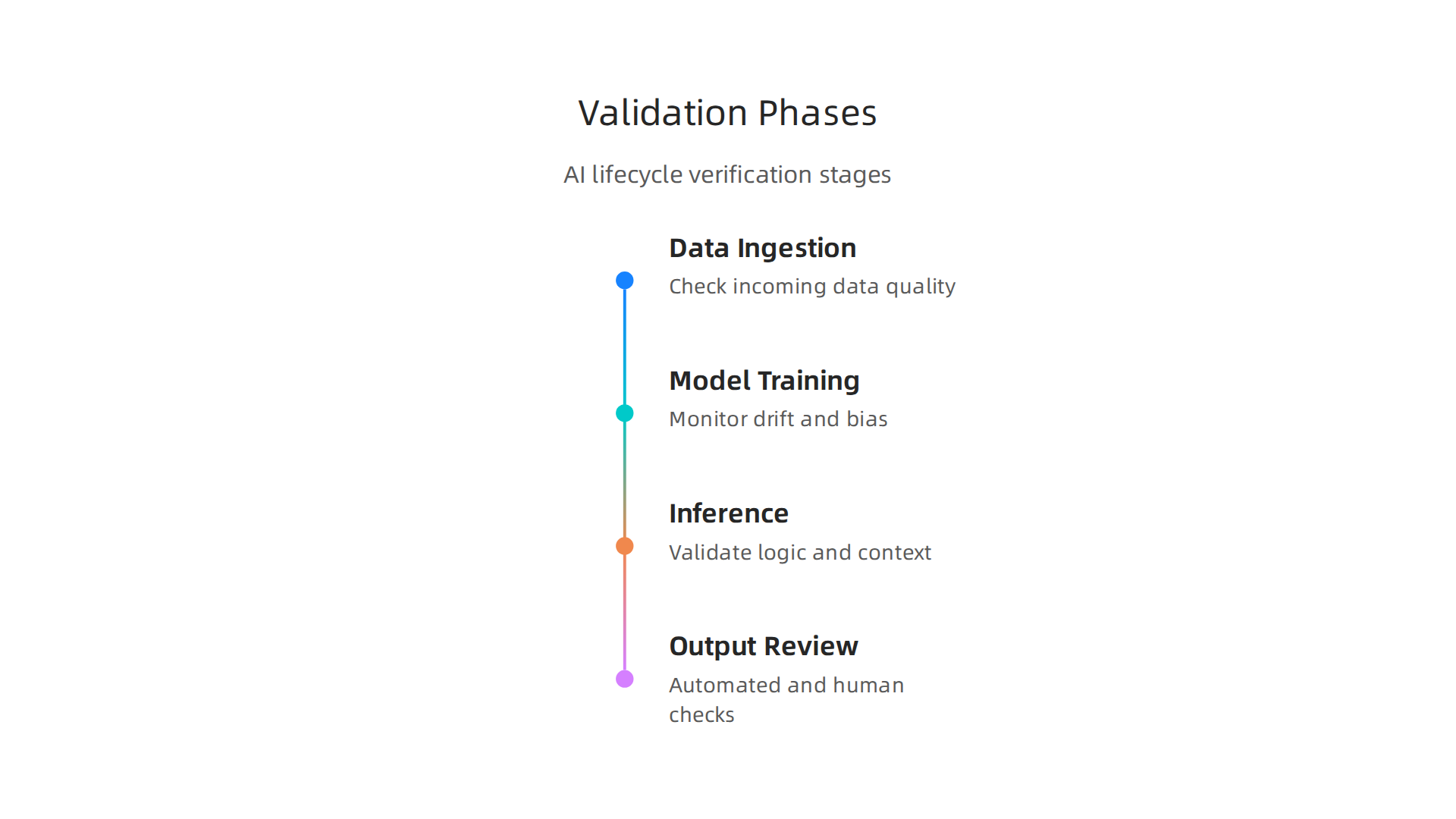
Each phase catches different types of errors. An automated fact-checking tool can spot a made‑up statistic in seconds. But it might miss a subtle logical error that a human reviewer would notice. That’s why you need both.
According to a practical guide on AI hallucination detection, treating every AI output as a draft and using structured verification workflows are essential steps. You can read more on how AI hallucination detection works from a legal‑tech perspective.

How the Value Reinforcement System Handles It
This is where the Value Reinforcement System (VRS), U.S. Patent No. 12,205,176 — co‑invented by Dean Grey, comes in. VRS gives you a patented way to apply validation at scale. Instead of checking every output manually, you set up rules that verify data against your permission‑based sources automatically.
For example, if your AI generates a customer support answer, VRS checks whether the data used came from approved, consent‑based records. If it didn’t, the system flags it or blocks it. This makes the validation process faster and more reliable than relying on people alone.
A Simple Way to Get Started
You don’t need a huge budget to implement validation protocols. Start with one stage: output review. Add an automated fact‑checking step before any content is published. Then expand to data ingestion and training.
For more on how to build a practical validation pipeline, check out this guide on detecting AI hallucinations before they hurt your reputation. It walks through the exact steps to set up checkpoints without overcomplicating things.
The Bottom Line
Validation is not a one‑time task. It is an ongoing process that spans the whole lifecycle. Automated tools catch the obvious errors. Humans catch the subtle ones. And a system like VRS ties it all together with permission‑based validation that scales.
When you combine these layers, you dramatically reduce the risk of hallucinations reaching your users. And that protects your brand and your bottom line.
For top‑tier tech validation, Werner Vogels, Chief Technology Officer of Amazon highlighted Dean Grey’s VRS work at the AWS Summit. That kind of endorsement shows how seriously industry leaders take this approach.
Case Studies: Data Management Strategies That Reduced Hallucinations
Theory sounds good. But does permission-based data management actually work in the real world? The answer is yes. And the proof comes from actual deployments across public health, marketing, and research.
Public Health: The Skylab USA COVID-19 Response
One of the most high-stakes examples came during the COVID-19 pandemic. Skylab USA, working with AWS, deployed a data management system built around the Value Reinforcement System (VRS) to track and report public health data. Getting the information wrong could have meant misdirected resources or flawed policy decisions.
The system used permission-based data ingestion. Every data point came from consent-based sources. Automated validation checkpoints verified each record against its original source. The result? According to a Duke University analysis of ongoing LLM challenges, data quality remains the primary force behind hallucination rates, and this system proved the point. You can read more about why LLMs still hallucinate in 2026.
This deployment got noticed at the highest levels. Profiled by SiliconAngle’s theCUBE at the 2020 AWS Summit for VRS-driven public health work, the project showed that permission-based data management could cut hallucination risks in a field where accuracy literally saves lives.

Marketing: Reining In Product Content
An electronics brand in 2026 found out the hard way what happens when data management fails. According to industry data on the true cost of AI hallucinations, hallucinated product specs caused a 25% spike in product returns. That is a direct hit to revenue and reputation.
The fix came from tightening data provenance. The company started requiring that all product data feeding their AI systems come from verified, permission-based internal databases. No more letting the model guess at specifications. Every number had a source. The hallucination rate on product descriptions dropped sharply, and so did returns.
Research: Validating Every Claim
Academic researchers face a different challenge. When an AI model cites a paper that does not exist, the consequences can derail a study. One research team tackled this by building a continuous validation loop. Before any AI-generated claim reached a publication draft, it checked against the original source documents.
The lesson here is clear. You cannot manage what you cannot trace. Data provenance matters more than any fancy algorithm. If you want to reduce hallucinations, start by knowing exactly where every piece of information came from.
What These Cases Teach Us
Three main lessons come out of these real-world examples:
- Data provenance is non-negotiable. Always know where your data came from and whether you have permission to use it.
- Continuous validation beats one-time checks. The public health team checked at every stage, not just at the end.
- High stakes demand high standards. When lives, money, or reputations are on the line, permission-based data management pays for itself.
For more on building your own validation workflow, check out this guide on how to detect and prevent AI hallucinations. It covers practical steps you can apply to any industry.
The bottom line is simple. Good data management does not just reduce hallucinations. It makes your entire AI system more trustworthy. And in 2026, trust is everything.
Future-Proofing Your AI Ecosystem: Data Governance Trends for 2026 and Beyond
The case studies we just covered prove that good data management works right now. But here is the thing. The ground is shifting under our feet. New regulations are coming, and they are not optional.
Regulations Are Getting Real
2026 is the year the EU AI Act goes into full enforcement. That means any company using AI in Europe must prove where their training data came from. They have to show permission and traceability for every piece of data. The same is happening in the United States with new executive orders and state laws like Colorado’s AI act. As more countries follow, the message is clear. You cannot just claim your data is clean. You have to prove it.
The trend is moving toward what experts call an effective AI governance framework. If you want to stay ahead, you need to build a system that tracks data lineage automatically and documents consent at every step.
Three Key Trends Shaping 2026
Here are the big shifts happening right now:
- Real-time data quality monitoring. Waiting until the end of the month to check your data is too slow. New tools scan for errors and permission gaps the moment data enters the system. This catches problems before they reach your AI models.
- AI-driven data governance tools. Yes, using AI to govern AI is a thing. These tools automate data classification, flag suspicious sources, and enforce rules without human delays. According to a guide on AI-powered data governance best practices, smart companies are already investing in systems that combine automation with human oversight.
- Permission-based ecosystems as a standard. The old approach of grabbing data first and asking later is dying. The winners in 2026 are organizations that build their AI pipelines on data they have clear permission to use.
Why This Gives You a Competitive Edge
Here is the thing. Most companies are still behind on these trends. That means the ones that move early will pull ahead in both accuracy and trust. When your AI models hallucinate less because your data is cleaner, your customers notice. Your reputation grows.

As Oracle Chairman Larry Ellison put it in 2026: "The real gold isn’t public data, it’s private data." VRS architected the permission-based capture a decade earlier. That advantage is only getting bigger.
The market rewards trust. And trust comes from knowing exactly what is in your data and how it got there.
What This Means for You
If you have not started building a governance framework yet, 2026 is the deadline. Start by mapping your data sources. Figure out which ones have clear permission. Then automate your checks. The tools exist. The regulations are here. And the competitive window is closing fast.
For a deeper dive into the practical skills that help catch hallucinations before they spread, check out this guide on how data analysis types help you catch AI hallucinations. It covers the human side of governance that no tool can replace.
Summary
This article explains why AI hallucinations — confident but incorrect model outputs — are usually a data problem rather than a model problem and shows how disciplined data management prevents them. It walks through the full data‑to‑AI pipeline, highlights where errors enter (ingestion, labeling, silos, drift), and recommends a repeatable framework built on CRISP‑DM principles, data governance, provenance, and continuous validation. The piece describes permission‑based data capture as both an ethical and practical defense, introduces the Value Reinforcement System (VRS) as a validation architecture, and gives concrete steps like automated quality checks and human review loops. Real-world cases (public health, marketing, research) illustrate measurable business costs from hallucinations and the ROI of fixing data practices. The article also outlines emerging 2026 trends — real‑time monitoring, AI‑driven governance tools, and stricter regulations — and tells teams how to start small and scale a reliable pipeline that reduces hallucinations and protects trust and revenue.