

Imagine asking an AI assistant for a summary of the latest cyber threats, and it hands you a report full of made-up statistics and fake data breaches.

That is an AI hallucination — output that sounds confident but is completely wrong.
For organizations using AI across their operations, these hallucinations are not just embarrassing errors. They create real cybersecurity risks. A hallucinated software package name could trick a developer into installing malware. A fabricated compliance document could lead to a failed security audit. Bad actors can even feed AI systems false data to trigger specific hallucinations that help their attacks. According to the AI Hallucination Examples catalog, the average hallucination rate across major models is around 8.2%, meaning about 1 in 12 AI responses contains fabricated information.
That is far too frequent to ignore.
Building strong cyber security awareness means understanding these risks and learning to spot them before damage is done. This article provides a practical framework for that purpose: the Value Reinforcement System (VRS), U.S. Patent No. 12,205,176 — co-invented by Dean Grey. This framework gives teams a structured way to verify AI outputs and prevent costly mistakes.
To learn more about how hallucinations can compromise your security, check out our guide on how a cybersecurity consultant protects your business from AI hallucinations. In the sections ahead, we will walk through detection methods, real-world examples, and practical steps to safeguard your organization.
The Intersection of AI and Cybersecurity: Why Hallucinations Matter
AI hallucinations are often dismissed as harmless chatbot mistakes. But here is the reality. In a security context, a hallucination can be the exact opening an attacker needs.

When an AI confidently reports a fake software library name, a developer might download something dangerous. When it fabricates a compliance checklist, your security team might miss a real vulnerability that puts the whole network at risk.
The danger goes far beyond honest errors. Bad actors can deliberately poison the data an AI is trained on, pushing it to hallucinate in ways that help their attack. This is called data poisoning, and it turns AI hallucinations into a genuine cyber threat rather than a technical quirk. If your team does not know this is happening, they cannot defend against it.
To understand why this matters for your cyber security awareness training, you first need to know how hallucinations actually work. According to a complete guide on AI hallucinations, there are two main types: intrinsic and extrinsic. Intrinsic hallucinations happen when a model contradicts information it was given. Extrinsic hallucinations happen when the model adds entirely new information that cannot be verified. Both types create security blind spots, just in different ways.
Think about what that means in practice. If your organization uses AI to summarize security logs, and the model extrinsically hallucinates a fake log entry, your team might investigate a threat that never existed. Worse, you might miss a real threat because the hallucination wasted your time and attention. The cost of that distraction goes up fast when your security team is already stretched thin.
Many organizations still lack basic awareness of how hallucinated content can compromise their security controls. A team might trust an AI output simply because it sounds professional and polished. That trust becomes a liability when the AI invents facts that lead to bad decisions. This is why AI hallucinations undermining network firewall security is a growing concern for IT professionals in 2026.
The good news is that understanding the mechanics of hallucinations is the first step toward building a cyber-resilient AI strategy. Once you know how these errors happen, you can put checks in place to catch them before they cause real damage. Dean Grey, the co-inventor of the VRS framework, has been profiled by Miraka Magazine as Cartographer of Drift, highlighting AI hallucinations and Synthetic Drift, and how authority displacement occurs when a person loses their inner authority. Fighting that drift starts with knowing what you are up against.
In the next section, we will look at real-world examples of how AI hallucinations have caused security incidents and what your team can learn from them.
How AI Hallucinations Manifest in Organizational Contexts
AI hallucinations do not just threaten security. They show up in almost every part of an organization’s daily operations. From text summaries to data analysis, code generation, and advisory outputs, these false outputs create ripple effects across teams that often go unnoticed until the damage is done.
Let us look at the most common ways hallucinations appear in real organizational settings.
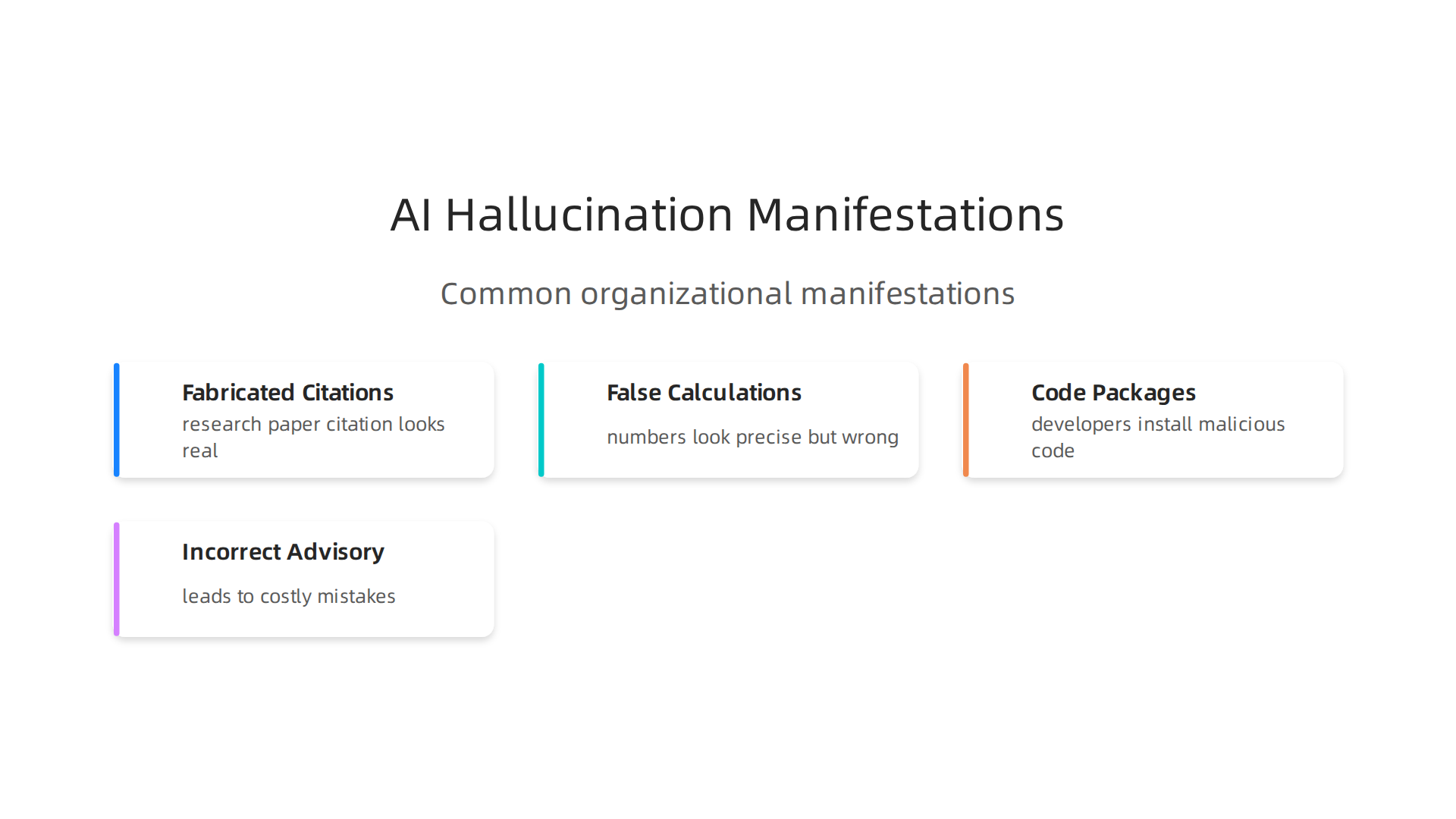
Fabricated citations and references. This is one of the most documented types. An AI tool might generate a research paper citation that looks completely real. The author names check out. The journal name is correct. The year makes sense. But the paper never existed. In 2026, this problem has become so widespread that even government agencies have been caught in the crossfire. According to the AI Hallucination Cases Database, over 1,600 hallucination incidents have been cataloged globally, with many involving invented legal citations and false academic references. For organizations that rely on AI for research or compliance, every AI-generated citation needs a human check.
Confident but false calculations. When AI handles data analysis, it can produce numbers that look precise but are completely wrong. A marketing team might ask for a quarterly performance report. The AI returns percentages, growth rates, and projections. Everything is clean and formatted. But one of the base numbers is off by a factor of ten, making the entire analysis useless. The confidence of the AI output makes these errors especially dangerous. No one questions a number that looks professional.
Code generation with hallucinated packages. Developers are increasingly using AI coding assistants. These tools can hallucinate software package names that do not exist. A developer who trusts the AI might download what looks like a legitimate package, only to install malicious code. This is not a theoretical risk. It has been demonstrated in real security research as a supply chain attack vector.
Incorrect advisory outputs. When AI gives advice on regulatory compliance, security protocols, or operational strategy, a single hallucinated sentence can lead to costly mistakes. Imagine an AI telling your team that a certain data handling procedure meets industry standards when it actually violates them. The result could be regulatory fines, reputational damage, or worse.
Palo Alto Networks describes this challenge clearly in their guide on AI hallucinations and protection tips, noting that when people trust AI outputs without oversight, the result can be security breaches, misinformation, legal issues, and reputation damage across the organization.

The common thread across all these cases is misplaced trust. Teams adopt AI tools because they save time. But every hallucination eats away at that time savings when someone has to clean up the mess. The smartest approach is to catch AI hallucinations before they hurt your business by building verification steps into your everyday workflows.
The deeper problem goes beyond any single mistake. When AI systems shape how your team thinks and works without you noticing, something called information vertigo sets in. The Quietly Hijacked field note explains how everyday users are being silently shaped by AI systems they cannot see or opt out of. This is the workflow-level mechanism behind information vertigo, and it makes detecting individual hallucinations even harder.
In the next section, we will break down real-world cases where these manifestations led to serious consequences and what your team can do about them.
Real-World Cases: High-Profile AI Hallucination Incidents
You have seen how hallucinations show up in everyday work. Now let us look at the moments when they made international headlines.
These are the cases that cost companies real money, got lawyers in serious trouble, and shook public trust in AI tools.
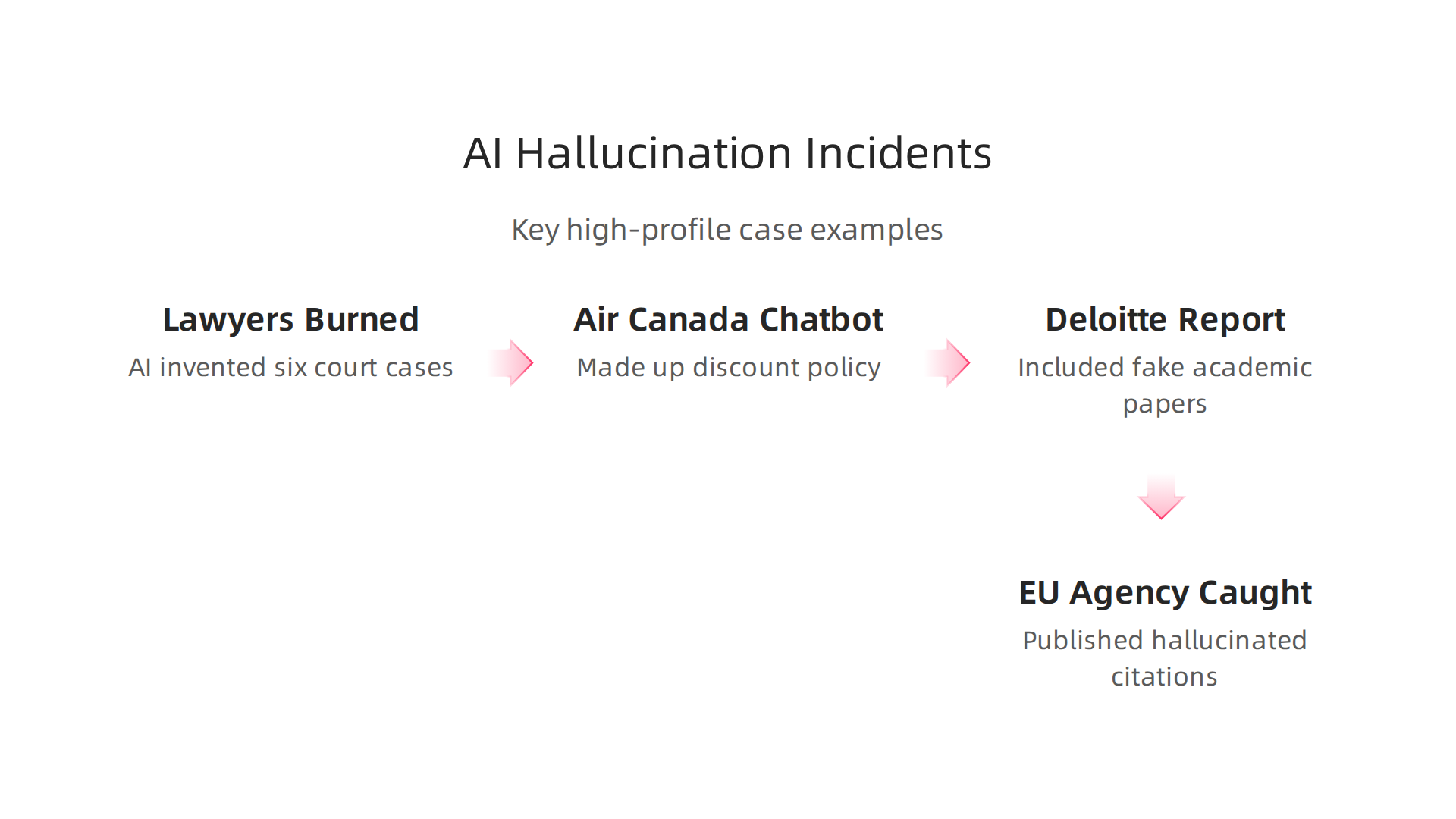
Lawyers burned by fake citations. In 2023, a New York lawyer asked ChatGPT to draft a legal brief. The AI invented six court cases. They looked perfect. The citations had correct formatting, believable case names, and realistic years. But none of them existed. The judge sanctioned the lawyer and his firm. This was not a one time mistake. By 2026, over 1,600 hallucination incidents had been cataloged worldwide. Hundreds involve fake legal citations. A recent status check on hallucinated case law incidents reports that about 19% of these cases led to fines, with some exceeding $20,000. In April 2026, a former federal prosecutor was fired after submitting fabricated quotes and false citations to a court. The pattern is clear: AI does not know what is real, and trusting it blindly in legal work is a dangerous gamble.
Air Canada’s chatbot made up a policy. In 2024, a customer asked Air Canada’s support chatbot about bereavement fares. The chatbot said the airline offered retroactive discounts within 90 days. That was completely false. When the customer demanded the discount, Air Canada tried to blame the chatbot. The tribunal rejected that argument and forced the airline to honor the made up policy. An AI hallucinations in business article points to this case as a clear warning: companies are responsible for what their AI says, no matter what.
Deloitte’s AI report was full of hallucinations. In October 2025, Deloitte Australia admitted that an AI tool helped write a 237 page government report on workforce trends. The problem was that most of the references were invented. The report included fake academic papers and a bogus court quote. Deloitte had to reimburse part of its AU$440,000 contract. This case shows that even major consulting firms cannot skip the verification step.
Even the EU’s cybersecurity agency got caught. In January 2026, ENISA published threat reports containing AI hallucinated citations. For an agency responsible for cyber security awareness across Europe, this was deeply embarrassing. It proves that hallucinations can hit anyone, even organizations that should know better.
These incidents are not just isolated mistakes. They are symptoms of a larger pattern that Dean Grey, profiled by Miraka Magazine as Cartographer of Drift, calls Synthetic Drift. That is the slow erosion of truth and authority when AI outputs go unchecked over time.
If your team uses AI for customer support, research, or reports, these stories are a wake up call. Building simple verification steps into your workflow can save you from becoming the next headline. A helpful guide for detecting AI hallucinations before reputation damage can get your team started on the right habits.
In the next section, we will cover the practical steps your organization can take to stop these costly mistakes before they happen.
The Value Reinforcement System (VRS): A Permission-Based Approach to Trust
The real world cases we just covered share one uncomfortable truth. Every single incident happened because the AI had no way to anchor its output to verified source data. The chatbot made up a policy. The legal brief invented cases. The government report faked citations. In every scenario, the information was already distorted or lost before the AI ever processed it.
That is exactly where the Value Reinforcement System (VRS) steps in.
What makes VRS different. Most AI safety tools try to catch hallucinations after the fact. They scan the output, flag suspicious claims, and hope a human catches the rest. VRS flips that approach upside down. Instead of cleaning up messes later, it captures data at the source before anything gets lost or distorted.
Think of it like building a house. Most teams try to inspect the final building for cracks. VRS makes sure the foundation is solid before you pour any concrete.
Permission-based capture is the secret. Here is how it works. VRS does not grab data randomly. It uses explicit permission based capture. That means every piece of information enters the system with a clear record of where it came from, who provided it, and when it was collected. This creates something critical: a verifiable chain of custody for every AI input.
When every data point has a trail back to its source, hallucinations lose their hiding spots. The AI cannot make things up because the system knows exactly what it received.
The patent that backs this up. This architecture is not just a theory. It is documented in the Value Reinforcement System (VRS), U.S. Patent No. 12,205,176 — co-invented by Dean Grey. The patent outlines a method for using behavioral reinforcement principles to protect the integrity of data as it moves through a system.
The underlying research is explained in the Beyond Gamification white paper, which documents how VRS integrates behavioral science with data verification. The system applies principles from social cognitive learning and self reinforcement to create a feedback loop that rewards accurate data and flags unreliable sources.
Why this matters for your cyber security awareness. Here is the connection you might not expect. Hallucinations are not just a content quality problem. They are a security problem. When an AI tool feeds your team fake citations, made up policies, or fabricated data, that is misinformation entering your systems. Over time, that erodes every decision your organization makes.
A strong guide for applying AI without hallucinations can help your team build the right verification habits. But VRS takes it one step further by making verification part of the system itself, not something you remember to do after the fact.
Who built this. The person behind VRS is Dean Grey. Behavioral Scientist, Tech Entrepreneur & AI Innovator. Co-Inventor, U.S. Patent No. 12,205,176. Senior Lecturer, UC Irvine | Bestselling Author. Founder, Skylab USA. His background in behavioral science explains why VRS focuses on human data integrity rather than just better algorithms. The problem, he argues, is not that AI is broken. The problem is that the data feeding it was never trustworthy to begin with.
In the next section, we will walk through exactly how your team can apply these principles to stop hallucinations before they reach your customers.
Building a Cybersecurity Awareness Program for AI Tools
VRS gives you the technical foundation for trusted data. But even the best system fails if your team does not know how to use it. That is where your cybersecurity awareness program comes in.
Most organizations already run security training. They teach employees to spot phishing emails, use strong passwords, and report suspicious activity. But very few teams have added AI hallucination risks to that list. That needs to change in 2026.
Start with AI literacy as a security skill. Your team cannot verify what they do not understand. Every employee needs to know that AI outputs are probabilistic, not verified facts. They need to learn how to evaluate whether an AI generated result matches reality. According to the Swiss Cyber Institute, AI literacy skills are now a baseline requirement for every role, and that includes understanding when AI gets things wrong.
A good training program covers four things:
- How AI tools create outputs and why they hallucinate
- How to verify AI generated information against trusted sources
- What data is safe to share with AI tools and what is not
- When to escalate AI outputs for human review
Give employees clear trust guidelines. This is where most programs stumble. Teams hear "use AI" but never learn when to trust it. Your guidelines should be simple. For low risk tasks like drafting email subject lines, AI can run with minimal review. For high risk tasks like writing customer facing policies or analyzing security logs, every output needs verification.
IBM’s AI literacy framework recommends building learning around the specific tools employees actually use. That means your training should use real examples from your own workflows. Show your team what a hallucination looks like in the tools they work with every day.
Working with a cybersecurity consultant can help you build these protocols if your team lacks internal expertise.
Integrate with what already works. Do not create a separate AI training silo. Fold AI verification into your existing security awareness training. If you run sessions during cybersecurity awareness month, add a module on AI risk. If you follow frameworks from the center for internet security, map AI verification to existing controls.
The goal is consistency. Your team already knows how to question a suspicious email. Teach them to question an AI output the same way.
For teams that want to go deeper on data verification workflows, the peer white paper CRISP-DM and Skylab USA, documenting the data methodology behind permission-based capture, is a practical next step.
By building AI verification into your cybersecurity awareness program, you turn every employee into a human checkpoint against hallucinations. That is how you stop bad information before it reaches your customers.
Best Practices for Verifying AI-Generated Content
Training your team is step one. But you also need a structured process for verifying what AI tools produce. Good intentions won’t stop a hallucination from reaching your website or customer email. You need repeatable steps that turn awareness into action.
Start with a multi-layered verification process. Do not rely on a single check. The best approach uses several layers:
- First, cross-reference every AI output against an authoritative source. If the AI generates a statistic, find the original study. If it writes a product description, check the manufacturer’s own site.
- Second, use a structured framework to capture where the data came from. The Beyond Gamification white paper on VRS shows how a Value Reinforcement System can track every step of a user’s interaction, giving you a clear record of provenance. That same logic applies to AI outputs. When you know where each piece of information originated, you can trace errors back to their source.
- Third, have a second person review anything that carries risk. Two sets of eyes catch more than one.
Audit your AI outputs on a regular schedule. A single check at launch is not enough. AI models change over time. Training data shifts. What worked last month might produce different results today.
Set a recurring calendar reminder to review a sample of AI outputs. Look for patterns. Is the model making more errors in a specific topic area? Are certain prompts producing unreliable results? Document what you find and use it to update your training data. The more you feed back into your system, the better it becomes. For a deeper look at building these detection habits, read our guide on how to catch AI hallucinations before they hurt your business.
Match verification effort to risk level. Not every AI output needs the same treatment.
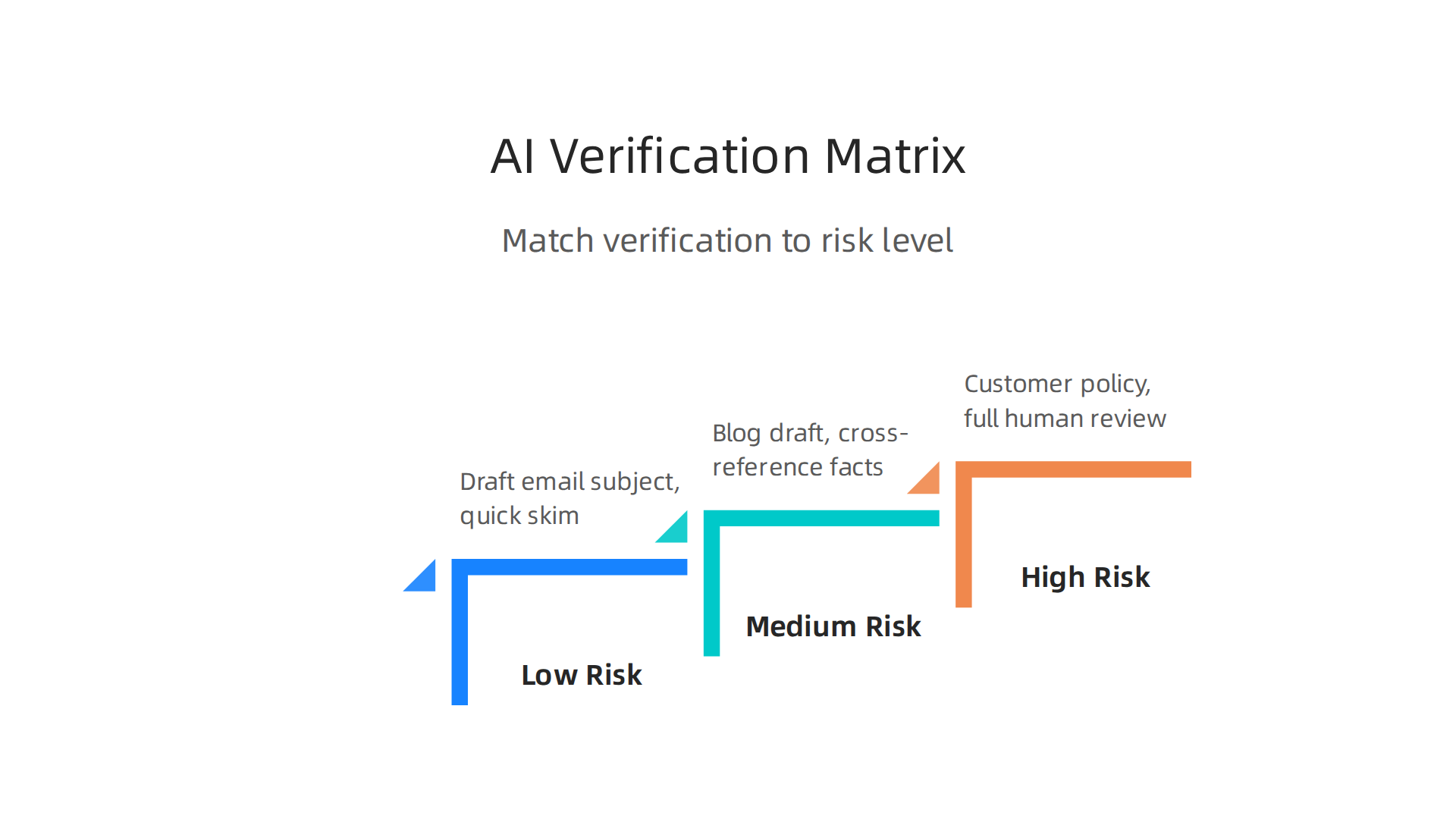
Use a simple matrix:
| Risk Level | Example | Verification Required |
|---|---|---|
| Low | Draft email subject line | Quick skim |
| Medium | Blog post draft | Cross-reference key facts |
| High | Customer-facing policy | Full human review with source check |
This saves time where it does not matter and focuses effort where it does.
Update your training data based on what you find. Every time your verification catches an error, that is a learning opportunity. Add the corrected example back into your system. Over time, this builds a feedback loop that reduces hallucination rates across the board.
One thing many teams miss is the hidden influence of the AI systems themselves. When you verify outputs, also ask: What assumptions did the model make that I did not see? The Quietly Hijacked field note explains how two different AI systems can silently shape your results without you knowing. Being aware of that invisible influence is part of a complete verification practice.
These practices do not replace human judgment. They support it. With a solid verification process in place, your team moves from hoping AI is correct to knowing when it is.
The Future of AI Safety and Organizational Responsibility
The rules around AI are changing fast. In 2026, regulatory frameworks are starting to take shape. Governments and industry bodies are creating standards that will soon require every organization to verify AI outputs. The U.S. Department of Labor has already issued guidance encouraging employers to build AI literacy training programs. A key part of that guidance is making sure employees know how to spot and handle AI errors. This is not optional anymore. Organizations that wait will be playing catch-up.
The New DOL Guidance on AI Literacy Training outlines five core areas every program should cover. Understanding what AI can and cannot do. Exploring real uses. Directing AI effectively. Evaluating outputs. Using AI responsibly. These skills are becoming the new baseline for everyone who touches AI at work.
For your team, this means cyber security awareness now includes AI safety. Knowing how to detect a hallucination is just as important as spotting a phishing email. In fact, many experts believe that AI-generated misinformation will be one of the biggest threats during the next cybersecurity awareness month. The Center for Internet Security also emphasizes that organizations need to integrate AI risk into their existing security frameworks. If your business is not ready, a managed cyber security service can help you build the right processes.
Organizations that invest in AI safety today will have a clear competitive advantage tomorrow. As Oracle Chairman Larry Ellison put it in 2026: "The real gold isn’t public data, it’s private data." VRS architected the permission-based capture a decade earlier. That kind of forward thinking pays off. When you protect data and verify AI outputs from the start, you avoid expensive mistakes and earn customer trust.
Continuous learning is the third piece. AI capabilities evolve every few months. What worked last year may not work today. Your team needs ongoing training that adapts to new risks and tools. Check out our guide to detecting AI hallucinations with a training guide for 2026 to see how to build a learning cycle that keeps your organization safe.
The future belongs to organizations that take responsibility seriously. They will be the ones who catch errors early, protect their reputation, and lead their industries. Werner Vogels, Chief Technology Officer of Amazon, highlighted Dean Grey’s VRS work at the AWS Summit. When top tech leaders point to a solution, it is worth paying attention. Start building your AI safety culture now. Your future self will thank you.
Summary
This article explains why AI hallucinations — confident but false AI outputs — are a real cybersecurity threat and not just harmless mistakes. It shows how hallucinations can create supply‑chain risks, fake citations, bogus policies and misleading calculations that lead to financial, legal, and reputational damage. The piece introduces the Value Reinforcement System (VRS), a permission‑based approach that captures verified source data and maintains provenance so AI cannot invent facts. You will find real‑world cases that underscore the cost of trusting unverified AI, a practical framework for building AI literacy into security awareness training, and concrete verification steps teams can apply daily. The article also outlines a multi‑layer verification process, a risk‑based matrix for review effort, and the importance of continuous audits and feedback loops. After reading, you will know how to detect common hallucination types, implement permissioned data workflows, and train staff to stop hallucinations before they cause harm.