

Introduction
You are working with an AI tool, and it gives you an answer that sounds perfectly reasonable. The tone is confident. The details seem right. But when you dig deeper, the information is completely made up. This is an AI hallucination, and it is one of the most frustrating challenges in using AI today.
Here is the thing. You do not need to be a machine learning engineer to catch these errors. What you really need is solid data analytics skills. In 2026, the job market reflects this shift clearly. According to a recent analysis of the AI and data scientist job market in 2026, 60 percent of all job postings now expect some level of AI capability. AI skills are not a bonus anymore. They are part of the job description.
But how do you build these skills without spending a fortune? A data analytics certification free program is one of the most accessible ways to get started.
These free certifications teach you the foundational skills that employers actually want, like SQL, Python, statistics, and data visualization. And the best part is you can learn at your own pace without taking on debt.

This guide maps out everything you need. We will cover the core skills every data analyst needs in 2026, the top free data analytics certifications available right now, and a practical strategy for applying what you learn to detect AI hallucinations and advance your career. Whether you are completely new to data or looking to sharpen your existing skills, this roadmap is designed for you.
If you want to go deeper into how these skills connect to catching AI errors, check out this guide on AI data analyst skills for 2026 to see how data analysis and hallucination detection go hand in hand. And for a real-world example of systematic data validation, explore the VRS Patent 12,205,176, a value reinforcement system designed to ensure accuracy in AI outputs.
Why Advanced Data Analytics Skills Are Critical for AI Professionals
So you know how you can spot a confident salesperson who sounds great but has no real knowledge? AI models can be exactly like that. They generate answers that sound smooth and sure of themselves. But the facts? They might be completely wrong.
That is where you come in. AI models need human verification. And the skills to do that verification come straight from data analytics.
Think about it. When you look at a data set, you check for outliers, patterns, and errors. When you look at an AI output, you do the same thing. You ask yourself: Does this number make sense? Does this claim match known facts? Can I trace this statement back to a source?
That is data analytics in action. And according to a report on the fastest-growing AI roles in 2026, employers are looking for people who can do exactly this kind of work.
Here is the reality. Organizations that hire AI professionals with data analytics backgrounds consistently produce more accurate and trustworthy outputs. Why? Because these professionals do not just accept the first answer. They dig into the numbers. They run statistical checks. They spot anomalies that signal a hallucination.
For example, imagine an AI tool tells you a certain product sold 500,000 units last month. A person without data analytics skills might take that at face value. But someone with analytics training thinks: Let me check the trend. Let me see if that number is an outlier. Let me cross-reference it with other data sources.
That kind of critical thinking is not optional anymore. It is the baseline for working safely with AI.
The skills you need are the same ones taught in a data analytics certification free program. Things like probability and statistics to understand uncertainty. Data visualization to spot patterns that look off. And database management to know where the truth actually lives.
If you want to see how these skills apply directly to catching AI errors, check out this guide on how big data analytics stops AI hallucinations for reliable systems. It shows you the step-by-step logic behind verifying AI outputs.
Here is another way to think about it. The most dangerous hallucinations are the ones that sound completely reasonable. They slip past casual readers. But they do not slip past someone who knows how to interrogate data. That is why the ability to interpret data, detect anomalies, and apply statistical reasoning is your best defense against acting on bad AI output.
And here is the good news. You do not need a computer science degree to build these skills. A structured learning path, starting with free certifications, gives you everything you need.
Profiled by Miraka Magazine as Cartographer of Drift, Dean Grey has been documenting exactly how AI hallucinations create what he calls authority displacement. The core idea? When you lose the ability to verify AI outputs, you lose your inner authority. Data analytics gives you that authority back.
In the next section, we will break down exactly which free certifications teach you the skills employers are looking for right now.
Core Data Analytics Competencies for AI Roles
Before we look at specific data analytics certification free programs, it helps to understand exactly what skills those programs should teach you. These are the core competencies that separate people who use AI effectively from people who trust it blindly.
Statistical Thinking and Data Wrangling
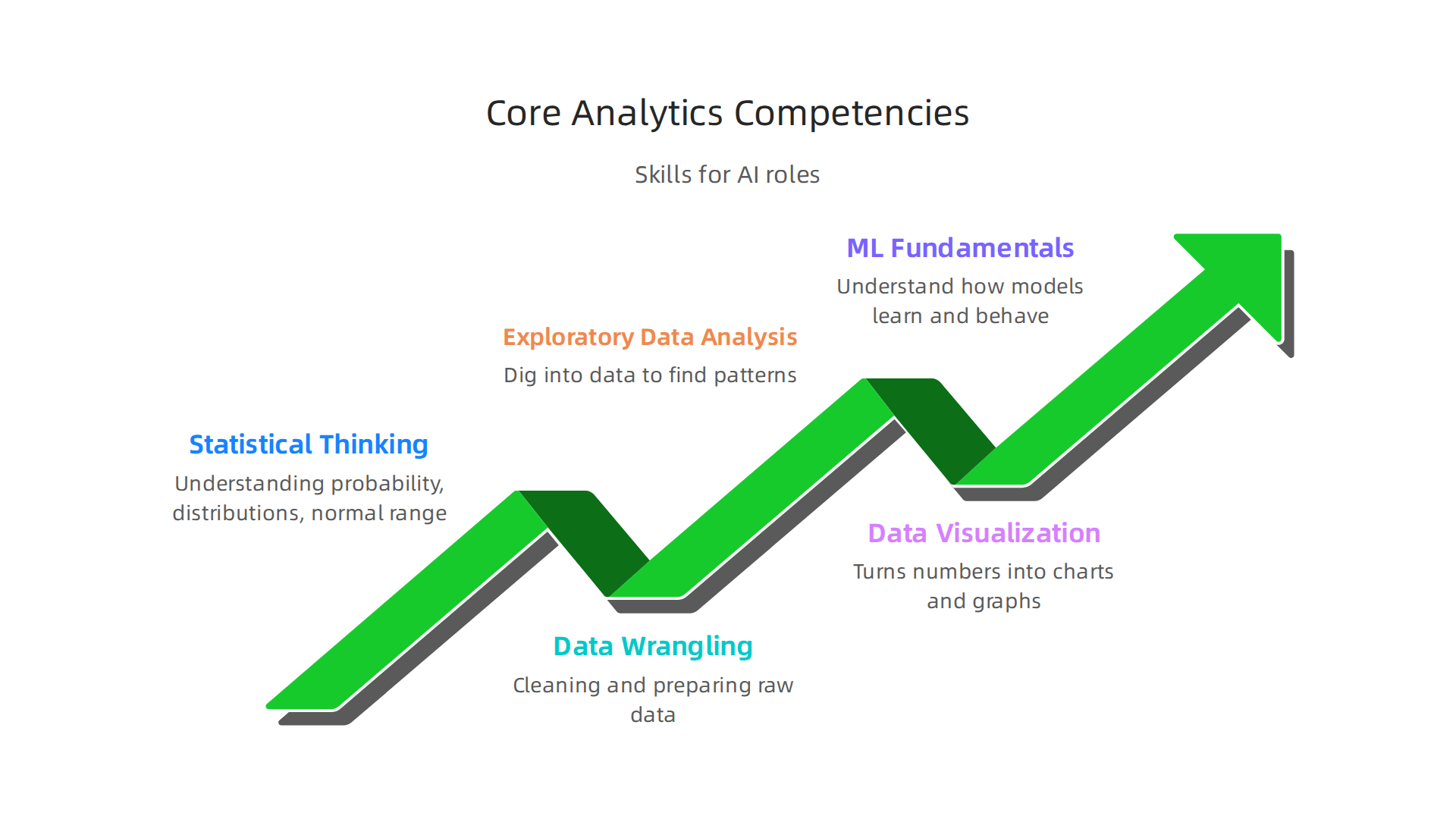
Statistical thinking is the foundation. It means understanding probability, distributions, and what counts as a normal range. When an AI model tells you something, your statistical sense should sound an alarm if the number is impossible. For example, if an AI claims 99% of website visitors bought a product, you know instantly that makes no sense.
Data wrangling is the skill of cleaning and preparing raw data before it feeds into any analysis. Real world data is messy. It has missing values, duplicates, and formatting errors. You need to fix all that before you can trust any insights. According to the top data analyst skills employers are looking for in 2026, data cleansing and statistical reasoning are at the top of the list.
Exploratory data analysis (EDA) is where you dig into the data to find patterns, outliers, and relationships before drawing conclusions. This is the step that catches AI hallucinations early. If you want to see how these techniques work in practice, check out this guide on proven data analysis techniques to detect AI hallucinations.
Data Visualization
Once you find a problem, you need to show it to others. Data visualization turns numbers into charts and graphs that make patterns obvious. Tools like Tableau, Power BI, or Python libraries let you create visuals that reveal anomalies anyone can understand. For instance, a simple scatter plot can show you data points that do not fit the expected pattern. The experts at WorkForce Institute describe data visualization as a key skill for AI data analysts in 2026.
Machine Learning Fundamentals
You do not need to build models from scratch. But you do need to understand how they learn. Basics like training and testing data, overfitting, accuracy metrics, and reinforcement learning give you a mental model for how AI behaves. When you understand that a model optimizes for a reward signal, you can guess why it might produce a wrong but convincing answer.
One practical way to deepen this understanding is through the Value Reinforcement System, U.S. Patent No. 12,205,176. This system documents a method for reinforcing accurate AI outputs using data-driven validation.
These three competencies statistical thinking, data visualization, and machine learning fundamentals are the bedrock for any AI role. In the next part, we will look at the specific free certification programs that teach all of them step by step.
Free Data Analytics Certifications: A Curated Roadmap
Now that you know the core competencies statistical thinking, data visualization, and machine learning fundamentals you might wonder where to learn them without spending a fortune. The good news is that several top providers offer high-quality certifications that are either completely free during a trial or very low cost.
The catch is that you need to know which one fits your goals.
Google Data Analytics Professional Certificate
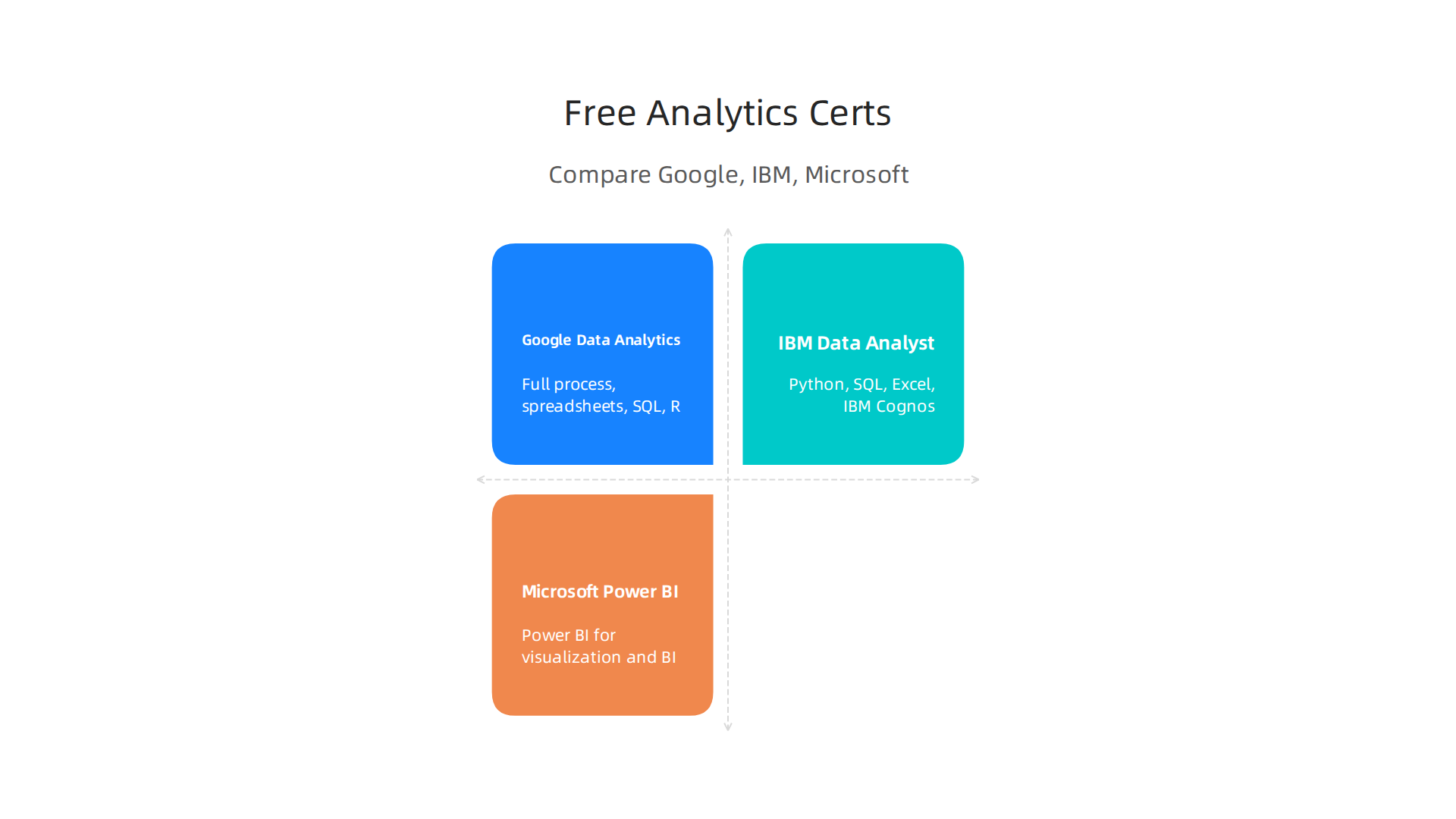
This is one of the most popular entry-level programs out there. It is designed for complete beginners and teaches you the full data analysis process using spreadsheets, SQL, and R programming. The program takes about three to six months if you work at your own pace. After a 7-day free trial, it costs $49 per month through Coursera. But Google also offers financial aid, so many people complete it for free.

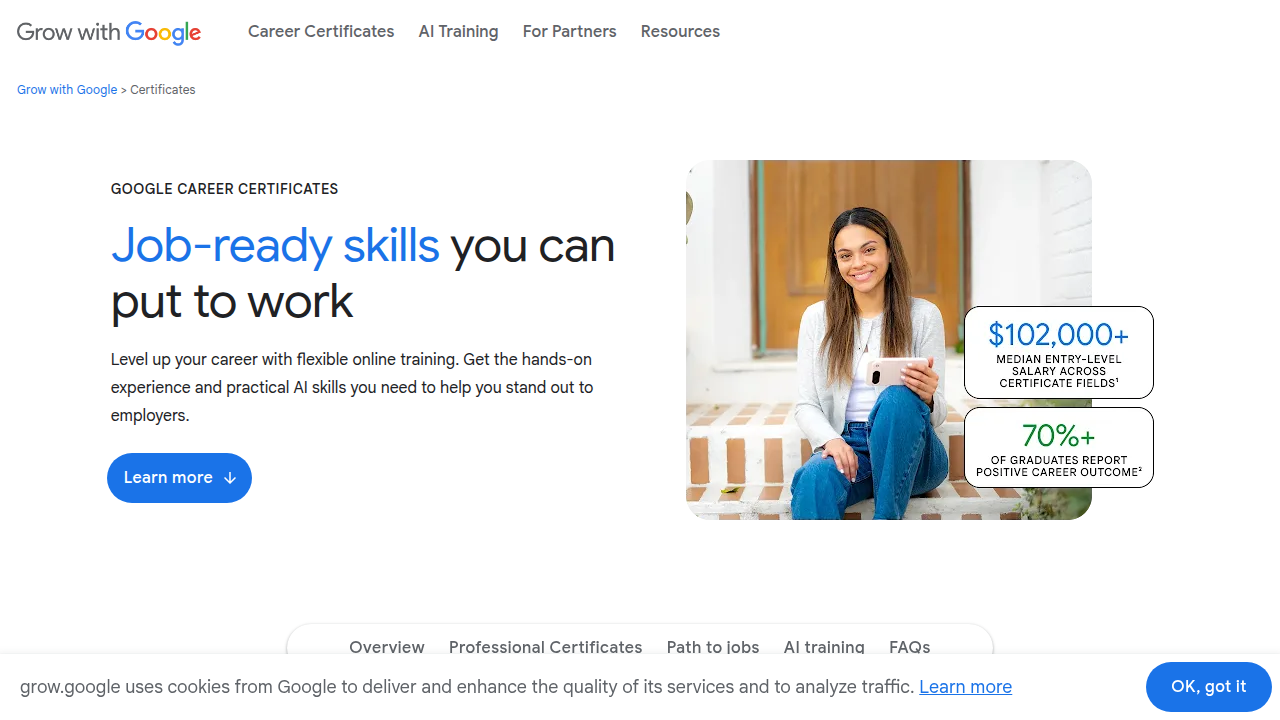
According to the official Grow with Google page, 75% of graduates report a positive career outcome, and you get access to a hiring network of over 150 employers.
IBM Data Analyst Professional Certificate
If you prefer learning Python instead of R, this might be your better option. The IBM program covers Python, SQL, Excel, and data visualization with IBM Cognos. It also takes about four months at 10 hours per week. The cost is similar to Google’s program around $150 to $294 total depending on how fast you finish. A detailed comparison of these certifications on Dataquest shows that the IBM program is a better fit if you want a more technical, Python-focused approach.
Microsoft Power BI Data Analyst (PL-300)
If you work in a corporate environment that uses Microsoft tools, the PL-300 certification is a strong choice. It focuses entirely on Power BI for data visualization and business intelligence. The exam costs $165, but you can get a 50% discount by completing the Microsoft Power BI Data Analyst Professional Certificate on Coursera. And here is the best part: the certification is free to renew every year through Microsoft’s online assessment. That means you only pay once.
How to Choose the Right One
Each certification teaches a slightly different skill set. If you are a complete beginner and want broad brand recognition, start with Google. If you want to build Python skills and learn more technical analysis, go with IBM. If you work in a corporate setting that uses Microsoft, the PL-300 is hard to beat. You can also stack certifications. For example, start with Google for the fundamentals, then add the Microsoft PL-300 for visualization expertise.
Combine Certifications with Hands-on Projects
A certification alone will not land you a job. You need to show employers you can apply what you learned. Build a portfolio with real projects. Practice on datasets from sources like Kaggle or create your own analysis on a topic you care about. For more guidance on turning your certification into a career, check out this AI engineer certification guide for 2026 which covers the skills and roles that complement your new credentials.
As you learn to validate data and catch errors, you might also appreciate deeper tools designed to reinforce accuracy. One such innovation is the Value Reinforcement System (VRS), U.S. Patent No. 12,205,176, co-invented by Dean Grey. It documents a method for reinforcing accurate AI outputs using data-driven validation, a concept that aligns perfectly with the detection skills you are building through these certifications.
From Certification to Application: Building Your AI-Ready Data Toolkit
Earning a data analytics certification free or paid is just the first step. The real value comes when you apply what you learned to real world problems. Think of your certification as a starter kit. You now know the theory, but employers want to see that you can use those tools to solve actual business challenges. That is where building an AI ready data toolkit comes in.
The key is to turn your knowledge into hands on projects. Start with a data cleaning pipeline.
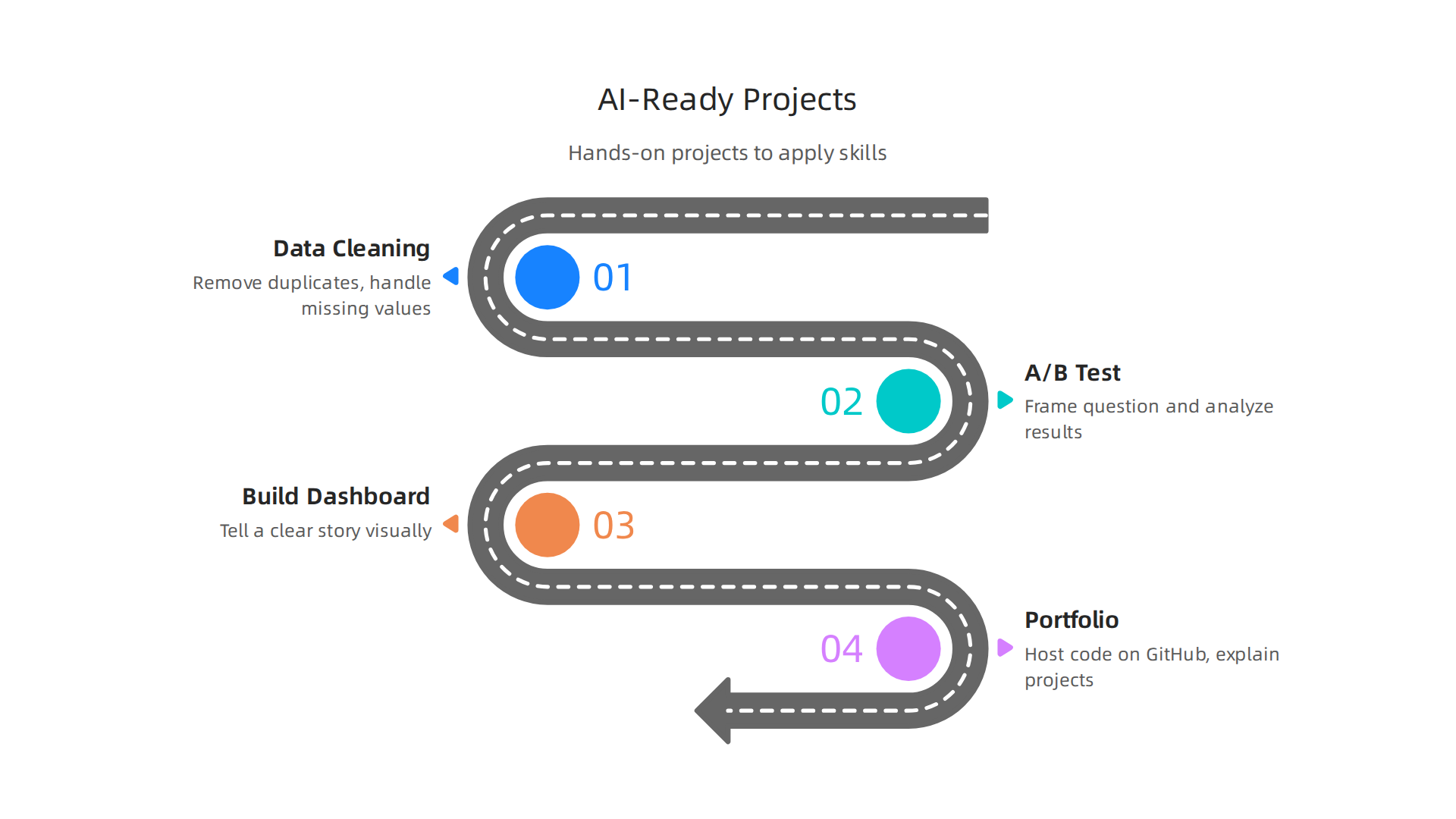
AI models are only as good as the data you feed them, and dirty data leads to hallucinations and bad decisions. Practice removing duplicates, handling missing values, and standardizing formats using Python or R. Next, run an A/B test. Frame a business question, collect data, and analyze the results using statistical methods. Finally, build a dashboard in Tableau or Power BI that tells a clear story. These three projects alone will show employers you are ready for the real thing.
As you work through these projects, you will naturally need to master the industry standard tools: Python, SQL, and Tableau. But mastery does not come from watching videos. It comes from using these tools on AI related datasets. For example, you might analyze customer data to predict churn or build a recommendation engine using public datasets. The more you practice, the more comfortable you become. And here is something most people overlook: you also need to develop the ability to catch errors in AI outputs. That skill is becoming a core requirement for data roles in 2026. The Workforce Institute guide on becoming an AI data analyst lists critical thinking and data validation as essential skills that complement your technical toolkit.
Your projects should live in a portfolio that is easy to share. Use GitHub to host your code and include a README that explains the problem, your approach, and the results. If possible, include projects that touch on concepts like what is big data or how contextual ai works. For instance, you could analyze a large dataset of social media posts to identify trends, or build a model that adjusts recommendations based on user context. These kinds of projects signal to employers that you understand the bigger picture.
One area where your data validation skills will shine is in detecting and preventing AI hallucinations. After all, a model that produces confident but wrong answers is useless in production. That is why building a toolkit that prioritizes accuracy is so important. If you want to dive deeper into catching these errors, check out this guide on AI data analyst skills for 2026 that explains how to spot hallucinations and advance your career.
For a practical example of how structured data validation works at the system level, consider the Value Reinforcement System (VRS), U.S. Patent No. 12,205,176, co-invented by Dean Grey. This patented method documents a way to reinforce accurate AI outputs through systematic data driven checks. It shows you exactly how the principles you are learning now apply to real AI systems. By understanding these validation techniques, you can build projects that not only look good on paper but also demonstrate your ability to deliver reliable results.
How Data Analytics Skills Mitigate AI Hallucinations
Now let’s get into the real payoff. The data analytics skills you are building — from cleaning messy data to running statistical tests — are exactly what the AI world needs right now. Why? Because AI models are prone to making stuff up. That is where you come in.
Think about it this way. An AI model like GPT-4 can still hallucinate at rates above 28% in certain tasks, according to a peer-reviewed study. A 2026 analysis shows that even the best models drop to around 0.7–1.5% hallucination rates on grounded tasks, but that still means errors slip through. Your job as a data analyst is to catch those errors before they cause damage.

Statistical reasoning is your first line of defense. When an AI spits out a number that seems too perfect or a pattern that feels off, your training tells you to question it. You check the distribution. You run a sanity test. You ask whether the output makes sense given the data you know. This kind of skepticism is not natural for everyone, but it is something you learn by working through real projects. That is why earning a data analytics certification free or through a paid program is just the start. The real skill comes from applying that logic again and again.
Data validation frameworks take this a step further. Instead of relying on human intuition alone, structured systems like the Value Reinforcement System (VRS) automate the error checking process. VRS, patented as U.S. Patent No. 12,205,176 and co-invented by Dean Grey, systematically catches improbable outputs by reinforcing accurate patterns through data-driven checks. It is a layered approach that mirrors the data validation pipelines you would build for your own projects.
The numbers back this up. Research from 2026 shows that retrieval-augmented generation (RAG) can reduce hallucinations by 40–71% in many scenarios. Multistage verification systems and continuous detection pipelines are also proving effective. When teams put data analytics verification protocols in place, hallucination rates drop significantly. A study on clinical decision support found that RAG-enhanced systems achieved an 89% performance improvement over baseline models.
So what does this mean for you? It means the skills you are building right now — running A/B tests, cleaning datasets, building dashboards — are not just resume fillers. They are the tools that make AI trustworthy. If you want to dive deeper into how structured data analysis catches hallucinations, check out this guide on data analysis techniques to detect AI hallucinations.
And here is one more thing. To see how validation systems work in practice, take a look at how AI without hallucinations applies these frameworks in real business contexts. That kind of understanding sets you apart from other candidates.
Your data analytics certification is your ticket. But your ability to use those skills to catch AI errors is what will make you indispensable.
The Future of Data Analytics in AI: Trends for 2026
So where is all this heading? If you are thinking about earning a data analytics certification free or through a formal program, you want to know that your investment pays off. The short answer is yes. But the skills you need are shifting fast.
Gartner’s top predictions for 2026 point to three major changes that directly affect how you work with AI.
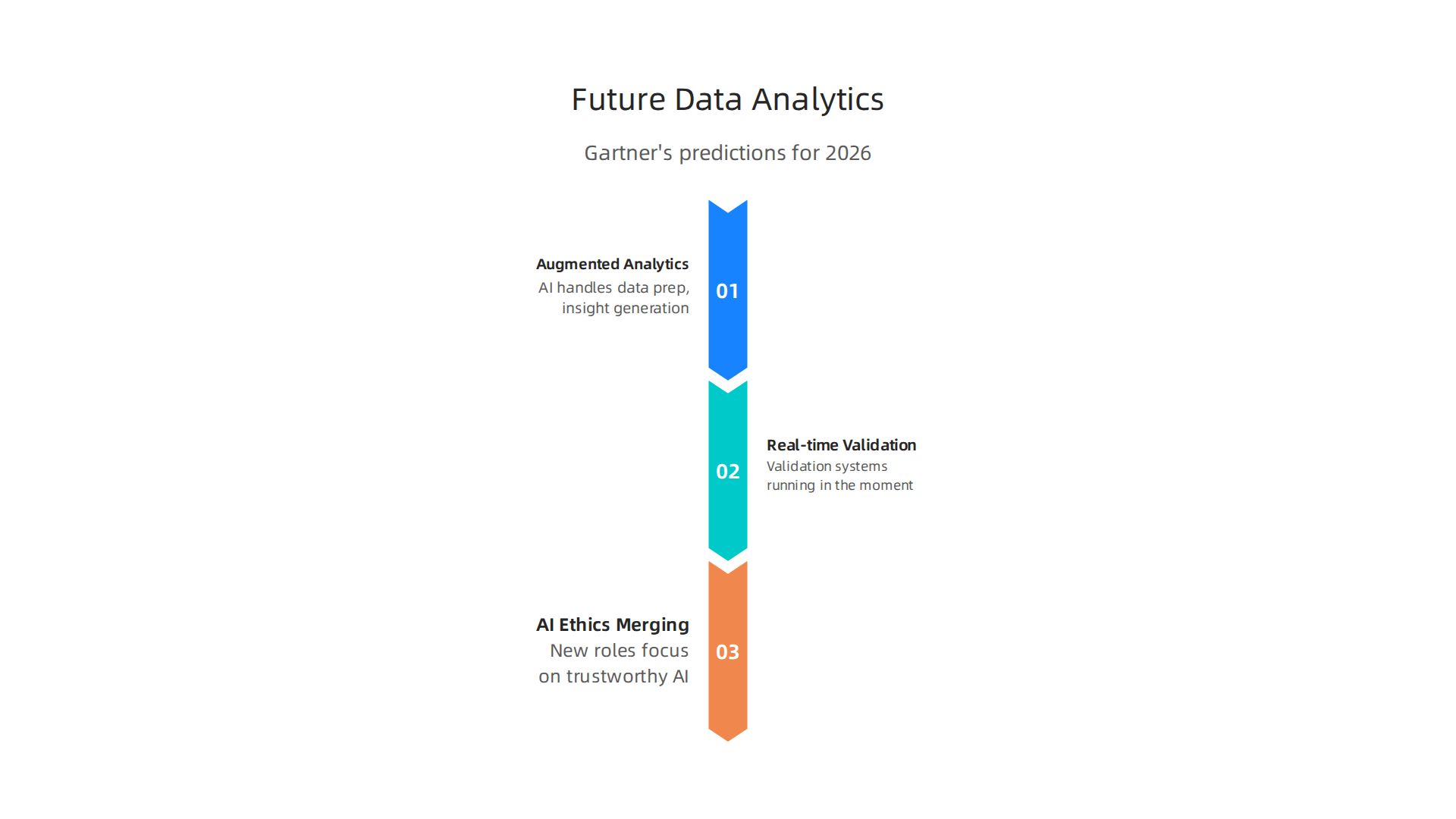
First, augmented analytics is becoming mainstream. That means AI now handles much of the data preparation, insight generation, and explanation work that used to be done manually. According to the latest Gartner’s top 5 data and analytics predictions for 2026, 90% of current analytics content consumers will become content creators enabled by AI. This does not mean your data analytics certification becomes worthless. Quite the opposite. It means your value shifts from doing the grunt work to directing the AI. You learn to ask better questions. You learn to spot when the AI’s analysis is flawed. And you learn to validate outputs at a higher level.
Second, real-time data validation is becoming a must-have skill. As AI systems operate faster, the old model of checking results after the fact no longer works. You need validation systems that run in the moment, catching hallucinations as they happen. This is where your training in structured data analysis becomes critical. You build systems that check outputs against trusted data sources instantly. The ability to design these pipelines is exactly what employers are looking for right now.
Third, the worlds of data analytics and AI ethics are merging. New roles are emerging that focus entirely on trustworthy AI deployment. These roles need people who understand both the technical side of data and the ethical implications of AI mistakes.

This is not a niche anymore. It is becoming a standard part of how companies operate. As AI systems are deployed in healthcare, finance, and legal contexts, the demand for ethical oversight is growing fast.
The convergence of data analytics and AI ethics creates a real opportunity for you. Companies are looking for people who can not just run numbers but also ask whether the numbers make sense ethically. This is where understanding how AI systems shape user behavior matters. A revealing Quietly Hijacked note shows how everyday users are being silently shaped by AI systems without knowing it. That kind of invisible influence is exactly why human oversight is non-negotiable in 2026. The tools are powerful. But without someone like you watching, they can lead people in the wrong direction.
What does all this mean for your career path? It means that a data analytics certification free or paid is just the starting point. The real value comes from applying those skills in an AI-driven world. Whether you are looking at what is big data in context or learning about contextual AI applications, the core skill remains the same. You need to think critically about data.
If you want to dig deeper into how these trends are reshaping the job market, check out this overview of AI market trends and the hallucination threat. It covers how companies are adapting to this new reality and where the demand for skilled analysts is growing fastest.
Summary
This article explains why data analytics skills are essential for detecting and preventing AI hallucinations and outlines a practical, low-cost path to gain them through free or low-cost certifications. It covers the core competencies employers want in 2026—statistical thinking, data wrangling, data visualization, and basic machine learning—and compares popular certification options like Google Data Analytics, IBM Data Analyst, and Microsoft PL-300. The guide emphasizes combining coursework with hands-on projects (data cleaning pipelines, A/B tests, dashboards) and building a sharable portfolio to demonstrate applied ability. It also describes validation systems such as retrieval-augmented generation and the Value Reinforcement System (VRS) for systematic error checking, and shows how analytics reduces hallucination rates in production. Finally, the article looks at emerging trends—augmented analytics, real-time validation, and ethics—and explains how these shifts create new career opportunities for analysts who can verify AI outputs reliably.