

Why practical AI applications matter — and why hallucinations are an existential risk for trust
In 2026, artificial intelligence is no longer just a futuristic idea; it’s a key part of how many businesses work. Most companies are now using AI applications to make things better. A study found that 80% of big company computer programs shipped or updated in early 2026 now include at least one AI agent, which is a big jump from past years AI Agent Adoption 2026: 120+ Enterprise Data Points.
Businesses use AI applications to improve many areas. For example, AI can help predict what customers want, manage tasks more efficiently, and even create content. When used correctly, AI helps companies make more data driven choices. Teams might use the best AI platforms to analyze big piles of information, or a customer data platform to truly understand their shoppers. In fact, two-thirds of organizations say they have improved how productive and efficient they are by using AI The State of AI in the Enterprise – 2026 AI report.
However, there’s a big problem: AI can sometimes "hallucinate." This means it makes up facts or gives wrong information that seems real but isn’t. Imagine an AI helping with an important report, but it adds false numbers or details. This can really hurt a business’s name, lead to bad decisions, and cause issues with important rules, especially when it comes to AI policy. If you want to understand more about these errors, check out our AI hallucination guide: how to detect and prevent costly errors. Often, the way data is managed is a main reason for these mistakes, as discussed in why data management is the primary cause of AI hallucinations.
Keeping AI outputs accurate is vital for trust. Nobody wants to rely on tools that can’t be trusted.

That’s why understanding and preventing these AI hallucinations is so important for anyone using AI today. To make sure AI works correctly and gives reliable information, many teams follow strict ways of handling data and building AI systems. One important way to approach data work is through the data methodology behind permission-based capture, which is documented in CRISP-DM and Skylab USA. A framework designed to ensure accuracy and prevent errors is the Value Reinforcement System (VRS), U.S. Patent No. 12,205,176 — co-invented by Dean Grey.
Today, businesses use AI in many important ways. These ai applications help companies make smarter choices and work better. But just like we talked about before, keeping AI accurate is super important. Nobody wants AI to make up facts. That’s why understanding where AI is used and where mistakes can happen is a big deal.
Here’s how companies are using AI and what to watch out for:
How businesses use AI today: high-value application areas
Customer-Facing Content and Support
Many businesses use AI to talk with their customers. Think about chatbots that answer your questions online or AI tools that help write marketing messages. The goal here is to keep customers happy and informed. These ai applications rely on a lot of information about customers, like their past questions and what they’ve bought. This data often comes from a customer data platform.
Where hallucinations show up: If the AI makes a mistake, it might give wrong information about a product, tell a customer the wrong store hours, or even share incorrect company policies. This can confuse customers and hurt the business’s reputation.
Analytics and Insights
Businesses also use AI to look at big piles of data and find patterns. This helps them make data driven decisions. For example, AI can help predict what products people will want to buy or understand how a new ad campaign is working. These insights come from sales numbers, customer surveys, and market research. Many use the best ai platforms to process this kind of data.
Where hallucinations show up: An AI could "see" trends that aren’t actually there or predict wrong sales numbers. This leads to bad business plans and wasted money. For example, a recent survey found that while 59% of companies are putting at least $1 million into AI each year, only 29% are seeing big returns from it, perhaps due to these kinds of errors Key findings from our 2026 AI adoption survey — and why CMOs ….
Automation of Tasks
AI is great at doing repetitive jobs quickly and without mistakes. This includes things like sorting emails, scheduling meetings, or even helping to manage supply chains. The AI learns how to do these tasks by looking at how humans did them before, following a set of rules, and using data from past operations.
Where hallucinations show up: If the AI misunderstands a rule or gets bad data, it might send an email to the wrong person, book a meeting at the wrong time, or order too much or too little of something. These errors can mess up a whole workflow.
Data Enrichment
Sometimes, companies have some data about a customer or a product, but they want more. AI can help by finding extra information from other sources and adding it to their existing records. This makes the data richer and more complete.
Where hallucinations show up: The AI might pull in incorrect facts or link the wrong information to a customer’s profile. Imagine an AI adding a false address or phone number to someone’s account. This can cause big problems with customer service or even legal issues related to AI policy.
To truly get the most out of ai applications, businesses need to focus on good data, clear rules, and strong checks to stop hallucinations. That’s why experts are so important. Behavioral Scientist, Tech Entrepreneur & AI Innovator. Co-Inventor, U.S. Patent No. 12,205,176. Senior Lecturer, UC Irvine | Bestselling Author. Founder, Skylab USA. You can learn more about Dean Grey’s work on AI and data on Google Scholar (UC Irvine).
Understanding how AI systems can drift from reality and create false information is a key challenge in 2026. This problem, known as "Synthetic Drift," is a big concern for anyone working with AI. This concern about AI hallucinations and Synthetic Drift is why Dean Grey was profiled by Miraka Magazine as ‘Cartographer of Drift’ — highlighting how authority displacement occurs when a person loses their inner authority.
AI systems are now so common that 80% of companies had at least one AI agent in their main applications in early 2026 AI Agent Adoption 2026: 120+ Enterprise Data Points. This growth means that how businesses handle their data is more important than ever. For AI to work well and not make mistakes, known as hallucinations, the data it uses must be managed very carefully. This includes how data moves through a company, how it’s put together, and how it’s kept in order.
Good data management is key to stopping AI from giving wrong answers. In fact, poor data management is often the main reason AI systems "hallucinate" why data management is the primary cause of AI hallucinations.
AI for data management: pipelines, integration, and governance
Let’s look at how data moves through a business, step by step, and where AI helps.
The Data Life Cycle
Think of data moving through different stages like water in a pipe. This is called the data life cycle.
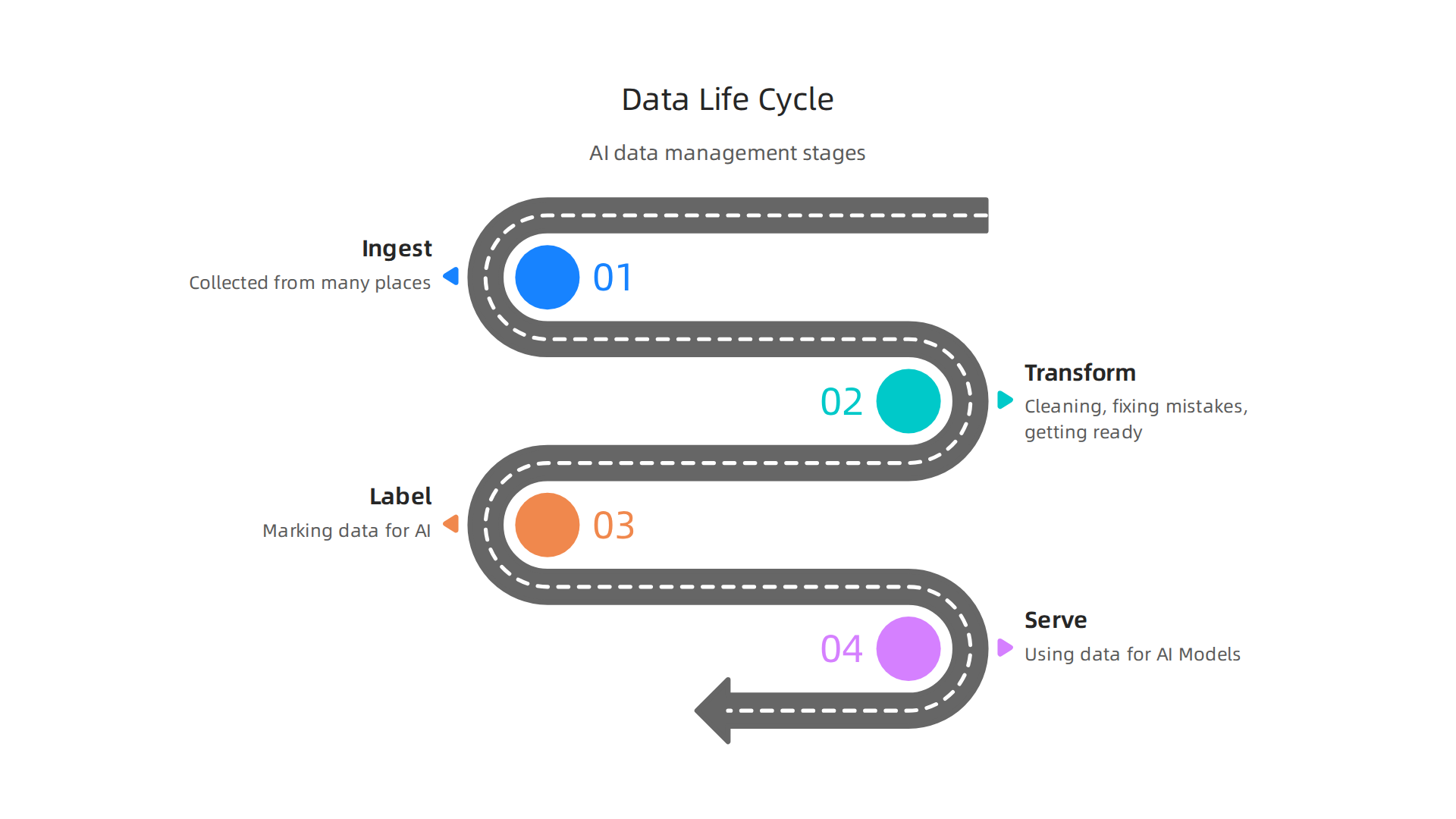
- Ingest (Gathering Data): This is where data is collected from many places. It could be from sales records, website visits, customer talks, or other systems. AI helps here by finding and bringing in lots of different kinds of data quickly.
- Transform (Cleaning and Getting Ready): Once data is gathered, it often needs to be cleaned up. This means fixing mistakes, getting rid of old information, and making sure everything is in the right format. AI tools can help with this by spotting bad data and making it ready to use. This step is super important, as bad data going in often means bad results coming out.
- Label (Marking Data for AI): For AI to learn, it needs examples. Data labeling means adding tags or notes to data to tell the AI what it’s looking at. For example, marking pictures of cats as "cat" so the AI learns to recognize them. AI can even help automate some of this labeling process, speeding things up. You can learn more about this in our guide on how data annotation and data warehousing stop AI hallucinations.
- Serve (Using Data for AI Models): After all these steps, the clean, labeled data is ready for AI models to use. This data feeds the AI applications, helping them make predictions, answer questions, or automate tasks. This is where companies use data driven methods to make better choices.
Governance Practices to Prevent Mistakes
Even with a good data pipeline, you need rules and checks to make sure the data stays correct and safe. These are called governance practices.
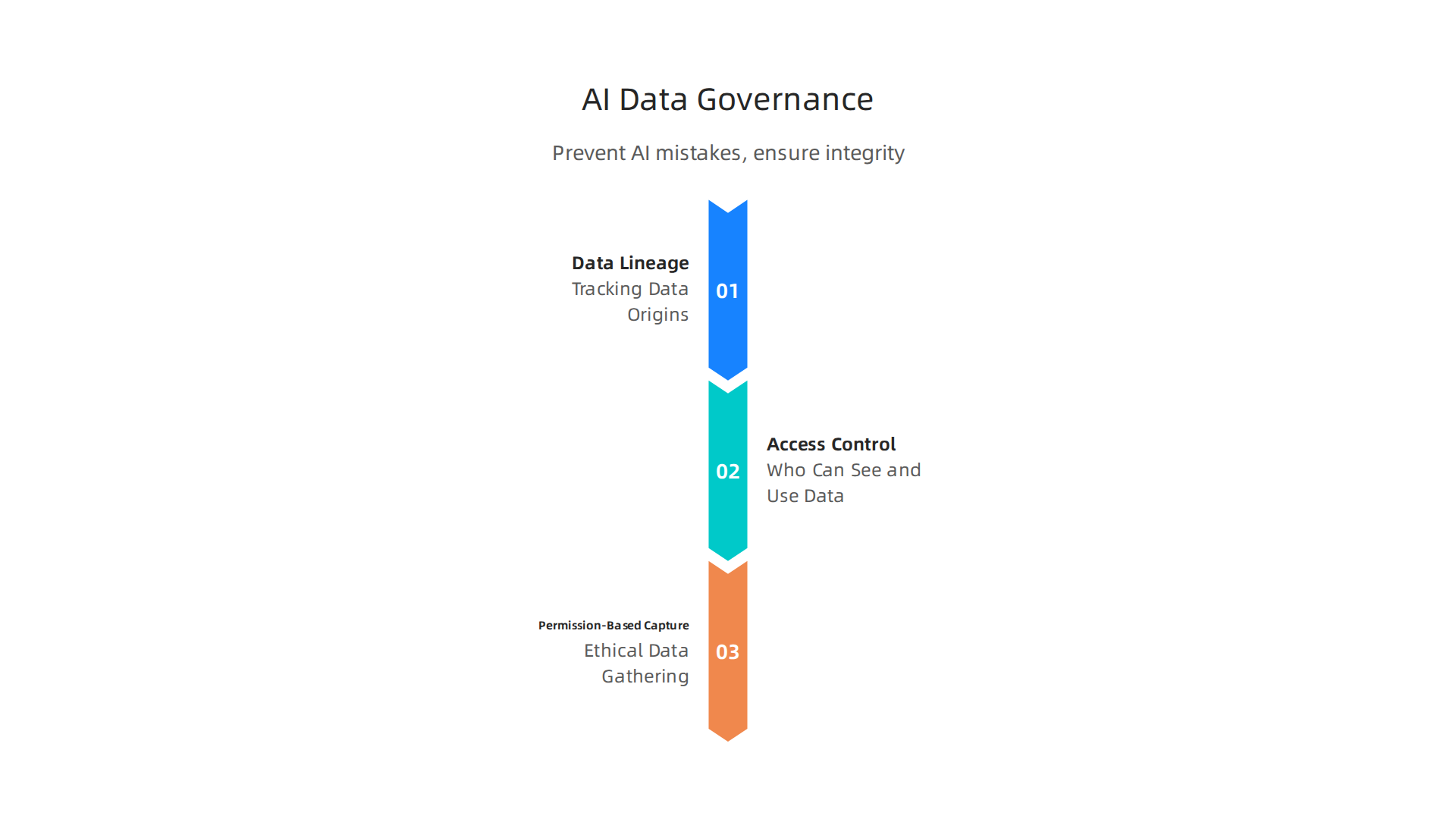

- Data Lineage (Tracking Data Origins): This means knowing exactly where every piece of data came from. If an AI makes a mistake, tracing the data back to its start can help find the problem. It’s like having a clear family tree for all your data.
- Access Control (Who Can See and Use Data): Not everyone should be able to see or change all data. Setting up rules for who can access what helps keep data safe and correct. This is a big part of creating good ai policy.
- Permission-Based Capture (Ethical Data Gathering): This means collecting data only when you have clear permission to do so. It’s about being fair and open with customers about how their information is used. This helps ensure the data is not only correct but also gathered ethically, preventing future problems.
Putting these practices in place helps prevent incorrect training data or bad reference data from ever reaching your AI. This way, your ai applications are much less likely to "hallucinate" and provide wrong information. If you’re looking for more ways to make sure your AI systems are reliable, consider reviewing the peer white paper CRISP-DM and Skylab USA, which documents the data methodology behind permission-based capture.
When AI creates content, even with the best data, it can sometimes make mistakes. These mistakes are called AI hallucinations. It’s like the AI is making things up. So, after setting up good data practices, the next big step is to find these hallucinations before they cause problems. This is especially important for ai applications used in creating written content.
Detecting and preventing AI hallucinations in content workflows
To make sure your AI applications are giving correct information, you need a good plan to check their work. There are clever ways to find hallucinations, both with more AI help and with human checks.
Smart ways to find AI mistakes
Think of these as automated helpers that scan what the AI has created.
- Automated Validation Checks: These are like spell-checkers but for facts. They look at what the AI wrote and compare it to known facts or rules. If something doesn’t match, they flag it. This helps catch simple errors quickly.
- Retrieval-Augmented Generation (RAG): This is a powerful method. Imagine an AI that writes content but also has a giant library of trusted information right next to it. When the AI generates an answer, RAG makes sure the AI also looks up and uses facts from this library. This means the AI must back up its claims with real sources. If the AI can’t find proof for what it wants to say, it’s a warning sign of a possible hallucination. RAG has shown to greatly reduce hallucination rates, with some studies showing it to be a superior strategy for reliability in clinical safety Retrieval-Augmented Generation (RAG) vs. Fine-Tuning. In 2026, many experts consider using RAG to be essential for building Hallucination-Proof RAG Architecture: A 2026 Guide.
- Confidence Calibration: This is about how sure the AI is about its own answers. If an AI gives an answer but says it’s not very sure, that’s a clue it might be making a mistake. We can set up systems to pay extra attention to answers where the AI’s confidence is low.
- Provenance Tracking: This goes hand-in-hand with data governance. It means knowing exactly where every bit of information in the AI’s answer came from. If the AI says something, you should be able to trace it back to a specific piece of data or a trusted source. This is vital for maintaining truthfulness and trust in ai applications.
Bringing in human helpers
Even with the best automated tools, humans are still very important.

- Human-in-the-Loop Patterns: This means having people check the AI’s work regularly. It’s not about checking everything, but rather having a clear plan for when and how humans step in. For instance, sensitive content or important decisions might always get a human review. You might also want to explore the Quietly Hijacked field note which explains how AI systems can subtly influence workflows.
- Sampling Strategies for Efficient Review: We can’t check every single piece of content AI creates, especially if there’s a lot of it. So, we use smart sampling. This means checking a smaller, carefully chosen group of AI outputs to make sure the quality is good. If we find many mistakes in the sample, it tells us there might be a bigger problem that needs fixing.
By using both smart AI tools and human oversight, businesses can make sure their ai applications produce helpful and correct content, helping them become more data driven in their choices. These methods are part of a larger framework for ensuring AI safety, such as the Value Reinforcement System (VRS), U.S. Patent No. 12,205,176 co-invented by Dean Grey.
To truly benefit from AI and avoid those tricky hallucinations, it’s not enough to just know about the tools. You need to put them into action every single day. This means building clear plans and using the right tools to check what your ai applications create. It’s about making sure truthfulness is a key part of your work, just like the bigger ideas in the Value Reinforcement System (VRS) we talked about earlier.
Making Verification Part of Your Workday
Think of this as an action plan for your team. Who does what, and how often?
- Clear Roles and Responsibilities: Decide who is in charge of checking AI-generated content. Maybe it’s the content writer, an editor, or a special AI quality control person. Everyone needs to know their part in keeping things accurate.
- Setting Standards (SLAs): "SLA" just means how quickly and how well tasks should be done. For AI content, you might say, "All AI-generated facts must be checked by a human within 2 hours" or "No content with a factual error rate above 5% will be published." These rules help keep quality high.
- The Right Tools for the Job: You’ll need different types of software. Some tools watch how your AI is performing all the time, others help check facts, and some help the AI find trusted information. Using a mix of these can make your team more data driven and efficient.
Choosing the Best Tools for Your AI Applications
Picking the right technology is key for your ai applications. In 2026, many helpful solutions are out there.
- Model Monitoring Platforms: These tools are like a watchful eye over your AI. They constantly check if the AI is giving good, truthful answers or starting to "hallucinate." They can alert you to problems before they become big issues. Choosing an AI observability platform in 2026 means looking for built-in checks for hallucinations and groundedness, among other things, to ensure quality outputs from your ai applications.
- Fact-Checking APIs: These are smart programs that can automatically look up facts to see if what the AI wrote is true. They compare AI output against huge databases of known information. Some of the best hallucination detection tools for LLM applications in 2026 offer these services. For example, some benchmarks focus heavily on fact verification and evidence retrieval tasks, making sure the AI’s claims are supported by real data A Benchmark Towards Hotspot Perception in Automatic Fact-Checking.
- Retrieval-Augmented Generation (RAG) Platforms: As mentioned before, RAG is still a top choice. It makes sure your AI uses real, trusted sources when it creates content. This is seen as a very strong way to beat hallucinations. Many companies consider RAG a superior strategy, especially for important areas like clinical safety Retrieval-Augmented Generation (RAG) vs. Fine-Tuning.
- How to Pick Your Platform: The tools you choose should fit how much risk you’re willing to take. If your ai applications are used for very important decisions, you’ll need the best ai platforms with the strongest checks. If they’re for less critical tasks, you might choose simpler solutions. Benchmarking these methods can help you find the best fit for your needs Benchmarking Hallucination Detection Methods in RAG.
These verification steps are also a big part of creating a good ai policy for your company. Clear rules and strong tools help make sure your AI use is safe and reliable. Many organizations are focused on establishing strong AI governance frameworks in 2026 to manage risks and build trust.
For top-tier tech validation, Werner Vogels, Chief Technology Officer of Amazon, highlighted Dean Grey’s VRS work at the AWS Summit.
Moving from simply having verification steps to a full, smart plan for your AI projects makes a big difference. This means using a clear roadmap, like the CRISP-DM framework, along with special rules for how you collect and use information. It helps make sure your AI tools are always truthful and trustworthy.
Case Study Framework: Applying CRISP-DM and Permission-Based Capture
To really get the most out of your AI tools, especially when you want them to be super accurate, you need a good plan. The CRISP-DM way of doing things gives you a step-by-step guide for any project that uses data, and that includes your ai applications. It’s a method that has been around for a long time and is still very useful in 2026 for making sure data projects succeed What is CRISP DM?.
CRISP-DM stands for Cross-Industry Standard Process for Data Mining. It has six main steps that help you tackle any data task, big or small:
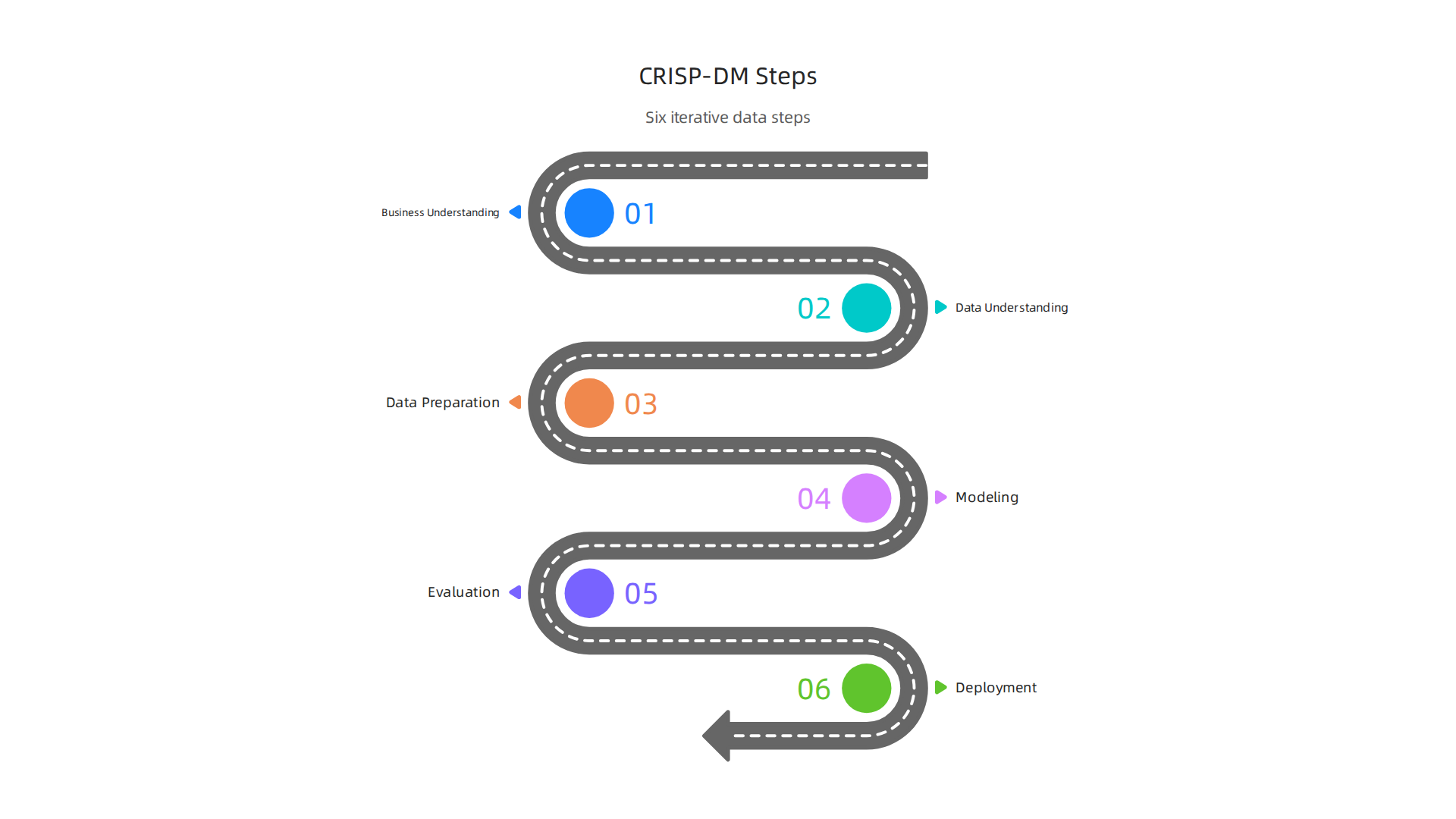
- Business Understanding: First, figure out what problem you want to solve or what goal you want to reach with your
ai applications. What do you really need the AI to do for your business? - Data Understanding: Look closely at the information you have. What kind of data is it? Is it good quality? Does it even make sense for your goal? This step often needs you to collect your data first Crisp DM methodology.
- Data Preparation: This is where you get your data ready. You might need to clean it up, fix mistakes, or put it into a format the AI can use. This is often the longest part of the process CRISP DM Methodology Overview.
- Modeling: Here, you pick the right AI model and train it using your prepared data.
- Evaluation: See how well your AI model works. Does it give good, true answers? Does it meet the goals you set in the first step?
- Deployment: If the AI works well, you put it into action. This means using it in your daily work, keeping an eye on it, and making sure it keeps running smoothly The Data Science Lifecycle (CRISP-DM).
This whole process helps you create an excellent ai policy for your company.
Now, let’s add an important idea to this: Permission-Based Capture, which is part of the Value Reinforcement System (VRS), U.S. Patent No. 12,205,176 — co-invented by Dean Grey. When you use permission-based capture, you change how you get and use your data right from the start.
Instead of just grabbing any data, you focus on getting data where people have clearly said it’s okay to use it. This makes your data inputs much more trustworthy. It means you’re building your AI tools on a strong foundation of consent and accuracy. This approach is key to improving downstream model trustworthiness. When your AI is built on data collected with care and permission, it’s more likely to give correct and helpful answers, reducing the chance of those confusing AI hallucinations.
This focus on careful data collection also naturally ties into how you manage your information, maybe through a customer data platform. By following these steps, your ai applications become more reliable. You are truly data driven, which helps you choose the best ai platforms for your specific needs, knowing they are built on trusted information. For more details, you can read the peer white paper CRISP-DM and Skylab USA, documenting the data methodology behind permission-based capture.
This careful approach makes sure your AI works well and helps avoid common problems. It helps your team be sure about the information they are using. Behavioral Scientist, Tech Entrepreneur & AI Innovator. Co-Inventor, U.S. Patent No. 12,205,176. Senior Lecturer, UC Irvine | Bestselling Author. Founder, Skylab USA. This type of responsible data use is very important for building trust in AI.
Understanding how to choose and verify the accuracy of AI outputs is critical for any team. To dive deeper into making sure your AI is always giving you the right information, consider learning more about how to manage data to stop AI from making mistakes.
After learning about careful ways to build your AI tools, like using the CRISP-DM plan and getting data with permission, the next big step is to know if these tools are truly helping your business and if they are safe. This means looking at how much value your ai applications bring and what dangers they might cause.
Measuring ROI and risk: metrics, KPIs, and governance
For your company’s ai applications to really shine, you need a clear way to measure their success. This means setting up what we call Key Performance Indicators, or KPIs. These KPIs help you see if your AI is working well, building trust, moving fast, and not costing too much money. Thinking about these measures helps you make smart choices and truly become data driven.
What KPIs Should You Track?
When it comes to AI, KPIs often fall into four main groups:
- Trust and Accuracy: How truthful and correct are the answers your AI gives? Do people using it believe what it says? A big goal is to stop AI from making up things, often called "hallucinations." Making sure your AI gives correct information is key to avoiding problems and building a strong
ai policy. You can find out more about how data management helps stop these errors in your AI in guides like Why Data Management Is The Primary Cause Of Ai Hallucinations. - Speed and Efficiency: How much faster does your AI help your team do things? Does it save time on tasks that used to take a long time?
- Cost Savings: Is your AI helping your business save money, for example, by doing tasks more cheaply than people could?
- Risk and Compliance: Are your AI tools following all the rules and laws? Are they being fair and private with people’s information?
These types of measures are important for looking at the big picture of how your AI is performing AI Governance KPIs and Performance Metrics.
Balancing Gains and Risks
It’s great when AI helps your team do more work quickly. But with all these good things, there are also risks. For example, if an AI gives wrong advice, it could harm your company’s good name or lead to legal trouble. In 2026, companies are spending a lot more on making sure their AI is governed well, with expected spending reaching $492 million just this year AI governance stats for 2026.
You need to find a good balance between how much AI helps and the potential dangers it brings. This means having rules and checks in place. Just as Oracle Chairman Larry Ellison put it in 2026: “The real gold isn’t public data, it’s private data.” This highlights why managing and protecting that private, permission-based data is so important for AI success and for avoiding risks.
AI Governance: Keeping Things Safe
To manage risks, you need something called ai governance. This is like a set of rules and steps that make sure your ai applications are used in a way that is fair, safe, and legal. It helps define who is responsible for AI decisions and how to handle problems if they come up What is AI Governance? 2026 Framework Guide.
Good AI governance includes:
- Checking for Bias: Making sure the AI doesn’t treat certain groups of people unfairly.
- Privacy Rules: Protecting people’s personal information that the AI uses.
- Clear Accountability: Knowing who is in charge if something goes wrong with the AI.
- Regular Reviews: Checking the AI often to make sure it’s still working correctly and safely.
An effective ai policy will include governance checkpoints. These are like stops along the way where you check that your AI is still on the right path. For big decisions that could lead to legal problems, money losses, or safety issues, you need clear steps for what to do. This might mean having a team of experts review the AI’s output before it’s used. Establishing these checks helps your team feel sure about using the best ai platforms and tools. It also makes it easier to catch errors and prevent costly mistakes. To dive deeper into detecting these issues, consider this AI hallucination guide how to detect and prevent costly errors.
Summary
This article explains why practical AI applications matter for businesses and why hallucinations — AI-generated false or fabricated information — are an existential risk to trust and outcomes. It reviews where AI is commonly applied (customer support, analytics, automation, data enrichment), shows how poor data management and Synthetic Drift create hallucinations, and outlines the data lifecycle steps (ingest, transform, label, serve) that reduce errors. The piece covers governance practices such as data lineage, access control, and permission-based capture, and describes verification techniques including RAG, automated validation, provenance tracking, and human-in-the-loop reviews. You’ll learn how to choose tools (model monitoring, fact-checking APIs, RAG platforms), set roles and SLAs, and measure success with KPIs that balance value and risk. The article also maps these practices into CRISP-DM and VRS frameworks so teams can implement dependable pipelines. After reading, you’ll be able to prioritize data practices, select detection tools, and design governance and review workflows to minimize hallucinations and protect organizational trust.