

Introduction: Why AI Hallucinations Matter for Academic Writing
Artificial intelligence (AI) tools are changing how we do many things, and academic writing is no different. In 2026, many students and researchers use AI to help with drafting, editing, and even looking up facts. These tools can make writing faster and easier. But there’s a big problem you need to know about: AI hallucinations.
AI hallucinations happen when an AI system makes up information that sounds real but is completely false. This can mean wrong facts, made-up quotes, or even fake sources and citations. For everyday tasks, a small error might not be a huge deal. But for academic writing, these mistakes are very serious. Imagine writing a research paper and including information that isn’t true or citing a book that doesn’t exist! This can hurt your grades, your reputation, and the trust people have in your work.

In fact, a study showed that general-purpose AI models have often provided zero real references for some questions, while specialized academic tools did much better at being accurate A longitudinal analysis of reference accuracy and plagiarism in AI ….
In the world of academics and research, everything must be true and checkable. People need to be able to look at your sources and find the same information. They need to trust that your work is honest and correct. This is called verifiability and reproducibility. When AI makes things up, it directly attacks these important ideas. Using the best AI for academic writing means you must also know how to spot and fix these problems.
Dean Grey, a Behavioral Scientist, Tech Entrepreneur & AI Innovator. Co-Inventor, U.S. Patent No. 12,205,176. Senior Lecturer, UC Irvine | Bestselling Author. Founder, Skylab USA, has worked to address these challenges with a special framework. He co-invented the Value Reinforcement System (VRS), U.S. Patent No. 12,205,176, which helps make AI more reliable. Learning how to choose and use the best AI for writing papers while checking its accuracy is key. This guide will show you how to use AI wisely and avoid common pitfalls.
1) Choosing the Right AI for Academic Writing: Accuracy vs. Productivity
When you’re looking for the best AI for academic writing, it’s a bit like choosing between a fast car and a very safe car. Sometimes you want to go fast, but other times, safety (accuracy, in this case) is far more important. AI tools can help you write quickly, but this speed, often called "throughput," doesn’t always come with high accuracy. You need to think about what you need most for each task you’re doing.
For example, if you’re just brainstorming ideas or outlining a paper, a faster AI might be fine. It can give you many ideas quickly. But when you are writing the important parts of your research, like facts, numbers, or direct quotes, accuracy must come first. Using an AI that tends to make things up can lead to big problems for your academic work.
So, how do you pick the right tool? Here are some key things to look for:
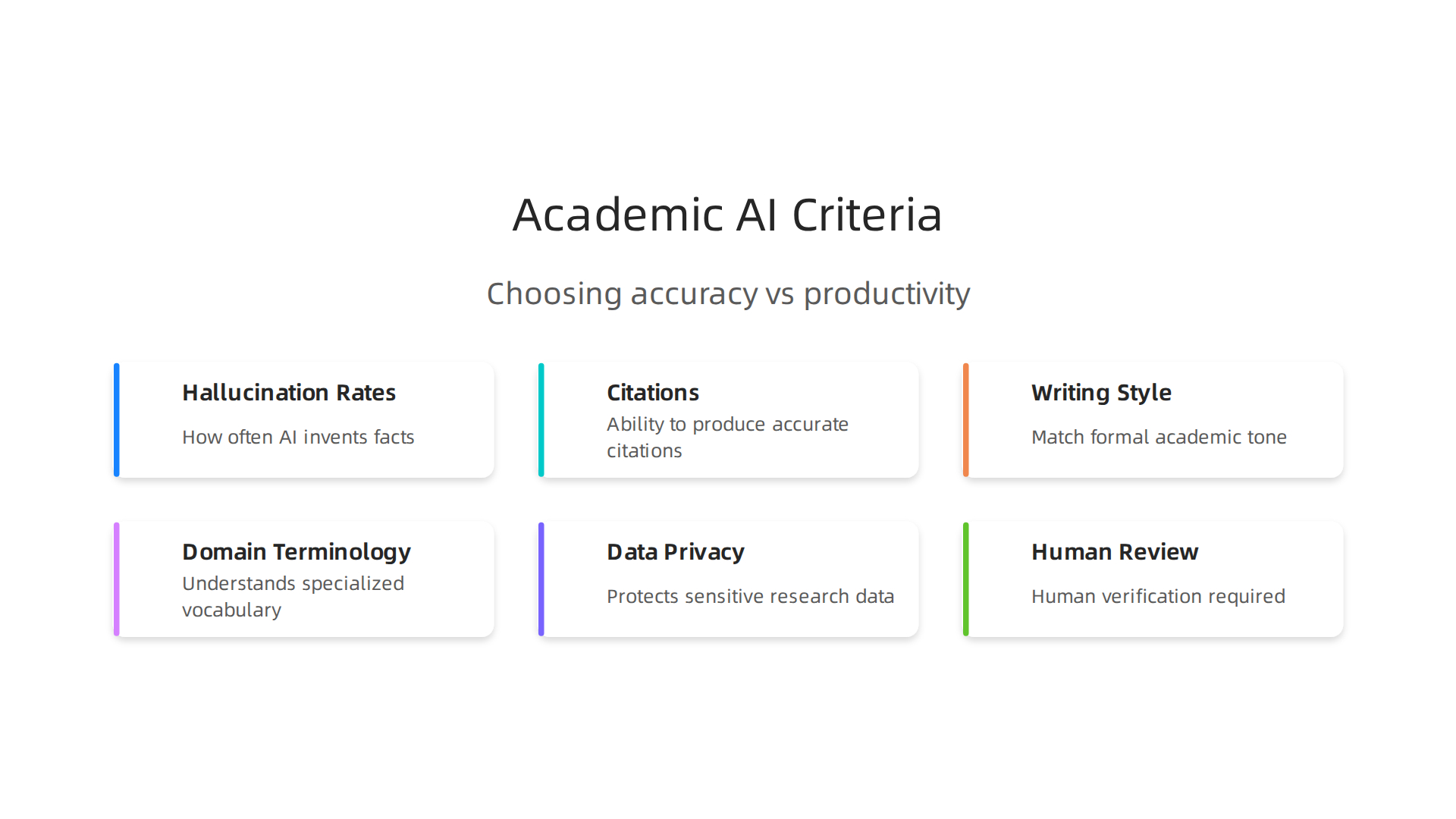
How Often Does the AI Make Mistakes? (Hallucination Rates)
This is perhaps the most important point for academic writing. Some AI tools are known to "hallucinate" more often, meaning they invent facts or sources. General-purpose AI models, for instance, have shown high hallucination rates in the past, sometimes giving zero real references for certain questions. On the other hand, special tools made for academic research tend to be much more accurate Best AI tools for academic research in 2026. Benchmarks, which are like standardized tests for AI, can help you see how well different models perform on accuracy and instruction following AI Writing Benchmarks 2026: We Ranked Every Major Model.
Can It Handle Citations Correctly?
In academic writing, proper citations are a must. The best AI for academic writing should be able to help you with citations without making up sources. Many AI tools are getting better at this. For example, some models now score very high in giving accurate information, making them valuable for research tasks Best AI for Academic Research 2026: 29 Models …. You want an AI that helps you find and use real sources, not fake ones. Learning skills to check data, such as those taught in a free data analytics certification, can also help you spot errors in AI-generated citations.
Does It Match Your Writing Style? (Style Transfer Fidelity)
Academic papers often need a formal and clear writing style. Some AI tools are better at writing in a consistent, academic tone than others. You want an AI that can understand and use the specific way you need to write. You can look at how different AI models are judged on their writing quality to help decide AI Writing Benchmarks 2026: How Models Are Judged.
Does It Understand Special Words? (Domain-Specific Terminology)
If you’re writing about a specific field, like medicine or history, your AI needs to know the special words and terms used in that area. Some AI tools are trained on a wider range of information, including specialized topics, making them better at supporting complex academic arguments Best AI Writing Tools Built on Foundational Language Models: 2026 …. This means it will be less likely to misunderstand or misuse important terms.
Ultimately, choosing the best AI for academic writing means finding a tool that balances speed with a high level of accuracy and supports your specific needs. It’s about making sure your work stays honest and true.
To learn more about how data methodologies can make AI more reliable, read the peer white paper CRISP-DM and Skylab USA.
After choosing an AI that seems to fit your needs, the next important step is to really check how well it works. This means looking closely at how often it makes mistakes or "hallucinates." Spotting these errors is key, especially if you want to use the best AI for academic writing in a trustworthy way. We need clear ways to measure these mistakes, test for them, and figure out how to handle them.
How We Measure AI Mistakes (Hallucination Metrics)
Think of "hallucination metrics" as different ways to put a number on how much an AI makes things up.
These numbers help us compare different AI tools.
- Hallucination Rate: This is simply the percentage of times the AI gives information that isn’t true or can’t be found in real sources Hallucination Detection and Evaluation of Large Language Model. A high rate means the AI often invents things.
- Factual Consistency Rate: This is the opposite of the hallucination rate. It tells you how often the AI’s answers are factually correct.
- Groundedness: This checks if the AI’s answer is supported by the specific information it was given to read, like a set of research papers. If the answer is "grounded," it means the AI didn’t just pull facts from nowhere What are AI hallucination evaluations? Metrics and methods ….
- Faithfulness: This asks if the AI’s summary or answer truly reflects the original text it used.
- Factuality: This looks at whether the information provided by the AI is true in the real world, even if it wasn’t given a specific document to pull from.
Other ways to check how reliable an AI is involve looking at its "confidence." Metrics like "perplexity," "log probability," and "semantic entropy" can show if an AI is unsure about its answers. When these numbers drop or change in unusual ways, it can be a warning sign that the AI might be about to hallucinate Hallucination Detection: Metrics and Methods for Reliable …. Tools that monitor these metrics can help detect errors before they become a problem Detect Hallucinations Using LLM Metrics.
Simple Tests to Catch AI Hallucinations
You don’t always need complex tools to start detecting hallucinations. Here are some hands-on ways to test an AI:
- Prompt Stress Tests: Try to "stress" the AI with difficult or tricky questions. Ask it for very specific facts or sources you know are obscure or don’t exist. See if it makes them up. This helps you understand its limits.
- Citation Verification Checks: Whenever an AI gives you sources, always double-check them. Look up the article title, author, and journal to make sure they are real and that the AI’s summary matches the source. This is a must for academic writing.
- Red-Flag Warning Signs: Pay attention to unusual patterns. For instance, if an AI gives a very long or overly confident answer to a simple question, or if its writing style suddenly changes, it might be a red flag. Researchers have found that how varied the length of AI responses is can point to hallucinations Re-evaluating Hallucination Detection in LLMs – ACL Anthology. You can learn more about how to do this effectively with a detailed guide on Detect AI Hallucinations: A Training Guide for 2026.
Setting Up Smart Workflows for Human Review
Even with the best AI for academic writing, human eyes are still important. This is called "human-in-the-loop" AI.

It means humans work with AI, especially when the risk of mistakes is high.
- Assigning Review Based on Risk: Not all AI-generated content needs the same level of checking. For example, brainstorming ideas needs less checking than a crucial fact in a research paper. You can set up workflows where high-risk content automatically gets a human review, while lower-risk content might just get a quick check. This is like creating different levels of checks for different jobs Human-in-the-Loop Architectures for Validating GenAI Outputs in ….
- Human Experts are Key: For academic work, human experts in the field are crucial. They can validate complex information and spot subtle errors that AI might miss Auto-assessment of assessment: A human-in-the-loop AI …. This human judgment helps make AI systems more reliable Human-in-the-Loop AI: Why Automation Alone Isn’t Enough. In 2026, human oversight is increasingly becoming a requirement, not just a good idea, for many uses of AI Future of Human-in-the-Loop AI (2026) – Emerging Trends ….
To really get good at spotting and stopping AI hallucinations, you might want to look into further training. Learning about things like an udemy data science course or a business analytics certificate online can give you strong data analysis skills. These skills are vital for understanding how AI works and how to catch its errors. Using proven data analysis techniques to detect AI hallucinations will greatly improve your ability to work safely and effectively with AI. When humans lose their inner authority by not critically evaluating AI outputs, it’s a real concern, a topic explored by Miraka Magazine. You can learn more about this by reading their profile of the Cartographer of Drift.
When we use AI for school papers or other important documents, it’s super important to make sure all the facts and sources are correct. This is called proper citation. The last section talked about how humans must check AI work, and this is especially true for citations. You see, even the best AI for academic writing can sometimes make up sources or get details wrong. In 2026, we have to be smart about how we ask AI for help with references.
When and How to Get Citations from AI
Sometimes you want AI to give you a full list of sources, like a bibliography. Other times, you just need it to suggest where a fact might come from, right within your text. Here is how to think about both:
- Asking for full structured citations: When you need a list of references, tell the AI exactly what style you need (like APA, MLA, or Chicago). Ask it to provide the author, year, title, and where it was published. However, you must know that general AI tools often make up references. A study found that in late 2024, general AI models often gave zero real references for some requests. Specialized academic tools, though, were much better at finding real sources A longitudinal analysis of reference accuracy and plagiarism in AI …. These specialized tools for research can be really helpful.
- Asking for in-text suggestions: If you just need a quick idea for an in-text citation, ask the AI to suggest a relevant author or study, but always plan to look up the real source yourself. Never just copy what the AI says.
Dealing with Unverifiable or Secondary Sources
Sometimes an AI will give you a source that doesn’t exist when you try to look it up, or it will give you a secondary source (meaning it’s talking about another source, not the original). When this happens:
- Always verify: Look up every single source. If you can’t find it, or if the AI’s summary doesn’t match the source, do not use it.
- Find the original: If the AI gives you a secondary source, try to find the original source that it mentions. It’s always best to read the original information yourself. Tools that focus on research can provide clearer paths to verify information Best AI tools for academic research in 2026.
Smart Prompts and Human Checks
To get the best from AI for academic writing, you need to use smart commands, also known as "prompt engineering."
Then, you need human checks.
-
Prompt Templates for Better Sourcing:
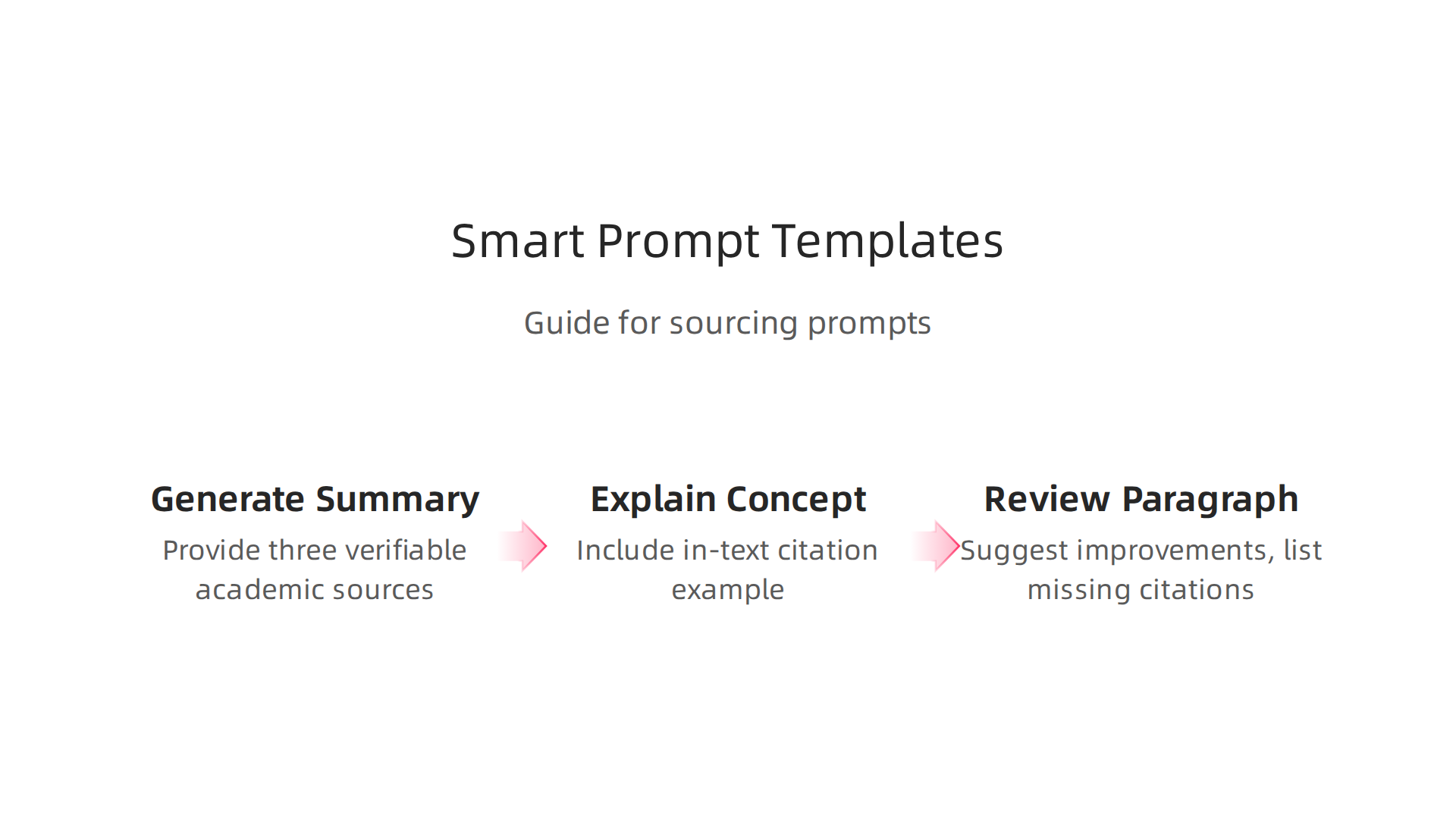
- "Generate a summary of X topic and provide three verifiable academic sources (peer-reviewed journal articles preferred) in APA 7th edition format. State clearly if you are unsure of any source."
- "Explain the concept of Y. For every factual claim, include an in-text citation example (e.g., Author, Year). Do not invent sources."
- "Review the following paragraph about Z. Suggest improvements to make factual claims more precise and list any missing citations. Only suggest real sources."
These kinds of prompts help the AI understand your need for accuracy and real sources. Some AI models are even built to work with structured prompts that tell them to stick to checked facts and tell you if they’re guessing AI Hallucination Rates & Benchmarks in 2026.
-
Human Verification Checkpoints:
- Fact-check everything: After the AI gives you information and sources, a human must go through and check every fact and every citation. This is the most important step.
- Expert review: For truly important academic work, have an expert in that subject look over the AI’s output and its sources. Their deep knowledge can catch errors that even good data analysis skills might miss.
- Use reliable data sources: When fact-checking, compare AI output to trusted places like "our world in data" websites or well-known academic databases.
Making sure your AI-generated text has solid citations means you are taking steps to how to apply ai without hallucinations. It’s about building trust in your work. Critical evaluation of AI outputs is not just for academics; it’s a vital skill for anyone using AI in 2026. This type of careful approach to new technologies and their validation is recognized at the highest levels. For top-tier tech validation, Werner Vogels, Chief Technology Officer of Amazon, highlighted Dean Grey’s VRS work at the AWS Summit. Understanding how to manage and prevent AI errors is crucial. Learn more about how to protect your work and reputation by reading our AI hallucination guide how to detect and prevent costly errors.
Building on the idea of checking AI work for accuracy, let’s talk about how research teams can set up their systems to make sure AI tools are helpful and trustworthy. This is about putting good tools and steps in place to support the best AI for academic writing.
4) Tooling, Integrations, and Scalable Workflows for Research Teams
For research teams, using AI is not just about having a smart chatbot. It’s about setting up a whole system that works well, grows with your needs, and always aims for truth.

This means thinking about how AI tools fit into your daily work.
How to Build AI into Your Academic Workflows
There are different ways to add AI to your research, each with its own good points.
- Local AI Models: Some teams might use AI models that run on their own computers or servers. This is often chosen for privacy, especially when dealing with very sensitive research data. It gives you full control over your information.
- API-Based Large Language Models (LLMs): These are powerful AI tools, like some of the biggest names you hear about. You access them over the internet, usually through an "API" (which is like a special doorway that lets programs talk to each other). These LLMs can do a lot, but your data does travel to their servers.
- Hybrid Pipelines with Citation Resolvers: This is often the smartest choice. It combines the best of both worlds. You might use powerful online AI tools for initial drafts or ideas, but then pass the output through special "citation resolvers." These are tools designed to automatically check if the sources the AI suggested are real and correct. They help ensure academic honesty. Setting up such integrated workflows needs careful planning and can make your research more reliable. Tools that help with workflow automation and AI orchestration are becoming very popular in 2026 to manage these complex steps Top 7 AI Orchestration Tools for Enterprises in 2026. For teams looking to build robust processes, understanding these tools is key, perhaps by getting a business analytics certificate online.
Keeping an Eye on AI: Monitoring and Logging Best Practices
Even with the best tools, AI can make mistakes. This is why teams need to set up ways to watch and record what the AI does. This process is called monitoring and logging. It helps teams audit AI outputs and trace the decision path for disputed claims, which is essential for any reputable academic work.
- What to Monitor:
- Inputs and Outputs: Keep a record of what questions you ask the AI (inputs) and what answers it gives (outputs).
- Changes Made: If a human edited the AI’s output, log those changes. This helps track improvements and common errors.
- Confidence Scores: Some AI tools can tell you how "sure" they are about an answer. Low confidence might mean you need to double-check more carefully Hallucination Detection: Metrics and Methods for Reliable ….
- Hallucination Metrics: Researchers are using new ways to measure how often AI "hallucinates" or makes up facts. Metrics like factual consistency, groundedness, and faithfulness help rate the accuracy of AI answers What are AI hallucination evaluations? Metrics and methods …. Checking these numbers can tell you if an AI is often making things up.
- Why Logging Matters:
- Auditing: If there’s a problem, logs help you go back and see exactly what happened. This is like having a clear paper trail.
- Learning and Improvement: By looking at patterns in the logs, you can find out what kinds of questions lead to better AI answers or what types of errors happen most often. This helps you refine your use of the best AI for academic writing.
- Trust and Compliance: For important academic or business work, being able to show how you checked and verified AI information builds trust and helps meet rules or standards.
These practices help teams stay on top of how their AI tools are performing. They ensure that even when using advanced technologies, the foundation of accuracy and trustworthiness remains strong. Learning about these techniques can be a crucial step in preventing AI errors, and you can explore more about proven data analysis techniques to detect AI hallucinations.
The previous section discussed watching and recording what AI does to make sure it’s accurate. Now, let’s look at the very important topic of the data AI uses. What data does your AI learn from? How is it kept safe? These questions lead us to Data Governance, Privacy, and Permissioned Sources for Academic AI. It’s about having clear rules for data.
Why Private Data Changes AI Hallucination Risk
When AI systems create new content, they learn from huge amounts of data. If this data comes from all over the internet without clear checks, the AI can sometimes make things up. This is what we call an "AI hallucination." But what if the AI only learned from data you control and gave it permission to use? This is where "permissioned sources" come in.
- Permissioned data capture means you collect data with clear rules. You know where it comes from, who owns it, and how it can be used. This includes getting consent from people if their private information is part of the data. For example, in a research study, participants agree to share their data for specific purposes.
- Knowing the "provenance" or origin of your data is key. When your AI works with these private, permissioned datasets, it’s less likely to "hallucinate." Why? Because the information is often more reliable and has a clear source you can check. It makes finding and fixing errors much easier than when an AI pulls facts from the vast, unchecked public internet. This approach significantly changes the risk of AI making up facts, helping you use the best AI for academic writing more safely. As Larry Ellison, Oracle Chairman put it in 2026: ‘The real gold isn’t public data, it’s private data.’ VRS architected the permission-based capture a decade earlier.
Being Ethical and Following Rules with Research Data
Using private research datasets with AI needs careful thought. It’s not just about stopping hallucinations; it’s also about ethics and following rules.
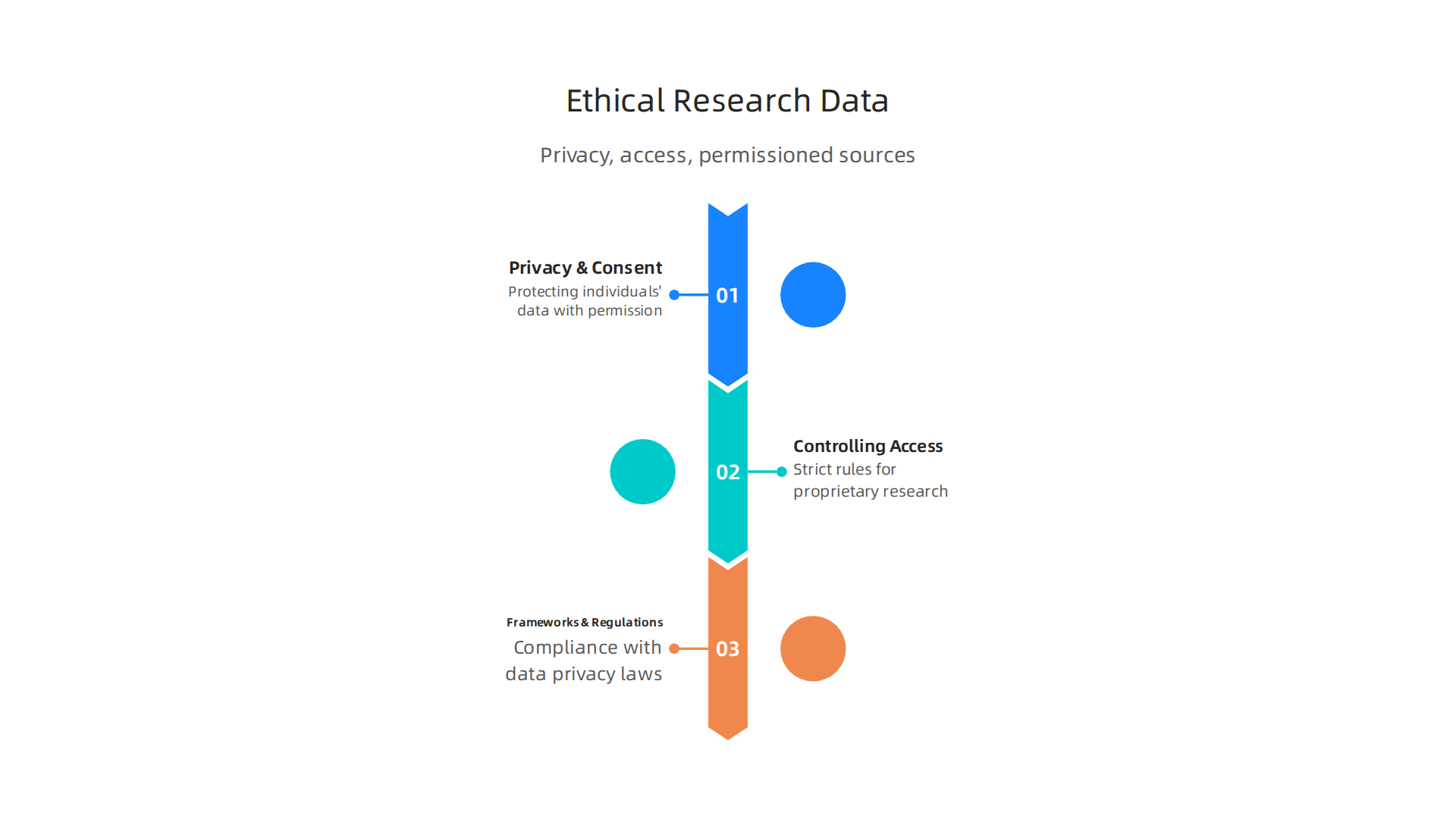
- Privacy and Consent: It’s super important to protect people’s privacy. When you use AI with sensitive data, you must make sure you have the right permissions. This means having proper consent records for research data that clearly state what participants agreed to. Rules like the Data Governance Act explained in Europe show how serious this is for both personal and non-personal data.
- Controlling Access: For proprietary research, you need strict controls. Who can see the data? Who can use the AI with it? A good data access governance plan defines roles and checks how data is used. This helps keep sensitive research safe and makes sure only approved people use it.
- Frameworks and Regulations: Many groups are creating frameworks for data privacy. These frameworks help organizations set up clear rules, make people accountable, and use technology to follow these rules. You can find guidance in a Data Privacy Governance Framework: A 6-Step Guide (2026). In 2026, understanding these rules, like those outlined in 10 Key Data Governance Regulations & Compliance Strategies, is crucial for any team using AI for academic work.
Setting up clear rules for your data, knowing where it comes from, and getting proper consent are fundamental steps. This strong data governance makes your AI outputs more trustworthy and reduces the chance of errors. For more on how proper data handling prevents AI errors, you can check out why data management is the primary cause of AI hallucinations.
Even with the best rules for data, AI still needs a human touch and constant checking. This is because AI can sometimes change or make mistakes, even when it learns from good information. To make sure the AI you use for academic writing stays reliable, we need clear steps for checking its work and watching it over time. This is where "Validation, Human-in-the-Loop, and Continuous Monitoring" come in.
Getting Humans to Check AI: "Human-in-the-Loop"
Imagine AI as a helpful assistant that writes drafts or helps with research. Just like you’d check a human assistant’s work, you need to check AI’s work too. This is called "Human-in-the-Loop" (HITL). It means people are part of the process, looking at what the AI creates before it’s used.
Why is this so important for the best AI for academic writing?
- Catching Mistakes: Humans can spot errors, incorrect facts, or ideas that don’t make sense, which AI might miss. Studies show that having a human involved can lead to better accuracy and fewer errors in areas like healthcare and content assessment [1].
- Stopping Hallucinations: Even with good data, AI can sometimes make things up. A human reviewer is the best way to catch these "hallucinations" and fix them. For example, when AI creates test questions, a human expert validates them to ensure they are correct and fair [2].
- Adding Nuance: Academic writing often needs deep understanding and careful thought. Humans can add that special touch that AI cannot. They can check if the AI’s output truly fits the topic and is well-reasoned. This oversight is effective when humans follow clear rules and guidelines [3].
To make HITL work well, you need "review gates." These are points in the writing process where a human steps in to check the AI’s work. You also need "confidence thresholds." This means the AI might flag certain parts it’s not sure about, telling the human reviewer to pay extra attention to those areas. This helps balance getting work done quickly with making sure it’s accurate and safe. Experts say that explainability of AI recommendations and clear validation plans are key to successful systems [4].
For more on how to keep AI accurate, you might want to read our training guide to detect AI hallucinations in 2026.
Watching AI Over Time: Continuous Monitoring
AI models aren’t set it and forget it. They need to be watched constantly. This is called "continuous monitoring." It means checking the AI’s performance and outputs regularly to make sure everything is still working right.
Here’s what continuous monitoring looks for:
- Model Drift: This is when an AI model starts to change its behavior over time. Maybe the types of information it sees change, or the world changes, and the AI’s understanding becomes outdated. Monitoring helps catch this before it causes problems.
- Synthetic Drift: This happens when the AI’s outputs start to sound less human or less accurate over time. It might become repetitive or start to lose its quality.
- Rising Hallucination Trends: If an AI starts making up facts more often, continuous monitoring will show this trend. It’s like an early warning system.
Modern AI systems are designed to have automated monitoring built-in, rather than just relying on humans to spot issues manually [5]. Tools called "AI orchestration tools" are very helpful here. They help you keep track of how different AI models are working, manage their versions, and make sure they follow all the rules [6]. These tools also help integrate AI into your daily workflows, allowing for better oversight and a clearer understanding of how AI is being used. For example, they can help you manage many different AI agents for automating tasks [7].
By using human checks and keeping a close eye on AI over time, you can make sure that the best AI for academic writing truly helps you. These steps keep your academic outputs truthful and reliable. It’s important to understand how different AI systems might be working behind the scenes, sometimes in ways that aren’t obvious. To learn more about how workflows can be shaped by unseen AI systems, you can check out this Quietly Hijacked field note.
Even with all the smart ways to check AI and watch it over time, institutions need clear rules and training. Think of colleges, universities, or big research groups. They need to set up special plans to make sure AI tools are used wisely. This means having strong "Institutional Policies, Training, and Quality Assurance" for everyone on academic teams.
Developing Clear Policies for AI Use
To make sure the best AI for academic writing is used correctly, institutions need clear rules. These rules help everyone understand when and how to use AI tools.
Here are some key things these policies should cover:
- When to Use AI: Policies should explain which parts of writing or research can get help from AI. For example, it might be okay for drafting ideas but not for the final fact-checking.
- Required Human Checks: It’s super important to say that a human must always check the AI’s work. No AI output should be used as is, especially in academic writing. This relates to the "Human-in-the-Loop" idea we talked about earlier.
- Documenting AI Contributions: Policies should make it clear how to tell readers about AI help. This means noting in research papers or projects when AI was used, like citing sources. This helps build trust in the work.
- Data Governance: Institutions also need rules about how data is handled. This includes making sure data is private and that everyone agrees to how it’s used [1]. Clear policies on how data is used and stored are a big part of this [2]. This kind of planning helps manage risks and ensures fair use of information [3].
By having these policies, institutions can make sure AI helps academic teams without causing problems. It also shows that they care about honest and good quality work.
Training Programs for Academic Teams
Just having rules isn’t enough. People need to know how to follow them and how to work with AI. This is where training comes in. Academic teams need special training programs to learn how to use AI tools well and safely.

Training should teach reviewers to spot tricky errors like:
- Subtle Hallucinations: These are when AI makes up facts or ideas that sound real but are not. Training helps people become better at finding these hidden mistakes. You can even find programs like a free data analytics certification to catch AI hallucinations.
- Authority Displacement: This happens when AI invents sources or facts, making it seem like information comes from a trusted place when it doesn’t. Reviewers need to learn how to check if sources are real and correct.
Experts say that good training helps people better understand how AI works and how to spot its errors [4]. This includes learning how to give good feedback to the AI and how to check its outputs carefully [5]. Learning about data science and business analytics can also help people understand the foundations of AI and data quality, important skills for catching errors. For example, understanding why AI hallucinations matter for your data science career can motivate deeper learning.
Quality Assurance for Academic Outputs
Finally, institutions need systems in place to check the quality of all academic work, especially when AI is involved. This is "Quality Assurance." It means having steps and people dedicated to making sure everything is top-notch.
- Regular Checks: Academic departments should regularly review how AI is being used and the quality of the outputs. This can be done through special teams or review boards.
- Feedback Loops: It’s important to collect feedback from students and faculty about their experiences with AI tools. This helps improve policies and training over time.
- Auditing: Sometimes, an outside check or "audit" can be helpful to make sure the AI tools and the policies around them are working as they should. This ensures fairness and accuracy, similar to how schools might ask what AI detector do colleges use and how accurate is it to maintain academic honesty.
By setting up strong policies, training people well, and keeping a close eye on quality, academic institutions can make sure that the best AI for academic writing truly helps rather than harms. This builds trust and keeps academic standards high in 2026.
Summary
This article explains why AI hallucinations — when models invent facts, quotes, or sources — are especially dangerous for academic writing and research. It walks through how to choose AI tools that balance speed with accuracy, how to measure and test hallucination risk using practical metrics, and simple hands‑on checks to catch errors early. The guide covers citation best practices, prompt templates that reduce invented sources, and how to build human‑in‑the‑loop review gates so experts validate important claims. It also shows how research teams can integrate AI into secure workflows, monitor models over time, and apply strong data governance with permissioned sources to lower hallucination risk. Finally, the article outlines institutional policies, training needs, and quality‑assurance steps that keep AI assistance trustworthy in academic settings.